
Google News Announces Limited Comments. Everyone Needs To Calm Down.
by Michael Arrington on August 8, 2007

googlenewslogo.pngGoogle made an announcement of an “experimental new feature – they will soon be allowing comments on Google News stories. Comments will only be accepted from a “special subset of readers,” which includes people and organizations who are part of the story. The blogosphere, which is of course all about conversation, seems to think the second coming of Jesus Christ himself is here. An example: normally reserved Tony Hung calls it “pivotal” and that it will “change online news as we know it.”
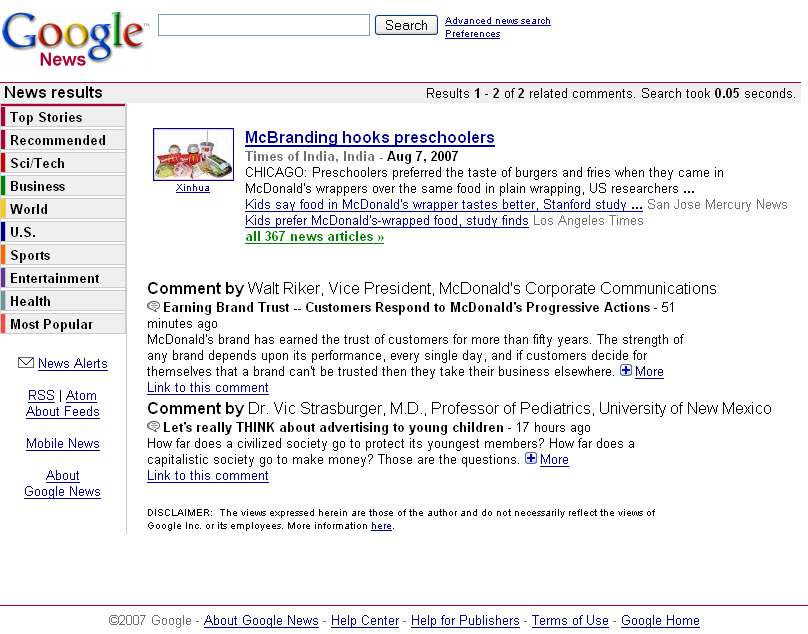
goognewssmall.pngHere’s how it will work. If you are involved in a story, you send your comments in to Google along with statements supporting how you are connected to the story. Google won’t edit your comments but can have them removed for hate speech, etc. And they aren’t yet saying how connected to a story you have to be to get in. Whatever the rules, this is going to require a ton of manual labor on Google’s end. This stuff simply can’t be automated. Google is going to have to see a very, very large increase in page views to justify the expense.

Having direct participants chime in with their two cents is certainly a good idea. It adds to the debate around a story, which until now on Google and most mainstream media sites is a one sided affair as interpreted by a fair and impartial journalist who may or may not have personal bias, financial bias, or laziness bias screwing up the real facts of a story.

But wow is this going to be a lot of effort on Google’s part. And all just to exclude the opinions of non-participants? That doesn’t make any sense to me. I certainly value the comments of participants in our blog posts. But equally valuable are the insights of third party experts who know more about given subject areas than we do. And getting the opinions of the interested masses also provides deep insight. It’s always good to take the temperature of the readers on story – and that’s why we and most other blogs allow even anonymous comments/rants. The downside is trolling and lobbying, but the upside is one hell of a good conversation/street fight. Good conversation is also why I tend to go to Newsvine for big media news. They’ve always allowed comments, which are usually better than the stories themselves.

At least a few people have avoided the group orgasm and see some problems with Google’s idea. John Murrell says this will result in a huge PR hiring boom and to expect “spin, spin, spin” as every negative fact/opinion is countered. Danny Sullivan says Google doesn’t know what it’s getting itself into. Frank Shaw, who basically controls all Microsoft PR, says this is “stupid” and predicts it will never get out of beta. That’s a pretty clear statement from the king of spin. And I agree 100%.

Advertisement

Comments rss icon

  • Hmmm there’s no question google will pull it off. Question is can someone make it even better?

    http://www.HelluvaJob.com

  • given the topic of this post, I was really hoping for high IQ comments v. spam to start things off. :-)

  • a lot of the crap that shows up on google news already *is* a crappy blog that allows commenting. werd.

  • It’s a good idea, and many people will use it. I basically made this exact same thing not too long ago – http://www.commentatr.com , I get feeds off BBC news, and allow people to comment on it. I just haven’t gotten around to promoting the service, Google has a head start in that respect ;)

    Google’s will be a success and soon I think they’ll allow anyone to leave comments.

  • OK OK Mike, the idea sounds great, let the people who are in an article defend or debate their opinion. But don’t blogs like TC already allow people to do this? Unfortunately google’s model doesn’t really work. You’re not going to get a ‘real world’ audience or feel if 1. you have only a select group who can place their comments. 2. All comments must go through a censor. What makes TC a good model I think is that is allows anyone to participate be it good comments or not. Just my 0.02

  • One thing that bugs me: they’re now hosting original news content, yet they prohibit other aggregators from crawling it (per robots.txt restrictions and TOS). Of course Google News relies on the openness of other organizations with original news content.

    I left a similar comment elsewhere without anyone reacting, so maybe I’m the only one who cares, but I thought I’d make a point of this anyway.

  • I don’t see it working well at all, not only are they going to have to entries that describe how the person is related to the story, but check to ensure it is the real person.

    What Google will see often, a news article is written about Bill Clinton and the Lewinsky Affair, John Smith writes into Google describing that he is Bill Clinton and gives his 2 cents (comments) on the story.

  • In terms of management, it doesn’t look like its something that’s going to be easy to manage because you have to verify also that these are real people connected to the story and not impersonators. So you have to be able to remove all impersonators and I think there will be lots of them and so it will require a lot of work on that end.
    Having said that, lets see how it goes.

  • I don’t know, this isn’t so revolutionary in my opinion. Google news is pretty close to Google in that it’s a navigation tool – it helps you find stuff to click off to and read. There’s not a whole lot to actually read within the GNews interface itself. Users would have to:

    1. Find interesting story.
    2. Click off and read it.
    3. Feel so compelled to comment that they return to GNews just to do so.
    4. …but only if they’re connected to the story in some way?

    It’s interesting but I don’t see it being a major hit…

  • Tony Hung? Wasn’t he famous for like 15 minutes? Oh…wait that was william

  • Hey Mike,

    I actually laughed out loud when I read the second coming of Jesus. I thought that kind of talk was reserved for Apple product launches.

    I do agree with Danny that they are getting themselves into a mess here. How do they expect to manage this? It seems against everything Google has done and is the first time from what I can see as Google actually creating the news on their own site instead of linking to it.

    I used to read Digg back in the day for its comments and would agree that comments can be better than the story. I will be extremely curious how this works out. Hopefully for Google it will fair better than their answers product but can easily foresee a scenario where it meets the same fate.

  • LOL! This is great! Another slap in the face for journalists. Between their declining TV ratings, their plummeting newspaper revenues, and the BREADTH of alternative sources now available, mainstream journalists must just be completely aghast at what’s happening here to their significance! Especially the older ones, all those cranky old elitists and self-infatuated curmudgeons who thought they had it ALL and now have to watch it all rot away right as they live and breathe — ah ha ha ha!

  • whoa, too early in the morning for me to write comments

    fixed up my mistakes below

    ————
    I don’t see it working well at all, not only are they going to have to read entries that describe how the person is related to the story, but check to ensure they are the real person.

    What Google will see often, a news article is written about Bill Clinton and the Lewinsky Affair, John Smith writes into Google describing that he is Bill Clinton and gives his 2 cents (comments) on the story.
    ————-

    ^ I should sleep for more then 3 hours before I write comments, I’ve learnt my lesson

  • Mike…you didn’t read *everyone* in the blogosphere on this. Actually, the overall sentiment in the blogosphere, IMO, is that it’s so great–in fact, lots and lots of us thought the idea massively flawed on many levels (my blog entry on it got some good traffic, incl. additional posting on Poynter.) Only the Google bloggers (and Tony Hung) seemed to be all happy, happy, joy, joy about the whole thing.

    The most bizaare aspect of it: Google’s mostly a news aggregator. So, people are going to send comments into a news aggregator, where they cannot get in touch with the journalist who originally authored the article? And what about the journalist? Will that person be allowed by his/her employer (a news agency) to respond on Google?

    Frankly, it seems more like a ploy on Google’s part to get more free content, which they will then monetize. . . and whomever submits the comment will have to surrender all rights to it as well, I’d bet.

  • Management of this would not be as hard as it may seem. Done right, Google would only really need to verify a person’s identity once and then allow them to request to comment on future articles that they are a participant of.

  • “Frank Shaw, who basically controls all Microsoft PR, says this is “stupid” and predicts it will never get out of beta. That’s a pretty clear statement from the king of spin.”

    I’d be careful with such a comment from a Microsoft guy. Wasn’t there a thing called new search algorithm that were “stupid” and not worth the money and never come out of beta?

    I say let’s see how Google handles that new functionality, perhaps that’s finally the quality improving mashup between traditional media & bloggers. I wouldn’t be surprised if others like MS and Yahoo! very soon try to do the very same.

  • I see this becoming a huge headache for google, how do you verify that somebody was involved in the story? For instance, fido the dog got stuck in a tree, the news report quotes the fireman and the kid but what about the spectators who where watching the story unfold on television and on the ground who are NOT quoted in the article.

    Besides, I really don’t see the added value of this vs regular blogging/new reports other then adding a lot of fluff, of which there is too much in the media nowadays anyways.

    Jon

  • Gabe, I care.

    Mike, who are you telling to calm down?

  • “which until now on Google and most mainstream media sites is a one sided affair as interpreted by a fair and impartial journalist who may or may not have personal bias, financial bias, or laziness bias screwing up the real facts of a story.” – Your sarcasm is great…Probably one of the reasons I keep reading.

  • What I don’t get is how very un-Google this is. This can’t be automated in any way, it requires human intervention at every step of the process. My guess is that it will be used only sparingly, to cover Google’s arse when wire stories get it wrong.

    Also Mike, you referenced Newsvine as a better alternative, but even more superior is Topix, which gets a lot of comments in its forums from involved parties about individual local US news stories.

  • What will happen, of course, is the corporate PR people will be posting their “spin” on each story. Think of this as a ‘PR Full Employment Technology”.

    But someone like me (well, me) is not going to go to the time to create a well thought out post (unlike maybe this one) and step through all those hoops of getting credentialed when they just might reject the post anyway.

    The PR people get paid whether the post goes in or not.

  • Google’s PR sucks.

    Today, Google AdSense denied my appeal and shut down my AdSense account for click fraud. After using the service for merely three weeks, I had only accumulated 80 clicks, which earned me barely $20. I did not EVER click on an ad or encourage anyone to do so. I work in IT and if I had really wanted to rack up the clicks, I could have easily clicked thousands of times on hundreds of unique IP’s that are at my fingertips daily. I didn’t even submit a payment method because I was only feeling my way around the service to see how it worked.

    I wrote a very honest, and genuine appeal to have them give me another chance for what I thought was a ludicrous verdict without a trial or warning. All I got in return (2 weeks later) was an automated email, not even addressed to my real name, with no reasoning, details, or evidence to help me see where they were coming from.

    I think this idea would be cool, but God help you if a story relates to you someday.

  • Shoshanna Morton - August 8th, 2007 at 6:48 pm PDT

    #19 Dave – you silly! He’s talking about you!

    I thought Jesus was used already for your 500 iphone stories? I don’t get why conversation about this topic isn’t ok, when conversation about any topic started on TC is? Who is the determiner of when we can discuss a topic?

    Isn’t conversation what the web is all about? Obviously its a hot topic!

  • Are they serious? They are going to have real people read each comment, read the commenter’s credentials, verify those credentials, and approve the comment?

    Is this some sort of joke?

    I would be laughing if I were Yahoo or Microsoft. This is impossible.

    The day this gets out of beta I will start a website dedicated to telling people how stupid I am.

    I’ve seen a lot of bad products talked about on this website, but I;ve never been so sure that anything would fail.

    This isn’t how the internet works. This is the information age, web 2.0, whatever. Everyone gets to have an opinion. How did Google get to be the most recognizable brand name in America without knowing what they were doing.

  • Identifying people is easy, they tie a Google Account with the owner of a website, a credit card, an adress, AdSense account, whatever other infos Google can have to make sure that the Google Account in question is really the representative of a certain company for example.

    And for the tens of stories on Google News everyday about each of those companies or people menshionned, thus it will be as easy as Post Comment link available only to the Google Accounts that are tied to the story.

    Basically every single Press Relations office of every single company, every famous personality will have a Google Account activated to be allowed to represent a company, a trademark, a name and so on.

  • Paul – you’re right about Topix. I should have mentioned them.

  • Comments are for commentary; that means information from outside sources that are completely unrelated to the article. If they’re only allowing related sources to comment, why not just include it in the article?

  • This is great cause it will enable the companies and personalities in question to immediately defend themselves against false rumors and bad reporting.

    Agents and PR firms will have their Google Accounts registered in a special way with consent from the company or personality in question so they can post to represent their customers.

    IBM for example has hundreds of stories per day on the Google News alert. Now they can have an official PR contact write Comments whenever needed. Any relatively famous company or personality gets tens of stories on Google News everyday. Some popular politicians get tens of Google News alerts a day. This is a platform that let’s them immediately and officially answer to articles and rumors.

  • Expect every single presidential candidate to have their personal Google Account tied to their name so that they can easilly and immediately respond every time their name is in a Google News story. If they don’t have time to personaly post a comment, then their representative will be registered to post comments officially for any story menchionning the name in question. And it’ll be clearly stated if it is the person in question or their representative who is posting the comment. Though there is nothing preventing the username and password for the person in question to be used by the official press relations representative.

    Expect also every single company, companies PR, journalist, newspapers PR, personality, personality’s PR to have an instant comment feature tied to their verified Google Account.

  • Google is stepping into quicksand.

  • google news is quick and its new feature will be accepted well in the market.

  • Commenters allowed are those involved in the story/article? Why not just email or call each other for further comments or clarifications? Or their PR Dept. could do just that. And we read? Ha! Nice.

    Anyway, this, according to the opening statement is ‘experimental’. I’m quite excited to read comments from notable people. I would love to read their thoughts. I hope it’s not done by anyone’s secretary or PR people. Do they really have time for this? It spoils the thrill.

    I can see the excitement in some political news concerning say for example, 2 world leaders with different mantra. It would be lovely to read what is racing in their minds.

    Ok, I’m a fan already. :)

  • A couple of things I can’t get past: Google is a news aggregator. They’re not creating/writing/reporting on the news, they’re just collecting it. And now they’re putting themselves in a position to take control of the stories they didn’t create. Debate is good, but a good debate online usually includes the voice of the person who created the content.

    Secondly, and as duly pointed out in other comments, this will create an entirely new category within the PR industry, with PR specialists focused on ‘righting’ the perceived ‘wrongs’ with canned, carefully scripted responses not created by their clients; only approved by them (and I know this because I own a PR shop). I’m just not sure this will have the intended impact over time and could potentially water down the news.

    Just because you can do something, doesn’t mean you should.

  • I believe distinguishing between normal readers (voting folks) and affected people (the storys subject) in a large database of users, including information on their geography and corporation is the story.

    I do not think, normal viewers are excluded from commenting, but their comments might get lower prio or are can get filtered out ba the user.

    That could be googles strategy on news as well as media / you tube in general:

    Whenever you have a story, there are 3 parties :
    - the publisher (e.g. Michael et. al. in Techcrunch)
    - the reader (us, who wish to comment – evenn anonymously)
    - the person(s) or corporation or artist (-groups), the story is about.

    In techcrunch the article and the comments in GREEN reflect his opinion.
    If Michael now ensures, by organising his database in a way, that emails from adresses speaking for their corporation – the third party above – get their comments in e.g. RED, that could be similar, useful for all of us.

    In those cases of storys on bad circumstances, a hurricane etc. the hurricane himself won’t be able to write a post, so you allow the regional people to register and write.

    Googles advantage will be a huge database of authors, the disadvantage is a lot of crap written and to get verified by google.

    Thinking this concept further, YouTube could use the same concept and compensate the authors of illegal contents (the “affected” party, e.g. NBC, CNN, Hollywood, Bollywood) directly with a share of the advertising income on those ads connected to the illegal movie. So they do not have to take it of, but rather share the income …

    Further advantage: The news site, where the news subject / affected party comments, is clearly market leader. You will read other blogs less, since they have to follow up the original comments. Its hard to blog on a moving story.

    Google will likely not rss-feed those additional comments to other weblogs, at least NOT FREE OF CHARGE, so this can lead to a weblog concentration / melt down. Just by thinking on it for the first time – it might happen different, but after web 1.0 inflation let the air out, there were finally also just a few left overs.

    Note to Michael: Talk to google or sell Techcrunch

  • This is a good idea by Google, that needs some guiding principles explained to the public. Having certain “experts” get priority when the story is about them is fine. Heavy censoring of the public opinion is not a good idea.

    The writer of the article will be encouraged to think twice before mis-quoting someone, knowing they will respond in a public matter online, with the help of Google. This will help reporting in general.

    Any blogger on the Web can become popular and talk to the original source, if the source trusts them more than Google, or the source is not treated fairly by Google in the past. So Google has competition also.

  • Google News comments…OOOO more ways to build links. The only situation for spamming issues is that the automation must have some superior CAPTCHAs of some sort…I don’t see how this will get out of Beta without serious changes in the strategy of allowing Google News Comments…

  • This isn’t going to work because it requires too much manual work.

    You don’t have to look any further than Adam Lasnik’s comments over at google groups to realize they are not big fans of actually manually reviewing millions of emails (http://groups.g...79a10c785d70aa6). They take such pride in being able to do everything automatically, why go down this path??

  • A cool thing to do!!!!!

  • Indeed, lots of manual work.
    But quite interesting…the only problem is that they dont limit anything, so you can invent some story how you are involved and what they can do about it ?
    Really flawed !

  • hi nice post, i enjoyed it

  • Great topic to read….

    Keep it up :)

  • Google Truths is the term used when a hacker tries to find exploitable targets and sensitive data by using search engines. It is the art of using Google’s ability to find secrets of the web and even attain personal, revealing or illegal information.

    Google offers many powerful features and advanced search capabilities that make it very helpful for finding certain kinds of information but this group (Google Truths) aim is to educate web administrators, security community and Internet users.

    Google Truths, Abhinav Karnawat, Innovation Loves Constraints, Truths Google, Gogle Truths, Google Truth, What Many People Do Not Know About Google, Google Hacker, Google Vulnerable Researcher, Hacker of the Google, Google Secrets, Google Hacking Group, Google Hacking Group

Leave Comment

Commenting Options

Enter your personal information to the left, or sign in with your Facebook account by clicking the button below.

Alternatively, you can create an avatar that will appear whenever you leave a comment on a Gravatar-enabled blog.

Trackback URL
bugbugbugbug
Techcrunch on Facebook