August 1, 2007

Remember Webvan? So Does Amazon

Michael Arrington

82 comments »

Check out Amazon Fresh - a new invite only service from Amazon that looks eerily similar to the quintessential 90’s Internet flameout, Webvan.

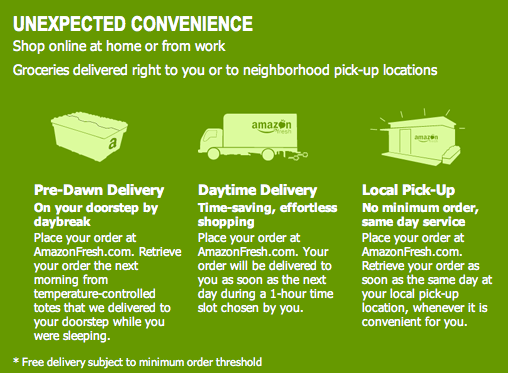
The new service promises speedy at-home delivery of groceries, including fresh produce, at “competitive everyday prices.” It’s available only in Seattle currently, and has not been officially announced. But at least one person caught a glimpse of an Amazon Fresh truck driving around downtown Seattle.

Users select and pay for groceries on the site. They can then choose to pick up the items themselves locally, or, with a minimum order size, have them delivered next day within a one hour time slot. Groceries will also be delivered to doorsteps pre-dawn in a temperature-controlled container.

A year ago Amazon began experimenting with sales of non-perishable food and household items, but did not deliver them directly and perishable goods were not available.

If you are a Seattle reader, keep your cameras handy. We want a picture of the delivery truck.

Webvan, which had a spectacular IPO and quickly expanded to 26 cities, went bankrupt in 2001. Before closing down, Webvan had acquired competior HomeGrocer. Coincidentally, Amazon was an investor in HomeGrocer.
  • Sphere It

Trackbacks/Pings (Trackback URL)

  1. Gizmos for Geeks
  2. diggita.it
  3. TekChakra » Amazon re-does a Webvan, defying the Bubble1.0 deadpool
  4. Would you buy your vegetables online? - Affiliate Marketing Forum
  5. Amazon Fresh at Kaizen Bits
  6. WebbAlert Day 2: This Show Rocks | Tekjuice.com
  7. The Bitt
  8. Amazon Fresh Shopping Bag Spotted In The Wild
  9. Amazon Fresh Shopping Bag Spotted In The Wild | Tekjuice.com
  10. Amazon Fresh y el acercamiento al mundo de los supermercados « ConsumoWeb
  11. The Software Abstractions Blog

Comments

RSS feed for comments on this post.

  1. alex

    Well why the hell is it only in Seattle?

  2. joe

    It’s only in Seattle because they want to stay in business for a bit longer ;)

    Webvan got crushed because they spent all their dinero on building huge DC’s that they didn’t need yet as opposed to advertising the heck out of the thing and then getting killed with poor customer sat by not delivering well. Showed that both strategies are good ways to kill a business.

  3. Jackson

    There was another one in Washington, DC. It was called HomeRuns (I think). I loved it and it changed the way my wife and I bought groceries.

    It was so nice to be able to browse the “aisles” and have a way to remember what I had bought before.

    I really wish something like this would work. I am willing to pay a premium.

  4. pizzed

    I actually believe that if anyone can pull this off it’s Amazon. I have some great friends that are executives at Amazon that really have instilled confidence in me that this will work. I believe though for this to be national Amazon needs to establish partnerships with nationwide grocery chains.

  5. Peter Sauer

    Maybe not as speedy, but on the east coast Stop & Shop offers http://www.peapod.com

  6. pizzed

    One more thing, this is a great experiment because it gives Amazon the opportunity to test drop locations which could translate into a new shipping and receiving medium for regular amazon items.

    10.10.84

  7. Allen Stern

    NYC has FreshDirect which from what I understand is doing amazingly well. It’s just like Webvan except things come in boxes instead of totes. Prices are NYC high but supposedly very fresh.

    I think Webvan was ahead of its time.

  8. Christian

    FreshDirect has been at is for years, and successfully so. It’s worth pointing out the successful stories along with the failures.

  9. Tim

    If anyone can do this its Amazon. They are pretty much the kings of distribution, and that is all this is.

    Those Webvan guys were pretty dumb for trying to grow that fast. I am sure Amazon won’t make the same mistake, and even if they did they sure know how to get funding.

  10. Marshall Kirkpatrick

    Since moving to Portland I’ve been doing all my shopping from the locally owned New Seasons online store. All organic, *locally owned*, biodiesel delivery van - I LOVE it. I see that van zipping around Portland all day long. They even deliver me beer.

  11. 80s.mobi

    i don’t know about this, but my bet would be in the end this will be a red venture for amazon

  12. John

    It works in many countries already - they just have to copy those models and it will work in your country too.

  13. Kate

    Not to be a downer here, but isn’t this the very least environmentally friendly way to grocery shop? We already have our food flown and trucked to us, why not take a stroll to the supermarket?
    Prices may be cheaper, but emissions certainly increase with this type of service. That said, it doesn’t seem to be deterring anyone in NY, where freshdirect is a big deal.

  14. Randy Stewart

    THANK GOD!

    I’ve often lamented the downfall of Webvan as the grocery store is one of the least pleasurable activities that I could imagine.

    Like Joe said above, the only reason why Webvan flamed out is the fact that they expanded too quickly and to the wrong areas. Dallas? Please. Geography and traffic alone preclude that town without even going into the arguments of broadband and internet penetration. Areas with urban density (Seattle, San Francisco, Chicago, etc) can support such a service, whereas vast suburban cities will make logistics a bit more painful.

    Bring it on, Amazon (hell, and if I can get my books and electronics the same way, I wouldn’t complain).

    Cheers,
    Randy

  15. David Mackey

    I love this idea. Hopefully Amazon can pull it off. But one of the biggest challenges is overcoming our desire to enter a physical shop. We can order books, movies, etc. online - but how many times do we go to physical stores simply for the ability to browse and touch?

  16. trade games GURU

    Vons supermarket here in Fresno does this on their own.

  17. The Growler

    WHY would anyone in their right mind want to get into a last-mile business that isn’t a monopoly?

  18. G Dodge

    Fresh Direct has been doing this for at least four years in NYC. I used them repeatedly when I lived there and they always had great food at a low price and with a low delivery charge. Stop & Shop’s Pea Pod service can’t compare. Good luck to Amazon. For those of us living in a city this is a welcome service.

  19. Sean

    Wasn’t WebVan the company with the TV commercial of a fleet of vans going over the Bay Bridge? Or in other words, “The 2nd most popular icon of the dot.bomb after the Pets.com sock puppet?”

    Yikes.

  20. John Dalton

    Kate (13), I’m not sure I follow your reasoning there. Let’s say that 10 people order their groceries through this service instead of driving to the supermarket themselves. Sure, the van is doing more miles than any one of those 10 drivers would have done individually, but it’s certainly doing less than all 10 combined as it can carry all of the groceries in one or two trips.

    As far as I can see this is going to *reduce* emissions, not increase them.

  21. Stephenie

    John (20), Kate (13)– traditional supermarkets also waste a ton of energy in the merchandising of their products.

    This is an environmental bonus I think we will see.

  22. Amy

    It’s kinda lame. There’s more to shopping for groceries than getting them.
    There’s package condition, freshness, and expiration dates. You can’t do much about all that if you’re getting it delivered. Or what if it’s extremely hot that day?

    I do like the idea of the milk men, though. Fresh milk in a glass on my door step. I’m too old fashioned, I guess.

  23. Neil

    Webvan gave these sorts of enterprises a bad name by being incredibly dumb about their distribution and logistics. There’s absolutely no reason this can’t work cost effectively, if you do the DC’s right. Its a bit counter-intuitive, but warehouse automation actually HURTS you when you’re in the early stages of figuring this stuff out - its super expensive and not flexible enough as you’re getting up and running. There was a company that Webvan gobbled up (blanking on the name) that got this right and grew profitably in SoCal…

  24. GuessWhat

    I think the guy running this for Amazon used to be at WebVan, funnily enough…

  25. MG

    Well, interesting. In the UK the most successful supermarket to do this was Tesco, and they did it by building the service on top of the existing stores, and not building out a new distribution infrastructure. What happens with Tesco is that actual people push a huge trolley around the inside of the supermarket collecting the items for your order (and a couple of other peoples orders at the same time), then it gets billed and taken out to the truck outside and off for delivery. Pretty smart, and really lowered the rollout costs.

  26. Ian

    Awesome. Freshdirect in NYC rocks. Safeway also does online in CA.

  27. Paul Kerton

    Every single major UK supermarket (Sainsburys, ASDA/Walmart, Tesco and Morrisons) offer identical services for grocery deliveries and are all very successful at it. Amazon have deep enough pockets to do this.

  28. mainstreetreporter

    I can think of a zillion types who would benefit from this type of service.

    What about: pregnant or new mothers who can’t get out much for a period of months, and would love to have groceries delivered. This group is ever changing, but is very well networked, young, and net savvy; older folks living in senior apartments that would like to eat one or more meals in their rooms each day, and don’t like to drive, or can’t, or have physical limitations. Granted, many are not net savvy. Many, though, are becoming computer literate enough to e-mail and order gifts and items, and love the new found freedom; anyone with limitations/handicaps. I have a family member (in her 30s) with a tough form of epilepsy. She can’t drive, can’t get out of the house some days, but spends lots of time on her MacBook, some of it shopping for clothes, gifts and things. Groceries delivered to her door would be fabulous; And of course the busy professional who preorders food and supplies and has little time to spend cruising the aisles.

    My money’s on Amazon. If anyone can do it they can.

  29. Earnest

    I’m going to hop on the Freshdirect bandwagon, too. When I lived in New York, Freshdirect had better prices than my neighborhood markets, stores that anyone but a New Yorker would recognize as overcramped and overpriced. Freshdirect was speedy and convenient, their produce was always excellent, and they had the only delivery people in New York that you didn’t have to tip. Webvan got too big too fast, and I hope that home delivery of groceries becomes common rather than a privilege available only to people in our biggest cities.

  30. god

    This should be a local thing IMHO. In my area we have http://simondelivers.com

    :D

  31. James

    Webvan, Pets, Kozomo, drkoop, etc… Dot com era….

    Babyboomer dot com. yeah right!!!
    New silent generation should rule web 2.0. we can kill their business plan. There alot of people making money on advertistment.

  32. Caroline

    I’m in NYC and have found FreshDirect to be great (I use it for holidays) but keep hearing rumors about how it’s “not doing well.” I’ve heard weird reasons ranging from lack of growth to the fact that parking ticket fees apparently cut into revenue. No clue whether any of it’s true, but I certainly do see fewer FreshDirect trucks now than I did when I moved here a little over a year ago.

  33. SVDaily

    This is a silly idea that will end up costing Amazon tens of millions if they roll this out to other cities. Dealing with produce, meats and milk is a disaster for delivery.

    The profit margins are too small to make this worthwhile plus supermarkets don’t even bother doing this because they know it’s not profitable.

  34. Doug

    For the record, it was WebVan’s poor execution that brought itself down. Companies like PeaPod (still around) and HomeGrocer were much more successful. It’s interesting that as much as we lemented WebVan, there’s so many people who are disappointed that they went under. But having said that, there’s a lot of others in this industry now including Albertsons and SafeWay. Amazon would be a nice edition, provided they don’t get all upity like WebVan did.

    Good job Amazon.

  35. Don Wilson

    This could be done by a fully financially stable company (aka Amazon) at a moderate pace.

  36. Gerald Walters

    Amazon Fresh, please come to my town. I’m begging you. Actually go to everyone’s town. I laughed when I read that this is not environmentally friendly. Many Americans drive alone in their gas-guzzling SUVs along their paved paradise, the suburban wasteland, to grab one or two items at Walmart, the mecca of consumer choice. The Paradox of Choice written by Barry Schwartz expresses the

  37. Rajehs Shakya

    In petty basis, many small vendors providing this service by different names like Personal shopper, Neighborhood Groceries and so on. But Amazon initiation looks promising.
    Wish Amazon the success.

    Rajesh Shakya
    http://www.rajeshshakya.com
    helping technopreneurs to excel and lead their life!

  38. Gerald Walters

    wups I hit summit on accident.

    *expresses the unhappiness induced by too much choice, the thirty different types of chicken noodle soup for example. Grocery shopping online is the sanest, least carbon ommitting, healthiest, perhaps most conscious way of shopping. Imagine the possiblities of Amazon launching an open API for this thing. TreeHugger.com could build a widget that would rate a product’s organic, fair-trade qualties on a green scale. You’d have the depth of the Internet providing context to your food choices. Which is the best soup to buy? Ask Consumer Reports! The possibilites are very exciting.

    Webvan failed for many reasons many which have been dutifully listed above. Amazon is in a unique position already overcoming all the obvious ones listed.

    A laundry list of differences between webvan and Amazon seems appropriate. I’m fanboying Amazon Fresh right now.

    The Internet of 2001 is not the Internet of 2007. (broadband penetration, YouTube, online-apps, social networking, new more powerful web languages: Silverlight, C#, AJAX, Ruby on Rails, Flash 9, XML; open APIs, mashups, and we can’t forget blogs) The Internet is an all together different beast. Imagine the Net Neutrality debate happening in 2001! ha

    Webvan was part of a fiscally irresponsible — a startup borrowing to fuel unsustainable and unstable growth. Amazon is a web giant who will reach deep into their pockets. Reminds me of MS and its pet project the once-thought-to-be-crazy Xbox. Amazon might burn a lot of money figuring this equation out, but there is a need that they’ll eventually, profitably fill.

    Amazon is king of logistics. The World is Flat anyone?

    Amazon has the sense to only offer this in markets that will be profitable. DUH! That “duh” was directed at Webvan. Dallas? D’(id) Bush ever get dem deir Internets yet?

    In Dieppe France, I got a bag with 6 pain au chocolate delivered to my host family’s house everyday. If Amazon can figure out an interface for local businesses to piggyback off Amazon’s delivery service, they could milk out even more profit.

    Ultimately, IMHO, I see a deciding parallel between Amazon Fresh and Apple’s early iTunes. This market will be monopolized by the first multidisciplined outfit that elegantly combines software, hardware, and dealmaking with an emphasis on the last one. iTunes did not become the juggernaut it is today without serious, timeless dealmaking. They made deals with record companies while everyone else said it couldn’t be done. Amazon will have to make deals. There is room for Amazon to become a distribution platform (ie desktop=>Windows; social networking=> Facebook; selling stuff=> eBay).

    The government should subsidise this which would reduce carbon ommisions today. With all our free time, maybe we’ll exercise more and we won’t be so fat… or maybe we’ll just read more TechCrunch. Doh.

  39. Natali Del Conte

    I think the market is ready for someone to try this again. Its a good idea for people who are not as mobile.

    Re: Quality: My mom used to order from Webvan and the quality of cold cuts and produce was really amazing. Safeway does it here in SF and the same can be said for that service.

    The only problem I have with grocery delivery is when they ask you to order produce by weight. I really don’t know how many pounds of apples I want, I only know that I want 4 of them.

    I think Amazon can figure out the logistics of this service just as well as anyone. Why not? They get me shoes through Endless with free overnight delivery! I know that one a little too well.

  40. Jim Bruene

    I live in Seattle…haven’t seen any vans yet. Nor been solicited by Amazon, where I’ve had an account since the very beginning. Used to see HomeGrocer trucks everywhere, WebVan bought them out before the fall.

  41. Chall

    I would benefit very much from this kind of service if it was available in my area. Sometimes I don’t have that much time to go shopping and a delivery like that would be the right thing for me.

    I wish Amazon all success.

  42. Tan The Man

    Would only work in a large metro area.

  43. Dogtown

    Having worked for Webvan, it’s worth pointing out that Webvan was operationally profitable in certain markets. It was the weight of the non-profitable DC’s and the longterm leases that sunked the company. On a limited scale, this should prove successful as it has with the other smaller companies in this space.

  44. Json

    For everybody that has used or is familiar with this kind of service, what kind of fee is charged for delivery?

  45. Josh Chandler

    Wow, this is such a different route for Amazon to be taking, I didn’t expect to see them go this far, although it will just mean they are becoming even more big in their reach. Because no doubt the shopping bags will have Amazon logo’s on them and it will get people more interested in finding more out about Amazon :P Good Job Amazon

  46. Misery

    Logistics. I don’t know about in the US, but isn’t it normally FedEx or the postal service who delivers Amazon stuff? Not saying that Amazon doesn’t have extensive logistics IT, but doubt if it has fleets of vehicles.

    In the UK, France and even here in Israel lots of supermarkets have a web ordering system. My wife with 2 young kids swears by it (not at it). I don’t know if it charges a premium, that’s how priceless it is.

    If Amazon can aggregate local companies to act as last mile suppliers, it could make a go of it, rather than rolling out enormous chilled distribution centers. Just needs a whizzy logistics and scheduling info management system, which of course they have already.

  47. Vishal Lamba

    Sometimes, I dont understand the rational behind some of the decisions by the people incharge of some companies. But, thats because I probably dont have access to past data and statistics and the in-depth research that they have. The first thought that comes to mind is that Bezos has definitely got something up his sleeve and has access to some stats which we dont. No doubt, there are similar locally run models in a select few cities which are working well. But I dont see the high-returns in this business. Perhaps it will come with scale?

    By going back to build something that failed so miserably in the past - its a big risk. But, perhaps he wants to foray into a bigger service eventually - ultimately delivering a whole gamut of perishable items, medicines, tickets, FMCGs etc. Perhaps Bezos is eyeing an oppportunity to become a “Walmart-to-your-doorstep”? I really dont know. But, given his past acumen, he’s definitely up to something bigger.

    Maybe they will build in a social shopping angle, and friends can ask friends to pick up and drop off stuff for each other earning points in some sort of barter-help mechanism. :-) ha!

  48. Todd

    Pass. Pink Dot brings me everything I need, when I need it.

    http://www.pinkdot.com/

  49. Shakir Razak

    I’m still wondering why Tesco didn’t buy AMZN when it was valued at sub-£5BN.

    People think about the headlines from google and Co., but it’s Amazon that is slowly tortoise-like building the different pieces for the future, quietly, nicely.

    In the UK, it’s expected of all the chains to do local delivery; and isn’t the widely-available service of Safeway a joint-venture with tesco.

    Once the kernal of the home/tv-shopping model has been proven, only logistics can hold back the ubiquity and universality….

    Yours kindly,

    Shakir Razak

  50. Rational Bloke

    Webvan was ahead of its time but it was also a product of its time. The mantra of the day was “Get Big Fast”, and if Webvan had gone to their investors (and later The Street), with anything less than a homerun strategy, they would not have secured the financing that they did. The fact that they skipped straight to the end-state of enormous highly-automated distribution centers with very tight delivery windows and pricing comparable to the grocery stores (despite the enormous value being given away to the customers) was their downfall. In a business model where it would have been cheaper to mail a $20 bill to every customer who logged onto the web site rather than to fulfill their orders, the solution should not have been VOLUME. No wonder customers loved Webvan - they got a very valuable service essentially for free.

    It should have been over before it began, really. The odd thing is that Webvan had actually achieved profitability in its more streamlined distribution centers (the ones inherited from Homegrocer) before the plug was pulled. Right up until that moment, things were going in the right direction and there was still plenty of cash left to continue refining the operation. The optimal DC solution was close to being worked out but the tremendous overhead wasted on things like re-branding the logo from the grocery bag to the W “squiggle”, was just a crying shame. There was a disconnect between those jumping ahead to look at the homerun strategy of providing the end-all solution to the last mile problem and those working to make tactical improvements. But without that strategy and the financing that it produced, the company never would have existed in the first place.

    Amazon stands a better chance of succeeding at this because they will not be quite as beholden to investor/shareholder returns for this venture alone. They don’t have to waste money on brand-name recognition and customer acquisition - they did that 10 years ago. They already have the DCs, though grocery is a different animal with multiple ambiances, perishability, health codes, and extreme handling requirements for things like eggs. The DC model could work if they could get the VENDORS to stock the shelves like they do in a grocery store; the vendors should be happy about this because they could often drop the merchandise in bulk or at least display it with lower standards than the grocery stores have - who cares if the label is facing forward in the DC? Amazon also has a world-class business development office to explore partnerships with brick and mortar chains if the DCs aren’t equipped or a given market can’t support a DC.

    Grocery is tough logistically and the margins are already razor-thin. Webvan knew that if you could solve grocery, everything else would be easy and they would then own the weekly customer delivery for other products as well. Amazon is coming from the other direction, first mastering dry goods sold intermittently. But they need to carefully consider the logistical difficulties of dealing with groceries. If Amazon is wise enough to price the products and the delivery service in a way that they will only serve customers that truly value the service, they’ll start well ahead of Webvan. My advice would be to set customer expectations early and then exceed them, rather than follow the path that Webvan took.

  51. Ben

    so, er, Peapod (peapod.com) has been doing this (in one form or another) for about 17 years…

  52. Hasan Luongo

    WebVan gets beat up at lot, but it was a simple case of the market not being ready and the mania of the times. I’m sure they made a ton of mistakes and building that business from scratch is crazy expensive.

    But the Amazon’s take on it in 2007 is pretty exciting. To me, Amazon is doing the most really cool stuff in the web marketplace right now.

  53. Jim

    for what its worth, the VP of amazon’s Grocery, Beauty etc business is a former executive at Webvan or one of those other deadpooled delivery services.

    hopefully he learned from past mistakes instead of being doomed to repeat them.

  54. Jose

    hmm.. I thought Albertson’s was doing it already..

    https://www.albertsons.com/access/lt_whatwedo.asp

  55. Antje Wilsch

    Nice to see Natali back on TC :)

  56. RedStapler

    I used to work in the food distribution business. The company I worked for supplied 40% of the McDonald’s in the US as well as every Red Lobster, Olive Garden, Chik-Fil-A, Arby’s, TGI Friday’s, Chili’s and others. We had 16 warehouses, 9 of them were 1 million+ Square Foot warehouses spread throughout the country.

    At the time, the company I word with had $9 Billion in sales, and only had $12 Million in profit. This is no Startup but a company that had given Ray Kroc his seed money to start McDonald’s and was very experienced. We were able to calculate that on average, our profit was 5 cents a case.

    I can tell you exactly why Webvan failed, and why Amazon needs to take it slow, and the risks involved.

    1. Dry / Refrigerated / Frozen – I order to supply grocery items, you must have a warehouse that is temperature controlled. That is not cheap. Since Freon (CFC’s) were banned due to the Ozone layer, alternatives for coolant now include Ammonia. Ammonia is highly toxic and deadly. It is used as a refrigerant. To comply with State / Fed / Local Environmental statutes when building and running a distribution center like this costs a lot of money. Special spacesuits need to hand on the walls in case of emergency, a retention pond needs to be on site to dilute ammonia in an emergency. All these things contribute to the high cost of building a dist center.

    Then you have the product itself. The company I worked for only supplied Case Goods (No fresh fish or produce). You really have to know what you are doing to handle produce. Banana shelf life is a lot different that tomatoes, etc. Better to let the local produce guys handle that. It is their specialty. Fresh fish is also a major problem. Better to let the experts handle that as well.

    2. Route Planning / Distribution - In planning your deliveries and routes you have to be ultra sensitive to time and cost, especially with gas prices, traffic / congestion. Then you have to plan the delivery window of when you are going to deliver. You also want to group your deliveries together as much as possible to make your deliveries as efficient as possible.
    I’m not even talking about the actually transportation issues. We had a huge fleet of refrigerated semi trucks. Or drivers were bound by federal laws. They could only be on duty 10 hours. Only 8 hours of driving. If they ran out of hours while on a route, they had to pull over and wait for another truck to come and take over the delivery.

    Distribution, especially food distribution when you add complexities of refrigeration has extremely tight margins. If you do not know what you are doing going in, your mistakes will be very costly. You’ve got to add in all those warehousing, trucking, inventory, and labor costs before you even see a dime.

  57. Niraj

    As many have mentioned already, Peapod has been doing this successfully for many years. They’re still expanding, and I don’t see any signs of them doing poorly or losing money. It looks like they’re currently only in the Midwest and East Coast though:

    http://www.peapod.com/consumerIndex.jhtml

  58. Craig

    HomeGrocer was awesome…they did everything right including having a name that perfectly described their business so that their trucks (which had a fresh, clean design) were rolling billboards. If Webvan (dumb name) hadn’t bought them out they probably would have done very well.

  59. Ben

    selling food is a notoriously rough business - whether it’s a grocery store, restaurant, distributor etc, it’s tough to make a profit. If a grocery store makes 2 cents on the dollar it is considered a great success

  60. Kate

    @John.
    That would be true if these services were trucking the goods from the closest supermarket to the customers, in the same way that people drive the the closest or one of the closest supermarkets most of the time. However, the door to door grocers (not the supermarkets that deliver like Albertsons etc) are cheap because they buy in bulk, and truck in food from warehouses out in the boonies. That means that they’re driving longer distances, often on freeways, to get into the city, then driving all around the city to deliver. I don’t know about you, but when I drive to the store, I don’t go across town, and I rarely take a freeway.
    Also, in large cities like new york, few people drive to the market at all, meaning that users of fresh direct are absolutely increasing emissions.
    Sure, these services are easy, and for people who have a hard time getting around they may be useful. But for everyone else, it’s a huge waste.

  61. John

    In response to one of the first questions, it’s in Seattle because that’s where Amazon is located. In terms of small scale rollouts for testing, they usually start in Seattle.

  62. Boomzilla

    Re: “plus supermarkets don’t even bother doing this because they know it’s not profitable.” - er Safeway does it and they are profitable.

  63. Lee

    This doesn’t sound any different from Pea Pod. This is nothing new and is not a reincarnation of Webvan. It’s just Amazon copying Pea Pod which has been going strong on the East Coast since before the .com bust!

    I would say it is like Blockbuster vs. NetFlix. The classic story of big business taking an inovative idea and trying the crush the little guy!

  64. Bud West

    Who can forget Webvan? It was supposed to be the wave of the future for grocery shopping. Though, I think that Amazon is better positioned to make it work because of it’s name and existing customer base.

  65. Cal

    I’m certain this is going to be the future of the grocery industry. WebVan was crushed under the cost of its own capital. I think Amazon.com has the stuff to make this happen.

    I really want to get my company involved in this. Does anyone have any advice on how to approach Amazon? I have an address to send proposals, but I’m not sure I know how to put a proper proposal together. Should we do something like we would do for investors? Is a mailed proposal really the best way to go?

  66. John Gallaugher

    The folks pointing to FreshDirect are correct to identify a model that works, albeit in NYC - a market with very special characteristics. I’ve lectured on FreshDirect in the past. Here’s a (crummy quality) podcast pointer to a year+ old lecture, but it does cover strategy issues (http://www.gallaugher.com/ecpodcastsspring2006.html - scroll to first two lectures). I’d be interested in comments from any who have insights on AMZN Fresh vs. FreshDirect. The evolution in this maket makes a great & constantly evolving teaching case.

  67. Daryn

    Spotted a truck again today.. Here’s a blurry picture from my blackberry.

    http://daryn.vox.com/library/p.....40004.html

  68. Neil J. Squillante

    I’ve ordered from FreshDirect every week since it opened in late 2002. Why the dot-com era online grocers didn’t start in New York I have no idea — population density doesn’t get any better plus New York has awful grocery stores. That combination plus great execution rocketed FreshDirect to success. Lately, many Gristedes locations have closed. Good riddance to those filthy stores.

  69. Jeff Sandquist

    i was able to take a picture of an amazon Fresh Truck this morning in Bellevue, WA.

    Photo is on my blog at http://jeffsandquist.com

  70. Jalyn

    hi nice post, i enjoyed it

  71. pwb

    Just because WebVan failed inthis area doesn’t mean Amazon will. It’s a hard business but not impossible. WebVan’s major downfall was that it expanded too rapidly. There was no synergy or cost savings in rolling out in multiple markets. Further, Amazon will be in a position to do unique things such as ship books more inexpensively. The haters should lay off a bit.