
ICTV: Interactive Television on the Box you Already Own
Nick Gonzalez
11 comments »
Interactive TV has been around for a while in various forms ranging from the SMS voting driving American Idol, to the Finnish choose-you-own-adventure drama Accidental Lovers. Interactive TV’s paradigm argues for pushing PC functionality on the TV instead of TV functionality on your PC. Mark Cuban has opined at length on the shift.
A lifetime ago, in the mid 90’s, the first generation of interactive television focused on using a peripheral device to enhance your TV stream. Web TV, one of the first examples, wanted to splice together the internet with your TV through a set top box. After acquisition, it later became MSN TV.
The next crop of interactive TV offerings is aiming to add the same interactivity, but without requiring consumers to invest in another piece of hardware. ICTV is adding interactive functionality by using the cable box or DVR box you already own. Compared to other attempts, ICTV uses a dumb device strategy. Your cable box just needs to send keystrokes to their servers through your cable operator. The keystrokes tell ICTV how to render the Mpeg 2 stream going to your TV. It will look like a TV stream, but act like an interactive application, similar to the DVD menus people are familiar with. More on the tech here.
For instance, you can use your controller to browse through archived TV content on branded channels, set up personalized video feeds, and get web like interactivity. You’ll get this web-like functionality because ICTV is using web standards to do it, enabling publishers to even splice content from their website into the feed. This openness is supposed to make it more flexible than the closed system on demand programs use to deliver a level of interactivity. Networks will be able to have greater control over advertisements and easily create deeper content. However, it requires buy-in from the very networks developing these offerings.
ICTV is currently deployed in a series of international tests. They have 900,000 subscribers online through PCCW, Hong Kong’s television provider. They are also testing with 100,000 Grande Communications subscribers in Texas.
Interactive television was an easier sell in the days before broadband hit its stride, but may still have a roll in closing the gap between the internet and the TV. Recent studies have shown the two platforms aren’t antagonistic. Neilsen found that while 63% of broadband internet users watched broadband video online, it actually had a positive effect on TV viewership. IPTV may be growing up on PCs and the XBox, but TVs aren’t going away any time soon.
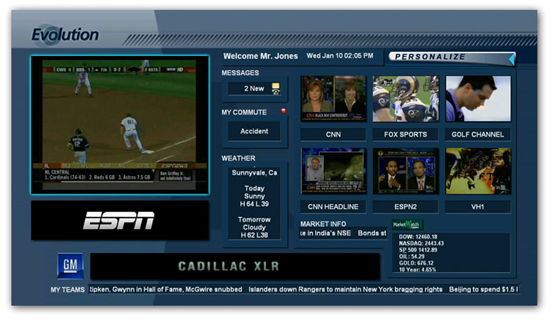


I agree that TV isn’t going away, in fact, more companies should get into this. After all, just like in the picture in the post, many families get together to watch sports games or movies on their main tv, not around the computer monitor. If you’re geek enough to set up your own media center and hook it up to the tv, that’s good, but there are people less knowledgeable.
hi Nick,
As an investment professional I follow the interactive TV industry (albeit not closely), but reading your article you say that the first generation interactive TV was in the mid 90′ties. Actually the worlds first (to my knowledge - please prove me wrong) real interactive TV provider was the Danish company ITE. It started already in 1988 and had up until the mid 90′ties developed a interactive TV show with a little small troll (!) called Hugo.
The viewer could, on live tv, play a game using a normal fixed line phones touch pads to run around a maze (first person view) and .. collect pints. All part of a larger live TV show. Then all other viewers would be able to follow the troll trough the maze. The company had patents on the technology that basically managed the timing/sync between phone touch latency and motions on the screen. I know it is no where near the new generations of interactive TV.. but still interactive TV
I found some info on it here:
http://www.thealarmclock.com/e....._trol.html
sincerely
Soren
You do realize that ICTV was founded in 1989, has spent something like $200 million, is on their 5th or 6th CEO and is just coming to market now (maybe).
AlarmClock listed them as the longest running failure in Silicon Valley.
http://www.thealarmclock.com/m.....t_run.html
I’d hardly consider these guys an up and coming, hot start up. Surely you can find more worthy projects to shine your light on.
I think TV is going away…Well, in the sense of a stand-alone box. It just makes more sense to have a computer handle television. The TV will be a dumb display model, controlled wirelessly by the household computer.
OldValleyGuy - I thought it was interesting because it got me thinking about the TV again, for once.
TV has been going away for years. At Disney we did the two screen model that worked well at the time (not sure where that project is now) in my opinion which ushered in the new media entertainment. But consider the fact that you can connect a computer to a projector and project high quality onto a wall. Anybody can have a “theater” experience. YouTube, CinemaNow, and others will soon make network television irrelevant. Give it a few more years where EVERYBODY has broadband - or Google gets the 700MHz bad - and TV is bye bye. Besides, there is no content on TV that is worth watching.
A similar company called Pach Networks was bought by Microsoft over 10 years ago and shut down. The technology works but is too expensive to deploy. It relies on streaming video of the screens the consumer accesses and is similar to a VOD system that streams lower bit rate content to each user.
I agree with one of the earlier comments the only news here is that this company is still in business and is able to raise money.
previous post should have said Peach Networks.
I hate current dvd menus; to be honest ….
- I want something like the wii remote on my TV … point and shoot …
The success of ICTV depends upon having sufficient capacity in the network to provide for unicast streaming of content to the home. On Demand proved the unicast model, but did not provide the necessary capacity: On Demand Networks are typically built to ~10% simultaneous usage, where some content in the ICTV model would require > 50%. Cable Networks are now looking at a thing called ‘Switched Digital Broadcast’, which changes cable by turning it into a fully switched video network with a granularity of a fibre node. This is different than today in that cable right now is essentially just a passthrough pipe for dedicated broadcast circuits: cheap, but very inefficient from a bandwidth perspective. SDB fixes this by only sending to any node the services that people in that node are actually watching. Revolutionary! In this model ICTV content is just another stream, where before it would have required dedicated bandwidth that was simply not available. The good news for ICTV: the cable industry and their suppliers are very focussed on SDB. The bad news: focussed means you’ll see it in the network sometime in the next 5-10 years (as opposed to maybe never). Cable is not fast. Gary and the principles at ICTV know this: they have waited out what could be the longest sales cycle in history. I doubt they are in much of a hurry at this point. The money has proven very very patient indeed.
Actually, the Dutch in 1988 weren’t the first. Try 1977 - Columbus, Ohio - Warner Communications (now Time Warner Cable) - it was Qube: http://en.wikipedia.org/wiki/QUBE