Ooma Launches Free Consumer Phone Service
Michael Arrington
131 comments »
An ambitious and long awaited new consumer VOIP startup - Ooma - launches on Thursday morning. Much like Vonage and the ill-fated SunRocket, Ooma allows consumers to use their normal phones to make and receive telephone calls, but at drastically reduced prices.
Vonage provides unlimited calling in the U.S. and Canada for a flat $25/month. Ooma, however, is using an innovative peer-to-peer architecture to significantly reduce their cost overhead. Because of that cost reduction, they’re charging for hardware only. Calls in the U.S. are free, and will be forever.
That doesn’t mean there’s no cost to the consumer, though. You still have to get your hands on the hardware, which starts at $399, and have a broadband Internet connection. That buys you a base hub. You plug broadband ethernet into one end, and a normal phone into the other, and you’re all set.
If you buy additional units, called Scouts, you can wire your entire house with Ooma. That is another distinct advantage over Vonage, which only allows a single phone to be plugged into the device. Spread the Ooma Scouts around the house, plugging one end into a normal phone jack and connecting it with a normal phone. It’s then part of the Ooma system and all calls will be free.
Instead of using normal exchanges to terminate calls like Vonage does, Ooma routes calls through the phone lines of other users if it can. That saves them the termination fee on the call and eliminates their largest marginal cost. That does mean that if you have a normal phone line (its not required to use Ooma) it will be used by other Ooma users, but it isn’t something you’d ever notice because your inbound and outbound calls are routed around it. And in the event you call 911, any phone call using your line is immediately broken and you are put right through. If there are no Ooma user within twelve miles of where your call is being terminated, Ooma uses the normal phone system. From the caller’s perspective, its all invisible.
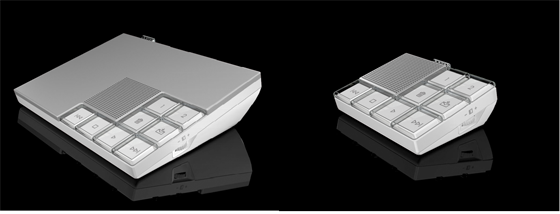
The Ooma hardware is both beautiful and functional. Answering machine functionality is built in to the Hub and Scout devices via physical buttons. Every Ooma account also includes two lines, and either can be accessed from either phone. A speaker phone is also built in.
Ooma isn’t just making money on the hardware. They’ll be adding additional for-pay features over time. One of the most interesting is ringtones, allowing people to have customized tones for incoming calls. That’s generally considered a cell-phone only feature. I can imagine other cell-phone type services being added over time as well, and possible Ooma branded handsets.
If you choose to keep your normal phone line, I’d recommend changing your calling plan to the most basic, least cost choice. It’s basically a 911 backup in the event of an emergency.
Ooma has a very deep management team and board of directors, and has raised $27 million over two rounds of financing.
I had the opportunity to interview founder and CEO Andrew Frame and Creative Director Ashton Kutcher (yeah, the actor) a couple of days ago. Kutcher is actively engaged in the business - part of his work will consist of creating a viral video series to promote the product. The podcast is up at TalkCrunch. In addition to Ooma, Ashton and I go on a brief detour and talk about the iPhone (he likes it, mostly) and his upcoming movie with Cameron Diaz.
The product is in private beta currently and we’ll be giving away a few Oooma’s tomorrow. They go on sale in September.


and like any p2p service, its useless if you are the first user
seriously, how will the first beta user route calls?
Whoopee - no, not at all. If it can use another user to terminate a call it will. Otherwise it use the normal phone lines to terminate calls. This is all invisible to the user.
Completely free phone service is fast approaching. I personally wouldn’t invest in advanced hardware like this because I’m sure that in the next ten years we’ll all be making free calls.
Now for cell phones… that’d be great.
-Chris
http://www.nerdcouncil.com
$399 amortized over a year is $33.25. After a 25% discount that gets you pretty close to the $25/mo rate charged by Vonage.
Now plug in the typical turnover rate for most VOIP users (est. less than 12 mos) and there you go…
No responsiblity (or very little) for QoS or the infrastructure. Sweet!
I guess my initial reaction is “$399 for some hardware?” And then how much are the “scouts”? So if this company goes bust in a year, then we have loads of hardware with no use. Cuecat comes to mind
You mention Sunrocket who took $199 from many customers for 2 yrs service and then went out of biz.
If I do the math and compare it to Vonage at $20/month, free hardware, that’s nearly 2 years of service to equal the price of this one hardware unit.
The ringtones sounds interesting, I do have customizable (8 or something) on my Uniden phone. I think ringtone sales work on cell because users like the idea of showing off the latest xyz song or theme on their phone outside. No idea if people want those rings at home. Perhaps the younger set.
And while I have been out of the telecom arena after my punchdown days in 94, I am confused Mike by how it works. Are you saying that my mother’s home phone line might be used to connect calls on Ooma?
The device does look “mac-like”.
Yeah- Why is this any better than Skype? For less than $80 bucks/year, I can get all the incoming and outgoing calls I want, and all I need is a cheapo usb phone or a mic/headset. I can’t justify the $399, especially since that is the same cost as 16 months of Vonage service, and who knows what technology will exist 16 months from now when it comes to p2p and voip?
And on a side note, here is a hint for Vonage customers- When I called the cancel, they offered me three months of service for free, plus they reduced my rate after that to $19/month. Clearly, the voip market is extremely competitive.
Allen - I compare this to vonage mostly to give people a frame of reference. You get two lines with Ooma and it works throughout your house on normal phone lines. It’s completely different and better. And If you keep it for years, like I have with Vonage, its hard to argue that the cost isn’t much lower.
Jeff - see my comment about vonage above. Skype is great, but Ooma is a home line replacement. Skype doesn’t go there.
Dude, I can’t believe you got Ashton to do a podcast with you. WHY didn’t you video it too???
Startup are planning to create Creative distruction. Ughh!!!
Punk’d!
Thanks Mike. I still think investing $400 is going to be a killer for them and I will bet that the price will drop quickly. It’s hard to compare leasing to buying.
So you can hook this up to a local phone line (ATT) without having any local service? For example, when I disconnected my local phone line, they completely cut the service off. Would it still work?
I assume they will also be able to transfer did’s?
11 comments thus far, and not ONE Demi Moore joke? Wake up, people!
Allen - I believe you can still use your normal phone jacks even without phone service to those jacks.
You can use your existing phone wiring with Vonage the very same way that the Scouts appear to use it:
http://www.vonage.com/help.php.....&nav=3
Oh and thanks for the reply, Michael. Sykpe does work for 5 phones in my house. I just get a weird sounding dial tone, and i really don’t like Skype’s lack of outgoing caller ID service. Does Ooma have the same problem?
It looks like a very promising concept but they are asking for too much of a leap of faith. I dont know how many people are going to spend that kind of money on a company that has no track record. If they allowed you to spread the $399 cost over the first year, that might relax some people.
Neat concept, but the startup price is too high…
#14 - that’s how my sister has it setup
#16 - Adam - but it has a major tv star behind it
Thanks for the clarification Mike - that helps.
This reminds me of “CallBack” services which were very popular up until voip and skype took over. They are still semi-popular in 3rd world countries.
Very pretty, but it looks expensive (B&O look). They’re going to sell it as being cheaper. Isn’t that a no-no?
Maybe they should get someone akin to Martha Stewart to market this, whoever that may be.
$400.00 is a massive price point - and one that takes them out of every retail chain in the US (if not worldwide). So - unless they have plans to open 100’s of Ooma stores (and more worldwide) their business model is dead before it even starts. They have no way to get this product into mass distribution, without spending like Vonage.
The concept of Scouts are redundant when I have a 4 handset $150.00 5.8ghz Phone, that I purchased at Costco and can put a phone in every room of my house, and ring tones for where? the base station? I want my phone to ring, so I can FIND it.
The hardware is a very nice ID, no argument there, but they have no chance at getting the required number of users to even coming close to ever turning a profit.
They have a great management team, but either they are drinking Oomaid, or I am missing something.
Huh? I have my Vonage plugged into my home phone wiring. All my original phone outlets work. Even the ones on the other side of the house.
Ladies do love the Kutchster! Do they love him $400 dollars worth when that gets them a nice pair of shoes or a bedazzled cell phone, is the question? Probably should offer more of a choice like $400 dollars for free calls for life or $200 + 9 a month. People might eat the $200 cost because it is closer to so many other technology gizmos. At $9 month for calls who wouldnt do that.
Quality of service is a definite concern with this p2p network. Need Custom Software Development?
Well-written article. Thanks, Mike.
Man…that hardware is just way too expensive. It’s nice, but they’ve created a barrier to entry for most people. Something like vonage (which I don’t like personally) is easy to adopt since you don’t have a big out of pocket expense.
Personally, I don’t have a land line and haven’t for years. Many 30 and under people are in the same boat. And I also pay no long distance nationwide with my mobile phone..it’s pretty standard these days. International is cheaper with calling cards. Frankly voip for the consumer isn’t a big advantage…there isn’t much cost savings if any and the reliability/quality isn’t as good, not to mention it’s not mobile. Now, commercial voip on the other hand can be a huge benefit to businesses.
sorry. sunrocket out of business?
thats news to me since as of this morning it worked just fine at home. there are no news on the site or email of any impending doom, so care to elaborate?
smash - http://www.washingtonpost.com/.....02466.html
Wait — so my calls are routed through someone else’s private home? Even if regular phones aren’t inherently secure, and wiretapping laws are well in place… it seems like the barrier for abuse would be all too low.
Hahaha, watching this flame out is going to be fun. Where’s Uncov when you need them?
Thank you for everyone’s feedback. I’d like to take this opportunity to address some of the points that have been raised here.
The price of the hardware seems to be a common objection, so let me lay down some context for the Total Cost of Ownership for some competing services. Vonage currently costs around $28/month (after you include all of the fees). Over a 3 year timeframe (their average lifetime of a subscriber was last reported at around 3.5 years), a subscriber would pay them just over $1,000. Comcast runs different promotions on their Digital Voice offering, but their base price (assuming you buy all of their other services) is $40/month. If you got in on one of their most aggressive promotions and got 6 months free, that’s still $1,200 over the course of 3 years. An unlimited calling plan from AT&T is $40/month, but throw in all the taxes and fees, and you are looking at over $50/month, for a 3-year cost of more than $1,800. In comparison, $399 for the ooma hardware should look a little more palatable. It is an investment, but we believe it is one that will pay off quickly for our customers. In the future, we will be looking at ways to reduce the barrier of the up-front cost of the hardware.
Statistics vary widely (40%-90%) about what percentage of people keep their landline when subscribing to a VoIP service, but clearly there is a significant market of consumers out there who have kept or are planning to keep their landline and use VoIP (and even cell phones) as complementary services. Instead of running ships-in-the-night, our product was built from the ground-up to integrate with an existing landline, allowing you to keep your phone number (without enduring the painful LNP process), retain real 911 service, and enable a seamless fallback in case your power or Internet goes out. If cost-savings is your primary concern, run the ooma system without a phone line, we’ll give you a new phone number, and eliminate the cost of the basic landline.
It is true that there are ways to light up the whole house with VoIP services like Vonage. Although straight-forward for someone comfortable with wiring and technology, it is still a somewhat intimidating procedure for the mass consumer market. In addition, it retains one of the limitations of in-home wiring which is that it is, for the most part, a bus architecture. Another way to solve the problem is to buy a multi-handset cordless phone system. They are cheap enough that many people have used this as a solution. Still, unless you get a more expensive 2-line phone system, you’re still on the party line when two handsets are off-hook at the same time.
We have approached the problem of extending phone service to other phones within the house through the creation of a satellite device called the ooma Scout. Each ooma Scout is individually addressable, allowing us to “virtually” break the bus architecture of the home phone wiring (converting it to a PBX-like architecture) and introduce unique features such as the Instant Second Line. While multiplexing multiple voice conversations over the same copper pair is an old idea, we have focused on ease and simplicity of the user interaction to create a better solution to a familiar problem - contention of the phone line. The ooma devices convert every one-line phone in the house to a two-line phone, and you get the second line on the same phone number you already have (along with all the calling features you’d normally have to pay separately for). No need for others to remember another phone number.
Now that minutes are free, like so many have predicted over the years, we hope to shift the attention to services. We’ve started off with the creation of the Instant Second Line and the Broadband Answering Machine - which solve familiar problems in unique (and hopefully better) ways. Look for more in the future.
Dennis Peng
Director of Product Management
ooma, Inc
When are the 25 units being given away?
Congrats to Frame, Peng, and the rest of the crew for getting this technically very impressive product out the door. The technology sounds quite innovative and they seem to have borrowed a page from the Apple playbook on the beautiful design.
Although I see the logic behind Dennis’ calculations, I think it will be the rare potential customer that will actually run through the numbers to justify the relatively large upfront investment. In the end, I’d bet that Ooma will have to push that price down to recoup its initial upfront investment in technology. My guess is that the cost of the unit and the service are so low that most of the $399 is flowing to the bottom line and hence they have a good degree of slack in pushing down the price (or being forced to by the market).
I’m a VoIP novice, but am curious whether Ooma can be used to make international calls and how that works.
Great post Mike.
That’s a really sweet concept that will be around for awhile. I would like to see the GUI first, because that is the only thing I like about bon vonage where its at the point I use Skype for outgoing calls.
I’d also like to hear what the telecommunications lawyers think. That’s revenue, especially in Canada with our broadband density.
let’s hear the podcast…
This definitely looks like an industry disruptor. This leads me to believe that we are not as far from free landline calls as some might imagine.
Cheers,
Aidan
http://www.MappingTheWeb.com
looks interesting, and while the price is a bit high for an unknown company (it’s not like we are talking apple and the iphone here), it’s nice to see some new competition come into this area and hopefully will serve to drive new innovation.
as a couple others mentioned, what’s the story with the possibility of a few of these devices being given away to loyal techcrunch readers such as my self?
I can’t decide if I think it’s really cool or super lame that Ashton Kutcher is involved with this.
Sounds great and all, but at that price they might as well start looking at Sharper Image for a shelf deal.
This service sounds great but I’ve recently had trouble with Vonage and my home security system - Vonage somehow interferes with the service’s need to connect with my house for updates and checks. I wonder if Ooma would cause a similar problem? If not, Ooma would be an option for me.
Dennis - can you share where you got the 40-90% keep a landline when moving to voip? You would be targeting the younger, iPhone set with this product and those demographics are not keeping their landline. And my mother wouldn’t ever use this, I can’t even get her past aol.
i use up about 50 bucks every month in international calls through gizmo skype and yahoo voice. for me, and many others like me, the per minute rates to a host of countries are THE point of interest. thats what i couldn’t find a hint of on their site. I’m sure it will be of some service at some point, but the site is just too full of management jargon, i.e. utter garbage at the moment. that turns me off.
Technologically, the device is very innovative, but how does Ooma deal with intercarrier compensation charges and terminating access fees?
Do they pay any at all? If so, is that why the device’s price is so high? If not, who pays?
yeah the ‘money up front’ hardware model; sucks.
- I would like to see Goog, throw some money at this;
- Also would like to see Goog; work on Wimax … (is that still coming?)
Are you sure you haven’t been Punk’d Michael? This surely isn’t going to be a “killer” of anything.
The concept is much like the original Free World Dialup from 4-5 years ago — install a router between your home Internet and POTS line, and others use it when you don’t. Not sure why that model didn’t work then, although I can see some challenges today:
- How many VOIP subs keep POTS? And of those, how many drop to the lowest service level, which often is measured or metered (i.e., past a certain monthly allotment there’s a per call charge)?
- Is P2P the best technology for latency-sensitive traffic? Perhaps Ooma’s not using the P2P I think of (e.g., caching, potential ISP mitigation), but latching on to the catchy description for the base hub function.
- How many potential users are there who have broadband + want VOIP + keep POTS + will pay $400 up front to an unknown when SunRocket just left its subs hanging? Wouldn’t these same folks use competing services such as mobile phones with included LD, Vonage, Skype, cable VOIP, etc.?
- Ringtones? At home? Maybe, but I doubt many will pony up much for this.
- Ooma-branded handsets? What can Ooma provide that the major CE companies aren’t?
More competition is good, so I hope Ooma succeeds. Good luck.
You can get a better deal with a mobile phone. Plus it fits in your pocket and takes pictures of pretty girls on the street. Take that oomy.
$399 for a wired consumer device that makes phonecalls?
And you posted about this on 4 sites?
Mike:
I ask also, when do the free units become available?
I am a former employee of a VoIP company and this is intriguing!
Mike
RE: Vonage, and only being able to plug one phone in. That’s incorrect. I’ve had Vonage from day one, and after disconnecting Qwest from my home telephone wiring, I connected the home wiring to the Vonage router. All my phone jacks work just fine with normal analog phones.
Michael
Andrew’s right. Somebody’s been drinking the Oomaid.
$400 seems pretty steep for anything that’s “free”, and the fundamental line-sharing concept is a bit creepy, too.
It looks like Ooma can’t get enough capital to build out an infrastructure, so they are hoping people will go for a kludge that means that the Ooma netowork will allow spying on people’s phone calls. Yuck!
Ooooh…..Valleywag begs to differ. If you listen to them, the two pretty boys are about to be Punk’d big time. VW makes a pretty damn good argument. Will be fun to watch who gets it right. Nothing more fun than watching bloggers with nothing better to do than battle it out in a desperate attempt to defend their egos…
(Nothing against you guys — on the contrary, I wish someone would take the time to actually consider taking my opinion seriously. This is all just envy personified
)
Mike:
I was lucky enough to get in on the free units…got one of the White Rabbit passwords to their site.
However, according to their Terms and Conditions, I must keep a local landline for this service to work, contrary to your post on this.
This goes counter to the reasoning to converting to a service such as this. If we are converting to an alternate carrier such as Vonage, et al, we are doing so to drop the landline. By their Terms, we must keep it. I had switched to Brighthouse Networks digital phone so that I could drop Ma Bell. My house has never been wired for landline…didn’t need to with VoiP. With Ooma, I’ll have to get a landline installed.
After making it almost to the end of the signup process, I had to say “no thanks”.
Michael
PS–GREAT article on you in Wired.
See their Terms on the phone line below…..
========
Your residential telephone line must permit unlimited local calling without per call or per minute charges, and you may use the equipment only while connected to that telephone line. You must authorize us to ensure that your residential telephone line is configured to work properly with our equipment and Services or you must undertake to do so yourself. You will be responsible for paying for any reconfiguration charges from your local telephone service company.
(b) 911 Emergency Calling:
Calls to 911 will be directed through your local telephone service line to your local telephone service company. Your 911 calls will be handled by your local telephone service company, not by us.
I have few concerns. Just updated my blog with some thoughts on privacy issues which may arise from OOMA using phone line.
Hi Michael,
I am a product manager at ooma and I run the beta program as well. Let me address the landline versus no-landline question.
During the invite-only White Rabbit Program only the landline-version of our product is available. In this version you are required to have the most basic landline from your local phone company (i.e. AT&T, Verizon, etc.) in order to use ooma. The most basic landline means unlimited local calling, which typically runs around $20 a month. This is great for consumers who are concerned about safety, quality, and reliability often lacking with traditional VoIP. Lets say there is an internet outage or power outage - ooma will automatically fall back on the landline maintaining your ability to place and receive calls.
Come September you will have the option to “cut the cord” as ooma will offer a non-landline version of the product, where you can simply plug in your broadband connection and still enjoy the ooma features as well as greater cost savings, since you no longer need to pay for the landline. You will lose the reliability and fall back of having a landline with this version. It will be a trade-off the consumer will have to make - higher cost savings (non-landline version) vs. greater reliability (landline version).
Hope that clarifies the issue.
Alex:
Would this be a free exchange to the non-landline version?
In other words, would us beta’s have to pay for the new unit?
Michael
PS, I’m all too familiar with the power/internet outage concerns with VoiP. I was Product and Systems Development Manager at a VoIP company. We had to repeatedly drive home the fact to customers that if you lost your power or your internet, you lost your phone service.
Allen - Jon Arnold commented on some research done by ChangeWave last year:
http://blogs.pulver.com/jarnol.....res_1.html
According to these results, 36% of VoIP users rely on their POTS lines as their primary service, with VoIP as a secondary service (maybe for outgoing long-distance or international calls). Another 34% use VoIP as their primary service, but maintain a POTS line. Only 10% said VoIP was their only home phone service. So this puts the percentage of people who maintain a landline at 70%, but with offerings in the marketplace today, the two services are operating totally independently of each other. We have built a product that seamlessly gives you the best of both worlds (POTS and VoIP), with no compromises.
Dennis Peng
Director of Product Management
ooma, Inc
Forgive my bluntness, but what it sounds like we have here is a very nicely designed ATA with a POTS pass-thru.
Is the phone line requirement being called for at present due to the company’s not having E-911 in place yet?
Michael
This seems like a voyeur’s dream… all one has to do is tap into the POTS line between the OOMA and the demarc box outside the house to listen in on random phone conversations, even record them. How long before we have YouLine, a website with live, unedited audio from random POTS lines?
Also, how can I be sure when I call someone (or they call me) that they are not using an OOMA that is being routed through an e-voyeur’s POTS line?
How can hospitals ensure compliance with HIPPA and schools ensure compliance with FERPA, if they cannot guarantee that random people aren’t listening in on their conversations?
From my point of view, it looks like a recipe for disaster. If, for example, I’m calling a friend in Tempe, AZ, then the OOMA servers look for the unused POTS line of an OOMA subscriber in Tempe; my call, to a secret third party, is routed through some random Joe who lives in Tempe and may have a recorder on his POTS line (because he’s of a creepy disposition, or because he is the target of investigation of some PI - in a divorce proceeding - or of some government agent with a tap warrant).
Am I missing something here?
Cheers,
-J
As Michael said above; Question for Alex (Beta Manager at Ooma):
Will Ooma be shipping us white rabbits the unit and letting us use when landline-less service is announced in September?
At the moment I am a white-rabbit with no land-line
-Ravneet
I’d like totalk with these guys about seetting up a related service for small businesses using my own infrastructure which provides free display advertising. Anybody out there have an email contact?
Cheers,
Derick
Michael - your ooma device can be reconfigured to work without a landline when we launch in September. It’s the same hardware, we’ll just provision it slightly differently.
As for the hardware, if it was just an ATA with POTS pass-through, we could have just used off the shelf hardware. But we didn’t.
Does anyone else think their base station looks like an Atari 5200?
Ravneet/Michael,
Yes, you will be able to switch from a landline unit to a landline-less unit come September free of charge.
Alex Gurevich
Product Manager
ooma, Inc.
Dennis–understood.
Would this be a remote provisioning ala a Vonage, et al box? Or would you need to provision it before it is shipped to me?
Since it would be plugged into my broadband and I, assuming, connected to Ooma’s servers, it could be remotely provisioned.
Still, can I use it without a landline even in the beta? While there is phone wiring in the house, none goes to an outside box from the LEC.
If this is so, then I’ll happily await my White Rabbit box.
Sorry if the comment about the ATA came off as harsh, it wasn’t intended that way.
Regards
Alex:
I see your reply to Ravneet/Me and that answers my other question posted earlier regarding switching the units.
Will there be any LNP requiremements on this? In other words, will I need to port my number to you when I go land-less? Or, can I just get a new number from you?
Michael
What a bad name. Sounds like the German “Oma” / grandmother.
Since I hate Kutcher’s films I will pass on this product.
Alex,
I have recently been introduced to ooma through sources I won’t get into now. Suffice it to say, the nature of my current role has me keenly interested in the product. I have been pro-VoIP/IP Telephony since my days at Cisco several years ago. Would you be able to have a White Rabbit share a token with me for the beta program?
My contact information can be found on LinkedIn. Best wishes on what sounds promising. It should be interesting to learn of the follow-on capabilities!
Looks very interesting, though I’ll wait a bit and see how it takes off. Don’t feel the need to be leading edge on this one.
The price point at which this product has any chance whatsoever of becoming accessible to mainstream audiences is $69-$149. Anything north of this is likely to preclude any kind of significant adoption.
It doesn’t seem designed for the mass market. The design is overly slick. If they want mass market lower the price and make it look uglier.
From a financial standpoint this company is a mess. Every company needs cash flow…. if you’re not paying and no one else is either ( on a reoccurring basis ) the company will go under. They will have operational costs to running the servers DID’s, VoIP overflow termination, …… those things are not free.
From the technical standpoint it’s cool, but a mess. P2P is far to much latency to sustain a VoIP call, there is no way to detect or stop non-trivial tapping of the PSTN line, the ways this could be subverted are endless.
From the legal standpoint… raise your hands if you think the incumbent communications carriers will allow you to terminate other people’s calls on your line for free? What happens when someone calls in a bomb threat on your PSTN line?
A Limerick
Kelso directing whats said,
Hey, It got Demi into bed.
Come on ooma,
Please dont go Booma,
We Don’t need another voip that goes dead
A Haiku
Sunrocket is dead.
White rabbits dance on it’s corpse.
Dude, Where’s my ooma?
Cheers.
The other day I was listening to a Stanford podcast with Andrew Frame talking about startup and vaguely mentioning Ooma, without giving any real details. The podcast is here: http://edcorner.stanford.edu/a.....l?mid=1681
@71 - Agreed on the legal and technical standpoints, but financially I have to disagree. The guy running this has a lot of experience with startups and has strong VCs backing him up. Think Google. How long did it take before they made any money? (and have they even turned a PROFIT yet?!)
The name however makes me think Ooma Thurman.
Justin
Google started running a profit in 2001. Google has a solid infrastructure and sold a good product ( ads ). This device is a solution in need of a problem since we already have a race to the bottom in VoIP cost. That coupled with it’s questionable legality makes it a poor bet. I’m paying $17/month for VoIP and it would take over 2 years just to break even assuming they are still in business…. no thanks.
Less than 1 in 100 startups make it, while he may have experience statistics are bound to catch up with him.
Anyone that got into the White Rabbit program that was given 3 tokens can you pass one to me? I am very interested in testing the service.
Thanks,
andrewscott71@hotmail.com
This might be a silly question, but in the TalkCrunch podcast, Andrew said that when you are on a call and someone else picks up another phone, they get an Ooma dial tone and can make calls. That’s cool.
However, what if you are on one side of the house, answer the phone and it’s not for you, the person it’s for is on the other side of the house…
Do they need to come all the way across the house to your particular phone because any other phone they pick up will have a new dial tone? There must be a way to use the current line by some switch on the Scout, but I gotta ask. Sorry if this is a stupid question.
Michael - yes, the ooma box can be remotely provisioned and switched over to non-landline mode in September. If you don’t have a landline right now, the box will not work. I may be able to get you into our no-landline beta program though.
Scott - every device connected to an ooma Hub or ooma Scout has access to each of the 2 lines. If you answer a call on line 1 and want to switch phones, you can put the call on hold by pressing the line 1 button. Pick up a different phone in the house, you’ll get new dial tone and be on line 2, but just press line 1 and you’ll join that call. If someone in the house wants to jump on the party line with you, they would follow the exact same steps. If you have cordless phones, you can also use the “flash” button to switch between the two lines. This provides a seamless upgrade for folks who are used to call-waiting.
IF X amount of users that buy the box per year, they get X * 400. They have to foot the bill on calls that don’t go to other voip/ooma. However, this amount gets less and less, while each year X gets higher and higher. Therefore, its just a question of reaching that critical mass, which I very much think they can do, with thier publicity. After that, they can even charge more for the boxes if they want, or less. Then, the money they’d get for each box would be mostly profit, and if it catches on enough, would be ALOT. This doesn’t just include the “techie” crowd, but can go and spread to the entire world as vo-ip is boundless and reallly really cheap for vo-ip to vo-ip calls.
That’s not even taking into account charging for extra services, which puts the balance into their favor even more. This is not the usual tech crunch BS. This has very real potential.
$400 is too rich for my blood when it comes to a company with no track record. I’ll stick with my reliable $19.95 Lingo service.
I’d surely welcome a White Rabbit token from anyone willing to share. I’m very interested.
lor.kutchins@gmail.com
I’d love to get a token for this service!
InTheSky74@yahoo.com
Thanks!
I’d like a White Rabbit token to check out the service. Thanks
I have already made the switch away from landlines. It is cell phone only for my family and I. Not sure I would use something like this even if it were free.
Cell phones already include most features that cost extra on landlines. I find I make many of my calls when away from home anyway.
It sounds like another wonderful solution in search of a problem.
This is interesting VoIP model and I would like to participate in the land line or land line-less beta (does anyone still have tokens to spare?). I have read some of the posts regarding security/wiretapping and have to say that this is something that needs to be addressed on the ooma website.
I just started trying T-Mobile’s HotSpot@Home service and have had mixed results. Calls over WiFi at home have dropped and call quality on my end is not great (not sure if its the Nokia 6086 handset or my WiFi network or T-Mobile’s implementation of VoIP). It did connect easily to T-Mobile HotSpot at a local Starbucks and it connected to a college campus WiFi network while we were visiting with our son for campus tour.
I’m also hesitant to plunk down $400 for something unproven, but, if it does work as advertised, I’d have to consider it as T-Mobile HotSpot@Home basically costs $50+/month.
I just started useing a over the internet phone service, Comcast.net. It works good so far. I sure would like to try this service, it sound great. Well woth the $400. If anyone has a token, I syre would love to compare the 2.
Thanks Ray Jacobs
Saint Johns,Florida
I just started useing a over the internet phone service, Comcast.net. It works good so far. I sure would like to try this service, it sound great. Well woth the $400. If anyone has a token, I sure would love to compare the 2.
Thanks Ray Jacobs
Saint Johns,Florida
Can you use your current number? Will it work with security systems that currently use landlines?
Dennis:
Great disruptive technology! I bet AT&T hates you already
Can I get a non-landline token unit? My reasons: my reliable SunRocket just went under (but they are still keeping me hooked - I take it one day at a time) and I am not ever going back to AT&T!
Good luck to Ooma!
Dennis:
Long-time telephony management consultant here. I live in the DC-area and would glad to be a seed for you guys.
I’d like an invite for beta unit. Please send to rblogan at gmail dot com
Thanks!
I’d like a White Rabbit token please. I had Vonage and it sucked. The article I read in the Chicago Sun-Times has me intrigued…
No official response yet on the “listening in” issue? You can bet the first bunch of subscribers will be hacker types recording calls for useful information.
I, too, am interested in a token, if someone out there has one and wants to share it.
I also would like a token if it is possible to get into the program with not having a regular land line. I discontinued Verizon when I started using Vonage.
As Nicholas Negroponte has observed everything about telecommunications is about to change, and is changing. I seem to fit the Ooma model, not afraid of new technology, have kept my land-line and need competitive long distance. I’m not home during most of the day, so why not share my land-line with others? I would like a White Rabbit token, thanks in advance. robincalebtimmers at gmail.
I am an early adopter and also have a landline with unlimited local calling. I am happy to share the landline that I rarely use. Would anyone please share a White Rabbit token with me? bmcfadd at hotmail
Thanks so much.
i work for a large traditional phone co. (a?&?) and would not have ever believed we could ever see this type of technology 10 years ago.
good luck ooma
I am a SunRocket customer and was caught off guard when they went belly up. Now I am looking for a new voip or internet phone service and would love to have an invite to become a White Rabbit cardholder. Could anyone direct me to an invite? — Thanks RH.
The idea sounds good on the surface, however, there are some technical issues that may cause problems for some customers.
1. The cost is $399 for the ooma hub, but that only allows you to use one phone device. If you want to connect other phone devices, to take advantage of the 2nd line, you must purchase their ooma scout for EACH phone device you have connected. the scout device is an additional $39. so the cost could add up pretty quick. If you want to use ooma and you have 3 telephones in your house you need the ooma hub and 2 scouts, bringing the cost to $478.
If you have one of those expandable cordless phone systems, you can just connect the base station to the hub and use any of the phones. But they won’t work as 2nd line. To use a 2nd line a phone device has to be connected to another phone jack in the house using their ooma scout.
2. The phone number of the owner of the ooma box will appear as the caller-id to the person receiving the call, not the phone number of the person who is making the car. (many people have brought this up)
3. When your POTS line is tied up because your ooma box is placing someone elses call, people who try to call you with a regular phone will not be able to get through. However, people calling you through another ooma box will be able to call you, since the are going through an ooma hub, they can call you using voip, and avoid your POTS line which is in use.
4. For various reasons, your call going through someone elses ooma box can be unexpected terminated if
- they try to dial 911
- they choose to unplug the ooma box
- someone picks up a phone not plugged into the ooma hub or one of their scouts. the ooma hub will detect that someone has picked up the phone and to prevent them from listening in on your phone call in progress it will terminate it. However, if they have that phone plugged into the oooma scout, then it will ensure that they cannot listen in and they can make a phone call, without terminating your call. but not everyone will buy the scouts.
5. Now the big one. They say you cannot listen in on other people conversations going through your ooma box:
- because it is encrypted. well of course it is encrypted. it would be idiotic not to encrypt the voip traffic. the voip side is not the issue.
- because they have some “proprietary technology to prevent and detect tapping of the phone line.” they basically built in a phone tap detector. you can go down to radio shack and buy one also. it basically detects a change in the electrical signal properties that occurs when another device is active on the phone line. so if you say insert a phone splitter and then try to connect a device to listen/record what is going over the phone line, the ooma hub will detect this device and will have no choice but to disconnect the call to prevent you from listening to it. so you can have fun disconnecting peoples calls by connecting a phone to another jack without the scout.
You can record other peoples phones conversations going through your ooma hub using an induction phone tap. induction taps are different because they can listen to a phone call without even being connected to the phone line, therefore there is no change in the signal properties. So using an induction phone tap the ooma hub will not be able to detect a listening device, so you can listen and record other peoples call. google it to learn more. this should be interesting.
Here’s a comparison between skype and ooma Why Skype is Better than Ooma
I’d like to participate in the beta program of ooma. It’s a great idea , and a perfect value proposition for VOIP, Hook me up, with a ooma hub, I’ll make sure everybody around me, knows about this product
I’d also like to participate in the beta program from Las Vegas. I am a retired executive from a major telecom company and find this very interesting. I currently receive free calls from Embarq and just wondering how this differs except that it would eliminate my local phone bill. Please advise on how to become a beta tester…thanks LVCHUCK
Mr. Peng, Mr. Gurevich
I think this sounds like a great idea on the surface but with all start-ups, needs to have testers to work out the kinks…I would be more then willing to be part of this process (the non-landline beta). Please let me know if you need help with this beta.
Josh #57 (and Ned #91): The ooma hub includes technology to detect and prevent attempts by other ooma subscribers to listen to your calls.
If you need additional assurance that an inbound call is not going through and ooma hub, check the caller id; better yet get your own ooma hub: then all calls from other ooma subscribers will go IP (and encrypted) direct to you!)
Likewise, if you use *82 on an outbound call, the call will be routed though a secure server that presents your caller id to the PSTN.
HIPPA/FERPA: ooma is [initially] selling to residential consumers.
Michael #56: Is the phone line requirement due to no E-911?
– yes and no: the current discounted sales ofer is for landline users that can build the ooma network; Many customers have a landline bundled with their DSL, so it comes for free. ooma believes that integration with the landline is the preferred solution for people who want no compromises in reliability and 911 behavior. E911 will be available as an option at the public launch in September.
Eric #71: From the legal standpoint… IANAL, but:
– the 1968 Carterphone decision asserts that the LEC must service calls placed to/from the customer’s [part 68] compliant devices.
– ooma fully supports CALEA and can provide an authorized Law Enforcement Agency with the identity of the ooma subscriber that originated a call that ooma placed through any ooma hub.
Jeff Peck
Principal Architect
ooma, inc.
Hawker #87: Yes, with ooma you can keep your landline, and your phone number; no “porting” is required.
And yes: your landline-based security system continues to work.
John #98: “there are some technical issues…”
Q: Caller id?
A: when a call is terminated through an ooma box, caller id is blocked.
If your call *must* have caller id, then dial *82 before dialing.
Q: when your line is busy?
A: the ooma Instant Second Line feature allows you to receive a call to your PSTN number or place an ouboutnd call, even while your PSTN line is busy. The second call does not need to be to or from an ooma subscriber.
Q: gateway failures? (intrinsic, accidental, or malicious)
A: Indeed, it is possible that your call could be interrupted. ooma’s network is designed to detect and route around unreliable gateway nodes.
Q: wiretapping?
A: ooma includes technology to detect and prevent eavesdropping.
There are many devices and many techniques to tap phone lines;
but to do so without legal authorization is a felony.
Jeff Peck
ooma, Inc.
Okay, I’m interested but I have one main concern:
What about International calling?
I have been a customer of Vonage since 2003 and have been very happy with there service. I use it primarily for international calls. If I were doing lot of long distance calling I use my cell phone since it is included.
I realize that over the course of a few years I c