Bay Partners Launches Facebook-Apps-Only Fund
by Michael Arrington on July 9, 2007

Here’s another indication of the importance of the new Facebook platform: Silicon Valley VC fund Bay Partners has earmarked millions of dollars for investments in startups creating applications for Facebook. The new program, called AppFactory, will be officially launched on Tuesday.

Like the Charles River Ventures Quick Start program, the idea is to allow entrepreneurs to raise a small amount of capital with a minimum number of hurdles. Bay is promising to make a decision to invest within a couple of days of meeting the company, bypassing the normally weeks-long process of raising capital.

Unlike the CRV fund, though, AppFactory is investing only new Facebook applications. Salil Deshpande, the Bay Partner who will run the program along with senior associate Angela Strange, says that Facebook is now the Social Operating System, and that new platforms and systems historically lead to a new economy. Bay wants to be in the middle of that economy and fund as many of the “killer applications” as they are able to find.

Salil says 40,000 developers have requested keys from Facebook to create applications, and over 1,600 have already launched on Facebook.

AppFactory will be making up to fifty investments ranging from $25,000 to $250,000. Salil says that they have preferred deal terms, but are willing to consider making equity or debt investments, and will work with co-investors as well. Basically, he says, they want to help entrepreneurs build and monetize Facebook applications with a minimum of hassle.

Is the Facebook platform real? Some people question the intelligence of entrepreneurs who build their new companies entirely on the back of another startup. But in general I agree with venture capitalist Josh Kopelman – building for Facebook removes many of the risks associated with getting a startup off the ground.

Advertisement

Responses

Comments rss icon

  • how exactly do they plan to monetize apps that are facebook only?

  • Do they realize Facebook apps take about a week to build?

    Andrew, apparently you can put your own ads on an app (though I can’t see that being allowed forever). Also, most apps to this point have either been acquired (silly IMO), or are generating traffic for existing sites. I really haven’t seen a single app that I would say is a “company” on it’s own.

  • Andrew,

    That’s a valid concern. But we think that incorrect conclusions are being drawn from the unmonetizability of some apps that have spread fast on Facebook to date. Some of those apps will always be unmonetizable. But meaningful apps will be monetizable just as meaningful web 2.0 websites are monetizable. We are interested in backing entrepreneurs that will be imaginative about what types of applications can be built on Facebook’s Social OS. The apps that are spreading virally today are not necessarily the best indications of apps to come.

    We definitely see the open Facebook platform resulting in real, valuable applications. We believe that the Facebook apps of the future will be deep and sophisticated and will strike the right balance between adding value to the Facebook fabric, and having value independent of Facebook.

    Salil

  • Has anybody monetized anything on facebook to date (I know it’s only been a few weeks)? Given how many people have developed apps for facebook already, it begs the question weather anyone really needs venture money behind it. Seems like some very committed teams of developers could develop some meaningful applications without much money behind it.

  • Although the upcoming applications will serve mainly Facebook’s interests and will probably monetize somehow they can’t actually overgrow the mother webapp (Facebook).

    However – given the huge amount of traffic, Facebook’s platform can be an awesome way of testing these apps and maybe develop them later on a stand-alone basis.

  • I do not see this as a good venue for a startup. Things that had traction on Facebook recently were already known. The competition for eyeballs and for the finite real estate space is just as brutal.

    More importantly, Facebook offers a way to plug into itself mostly as the news mechanism, serious apps like Flixster, etc. still have their own sites. So I do not really see how this is a good idea.

    Alex

  • facebook platform has many limitations to develop full fledged apps (we had to do considerable amount of engineering re-work to make our yet to be released ticketing app to work on fb), having said that it is a good start to launch consumer centric apps/portals….lets see how long this fb mania exists!!

  • Alex,

    I like to think of what Facebook offers as a mesh of “dots” and “lines” that connect those dots, where the dots are people, and the lines are relationships.

    There are *certain* *types* of applications, in a wide variety of categories — fantasy sports, swapping, gaming, dating, gambling, media sharing, trading, money management, epayments, fashion, auctions, you name it — that are *naturally* more suited to deploy onto an existing mesh of “dots” and “lines”, than to taking a destination-site-only approach, where you expect all the “dots” to sign up to yet another site, and recreate all the “lines” in order for the site to reach its potential. Often the latter, especially the recreating of relationships, is just too much to ask.

    Salil

  • We could really use that funding to add new features to our Facebook application called “The Fame Game”
    http://www.face...p?id=2409301734

    Let me also add that coming up with an idea for a killer app is one thing, but finding the talent to implement it is another.

    Allen
    Famesource.com – Claim your fame!
    http://www.famesource.com

  • This is insane. There are a lot of logical reasons why funding Facebook applications doesn’t make sense which I mention on my blog, but you really don’t need to look any further than the terminology Bay Partners uses to describe this program to see that this is pure irrationality. Social Operating System? Marketplace of applications? Factory Entrepreneurs? NEW ECONOMIES?

    You’d think that VCs would want to refrain from putting the word “new” next to “economy” for the next 20 years after what happened the first time they tried this. As George W. Bush said:

    “There’s an old saying in Tennessee — I know it’s in Texas, probably in Tennessee — that says, fool me once, shame on — shame on you. Fool me — you can’t get fooled again.”

    http://www.dram...ew-new-economy/

  • This seems to be a smart investment move..reminds me of Technorati tag line.. There are xxx blogs, some of them must be good!..Same is going to be true for Facebook apps.. With this focused fund, if Bay gets visiblity and reviews (good) ideas in nascent stage, then I would say there is a good chance they will be engaged with the few blockbuster winners that come out..Small investment – huge returns.. Also with so many apps from one VC fund, there will be natural collaboration among these app builders..and we all know how well it works when one app promotes another app on Facebook.. Filtering out noise of too many proposals will be quite a task though..

  • ……. ha ha ha ha ha
    Now this is funny….How desperate for a hit can anyone be….Facebook has been around for about 3 years ? ….and now they are crowned the operating system for social networking…..I m willing to bet that there will be very few facebook applications that can be monetized to the point that they are of intrest to an acquier or for the public market…..any good idea that will generate revenues will also be in the sights of facebook that has the power to turn them off; and or make their own version of the application…….The face book api is not an “Open” platfrom….In fact it is an api into a silo….this of course means that they have a finite possible number of members, with a finite amount of pages, and a finite amount of time to use any of the application that are being created for the silo….

  • The reality is that there are 100s of early stage IT VC firms nationwide and these firms need to find ways to differentiate themselves. While there is a lot of money being invested in early stage companies, getting good deal flow continues to be a challenge for some firms. AppFactor creates buzz for Bay, which might equate to more deal flow coming in the door, and allows the firm to meet interesting entrepreneurs. The fact that this program has a unique name validates that this program is being used as a marketing tool for Bay.

    Based on the numbers stated in the article Bay might be investing up to $12 in this program (based on 50 deals X the maximum of $250K). If they are able to make a small return on this progam than it is worthwhile for both Bay and the entrepreneurial community.

  • milk and gas prices = stock market crash.

    This is early sign inflation.

    http://www.busi...x?ID=BD4A512571

  • Drama 2.0:

    I read the reasons for your skepticism. RE your reason #2 (”Creating an application for Facebook is not a significant development undertaking”) and reason #4 (”no solid evidence that applications themselves are much more than novelties”) please see my earlier comment about the fact that current set of apps are just scratching the surface, and are not indicative of the apps of the future.

    I would submit that your imagination (and thus your analysis) is being limited by the apps that you can see today by clicking around on Facebook.

    RE your reason #3 (”no solid evidence that application creators will be able to monetize their applications”) please see my comment above on monetization.

    Your reason #5, however, is quite a valid concern (a pleasant surprise after reading the rest of your post.) I think you’re right. If Facebook is going to remain a viable platform long-term, then it’s going to step up its game and do all the things that platform companies [must] do — starting with an SLA describing what Facebook apps developers can and cannot count on. That, and other things like that, which will commit Facebook to certain levels of support of apps on their platform, and constrain Facebook’s their behavior and attitude towards runaway successful apps up front, will reduce the risk for Facebook apps developers. This needs to happen.

    And I think it will. You make the analogy of auto parts maker Delphi basing its business too closely on GM. The analogy is not completely valid. If it were, nobody would write to the Windows API. Or Unix/Linux, or Mac? Too risky to base your business on another business?

    Platforms have emerged before, and thrived when managed properly. Let’s hope Facebook can do that. They will need to make a significant investment in managing the platform, as it is quite different from being a destination site.

    Salil

  • I think this is interesting. Right now, the apps aren’t the best, but we’re about a month in. Patience folks. Salil, a couple of questions if youre still up late :-) :

    1) Can the app eventually deviate off into its own destination? ie- hook em in via facebook, get some great growth, and launch a site on its own domain.
    2) What sector seems the most interesting?

    -jlb

  • Thank you, Jason. :) Yes, still up late, prolly my last comment tonight tho.

    To answer your questions:

    1) Yes. We think interesting apps will combine — and find the right balance between — on-facebook and off-facebook user experiences.

    2) There are too many sectors that seem interesting. I started making a small off-the-cuff list in an earlier comment above, but it doesn’t do justice. This is pretty horizontally applicable. Perhaps a more useful categorization is not by sector, but by type of app: apps that become more valuable when (or are only valuable when) a critical mass of users with defined relationships (which can be traversed and manipulated by the app) start using the apps.

    Salil

  • Salil: I would submit that imagination should not be mistaken with blind faith. I can imagine ways to monetize Facebook’s platform, however I don’t have blind faith that the platform will turn out to be an effective means of the type of monetization that warrants the attention your firm is giving it. You state that the current applications are just scratching the surface of what is possible but provide little more than assumption and theory to back it up. I suggest you read the recent Jupiter Research report on the impact of social networking on online shopping, which I discuss at:

    http://www.dram...nline-shopping/

    Obviously, there are a lot of ways we can “imagine” Facebook applications being monetized, but at the end of the day, few standalone Web 2.0 startups are themselves achieving impressive monetization. Even MySpace and Facebook have very poor monetization on a per-user basis and my personal discussions with marketers at large brands has revealed considerable disappointment in the results achieved (or rather not achieved) through campaigns on social networks. While I’m sure that there’s room for improvement, I don’t know where people get the impression that a considerable number of Web 2.0 services are making huge amounts of money. Not many are, and if the standalone services can’t monetize effectively, I don’t know why we expect the applications within them to fare any better.

    In regards to the Delphi/GM comparison, I clearly stated that it is not an apples to apples comparsion, however I think the comparison to Windows, Unix, Mac, etc. is even less applicable. Those are bonafide operating systems. I am not convinced that Facebook is an operating system. You obviously are. There are a significant number of differences and we could spend an entire day discussing them.

    All this said, I hope that Bay Partners will keep everybody informed as to the applications being funded and produced by your “application factory.” If your investments of $25,000 to $250,000 result in the holy grail of application/widget monetization that has somehow eluded startups like Slide (which have raised millions upon millions in funding), I’ll be the first one to send kudos your way because you’ll have proven that the large investments in companies like Slide were foolish and unnecessary.

  • Drama 2.0: So you’re bearish on monetization. That’s cool. You are right though about our primary difference in opinion: you do not believe that Facebook will become a viable platform. We do.

    We think that what Facebook did last month has indeed set off the creation of the social operating system. LinkedIn and MySpace made announcements that they will open up their APIs also. Bebo, which hasn’t announced anything, might even beat them to it.

    And by the time other social networks open up their platforms, Facebook may have a sizeable lead in developer mindshare, and in the number of applications on their platform. The other social networks may struggle if they introduce APIs that are not compatible with Facebook’s. We think that the other networks will consider making their API compatible with, if not identical to, the FaceBook API. This could allow one-click deploy of apps written for the FaceBook platform, onto the other platforms.

    If they don’t, then some sort of federation will be necessary to take care of the disparity, and that federation will be the social OS. Either way we are getting a social OS with Facebook in the lead.

    Salil

  • We think that facebook may be the platform to introduce users to the functionality of your applications and the monetization might happen outside of Facebook… Our Flat Planet Phone Company is a good example. We have a platform that enables immediate provisioning of telephony services. Start your own Jajah or Grandcentral. Start services, sell more later!
    http://flatplan...ordpress/?p=268

  • Personaly i think all that hype about facebook is not needed in terms of online networking there are alot better sites on the market right now such as linkedin and highflya.com i am a bit skeptical of the app that they build not a single app is a company on its own.

  • Facebook platform does have its limitations; some for security purposes. For instance, they do not allow AJAX on the profile page. But your work around is using Flash. With an application, one can monetize through ads on the canvas (main) page of the application.

    I must disagree that Facebook applications take only a week to build. Yes, for some simple applications, it does take only a week (or less to build). However, I’ve seen more than a fair share of pretty complex, multiple page applications.

    I think the money will be justified depending if the idea and team is solid. If one were to look at Facebook solely as an opportunity to get your product out there to show there’s a definite value to the users, this Facebook application can prove just that. So what if Facebook may pull the plug on letting outside developers monetize on their canvas page? I doubt it. Even if they dare, they’ll face a backlash from the community. Regardless, if the application is solid enough, Facebook is a great outlet to get your product recognized. And if it is, users will be curious to check who you’re really about (redirected to perhaps your homepage).

    Thumbs up for this move.

  • facebook facebook facebook: BIG YAWN.

    Next!

  • I agree with Jack highflya.com is much more superior to facebook interms of features and communication i dont know what the big hype is on facebook their not that great.

  • Salil,

    Interesting proposition for entrepreneurs. I think however, both sides would benefit if you provided more laymans details about your funding structure.

    Many early stagers will not be familiar with convertible notes, preferred terms, super pro-rata rights, etc. Some examples would be useful also.

    Something along the lines of the FAQ for the mentioned CRV Quickstart — http://www.crv....ckStartFAQ.html — comes to mind.

    My question is whether you will have convertible loans with no equity dilution (but with future investment rights for the VC), like CRV Quickstart does. That would be a model I could be comfortable with.

    Mike

  • These VC clowns should read that great post from last week (or so) on Valleywag about the futility of Facebook Apps.

  • This is a private answer to google – starting their little widget vc ..

  • @24…the only side that benefits is facebook.

    Actually here is a good idea for a techcrunch article, make a list of top 10 facebook apps that actually monetize their application, with # of registered users etc. I think we will all be surprised by the lack of users in that top10 monetized list.

  • This is brilliant. That Kleiner Java fund did wonderfully as did the RSS fund from those hedge fund jokers at Ritchie Capital. I’m sure a facebook fund will have a similar amount of success. How about some creativity here?

  • Anyone remember the KPCB Java Fund? Regardless of the merits of Facebook, its application platform or debates over whether anyone can ever monetize Facebook apps, why target such a narrowly targeted set of investments?

    The portfolio gets no diversification, and if the main thing a VC invests in is the people (passion to succeed, tenacity to persevere and smarts to know when to change direction), big market opportunities and sustainable competitive advantages, Bay is limited on virtually everything except perhaps the big market opportunity.

    As a way to throw small amounts of portfolio money at speculative ideas that might hit, maybe. As a PR strategy to get Bay some good press coverage and awareness for other entrepreneurs, this is good marketing. As an investment strategy, silly.

  • I wish I had time to read more comments at the moment, they look interesting.

    One of the ceos I know had a really solid argument for why creating facebook applications was foolish. Something about how it also done at Salesforce.com – I wish I could recall it all. It made sense when he was saying it. I can’t recall why.

    To be honest, I can’t say I think this is a bad idea, but overall, my experience in watching VC over the years usually leaves me scratching my head wondering how companies got them to give money.

  • I’m not sure about facebook-only applications. However, skinnyr was ported to facebook last week (despite being in the deadpool), and as a result is now seeing 30 – 50 signups per day.

    And another FYI… the site is in the beginning phases of being monetized. Life after death is great! :)

  • This is actually a very smart idea. Many of the facebook developers that we speak with are typically coders with little business experience. They could benefit from a vc group such as this for many reasons.

    Facebook apps that are deeply integrated can create great value. Many entrepreneurs will need infrastructure cost support to keep their apps running and to stay on the path to profitability.

    Great Idea!

    Rodney Rumford
    http://www.facereviews.com

  • I don’t think this is a worthy investment cause. Expecting the world to fold on Facebook as a platform is insane (apologies for beign harsh here). Bay Partners is wasting time and and their LP’s money. First for $25K people will not go to VC’s. To do anything which is business-like you need a lot more money than that to even start thinking. Second, the whole model of monetization which each and every real VC will ask in the valley and other places is just present in this.
    Maybe Facebook gets a cut for these types of ventures being funded by these psuedo business players.
    Anybody who has developed real business would know that to build a monetizable business one needs a lot more control and freedom on what you build, where you build and how you sell. All three factors are handicapped here. Everything you do makes Facebook more popular. Great model for Facebook

  • I think Facebook could be considered another marketing/acquisition vehicle for companies who need exposure and more users. But to build Facebook only apps doesn’t make sense to me and adds another layer of risk to the start-up. If Facebook doesn’t perform, or if the platform becomes less popular, the apps are doomed.

    I wrote a short article about the folly of designing apps just for Facebook: I Hope My Competitors Develop Apps for Facebook

  • Salil,

    Although I am not a developer, I agree with you that Facebook is a strong platform for development. Around F8, there were numerous articles about Facebook and its strategic alliances with Microsoft and the Washington Post. Right now we are seeing a phase of “it’s new so lets test it” applications, but I believe that there will be several income-generating applications once the dust settles.

    Please keep us updated.

    David

  • “And by the time other social networks open up their platforms, Facebook may have a sizeable lead in developer mindshare, and in the number of applications on their platform. The other social networks may struggle if they introduce APIs that are not compatible with Facebook’s. We think that the other networks will consider making their API compatible with, if not identical to, the FaceBook API. This could allow one-click deploy of apps written for the FaceBook platform, onto the other platforms.”

    This is hilarious. MySpace launches their API based on FBML? Facebook’s API is completely customized for Facebook and wouldn’t even apply to MySpace. (Have they actually looked at Facebook’s API manuals and spent any time on MySpace?). One-click deploy of apps written for the Facebook platform onto other platforms? Where do they come up with this stuff.

    Developers have been writing apps for MySpace for a long time already! It was just a question of MySpace shutting you down. MySpace has many more users than Facebook. When they launch an API, companies and independent developers will rush to it even faster than they rushed to the Facebook API.

  • Salil: when you state “And by the time other social networks open up their platforms, Facebook may have a sizeable lead in developer mindshare, and in the number of applications on their platform.” I think you’re forgetting that a considerable number of companies have already created “widgets” for services like MySpace. Obviously MySpace doesn’t have a real API, but this talk of Facebook establishing an insurmountable lead in “developer mindshare” is a joke. Facebook applications can be developed very quickly. If every other social network released its own API, it’s not as if developers would have to choose between them. They’d develop for all, so the other social networks don’t need to make their APIs compatible. Developers will go where the users are, and if MySpace released an API tomorrow, developers would flock to it because MySpace still accounts for the majority of social network traffic (according to Hitwise).

    Neal: you hit the nail on the head. I think this is less a real investment opportunity and more a marketing exercise for a venture capital firm. Personally, if I was a limited partner in a fund and saw that the fund was doing something like this, I’d probably start to question whether I put my money in the right place.

    Rodney: why should a venture capitalist give money to people with little business experience? That makes little sense in this case in particular because Bay Partners is looking for startups that can monetize applications, and typically you have to have business experience/knowledge to monetize. VCs (outside of the YCombinator types) do not exist to fund coders who can’t build viable businesses. Additionally, please note that while VCs can provide guidance and advice, and can help you build a management team, they are not in the business of actually running your business for you. In my opinion, even the value of the guidance and advice they can provide you is oversold.

    SG: you’re dead on about the importance of independence to monetizing a business and what Facebook’s platform is truly about – getting others to develop new offerings that Facebook just wouldn’t have the time/resources to develop on its own. Facebook’s new hire of Chamath Palihapitiya and the WSJ’s noting that “one of Mr. Palihapitiya’s key challenges is finding new ways to make money” begs the question: if Facebook needs to increase and diversify its revenue streams (it reportedly makes a significant chunk of its money from the Microsoft ad deal), why is it letting application creators keep all the revenue from their applications? Maybe the answer is that Facebook is just as baffled about how to monetize these offerings as others are.

  • Sail, I think you’re missing the real problem with Facebook apps. They are getting too crowded. When you’re one of a few, attention is easy. When you’re one of a thousand, attention is hard. Facebook apps have the same problem that all the Web 2.0 companies with baby toy names have – it’s very, very difficult to build a large enough community that you can build something worth monetizing.

    Let’s for a second assume that you invest in an “apps” company that employs 4 engineers and 1 business person (if there’s no business person involved, I hope your LPs don’t commit any further funds to your firm). Let’s assume you low-ball on salaries because the engineers are all co-founders and you get them to work for $40,000/year. Make that fully loaded and you’re up to about $60,000/year. For the sake of argument and simplicity, let’s assume the business guy comes at the same price so we’ve got 5 people at $60,000/year fully loaded. That’s $300,000/year in H.R. costs. Now add in $100,000 for using Amazon’s EC2 and S3 and $50,000 for office and $50,000 for legal. You’re up to a $500,000 per year cost structure.

    If we are to believe Andrew Chen at Mohr Davidow (http://www.insi...w-chen-mdv-eir/), we see that Facebook app CPMs should be somewhere around $0.01/CPM.

    Now, just to cover the operating costs of the business, we have to hit 50 milion CPMS which is 50 billion views.

    Let’s say the average app user logs in 300 times per year (I think I’m being quite generous here), then you need 166 million app installs to just cover costs.

    Please do enlighten me how your “portfolio apps companies” plan on getting 166 million Facebook users to install the app given Facebook doesn’t even have that many members?

  • Young people can’t express themselves within Facebook’s fixed boxy columns.

    If Facebook wants to compete, they need to look more like Times Square and less like Donald Judd.

  • Steven, I haven’t seen an app yet that couldn’t be built in one week of full time work. I’m building a fairly complex app right now, and it’s taking us probably not more than 30 hours total (15 hours each).

    If you know what you’re doing, Facebooks apps are pretty easy to make (even complex ones). All of the user infrastructure, security, etc. has been built already.

    Point being, I don’t know who would actually need funding to build one.

  • I think the point a lot of people seem to be missing is that facebook apps are very young and simple at the moment. A killer app that is able to show the power of being able to very quickly connect to millions of users has yet to materialize. When it does- and it will- I think people will look at this question quite differently. Just the idea of the exponentially lower user acquisition costs of developing for facebook is enough to get me very excited.

    Zach

  • Reading the negative posts here is like a re-reading the naysayers in The Search by John Battelle as everyone dismissed the idea of monetary value in search. If only there was a 1999 Techcrunch comment archive. First there definitely are applications that are making money. Not huge money but a few hundred dollars a day. Not earth shaking money but proof of concept. Second, if you don’t think its possible to monetize a community with 28 million people growing by the day then you probably wrote your post while on the clock working for someone else. Leave it to the entrepreneurs to take some risk and put skin on the table in order to bring new ideas, better projects, and push the envelope. Salil you can expect my application to join your pile soon. Best of luck.

  • Here is the point, Facebook opened its platform, now it is up to developers and people guiding developers for the apps which can be used by the users and value to them.
    I am happy to see Salil Deshpande commenting on this post, it gives us the idea of the mindset of the people who see the potential of this opening of social Networks.

    Valuable within and without facebook apps makes me thinking, what value can I provide.
    Surely I will come with an app which is fun to develop and cool to have on your profile.

    Vijay

  • Jay,

    I have not read the article that you indicated but a standard CPM probably won’t work just as you indicate. But consider that you could potentially have the most contextual ads imaginable since the application owner has access to all the information in a user’s profile. If advertisers are only paying .01 to target an ad to a specific person that they know they geographic location, education, favorite movies, favorite books, ect then you are right. FB will never work. But I suspect that type of advertising is worth a great deal more than $.01 CPM.

  • Jay (comment #38),

    I think the target investment is going to be a small startup that has already built version 1.0 with sweat equity, and who’s willing to build version 2.0 with more sweat equity as long as there’s an investor who’s going to help pay for marketing. If you go to the Facebook Developer Community, you will find quite a few entrepreneurs in this boat… Let’s say $150K in marketing buys 25K subscribers which in the right vertical is worth $10 per subscriber per month. That’s a viable business. When the startup matures a bit more, Bay Partners can “merge” it into other portfolio companies.

    Of course, there are a lot of “ifs” and risks, but that’s what venture investing is all about…

  • Nic,

    That is a good point that there are opportunities to target the advertising. There are a couple of obstacles to that:

    1. Widgets inherently don’t take up much space meaning that the ability to insert graphical advertising will be difficult. Contextual text advertising may work, but all advertisers know that Google’s Search Ads have much higher ROI than Google’s Contextual Ads on other people’s sites. It’s the difference between hitting someone when they are looking to buy vs. when they are just reading/learning/being entertained.

    2. Advertising sales are going to be difficult as well. There are going to be a lot of privacy concerns beyond what Google faced when they did contextual advertising for Gmail.

    3. How long will apps stay on someone’s page? There will be a lot of drop-off when the advertising becomes obvious.

  • Facebook is a great and real platform for development, however, I think the Competition would be greater for those who want to start.

  • Nic,

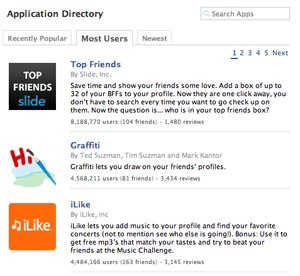
    The advertising prospects aren’t so clear. First, advertising is restricted to canvas pages only. That means you can’t advertise directly on people’s profiles, which is where most impressions are happening for most apps. Many of the really popular apps, e.g., Top Friends, aren’t much more than a profile box.

    Second, Facebook’s TOS explicitly forbid the storage of user data outside of Facebook. I cannot, for example, keep a record of a person’s favorite books, though I have access to it. I can re-request it each time a person views a certain page, but this increases the technical complexity.

    Third, Facebook severely limits the means by which one can include external resources, even in canvas pages. Javascript can’t exist outside of an iframe, which immediately negates all the contextual possibilities for something like AdSense if you take into account the second point.

    Right now I think the best ad strategy people have is finding partners whose existing products align with the app, e.g., an app about travel partnering with Travelocity, or an app about mobile services partnering with a mobile service provider.

    Jesse
    http://appaholic.com

  • Nic,

    I’ll just amend my last comment to say that I agree with you that there’s a huge potential for targeted advertising here with a much larger-than-usual CPM. I wouldn’t be surprised if Facebook itself had model’s of people’s behavior, e.g., who the influencers are in a group of friends, what cars you’re likely to buy, etc.

    Still, this data is largely unavailable to app developers in any real way.

    Jesse
    http://appaholic.com

Leave Comment

Commenting Options

Enter your personal information to the left, or sign in with your Facebook account by clicking the button below.

Alternatively, you can create an avatar that will appear whenever you leave a comment on a Gravatar-enabled blog.

Trackback URL
bugbugbugbug
Techcrunch on Facebook