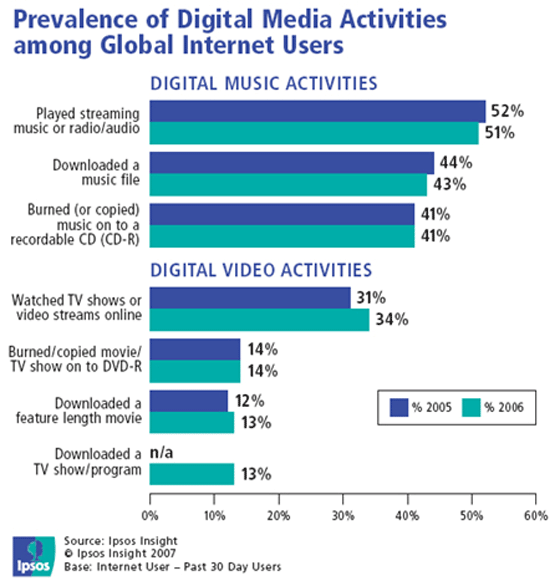
A new data release from The Face of the Web, Ipsos Insight’s annual study of Internet and Technology trends, shows (probably quite obviously) an increasing use of video and social networking sites.
According to Ipsos, the evolution of Internet users’ digital media and online habits appears to be transitioning “to the digital video age”. At the end of 2006, online video activities had taken over from audio as the fastest growing sector in digital media.
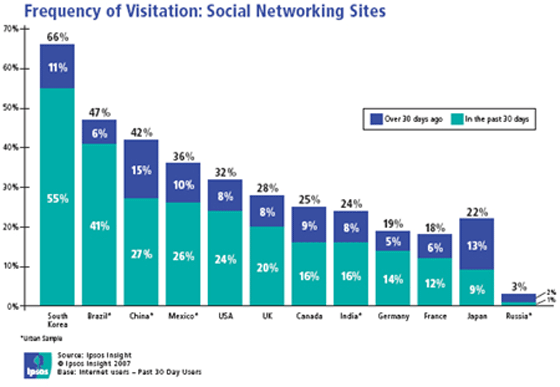
Thes study found that one in five adults worlwide had visited a social networking website. South Korea was the leading social networking market with two thirds of all adults having visited at least one social networking site. In comparison, only 32% of Americans had ever visited a social networking website.
Full details of the data release are available here. Access to the full report is $24,500.


Doesn’t surprise me in the least. Having been part of the evolution of digital music for the past 7+ years, it is a sad to see the RIAA still poaching from online user habits. There needs to be a referendum on streaming radio licensing, plain and simple. Otherwise, be prepared to see a vast decline in terms of streaming audio in the coming quarters.
I realized the other day that I no longer even have my cable box directly connected to my projector. If there’s something I really want on TV I can grab it out of Firewire, but sitting down for a scheduled program is going to be reserved for pretty much Super Bowl only anymore.
I have a copy of the report and sell it for half of the price – $12.250 – contact me from pirate@gmail.com
Sorry I was too bored.
So, based on these charts, 42% of the Chinas population is online. Meaning there are over 420,000,000 Chinese people that have visited a social network recently.
Doesnt that number seem a bit high? Isnt most of the Chinese population still without computers stuck in poverty land?
Facebook is an English-language social networking website. It was originally developed for college and university students but has since been made available to anyone with an email address. People may then select to join one or more participating networks, such as a high school, place of employment, or geographic region.
The founder Mark Zuckerberg in an exclusive interview says, ë°’ did not want to be left out, sitting on the sidelines watching while so many others like Larry Page and Sergei Brin made incredibly huge amounts of money on the Internet. People are flocking to it in droves. I knew that if I started a site and put in basic software that allows for a free flow of information that is personal and private then I would make a fortune from scratch with the speed of rabbits breeding and multiplying. I am just a little nerd. I get bored easily with hard work. I worked for a week to create Facebook. I put in basic code. I feel sorry for the dimwits in the old economy who have to work for more than 10 lllong years for a few grand at the end of each month.
ë° y goal is to not have a job and enjoy luxuriating in five star hotels, eat gourmet meals, sleep for nine hours at night and three hours in the afternoon, watch four films a week without working to pay the bills. The day I launched Facebook was the day I hit the lottery. I will not to worry about holding down a job and upgrading my skills so that I can make a few more grand at the end of each month. That is so old school. At Harvard I read news story after news story of dot-com millionaires made overnight. I read once that some dimwits who started their own e-commerce Internet Website two years ago sold it to Barnes & Noble, for 664 million dollars. In the old economy you have to slog the whole month for a few lousy grand.
ë°«he great thing about the net is that though I was totally confused by the Internet, even though I had no time to learn computer stuff, even though I am too lazy to master a whole new set of computer-related skills none of that matters. In fact I realised at Harvard that I did not need special education…… virtually no money put at risk. All I had to was to spare time and the willingness to follow very easy-to-understand instructions. So simple even a 10 year old could do it.
ë°«he Internet is The Lazy Manë© Way to getting rich. Ië¢ not kidding about that either. The first thing that is important is not to have ethics. That is why I breached security ay Harvard and violated copyrights and privacy. I had hacked into House websites to harvest images of students without their permission and made money with it. In 2004 I made Facebook, took a leave of absence from the college, and a year later dropped out.
ë°«hereë© one BIG thing you need to be successful online and thatë© getting the basics down. Face it. You just have to start a site and put in junk software that allows moronic teenagers to share photos, pictures. I spent a few hours each week writing basic code. I often refer to myself as a lazy Internet entrepreneur because I know that there are many things I could be doing to further improve Facebook but often prefer not to. My problem is that I can always find something better to be doing than working like sleeping for three hours in the afternoon. I will now become a billionaire even though I can’t even be bothered to spend a few hours learning how to do some of the most basic tasks. I want at least three billion dollars personally from the deal. I was very upset that Yahoo only offered one billion. Peter Thiel told me that it is worth at least eight billion.
ë°’ must say that thoughts of a hedonistic lifestyle are going to my brain. Facebook is out of control as I am becoming a megalomaniac. The site that was once used to innocently keep in touch with friends has now become a monster that allows and encourages ?random people to stalk innocent victims. As per my vision it simply wasnëª enough that friends and fellow students at your college could see profiles and message the person. The past year has brought new features that allow users to add pictures, tag pictures, set a ë±’tatus?so the whole world and grandpa knows what my visitors are doing and write notes or import an existing blog. And they say celebrities donëª have any privacy. Ha!
ë°Šace it. The user base makes it worth $8 billion. The ad revenue makes it worth whatever it’s worth. The demographics of the user base how much advertisers can be charged. Isn’t it annoying that idiots like me become billionaires??/font>
“I was lazy I didnëª even graduate from college like Bill Gates. I stumbled upon a technology like a hyperactive kid that took advantage of peopleë© inherent insecurities. This is only the fastest growing of the three internet models. Once you understand that people are lazy, desperate for information and insecure, you too may be able to become insanely wealthy at a young age.
“Another secret. The most promising area of Internet expansion is that which assuages peopleë© insecurities. People are lonely. The rapidly growing $2.5 billion Internet pornography industry knows this all too well. People want to feel in control of their lives, image and future. Most importantly, people want to feel connected, loved and popular. Only recently have companies such as Facebook been able to so successfully tap into peopleë© insecurities.
“The average Facebook user checks the site six times a day. Why are college students so addicted to it? This because Facebook is more than a rolodex with photos. It provides an exact measure of our stature, popularity and coolness. It allows us to place ourselves in a pseudo-fictional world like Hollywood films like Inland Empire, Notes On A Scandal, Grindhouse, Shooter, Crash, Brokeback Mountasin, A History Of Violence where everyone we know is pigeon-holed into friend or non-friend. We never have to worry about our looks because with enough Photoshopping we can present ourselves exactly how we want to be perceived. Moreover, everyone on the Facebook is at the center of a massive web of friends. Unsure? Click ë°®isualise my friends?and it will even draw you a map.
“Appealing to human insecurities is an easier way to make money than writing search engines or actually selling real products in a Mcjob in the old economy. That is so old school. I know 40 year olds in the old economy with Mcjobs. They can make a few extra thousand bucks each month by cleaning their offices after work. Their salaries are so poor they have to claim benefits to make ends meet. Facebook is neither technologically innovative nor expensive to design. I just followed instructions that were so simple even a 10 year old with Autism could have done it.
“For those budding hi-tech entrepreneurs who want to hit the jackpot without working which is what I have done my advice is this: remember that people are lazy, information starved and insecure like my embarrassing uncle Terry Semel. Best of luck!”
I have to say: whoever the guy is that posts these phony rants is actually right on the money about almost everything except the “five hours a day” he always throws in. Even if your site is basic, once you get 17 million users it requires a team of droids working 24/7 just to keep the thing running.
not very informative, but i doubt anyone would pay that much to get the real info……
What is the determination of Streamed music vs downloading music?
Does that just mean listening to music “in-browser” rather than seperate from the computer (ipod, etc.) Or is it specific to Real, Win, Flash streaming formats versus Mp3 format?
-JS
Social networking stuff is like saying “build it and they will come”.
Once a site gets online, there will be people who go on it, and then it builds on itself.
It is no suprise that people are willing to spend so much time on these things.
Video is definitely the way to go. I use video email, live web-broadcasting, store music, videos, & photos all on one collaboration suite. This is where the digital life is going!
Check out live video samples on my website at http://www.getvme.com!
I’m definitely a fan of video. It’s a great breakthrough that with the increased speed of internet, we’re no longer the victims of TV schedules!
I want to make a few statemants about the web video phenom.
I truely beleive that video is going to be the the main staple of the web, but only for those who actualy have systems powerful enough to recieve a clear transmition from those who are actualy satreaming the video feeds.
One problem that I have with this is that that average web surfer, at least in the USA, is still connecting to the web with systems that are at least, 3 to 7 years old with opperating systems that are just as old, like Windows 2000, and are only capable of running with a maximum 128 mb of RAM.
Along with the fact that they are also using a dailup connection, this makes for a very frustrating experience when it comes to viewing any type of streaming video.
So what it comes down to is, that untill the technology catches up, as it always does, with the average users capability, to satifactorally use the technology, then and only then will we see a major flow in the general usage of the new web video technology.
Now on the other hand, I myself am using this latest video technology on my web sites in order to successfully increase my visitor stats.
And I have been careful to insure, that my videos are constantly accessable, by even the slowest of systems that are bieng used to access the web .
But still sadly to say, because of the compression ratios, that are required, in order for the users with slower systems and ISP connections to be able to satifactualy view my online videos, I have had to sacrifice some of the video motion quality.
But this is a neccessary proccess in order to have a smooth and consistant viewable vidoe stream, without the usual buffering, halting and stuttering choppiness that you see when you try to view the average online video stream.
Even though this does require larger video files, this problem is easily overcome by having a larger webhost server capacity of at least 100 GigaBytes and no bandwith restrictions.
For now it’s kind of a catch 22 for web video, because you either get high quality video that only those with high end, state-of-the-art systems can view, or you sacrifice some of the motion quality and get video that anyone connecting to the web can consistantly view and appreciate.
Now there is one thing that makes the difference, and that is, in todays world, most people would rather watch the vidoe of a good story instead of reading the the book about the same story, even though they both turn out the same way!
Because of this one reason alone, web video is the way of the future on the world wide web.
And if anyone has plans of doing business on the internet, they will be left behind if they do not intergrate video into thier websites ASAP.
Well, thats my oppion and untill the real breakthrough for even better video compression happens, I’m stiking to it.