
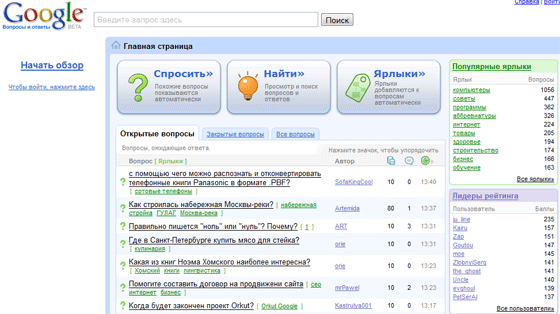
Google Answers, famously shut down by Google in November 2006 after losing the Q&A war to Yahoo, has risen from the dead in Russia.
Google Questions and Answers (Вопросы и ответы in Russian) allows users to ask a “difficult question that is interesting” and receive an answer from other users. Users earn points based on the quality of answers given and can gradually become an expert in a particular field. According to Alex Moskalyuk every new user starts off with 100 points, and can spend those points asking a question. The cost of the question can be 10, 20, 30, 50, 80 or 100 points. Logging in daily earns a user 5 points, every answer to a question is worth 2 points, and rating a specific answer if worth 1 point. The best answer gets all the points paid by the user who asked that question, providing motivation for answering higher-priced questions first. Whether these points can be purchased or redeemed for cash or something else of value was not clear from the translated version of the site or the post announcing the service on Google’s Russia Blog.
The Google Russian team notes that they are particularly pleased to announce that Russia is the first country “where we are launching this service”, a sure sign that Google is planning on rolling out the new Google Answers to other countries, possibly worldwide in the future.
Google Answers was an innovator in the online Q&A market and yet its model of paid experts answering questions failed dismally against free and open competitors including Answers.com and Yahoo Answers. The new Google Answers will still face that same competition today. Google must have something planned for the service to help it compete this time around; it’s not clear from the Russian version what secret recipe Google has planned but it surely wouldn’t make the same mistakes twice. Yahoo has nothing to fear quite yet, but it does look like the Q&A space may well get interesting again in the near future.


I dont seem to understand 1 thing …… It has beeen hardly 10 – 15 years the WEB has been commenly used by the People – but now inself I see all that is possible implimented via. WEB ( u shouldnt forget even concepts like Mizpee
) has been released ….. so looking forward there are still hundred’s of years to com and Generations to pass by ….. what will de WEb look like then ????? ….. already all ideas are drained out and implimented …. very hard to search for new ideas now in self ( even when the web is just a baby )
Это очень хорошо сделано. Это полезно и будет намного больше так на других языках. Вообразите, сколько знания находится там в мире, если только каждый имел шанс задать вопрос так, чтобы независимо от языка это могло быть понято и отвечено. Это – только начало к большим вещам. Возможно это – новая башня лепета?
Это позволит больший склад знания для мира. Возможный больше проблем решено в течение более короткого времени. Вероятно больше продвижения науки и медицины однажды языковые удаленные барьеры.
Yeah it does seem like the well is tapped out. And even if you do come up with something groundbreaking, the big boys will copy you and drive you out of business. Or if they fail they’ll buy you off and get even more users to drive the next guy out of business.
As far as the future I think we’ll see the following:
Next year
1-movement of OS apps onto the web.(can be seen in the latest Word and Powerpoint products)
2-more cell phone support, sites that will provide users with information and games etc
3-more social networking/videos etc
In 2-3 years when there is faster broadband:
1-interactive TV(no I don’t mean the crap that Joost etc is coming out with), I mean a direct stream of actual TV content in real time, in good quality over the high speed internet. And of course a number of supporting apps that will work like Tivo
2-more merging of household objects/cars with the internet. (iKitchen etc)
3-online Cinema theaters
The stuff longer than that will depend on a technological/adaption breakthrough
1-Virtual Reality: using the data in the dna code, create a program, that will let you feel virtual reality w/o feeling the suit/helmet on you. (We have the technology to make visualization happen, but the helmet/suit is too uncomfortable to use and seems like it takes away from experience). Something along the lines of figuring out which impulses control what, and sending those to the person. This will in turn move all the business to the Virtual reality, and there will be an adaption of current websites to Virtual Reality spots
2-New browser/browser support applications, applications that will give a new way to visualize information(a more fancier and much more evolved flash type program that is easy to use)
3- who knows
Yes I know the last part is a little bit science fictionally, but with the current technology I think we’ll see something like that in our life time. (Well I know I will, I don’t know about you old farts
)
rob tut ne vse goveryat po ruski
@Andrew – sorry I had posted in both languages, but must have cut off the English.
First, I did want to say I agree with your points, in particular true interactive TV (ideally TNG holodeck would be cool). The biggest hurdles in communication right now seem to be the medium, the language, and overload. The Google Answers, while not perfect could be combined with their language/web page translations they have now and do a transparent meld of questions – so sender and receiver anywhere in the world could communicate in their native language – transparent to one another. Per my comment about Babble. Here is the English version of what I attempted to say in Russian.
“This is very well done. It is useful and will be much more so in other languages. Imagine how much knowledge is out there in the world, if only everyone had a chance to ask a question so that regardless of language it could be understood and answered. This is just the beginning to bigger things. Perhaps it is the new tower of babble?
What they are making will allow a greater knowledge repository for the world to share. Maybe more problems can be solved in a shorter time. Maybe more advances in science and medicine once language barriers are removed.”
There will always be an overwhelming desire for people to ask and answer. So its no surprise that Google Answers survived in some form or another, Russian or otherwise.
Here’s another example of Q&A site called AskSolvers. It’s a bit more free-for-all in format http://asksolve...viewasks/?go=92 and http://asksolve...viewasks/?go=79 .
Cheers!
Michael
There will always be an overwhelming desire for people to ask and answer. So its no surprise that Google Answers survived in some form or another, Russian or otherwise.
Here’s another example of Q&A site called AskSolvers. It’s a bit more free-for-all in format http://asksolve...viewasks/?go=92
hehe, @Rob, maybe its a pun.. babble, or babel ?
Is there another pay-for-answers service like the old Google Answers? For real problems that can be solved with web research but for which many people often times lack the time, Yahoo Clever is not good. Too much community-oriented with stupid or fun questions.
I really like the Q&A web service idea. It allows to get answer on any question promptly and the answer quality is good usually. But I think they should move further – namely combine the Q&A concept with some other service(s). This would significantly increase the overall worth of the service.
As an example I would suggest combination with some remote desktop access service like Techinline Remote Desktop or similar. So, when users encounter a PC-related problem they could get quality help.
michael, i mentioned last summer in another blog comment run that google is going to be relaunching “google answers” for enterprises within a year or so…my timing is a little off, but i expect to see this still within a year…this russian iteration only confirms my belief that they still have faith in this human utility…
Oh please. The Web isn’t tapped out of ideas or opportunity, it’s that the majority of companies launched aren’t playing into the bigger picture. Instead of creating things for what’s next, people are still focused on what’s now – or worse, what was (which lots seem to keep continuing to do). Each time I hear about another social network site launched, I cringe. I think it’s foolish.
I think it’s very interesting that Google would roll something out in a specific country. I don’t recall hearing many companies do this – in fact, the majority seem oblivious to the fact that we’re in a true global marketplace and that most sites (including my social media company StyleDiary) have a large number of users outside of the U.S. Tons of markets are booming in tech (Israel, India, Russia) but you don’t see much talk about people playing into it. I don’t know that this is what prompted Google to roll something out in a specific country, but it’s a relief to see somebody noticing another market besides the U.S.
Is it me or are they copying Yahoo’s model
– if Yahoo copies Google, we here about it sooo much –
– if Google copies Yahoo; not a hint – of the stinch
– Although I would rather be a – Google expert – than a Yahoo;
-RB
In Soviet Russia, the answers question you!!
Anatoly: you beat me to saying that.
Anybody know what vodka is recommended most by users of this service?
But Why Russia? Why is it not China they have a more bigger auditory. I think Google has a big plan of invasion, from the side, which is unexpected by competitors.
Pssst…
Former Google Answers Researchers (and their customary stellar service) are available here:
http://uclue.com