The Long Tail Is Getting Fatter
by Duncan Riley on June 15, 2007

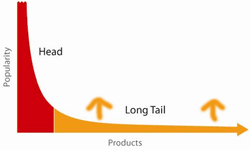
longtail.pngThree separate news stories involving numbers this week caught my eye. iLike announced it has now has 6 million registered users and is now adding 300,000 new users a day. Apple’s Safari browser for Windows has now had 1 million downloads. Finally SpaceTime, a 3D browser we reviewed June 5 passed the 100,000 download mark.

All three may not seem obviously related, but there is something they all share: large user numbers.

It wasn’t that long ago that 100,000 users was considered huge for a Web 2.0 related business. Today a small startup such as SpaceTime can gain those numbers in two weeks. 6 million users three years ago would have seemed an impossible dream, and yet iLike joins a long and growing list of Web 2.0 sites with 1 million or more users. Web 2.0 offerings are improving their appeal to a broader audience which in turn is driving growth in the overall market: the Long Tail is getter fatter.

Although this fattening of the Web 2.0 marketplace makes it more difficult to stand out from the crowd, the marginal cost and ROI potential has now improved. Consider the SpaceTime browser. Immediately many would question the need for an alternative browser, yet this isn’t an all or nothing proposition. Every single user of SpaceTime presents a ROI for the company due to search deals. An average SpaceTime user might return $5 per month to the company by clicking on Google ads or surfing eBay; $500,000 per month @ 100,000 users. The figure could be lower or higher, but it’s still a return. Safari will be operating on a similar model for Apple. The need to find appeal has actually decreased as a percentage of the overall market. Conversely the bar to creating a sustainable business hasn’t risen in line with the number of potential users, today startups can achieve with a smaller percentage of the overall market.

From a developers or startups view, the fattening long tail should be seen for what it is: a marketplace that has improved opportunities for smart startups. A bigger marketplace makes today and tomorrow an even better time to build a Web 2.0 business than yesterday. A fatter long tail means that as a whole there will be an increasing number of success stories and sustainable startups, a win-win all round.

Comments

yes, the long tail is getting fatter…so is the short tail and everything else in between - all proportionate growth for the most part


don’t confuse “registrants” and “downloaders” with “users”.

tell me how many downloaders of safari were using it even fifteen minutes after sampling a few pages with it.

were most services out there following some policy of killing inactive accounts after 90 days, most of the user stats you see in use would be gutted.


People who survived the dotcom crash waited it out until the war was quite underway and then went to B-school. There’s a wave of fresh MBAs out there.


I just had to share this

In a blog post Marc Andreessen (the inventer of the web browser Mosaic and one of the founders of Netscape)

“But my back of the envelope calculation is that it is about 10x cheaper to start an Internet business today than it was in the late 90’s — due to commodity hardware, open source software, modern programming technologies, cheap bandwidth, the rise of third-party ad networks, and other infrastructure factors.

And the market size for a new Internet business today is about 10x bigger than it was in the late 90’s — there are about 10x more people online (really!), and they are far more used to doing things on the Internet today than they were in 1999.”

If you want to read the full post it can be found here.

http://blog.pmarca.com/2007/06....._the_.html

Yes, this definitely are good times for Internet based businesses.


i like the use of three separate services/products to tie the central idea together, great post Duncan.

would be interesting to see if the statshold true on some earlier web 2.0 sites like del.ic.io.us, this blog, and cafemom for instance.


..the long tail is getting fatter but time will tell if cpc rates will still be as lucrative –or diminish in value, as new formed web 2.0 ventures compete for the same eyeballs..


If that’s true on a serious scale, then it could be bad news for businesses like Mahalo that leverage the head.


Last time I checked with my bank I couldn’t deposit unique visitors, page views, downloads, nor members.


unfortunately samir, your utopian calculation quote is upset by the 1000x number of pikers looking to cash in on it all


whoopee: exactly. I’m amazed at how many people implicitly believe every usage statistic publicized by a startup. If you look at some of these numbers with skepticism and do a little research, it becomes apparent that many of the startups are publicizing numbers which appear to be inaccurate at best and outright lies at worst. As an example, I recently saw a press release from a social network I had never heard of (Alexa ranking over a million) that claimed a certain number of people were registering each week. I decided to sign up and check it out. The browse/search functionality on the site revealed that the total number of registered users was lower than the amount the company claimed were registering every single week!

Outright deception aside, the concept of a “user” is not well-defined. SpaceTime might have recieved 100,000 “downloads” in a matter of weeks, but how many of them are actually using the service on a regular basis post-download?

“An average SpaceTime user might return $5 per month to the company by clicking on Google ads or surfing eBay; $500,000 per month @ 100,000 users.”

Is this for real? Is this the type of unsophisticated thinking that drives investment in Web 2.0 companies? I think it’s hard to argue that every single “download” has resulted in an active user and I seriously doubt that of the users who are active, $5/month monetization has been achieved. If Facebook, for instance, was acheiving that type of monetization, with 20+ million claimed active users, they’d be making $100 million each MONTH(actual ANNUAL revenues are reported to be in the $100 - $150 million range - a big difference). Clearly Facebook and SpaceTime can’t be compared on an apples to apples basis, but I’d argue that Facebook has the potential to be a better platform for monetization so I doubt that SpaceTime’s average active user is generating anywhere near $5/month for the company.

Needless to say, I think many of the numbers floating around out there are exaggerated by startups hoping to get bought out or raise big VC rounds, and even of the startups that do have a decent audience, it’s not clear with most of them that the audience can successfully be leveraged to build a viable business. If you have a service with 2 million users but your revenues are less than a successful small business, the question has to be asked: why the hype and investment? I’d rather invest in a company honest about having a smaller active user base but solid monetization than a company who can’t make money that pumps out numbers that don’t stand up to scrutiny.


I agree with whoopee and Drama 2.0. Somehow I don’t believe that the number of “downloaders” or “registrants” translate to “users” of a system. I myself have registered at many sites to get an idea or test drive. After that I never re-visit the site again. Would that count me as a user?


I take the negatives on board, but for me it’s a numbers game, sure registrations don’t equal users, Second Life is a classic example (6m v <400k) however the more the merrier and there is a growing pool of potential users now. The days of first adopters have passed and have been replaced by a full market, and if you think no further than your supermarket shelf you’ll know that larger numbers result in more sustainable choices. Also I’d note I didn’t say everyone would survive, they won’t and I see stupid startups regularly, but the fuller market will allow more startups to build an audience and succeed.


Another quibble is with the idea that people are seeing ads. The sort of people who download Safari or 3D browsers or whatever are in the main clued up and are running things like ad blockers. I almost ever see an ad on any website and I certainly have never clicked on any of the ones that do slip through the filters.


Are registrations the 2007 version of hits 1995? I remember thousands of sites screaming at me about how many hits they had. Today we hear screaming of how many registrations sites have.

But a registration to me is worthless. Just look at the numbers Mike seems to mention before about Digg and their 10 mil and his 10 accounts. I bet the new Netscape is a great example - how many registered for it when it started and how many are using it now.

Just like in 1995, you have agencies in many cases that want to make sure they hype the best numbers. I fought tooth and nail back then that hits were worthless, looks like the new fight is about registrations.

If we as journalists, bloggers, writers, whatever you want to call the group, push these BS numbers, then we are continuing the madness. InteractionMetrics are what matter.


you shuold make an analysis of the number of startups too, i would say for every successufl startup like spacetime, there are hundreds wannabees out there.


Number trivia: Adobe Flash Player continues to see over five million completed installations each day.
http://www.adobe.com/products/.....ashplayer/

(Apple’s download stats have traditionally been for initial download requests, rather than completed downloads, or successful installations.)

jd/adobe


Dear jd/adobe,

Flash completed downloads. How many of them are new and how many of them are upgardes from older versions?

The whole point is, one can not make 500,000 downloads look like a million by fudging. The number should be correct approximately.


Lawrence do you have data to support this?

“yes, the long tail is getting fatter…so is the short tail and everything else in between - all proportionate growth for the most part”


“Flash completed downloads. How many of them are new and how many of them are upgardes from older versions?”

Indeterminate… we don’t know. Most should be updates, rather than virgin machines, because few computers don’t have any Adobe Flash Player installed.

(The first use of a newly-installed Player sends a confirmation ping back, but that’s the only information we have. More than five million completed installations per day, every day.)

jd/adobe


If you assume out of 1 million downloads 10% converted to full time users you get 100k, if out of that number 10% converted to a click or a search on an ad you might get $5 per month, that’s 50k. If they got really lucky.

The reality of course is that people don’t convert at 10% they generally convert at 1% or less, so 1% of 1% of the customers is $5k USD per month.

Doesn’t Firefox use the search revenue model and they made around $15m for the year ? And of course most people that use these browsers indeed have ad blindness or a blocker in place.


THe tail is not getting fatter, it’s just that these businesses are in the fatter, left-hand side of the tail… they have become mainstream


Well, I think Duncan summarized it very well in his comment. The claims of huge multipliers are definitely erring towards exaggeration, however there is a strong underlying truth to the realism of a healthy and maturing market, with much less of euphoria. Needless to cite several socio-economic indicators that we observe in our day to day life.


Duncan, I agree with the conclusion (it feels right) but I think your examples are poorly chosen.

iLike is not a long-tail buisness. It’s a music website whose growth is being propelled by facebook. Since when was music not mainstream? Whilst iLike is “new” it’s not in a a true long-tail market. Much more ‘medium-tail’ with huge uptake thanks to it’s mainstream link.

SpaceTime has had a lot of downloads, but that’s becuase it has a techcruch preview and as readers, we’re all early adopting, download tarts. We love to try everything techcrunch throws at us. It is our interest in techcrunch and all around it that creates the download - not our desire (in this case) for 3D web experience. I bet less than 10% of the 100k downloads you mentioned got used for more than 30 minutes.

So you can’t use these two to draw your conclusion (appealing as it is). Thankfully the conclusion does still stands because antique pen and labrador lovers websites (which are long-tail) show the effect you describe. Just not as much, yet.


Makes sense, though the article is a little weak on specifics - distribution network controlled channels of media consumption always made the the “long tail” hypothesis a “duh yeah” kind of scenario. The Internet-based distribution kills the long tail - you no longer have to pick out of 490 crappy programs, 5 OK ones, 4 decent and 1 really good at any time anymore, there is some gal out there producing exactly what you need at 4 AM in the morning - so yeah, that would trucate the fat head, and guess what, that does fatten the long tail. What would be really useful is for someone to actually quantify what the limit on this fattening tail might be (or correspondingly the limit on the trucation of the fat head).


The number of increasing people is also from new emerging countries (india, china…) where the amount per user is low. So there is not a symetric increase from user and turn over. Fatter but not fatty.


Lots of arguement on a / speculative / theory / - RB


Will someone post a screen shot of their revenues from a web 2.0 site? And lets not show Facebook or My Space as an example.

What if you haven;t been profiled by Tech Crunch or some other popular blog? How much are your revenues?

Until I see proof, users mean nothing, monetization is all that counts, I can’t find any real academic study to show web 2.0 is a cash generator.


Duncan while I agree on the numbers game and how with enough numbers you will make money.

However I am not sure the long tail is in fact getting fatter, it might be a better to describe it as the tail is getting longer. As the marketplace gets bigger the tail get longer.

Just a thought.


Leave a Reply

Create a Gravatar for your comments.
« Back to text comment