
Revver Founder Launches Thoof: Personalized News Service
by Michael Arrington on June 15, 2007

The web is littered with failed or stagnant personalized news startups. New startup Thoof is going to give it a whirl and see if they can do better than the ones that have tried it before.

The idea around personalized news: instead of showing stuff based on what an editor chooses (like this blog, or the Washington Post) or via some sort of community action (Digg, reddit), a user will see news items that the service thinks you will like, based on your past behavior compared to the community at large.

Services that we’ve covered that have entered this space in one way or another include Searchfox (deadpool, assets acquired by Yahoo), Findory (deadpool), Spotback (change in strategy) and Feeds 2.0 (no idea what their status is, site is live).

I have my own reasons for explaining why, so far, these sites haven’t succeeded. I think people usually want to read news and then discuss it with friends. So what is considered “interesting” is influenced by what everyone else is consuming that day. People flock to the big news sites because everyone else flocks there, too, and the niche audiences that really want personalized news aren’t enough to sustain these startups.

But others disagree, including Thoof founder Ian Clarke. Clarke, formerly a co-founder of video site Revver, thinks the sites that came before Thoof simply didn’t have a good solution, and users were left wanting.

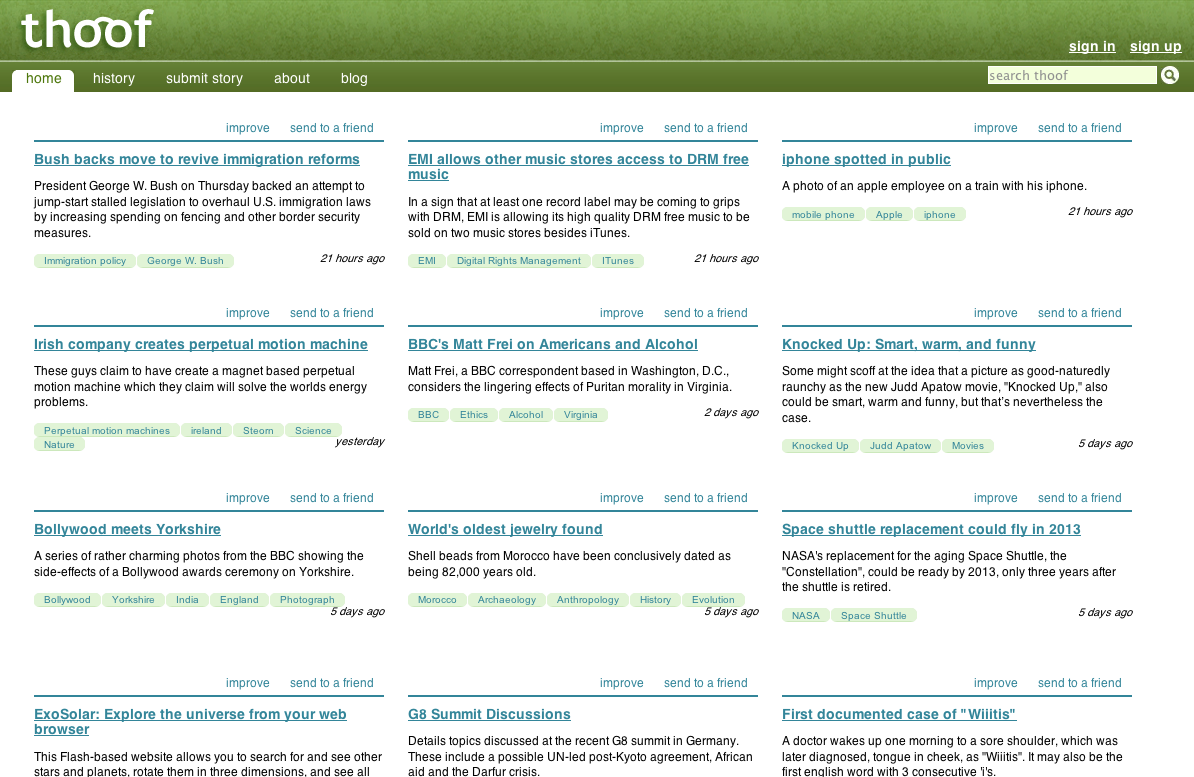
Thoof is all about personalized news, and it learns over time what you want to read. But it’s also part wiki and it has Digg/del.icio.us-like attributes as well.

News is submitted by users in a Digg-like fashion. A link to a news item is submitted, along with a title, description and tags. Other users start to see the news item if Thoof determines they will like it. However, submissions can be easily be edited by other users who think there is something lacking. Any aspect of the news item can be changed, including the link, in a wiki-like fashion (see screen shot above and to left). Other users will see the change and be asked to vote on it. If enough users say yes, the changes stand. Otherwise, it reverts back to the previous submission.

Thoof determines what you like based solely on what stories you click on to read. Asking for specific feedback, like voting or rating of stories, is too much to ask of users, Clarke says, noting that only a very small percentage of people who watched videos on Revver ever actually rated them. By analyzing what you tend to click on, Thoof will return results that it thinks you are more likely to click on than others. The result, over time, is a perfectly tailored news page for an individual. See the screen shot below.

So will this work? Clarke argues it will. in an email exchange where we were debating my position (the masses want popular news) v. his (the masses want tailored news), he writes:

Historically, news has been delivered in a one-to-many manner, meaning that lots of people tend to get the same news at the same time, but I think this is more of a bug than a feature. People don’t necessarily *want* to be shown the same stuff that everyone else is seeing, but the limitations of the technology somewhat required that this be the case. They would much rather see things that are specifically tailored to their interests, its just that either that option hasn’t existed, or it has been poorly executed.

The company is based in Austin and has five employees. They’ve raised a $1 million round of financing from Austin Ventures, Ron Conway and others. They launch today by invite only. Like Gmail and Joost, active users can invite a limited number of others…we’re working on getting some invites for readers.
Advertisement

Comments rss icon

  • You know what… I might give this one a try … never really liked the personalized news sites but I think I might give this one a try … if I can get my hands on a Invite that is.

  • While the idea sounds great in theory, I think they are way too late to the game. They simply are not unique enough to make users want to switch away from other news services.

    On the other hand, news sites like this are relatively inexpensive to run since most of their content is not original. If the traffic is there, the site will run itself. So for Ian Clarke, the low startup costs and maintenance might be just what he’s looking for.

  • The business format is very interesting.

    Marcelo

  • The problem with personalized news is not aggregating it–like Thoof and others–it’s generating it. Any personalized news aggregator is ultimately limited by the amount and quality of the news sources that it can scrape/rank/rate. There are only so many ways to slice and dice the available content online.

    On the other hand, Facebook (for example) is a platform for creating and distributing extremely specific, personalized, almost unique news content to a relevant audience.

  • With a name like “Thoof”, how could it fail?

  • Hey that was my idea :) it came to me a month ago. At least, the voting up of meta-descriptions of links (i would do it via comparisons, “is A better than B?”). Although my idea involved pulling all the “top” and “most emailed” and “most recommended” and “most blogged” lists from many big news or semi-news sites, and aggregating them because I basically want to read whatever is hot each day – to feed a cultural zeitgeist addiction. (echo of the point made here that people mostly want to read whatever other people are finding interesting, especially when they are just doing the net equivalent of channel flipping the remote control)..
    the name is stupid though. Couldn’t they have bought a better name with $20k of their $1m?

  • Wee .. hehe I Just got my Invite ;D – Niice

  • The name is a deal-breaker. It may be the worst web 2.0 name yet. These goofy names may work for the technorati but I don’t think they scale. You can’t even say it without sounding like you have a speech impediment.
    The service may be interesting but the branding verges on idiotic. This is where VCs should offer some oversight if the founders are insistent on a silly name for a consumer service like this.

  • Im not a fan of personalised news services, people want the new from the big names.

    (Link: http://www.dischorde.com)
    (Link: http://www.crenk.com)

  • I will seek an invite as well. Interesting concept

  • name sucks, concept uninteresting. these sites fail because most people prefer to just pick up a newspaper or go to a news web site. there aren’t enough news junkies to use these services.

  • Hi Mike,

    I’m Nicholas, the CEO of Feeds 2.0. We are still on private beta mode mainly due to lack of sufficient funding (unfortunately in the Web 2.0 world geography does count!).

    Registration is still open however and we occasionally send invites to new registered users. The latest scenario concerning the future of the service is that there is a strong chance that we’ll get a round of capital during the summer that will allow us to to open the service publicly by the end of August.

    Thanks

  • I respectfully disagree with those criticizing the name — it’s a neat example of onomatopoeia.

    Ever hear the sound a potato canon makes when it launches its projectile? You bet you have, and you loved it. Because it’s a bassy, satisfying
    .
    .
    .

    *THOOF!*

    Connotes speed and impulse. I like that in my news.

  • I do not understand what it is the point of having fake and misleading news. Don’t we have enough around already?

  • “thoof”

    – the sounds the site makes when it hits the deadpool

    – names sucks; could never say “we’ll just Thoof it!”

    – heh; the weakest sauce

  • Google News gives me all the personalization I want. I have a dozen or so personalized news categories that I’ve asked it to track for me and that’s all I want/need in a personalized news site.

    …Dale

  • Sounds like TiVo’s recommendation system.

  • Digg could probably add this as a feature — another tab with personalized news based on all your Diggs or even just your clicks. Maybe a Digg would count as more in the algorithm.

  • Personalize your news in a second with our news search range:

    http://news.fis...hp?q=steve+jobs

  • Hi there from Argentina! :P We are working on this kind of concept from tha last year, a simple explanaiton at http://www.cada...com/cadaminuto/ we are working hard to work in other languages than spanish.
    I think that’s a good approach to the market needs.

  • So it’s kind of like Fark, with a bit more Digg-ishness than Fark, and a desire to be kinda like Yahoo! News or Google News or Newsvine? How could it fail?

  • Nicholas Macias - June 15th, 2007 at 1:11 pm PDT

    The error with this concept is not so much the name but rather the logical conclusion of such a granularly tailored news service — an overly self-reinforcing worldview. DC comes to mind.

    Niche news sources are wonderful — see TechCrunch — but as your primary news routine? I’ll pass, at least.

  • I like this idea. I use Digg a lot, so if I switched over I’d probably use it enough for the personalization to work.

    I like the name.

  • so true, now can i customize to just trading news and publish to my site, if not can i do it some other way? it’s just parked now but coming soon: http://www.Trad...gOnlineFree.Com like the thoof concept look and feel –i’m in a niche!

  • I wish Thoof luck, but wanted to pick up on a specific point:

    >people … want to read news and then discuss it with friends.
    >…what is considered “interesting” is influenced by what everyone
    >else is consuming that day. People flock to the big news sites
    >because everyone else flocks there, too

    We see this happening *a lot* in Me.dium (full disclosure, I work there). In Me.dium you can see where your friends are online, and you can see other “relevant” people and what webpage they are on. So every morning when I open Me.dium I see crowds of people gathered around interesting and relevant news content – mostly, it must be said, on the big news sites. Then I can join those people – i.e. go to the same pages they are on, read what they are reading – and get into discussions with everyone near by (i.e. cross-site chat) concerning the news we are reading.

    Sorry, this is starting to sound like a pitch. It’s not meant to be. I’m just trying to say that everyday I “see” Michael’s hunch about the way we like to read and discuss news – and it’s a very compelling form of social content consumption.

  • Hey all, I’m the CEO of Thoof, I thought I would respond to a few points.

    To those who don’t like the name, I guess all I can say is “sorry”. I think mostly names are defined by the companies that use them, rather than the companies being defined by the names. Consider the impact of “Yahoo!”, “Flickr”, “EBay”, or “Skype” before they became well known companies. I think most people probably viewed them as being rather strange, but now they are part of our language. I think if Thoof is a success, that will define people’s perception of the name, positive or negative.

    To those who like the name, we agree! :-)

    Nicholas Macias is concerned that the personalization algorithm would result in ghettoization of users within a very narrow niche. This is actually a concern that was at the forefront of our minds when designing our targeting algorithm, and we have made sure that the algorithm will be biased towards your interests, but not to the extent that this will occur. We also have the means to monitor and correct for this problem if it does start occurring.

    We actually did some quite aggressive testing of the personalization algorithm, as it is a rather novel approach. Netflix made available the ratings data for their movies, and so we decided to try out a variety of algorithms, including our own, on that.

    To test an algorithm, we would select movies to show to a user using the algorithm, and see what proportion of those movies the user actually liked.

    To begin with we tried a naive approach of randomly selecting movies. In this case, the average user liked 10% of the movies they saw.

    Next we tried a “most popular” approach, taking the most popular movies, and showing them to everyone. Amazingly, the average user only liked 15% of the movies that were deemed globally popular! Bear in mind that this is essentially the story selection algorithm used by today’s biggest user-generated news websites.

    Finally, we tested our algorithm, and were very pleased to find that users liked 40% of the movies it selected. A pretty clear improvement over the other approaches.

    Anyway, thanks again for your feedback.

  • We do similar stuff in the Indian news and blogs aggregation space. We use the names of the sources as well to drive credibility to the news itself.

    Sorry if this sounds like spam.

  • I like the idea. This could a big help in finding new stories when I have nothing to blog about.

  • I’m interested to see if actually recommends stuff in my favor … I’m sending my email to Thoof to get on the “List” ;)

  • Ian (27), thank you for the considerate followup. It does sound like you have a relatively rigourous product design process in place, and that should serve you well. Best wishes.

    I feel I might still miss the serendipity of reading a newspaper. Maybe there’s a feature in “opposition” (though, so much of the world falls into the grey area in the middle).

  • I think you are a shit head, digg is a piece crappy shit as well i really think you a dickhaed

  • The precise reason that news works is that people want a filter.

    “Here’s what will interest you” is a great model. CNN, and Google News by default, offer the most interesting stories that we all can chat about around the “water cooler” wherever that may be.

    News stories connect us. Good news is filtered for a mass audience. And in G-news case, by a mass audience.

    What makes good news? Context, context, context. And context is lost in a user defined filter.

  • I don't get it. - June 15th, 2007 at 6:09 pm PDT

    That user interface cost $1 million dollar to make. You can make wikis in your own. all you have to do is buy PHP server and upload wikis. What’s so hard about that?

    Can anyone tell people why VC would throw money on highly educated people?

  • Wow… this is like the worst startup of the month. Mike, you need to start giving awards for them like Kaplan did. This “Thoof” thing has NO chance whatsoever. Is today a slow news day or something?? This is the best startup to come across your desk today?!

  • no one cares to spend three months training these systems. they will never take off as standalone sites, but perhaps culled from a more populous log corpus like google or yahoo

  • Would love an invite when those role around!

  • How many people here believe WWE is real? - June 15th, 2007 at 8:20 pm PDT

    lol… it’s soo fake…

    http://www.yout...ted&search=

  • Is there any service that I could use that scrapes content from newspaper sites and aggregates it all for me?

  • it is hardly to copy a succesfully model. and there are too many web 2.0, i don’t like the name web 2.0! i think a website helpful to people will be success.

  • I liked the http://linkedfeed.com recommendations engine inside of a news feed aggregator that looks like Netvibes a bit..

    I hope Thoof is a great product, I would like to try it out and see what it can recommend me to read.

    It’s hard work to look through my hundred feeds in Google Reader, and Google News doesn’t seem to make news really personalized the way I would really like it.

  • Mike, you’re dead on: “people usually want to read news and then discuss it with friends. So what is considered “interesting” is influenced by what everyone else is consuming that day.”

    This explains why people decry the media but still follow it– it’s how you participate in society. Over-personalization implies that people want an isolated news experience, when the opposite is true. The philosophy you hit on is actually driving the next development phase at GroundReport.

  • Leonard, We just launched http://www.Keegy.com that integrates content from newspapers, blogs and news sources, reads your location and show the relevant content near you based in tags categorization… The important thing is that an IA Algorithm make all for you. We will launch new user friendly functionalities in the next days… Thank you!

  • The merging/updating concept is interesting in itself, however we will see how good it will be in the real life. I am for voting system and niche “diggs” instead of adaptive algorithms for picking news.

  • Mike … got any invites … i’m interested!

    Darin

Leave Comment

Commenting Options

Enter your personal information to the left, or sign in with your Facebook account by clicking the button below.

Alternatively, you can create an avatar that will appear whenever you leave a comment on a Gravatar-enabled blog.

Trackback URL
bugbugbug