How long will it be until we can stroll through the streets in a virtual world that is identical to our own? Given the state of a number of technologies, not very long. Over the last couple of years we’ve seen Microsoft Street Side and Virtual Earth as well as similar efforts from Google. But different technologies are now being deployed that are even more interesting that the results achieved from large companies taking and processing massive numbers of photos into now-standard 3D views.
Two standouts are Microsoft’s Photosynth Project and newcomer Everyscape, which Brady Forest wrote about today on O’Reilly Radar.
Photosynth
First, Photosynth. The idea is to take many pictures of a given thing or area and combine them into a 3D image. Fly around it, zoom in whatever. The results are jaw-droppingly beautiful - see the demo video above by Blaise Aguera y Arcas from earlier this year. The BBC also just announced a partnership with Microsoft; they’ve launched a new site using Photosynth technology that will show 3D photographic representations of historic sites around the UK (Ely Cathedral, Burghley House, the Royal Crescent, Bath, the Scottish Parliament buildings and Blackpool Tower Ballroom). For now, though, Photosynth only works on Windows machines.
Everyscape
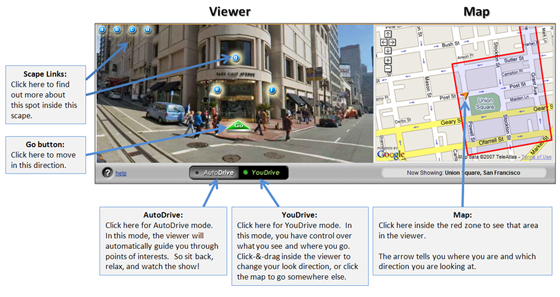
Everyscape is a much simpler product technically but is quite a bit more useful in the near term. They turn regular 2D pictures into 3D images that look like they were taken with special cameras. Viewers can pan around a 3D area, and move from point to point. See the demo on their site to get a feel for it. The video at the top of the post was created by founder Mok Oh and seems to show features that go way beyond the early beta version of the product.
Everyscape launches this Fall, promising ten cities. Users will also be encouraged to submit their own photos to be included in the models.
The company is attacking Google and Microsoft head on in those companies’ efforts to photograph the world and let people meander through it. They may have a chance - there are no special downloads required and they’ll be relying on users to take many or most of the photos used in the service. Whether they make it or not is unclear, but it’s fun to play with these products anyway. Good luck to them.
Fotowoosh is another service we’ve covered with much simpler goals than Photosynth or Everyscape: they just turn a single 2D photo into a 3D image. But the results are very cool.


See all


I loved the video. I like the music. I like the analogy with The Matrix.
This post is very much aligned with the new Rome virtualization tour. Look at here http://youtube.com/watch?v=XA1BSfxGqbQ
Since I am in the ERP business I would like to know when are we going to have there tools to model a company and change parameters.
I have worked in simulations manufacturing shop floor buy the nice tools on graphics are not the best ones I have tried.
Mario Ruiz
http://www.oursheet.com
Very cool stuff indeed.
great post and thanks for covering 3d (other than SL oddities).
Guys peolpe will lose toach with reality and get confused between real and virtual and the problem of Nerds will grow many fold.
@Rajeev - If people are losing their touch with reality as a result of this type of technology, then they were already disconnected with reality.
The companies who would look into this should allow the people to create the world for them like the virtual world Second Life.
@Rajeev: Explain the problem of nerds vs virtual world? I disagree with you. If we take your point, I agree with Smith288, the world would already be disconnected. But it isn’t.
World as is has been connected more with all the net mediums and virtual world will yet be another tool to bring people together. Basically all these are just a form of communications which never existed before the net.
@Rajeev - don’t worry, I thought it was funny.
I loved the demo - absolutely jaw-dropping.
- nice demo / very nice / the whole book /
- reading the paper / wish the live demo was more fun / be nice to be able to read the paper daily or something as a demo instead of a static set of old photos
- still impressive
- fotoswoosh looks good also / but still closed beta
amazing!this is like travelling around the world at home!
This semantic imagary would create an incredible ‘3D Search’ environment. Imagine the Advertising possibilities too? I look forward to playing with it on my 17″ Apple multitouch tablet computer very soon.
Ciao Mike! technical term for above is mirror worlds and answer to your question is 2008
Two of the early things I did with SL was demonstrate downtown redevelopment based on someone else’s scale model of the Dartmouth-area downtown strip, as well as a post-Katrina demonstration of water levels and flooding in a fictional city. Just pixels. Google, has all these pieces–, so being able to do things like real estate, disaster planning, or even fiction writing (go write a futuristic story based on Silicon Valley geography 100 years out), is really exciting, productive AND recreational.
All of this is wrapped up with a couple layers of social media, making all of us able to do this ourselves and with each other. Wacky.
I wonder if eventually you could have a virtual world in which you “virtually” explore the virtual world. Kind of a recursive virtual world! It’s kind of a crazy idea. I’m sure the philosophers would have a lot to say about this.
Cool post. Thanks for bring to our attention all of these up-and-coming virtual world services.
The trick to all this isn’t technology, it’s simply making it easy for the average user to interact and post pictures. Right now, it takes lots of post-production and 3D expertise to create “virtual worlds” of any shape or desire… allowing the average Joe down the street to do this without any knowledge of neither technology will do to “visiting technology” what blogs did to journalism.
Jon
We’re already there! Didn’t you guys see DejaVu??? Crazy stuff going on!
Michael,
Iowa State University has the world’s most realistic virtual reality lab. It is called the C6 and is a six sided room with 100 million pixels. http://www.iastate.edu/~nscent.....date.shtml
Trevor
Three words: Get A Life.
I’ve played with the EveryScape demo and it is NOT 3D. I don’t know why people keep saying it is.
It’s essentially quicktimeVR, a 360 degree 2D image that you can only pan around. Moving from node to node has a nice “warp” effect — a blend of two 2D images — but I’ve seen nothing that indicates it’s 3D. And it’s slightly better than StreetView in terms of resolution, at the expense of density of nodes.
Real 3D information would allow you to move side-to-side to see some actual parallax at each node, or would ideally let you move freely within the environment. If there weren’t enough data-points, that might show up as undefined “gray” areas, but it wouldn’t necessarily limit your view to only a few well marked nodes.
PhotoSynth is a bit closer to real 3D in how it works. But I’m still waiting for them to stitch all of the photos together into a more seamless 3D model. Right now, it’s more of a ‘2D flickr with 3D navigation’ than a true 3D reconstruction.
But people are working on the next level up. I’d give it 5 years to bear fruit. I just haven’t seen anything that can run on a PC in real-time (without heavy pre-processing) yet.
@14. Jon I’d agree that the learning curve can be steep, and yet the man behind the curtain is the console/desktop gaming world.
It’s so easy to forget how ungodly massive the gaming space is; as well as the emergence of more ‘casual’ gaming spaces, and how there’s much much less of a barrier when 3D stuff is phrased in that context.
Microsoft could in theory, win, because they’ve got the killer app already (xbox live). That’s not weird at all.
Google doing it may work web-side, Microsoft might wait, I dunno. I keep hearing rumors about SL/Microsoft XBOX. It’s a neat sneaky way to corner a market with virtual representations of real places a la Virtual Earth Maps Places Live etc.
Don’t ignore the video game biz when talking about this because it is a machine that’s running Right Now.
Amazing how far along virtual computing has come. What’s next?
http://www.whatshottoday.com/i.....Itemid=279
Good !
This all is similar to what is called stereoscopic effect. The superimposition of two images generates the 3D effect.
Prior to seeing this video I thought only Mrs W and the new playboy sim in SL could elicit that kind of reaction from me….
Phwar…!
N E R D S !
Wait till you guys see my video version
Social technology mirrors spiritual enlightenment because soon, everyone is going to get blipd!
check out mtv’s virtual lower east side - alpha just launched yesterday
http://gothamist.com/2007/06/1.....ower_e.php
http://www.3pointd.com/2007061.....ommentlist
Holy crap!!!
Check out Jeff Han’s touch screen innovation. I never seen anything like it. This is innovation hype. It looks like Minority Report the movie.
http://www.ted.com/index.php/talks/view/id/65
you can’t buy it…. U.S government and Military won’t let you buy that touch screen technology…
http://www.ted.com/index.php/talks/view/id/131
I can’t wait to innovate something. I love to do presentation standup someday…
I’ve always thought that 3D Virtual technologies would really help those in search & rescue industry. Firefighters can see where they’re going and what they’re dealing with while on the way to the scene, same with police, swat, and more. Scary technology in the wrong hands, very helpful in the right.
First Chinese city goes into 3D is Dalian. http://dalian.edushi.com/
Nice combination.
photosynth is teh awesome, so is TED.
Reminds me of first chapter of Simulacra and Simulacrum (pre-Matrix of course
“The simulacrum is never that which conceals the truth–it is the truth which conceals that there is none. The simulacrum is true.” -Ecclesiastes
“If we were able to take as the finest allegory of simulation the Borges tale where the cartographers of the Empire draw up a map so detailed that it ends up exactly covering the territory (but where, with the decline of the Empire this map becomes frayed and finally ruined, a few shreds still discernible in the deserts - the metaphysical beauty of this ruined abstraction, bearing witness to an imperial pride and rotting like a carcass, returning to the substance of the soil, rather as an aging double ends up being confused with the real thing), this fable would then have come full circle for us, and now has nothing but the discrete charm of second-order simulacra.l
“Abstraction today is no longer that of the map, the double, the mirror or the concept. Simulation is no longer that of a territory, a referential being or a substance. It is the generation by models of a real without origin or reality: a hyperreal. The territory no longer precedes the map, nor survives it. Henceforth, it is the map that precedes the territory - precession of simulacra - it is the map that engenders the territory and if we were to revive the fable today, it would be the territory whose shreds are slowly rotting across the map. It is the real, and not the map, whose vestiges subsist here and there, in the deserts which are no longer those of the Empire, but our own. The desert of the real itself.
“In fact, even inverted, the fable is useless. Perhaps only the allegory of the Empire remains. For it is with the same imperialism that present-day simulators try to make the real, all the real, coincide with their simulation models. But it is no longer a question of either maps or territory. Something has disappeared: the sovereign difference between them that was the abstraction’s charm. For it is the difference which forms the poetry of the map and the charm of the territory, the magic of the concept and the charm of the real. This representational imaginary, which both culminates in and is engulfed by the cartographer’s mad project of an ideal coextensivity between the map and the territory, disappears with simulation, whose operation is nuclear and genetic, and no longer specular and discursive. With it goes all of metaphysics. No more mirror of being and appearances, of the real and its concept; no more imaginary coextensivity: rather, genetic miniaturization is the dimension of simulation. The real is produced from miniaturized units, from matrices, memory banks and command models - and with these it can be reproduced an indefinite number of times. It no longer has to be rational, since it is no longer measured against some ideal or negative instance. It is nothing more than operational. In fact, since it is no longer enveloped by an imaginary, it is no longer real at all. It is a hyperreal: the product of an irradiating synthesis of combinatory models in a hyperspace without atmosphere.
What would be very cool is that if the “real street view” could be integrated into a car’s GPS navigation system…and I agree with Drew: it would definitely help in search and rescue. The only problem is that there’s a lot of areas that haven’t been photographed yet.
I always trusted in 3D, and I am amased with this technology.
I have worked and found X3D wich is now Newsight 3D plasma screen…
I really believed in real 3D for very soon….
Maybe and then again …. maybe all these companies will be forced to pay a licensing fee for every building shown on their system
http://play.tm/story/10928
The same way cars, stadiums, and other things have to be licensed.
We work on a project quite similar http://www.villevirtuelle.eu . We’ve had already put some belgian cities with the possibility to look inside the shops.
It’s going to be exciting to see where these technologies lead. One thing I’m hoping for is multi-camera capture of sporting events with post processing that allows viewers to fly around the event, pause, slow down, check from another angle etc..
Am I the only one that thinks of “Dizzycity.com”? Long ago - far beyond at the time.
Nomax
Virtual real Worlds are here now see my house “White Croft” virtaully recreated.
See http://www.mellanium.com for details and You Tube for a video of the virtual real world.
http://www.youtube.com/watch?v=BSuFaBKhlko