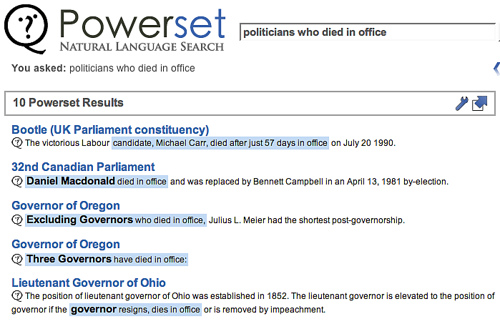
First Public View Of Powerset Results
by Michael Arrington on June 11, 2007

Powerset is being extremely careful about showing the public how their search engine works until they are ready. After some initial hype (see our posts here, here and here), the company pretty much shut its doors to the press. I did finally get in to see a demo, and was impressed. But the meeting was off-record and we are waiting for a green light to start writing more about the demo and other background information.

For those of you unfamiliar with Powerset, it is a new, well funded search engine that aims to allow users to write their queries in natural language. In a blog post in October 2006, CEO Barney Pell wrote out some of the ideas driving the company.

A couple of days ago the company showed a sample query and result on their blog. Normally boring stuff, but a lot of people are dying to get more information on the product. We’ve copied the screen shot above.

The query is “politicians who died in office.” This is a much better query that previous examples like “books by children” v. “books for children.” Those queries can be handled fairly well by Google by simply putting quotes around the query. But for “politicians who died in office” the results on Google won’t be as good. Context is required: Google has only six results for the query in quotes, and without quotes it loses its meaning and the results aren’t useful (notice the Powerset blog is the fourth result). The Powerset results are relevant and useful.

Hand picking a query here and there and showing a screen shot of results isn’t the same as killing Google. But it does show that Powerset has the potential of being extremely useful by attacking search from a different angle. I look forward to their launch.

Advertisement

Comments rss icon

  • good going…..i want a good competitor to Google to bring fast innovation into search space..which has become stagnant….

  • Google links me to politicalgraveyard which has a clean list: http://politica...fices/pdio.html

    Honestly powerset’s results are confusing(why repeat oregon as #3 and #4 result?).

    If I have to train myself of a new way to process search results, I may do it if PowerSet ends up kicking ass but it is just one more hurdle for powerset.

  • Exactly Zaid…

    Google [politicians "died in office"]

  • Michael,
    Personally, I cannot be impressed by a few screen shots. Even if they didn’t hand pick the results, it may only work for a small category of searches; that’s not good enough to compete with Google.
    Truth is that “web search” has many many complicated layers and implementing them all is a huge undertaking for small company. I am not suggesting that it is impposible for Powerset to succeed, but I am simply skeptical!

  • #1
    if powerset’s technology(or even hype) is *any good*, they’ll be surrounded by suitors from MS, YHOO and you bet, GOOG. We know even google probably wouldn’t be the same if Yahoo had acquired it back in ‘01. The next google will need some ballsy founders who pass acquisition offers.

  • Powerset is kinda confusing obviously more complicated then google.

  • I still find it amazing that this company gets so much attention for an unfinished product. It’s not like this is the first company to create a natural language search engine.

  • The fact is that there exist web sites at the other side of Google. Some of them must have valueable answers or products. The key how to discover them.

    The semantical aproach is comming to town: one way (W3C’s Semantic Web) or the other (Powerset). Like.com is nice try visual aproach to searching.

    Mario Ruiz
    http://www.oursheet.com

  • Powerset may not be a useful engine for any of us (i.e., the TC/MyBlogLog crowd), but NLP is the right way to go for the masses. Hence, Powerset might easily grab significant market share.

    I don’t necessarily see Google as the loser in a future battle with Powerset; I see Ask as a clear loser, with Yahoo and Live also losing share to Powerset. Their demographics more closely map to the demographics best served by Powerset. No doubt, either Microsoft or Yahoo will buy them. Maybe Google will buy Powerset, but I see a bidding war between Microsoft and Yahoo, each using Powerset to try to regain share. And unless the numbers from Yahoo were much better than the numbers from Microsoft, I’d go with Microsoft.

    Surface is for the masses; so is Powerset.

  • Power-fully Set for failure.

  • Can Powerset do Cross-Language Search?

    Cross-language Search: What’s it all about?

    The term “cross-language search” is used in many different senses:

    1. Some search engine providers claim to support multilingual or cross-language search if they can handle and index documents written in different languages. They search for the exact appearance of the entered search terms, e.g. “war” finds English documents referring to military actions and it finds German documents containing “war” in the sense of “was” (i.e. a meaningless glue word).

    2. Other search engines (see, e.g., http://www.goog...e_20070523.html) provide a tool for the translation of a query into a selectable other language, and then, the query is submitted with the translated query text. This is certainly a progress and can be useful in some specific situations, e.g. if one is looking for a hairdresser in Paris.

    Shortcomings:
    - If one is looking for “member of the board” and “SAir Group” (Swissair) and searches for German documents, the translated query “Mitglied des Brettes” und “SAir Gruppe” won’t provide any results. If “member of the board” is replaced by “Aufsichtsrat” some documents are found but they do not correspond to the commonly used terms “Verwaltungsrat” or “Verwaltungsräte” in conjunction with the Sair case.
    - For information research and intelligence services the above-mentioned method does not help because it is not able to compare and rank documents written in different languages.

    3. A true cross-language search is possible only if the search engine is able to recognize the thematic content, i.e., if the system realizes that the English translation of a French (or a German etc.) document is equivalent to the original document. This advanced technique is implemented in http://www.infocodex.com. It simultaneously finds documents in all supported languages, without the need for a cumbersome (and arbitrary) translation into each other language. Because of the cross-language content recognition and a well-founded similarity measure, the documents can be ordered by their relevance with respect to the query.

  • great stuff here.

    hope they improve it.

    amazed that none exploited all the traffic coming to that search page yet :P

  • The fifth result doesn’t seem relevant at all (in a contextual way). And as others have pointed out, you can get better results with Google on versions like ‘politician “died in office”‘, although admittedly this isn’t as cute a query.

  • Another example query. One they didn’t show.

    http://www.flic...ext=photostream

  • hi michael,
    do you have any info on their technology? is this done by their staff? or everything is automatic, done by natural language processing algorithms? does it work with other languages than english?

  • can you say “hard coded”

  • Correct me if i’m wrong. I recall a few years ago IBM was working on a similar search engine using natural language as well.

  • Good article, thanks. Did you try the same search on http://www.hakia.com or http://www.lexxe.com?? They have public betas (or alphas?) that are admittedly wip but nonetheless available.

  • I’ve yet to see a powerset example query where google didn’t have the results on the first page. In this example, politicalgraveyard is the first two results on google. I saw a video posted of Barney Pell presenting at UW and googled along side, frankly not compelling.

    I occasionally have trouble finding what I want from google. But in those cases it’s because I can’t articulate what it is that I want. No amount of natural language processing of web content is going to help me there. A real, live librarian couldn’t help me either.

    Maybe they’re holding back the good examples so that people don’t blog about it and instantly improve the google serps for powerset’s favorite queries? I hope so.

  • Yeah this is the 4th post for a company that isnt launched.

    – Seems weak :/

    – Rbowles

  • Seems to be clustering similar resources, in this case, words; tremendous leap-frog potential if implemented via self organizing maps.

  • how telling…the company is careful to put out screen shots to a site like techcrunch which give pr to companies. Oh that stealth strategy makes sense…go to the biggest web 2.0 sites and tell people that here’s a screen shot and that’s it

  • I did that same #2 did…much more useful and I get a complete list. My two search places remain: Google, then Wikipedia. Thanks but no thank Powerset.

  • Does mike hate powerset? - June 11th, 2007 at 8:40 am PDT

    ?

  • Jessica Mah first broke this screenshot, http://jessicam....com/blog/?p=86, give her a link, Mike:P

  • search is no longer a technical problem, it is a marketing problem

  • Google, Yahoo and any search engine can use a synonym table to translate politician to senators, governors, etc. (which they already do), and automatically insert quotes to preposition phrases and verb phrases, and get much much better results on any of the examples powerset has shown.

  • They will have to spend a fortune on advertising. I’m not sure how much Ask paid for their billboards and commercials of girls with swords but they have just a shade over 5% of the market. The TC crowd knows about them and either loves the idea or hates it. The general public though, loves Google and can’t get enough, that’s why they keep gaining in share and everyone else falls. Powerset will be lucky to have 3% in 3 years.

    I seriously can’t imagine anyone saying “Hey, I Powersetted you last night”.

    They better hope they get acquired and soon or else they just wasted a boatload of time and money.

  • So there is a total of 10 results in this result page, presumably extracted from mostly recent content. However, according to politicalgraveyard.com, there were 2620 politicians who died in office…

    I think that for any topic of common interest there will be at least one site/wikipedia page/blog about it. And the problem is to find it. Current web search engines are very good at doing just that. And these results are likely way more accurate than anything PowerSet’s NLP algorithms can generate.

  • What is so impressive about those results? Cognition is much further along than Powerset. They are not afraid to show people that their Meaning-based Linguistic Search works @ http://www.cognitionsearch.com (over 300 years of development, compared to Powerset’s few months… See for yourself!

  • I find it somewhat revealing that out of 5 results shown on the screen capture, two (#3 and #5) are actually irrelevant (according to the excerpt).

    Semantic analysis on the query might help in some cases to improve the search, but I would bet it’s mostly a hit&miss kind of things, and overall I don’t see how it can be so much better than google.

    It doesn’t look like they do any kind of semantic analysis on the results (or else they should have noticed that #3 is actually a negation of the query).

    Also, nobody pointed out that this is an English only thing. I’d be curious to know if their algorithm works as well in other languages.

  • While there isn’t much available to judge PowerSet’s capabilities, the intention is undoubtedly correct. However, there seem to be several people in this comments section who can’t digest this fact. I think the critics consist of people who have been involved with projects that didn’t take off or who have not been able to gather publicity for the same and have now shut themselves to the idea of anyone doing something that Google has not.

  • for that example query, a good search is just ["died in office"]. it’s an idiomatic phrase that’s applied only to politicians, so any occurrence of that phrase is relevant.

  • I guess one could argue that the Political Graveyard site doesn’t list FOREIGN politicians who’ve died in office. If this is the argument by Powerset, then there’s SOME benefit to Powerset because it can tell you about Michael Carr and Bennett somebody from the UK!?!? Actually, it’s more an argument that if Political Graveyard is making any kind of money at all, they ought to invest the profits in a similar site for UK politicians!

    I haven’t seen this much hype since Clusty! Remember Clusty everyone!?!

    Just because Peter Thiel invested in the company, doesn’t mean anything– the guy sold a great business, Paypal, to what amounts to pocket change, simply because Marge threatened him and he caved like a wet lunch bag. Now his claim to fame is that sometimes the cute Asian reporter from Street.com interviews him on the television set.

  • Hmmm…These results are useful. I didn’t think Powerset was gonna be very good, but they might be on to something. Still, I think human search is going to be an essential feature of the future of search.

  • With or without quotes, I get to
    http://www.poli...lgraveyard.com/

    On Google as the first or second result, and that page seems to answer what the question is about — all without the whiz bang technology that is so complicated it has yet to see the light of day.

  • It must be fun. Anyway the market place is almost empty. Though demos put around few specific examples (or even just one) are often not representative. Looking forward for more!

Leave Comment

Commenting Options

Enter your personal information to the left, or sign in with your Facebook account by clicking the button below.

Alternatively, you can create an avatar that will appear whenever you leave a comment on a Gravatar-enabled blog.

Trackback URL
bugbugbugbug
Techcrunch on Facebook