Eyebrows were raised when Seattle-based Jobster shredded their business model and moved to free job listings in February. It was a direct assault on Monster, which charges up to $475 per job listing. Many of the commenters in the post discussing the change said it was the last ditch effort of a troubled company.
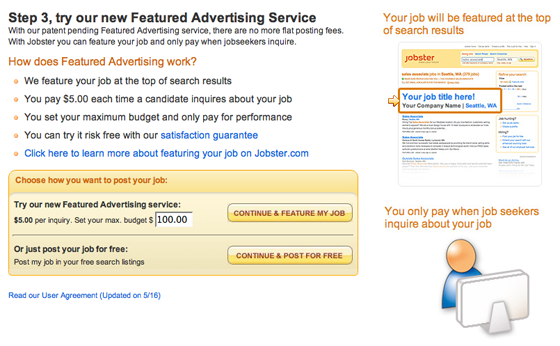
This week Jobster quietly rolled out phase two of the plan, adding pay-per-applicant job listings to the mix. The listings are still free, but companies who agree to pay a per applicant fee are shown on the top of search.
CEO Jason Goldberg says it will be a much more efficient model than anything that exists today. Companies don’t pay anything unless they receive a qualified job applicant. This gives Jobster the incentive to make sure lots of potential employees see their listing.
During a beta period, Jobster is charging $5 per applicant. Later they’ll allow companies to set qualifications, so they will only pay for, say, the application of someone who lives in San Francisco with Ruby on Rails development skills. At that time, they will also be moving to an auction model and let companies compete for those top places on search results pages.
Jobster is also the exclusive Job Listing provider to Facebook (mentioned at the end of this post), although the new Facebook developer platform would also allow other services to add their application. The new job listings will eventually make their way to Facebook, Goldberg says, increasing Jobster’s reach exponentially.


I guess that’s always the trick, isn’t it? Finding a way to monetize your new Web 2.0 widget. This isn’t a bad strategy, companies that run highly successful campaigns will have to pay more for Jobsters service. It seems like the sort of model that should be imitated by others — draw value, charge more for that value.
A great job done by jobster to meet the companies need of having qualified job applicants applying for their vacancies.
“Later they’ll allow companies to set qualifications, so they will only pay for, say, the application of someone who lives in San Francisco with Ruby on Rails development skills.” i think this model could get a little confusingly complex.
ella – it will be tag based (remember jobster acquired Jobby:
http://www.tech...onth-old-jobby/
it will be no more complicated than buying adwords.
Essentially this would be a directory/db of applicants and the openings… so the search model is now applied to the directories also. I have seen this happening at a small scale.
Good luck to Jobster.
Best wishes to Jobster, keep moving!
We are preparing to launch a job widget with a similar pay per applicant model here in Japan.
http://joblet.jp
Our listings ask companies to list their requirements for each applicant, and beyond that we give companies the ability to approve or reject each candidate within seven days.
“The biggest mistake that you can make is to believe that you are working for somebody else. Job security is gone. The driving force of a career must come from the individual. Remember: Jobs are owned by the company, you own your career! “
Facebook?? Nice model if you’re looking for extremely young applicants, I guess, but wow… I’ve lost track of all the wet-behind-the-ears programmers I’ve hired that didn’t work out..
Michael, I love the new “Print Posts” feature…I normally print out your posts before going to bed at night and read them as I fall asleep. Is there any way to get those posts to include comments though? Often times I find the comments almost just as good as the article itself.
@old dude
the average age of facebook users is rising fast
I think an even better move would be to charge job applicants a fee to apply to each job. After all, there are way more job applicants than companies with jobs. The true way to grow revenue is to shift the revenue model from companies to job candidates. I also think this would solve a significant problem in the recruiting world. The worst thing about being a recruiter is opening a job requisition and having 1,000 people…95% of whom don’t have the required skills listed in the job description, apply for the position. If job boards charged say a $25 fee for a candidate to apply for a job, this would naturally filter out those “Job Spammers” who simply apply to 50 jobs and see what sticks. Just my two cents.
You write: “Jobster is also the exclusive Job Listing provider to Facebook.”
Facebook never said that, and it is simply not true. I would challenge anyone at Jobster, Facebook, or Techcrunch to justify the junction of the works “exclusive” and “job listing provider” to Facebook.
What Jobster has said is it provides a “career center” at Facebook (http://biz.yaho...06140.html?.v=1). Indeed, if you will notice, in this press release, the quotes from Facebook don’t even mention Jobster; they just talk about the Facebook API. If you examine the facts, Jobster is just a group and a plugin to Facebook; nothing more, nothing less.
Also, Facebook has its own marketplace for classified ads, which includes job listings.
Get your facts right. Isn’t it time that we all turned up our Jobster bs detectors to 10?
So, the new click fraud, will be people submitting false job applications to their competitors. Interesting model
I wonder if the model will eventually resolve to “qualified” leads to prevent that sort of abuse. heh.
I’m the CEO of Jobster. I thought that it would be good to address a couple of the comments (always dangerous).
Hi John #13.
I can assure you that Jobster does indeed have an exclusive relationship with Facebook.
While the details of our contract are confidential between Jobster and Facebook, I can tell you that none of our competitors can place sponsored career content onto Facebook.
One very powerful example of that which you may not be familiar with — and which I’m happy to share with you and the world — is as follows. Every day, hundreds of thousands of Facebook users receive highly targeted sponsored messages to their homepage via their newsfeed. These messages, powered by Jobster, provide specific types of Facebook users (e.g. certain schools, majors, interests, cities, regions, etc.) with very targeted employment opportunities. Employers can only do this through Jobster. This has proven to be very effective. We enable employers to send branded messages, video messages, etc., right to the users’ homepage.
As Facebook “Marketplace” is still in its early days, these highly targeted messages powered by Jobster to users’ homepages are currently/still the most effective way for employers to reach/target Facebook users. As/if Facebook Marketplace develops into a popular destination though, you can expect that Jobster will enable employers to target sponsored career content there as well. You can also expect to see Jobster sponsoring career content in other unique ways on Facebook.
As to Sean, #14: As Mike notes, pay per applicant is just a start in a broader move we are driving towards a more robust pay per good applicant model. I like to call it CPGA. Cost Per Good Applicant. Or, a more refined CPA model (with A being either Action or Applicant in this case). Anyway, we’re working on this step by step and as I told Mike, it is going to take a while to unfold and develop as we ship, test, ship, test, but we’re headed in what we believe to be a very interesting direction for the broader industry. Pay to post is a fairly “simple” model vs. the more performance based models which have developed in most other advertising categories. We’re really jazzed up about pushing towards more performance based models for recruitment advertising.
Everything is going the way of auctions.
Indeed.com has a similar model in beta.
http://blog.ind...applicant-beta/
JobTarget has been selling resumes like this for 5 years – so have the 700 association career boards we power.
With the Facebook job listings, is there a way we can filter out applicants who spend more than 15 minutes on Facebook each day and/or who have posted drunken photos from frat parties?
Thanks for commenting Jason but my Jobster bs detector is set to 10.
Jason #16:
Go get your friends at Facebook to say something that supports your claim of exclusivity. It must be embarrassing to issue a press release that can’t get a supporting comment from the other party.
Also, as I said, the TechCrunch article which we are discussing says: Jobster is “the exclusive Job Listing provider.”
You say: “an exclusive relationship with Facebook. . . . I can tell you that none of our competitors can place sponsored career content onto Facebook.”
“Sponsored career content” does not equal “exclusive job listing provider.”
“Career content” can mean a lot of things. “Job listing” means: It’s a job. You can apply for it. It’s a well-known commodity. And, as I note, Facebook has its own bit for that in Marketplace, so the claim that Jobster is an exclusive “job listing” provider is simply false.
What you say is flat-out different from what TechCrunch is reporting. Please ask them to correct their facts.
Sillicon Dalley@12,
If you loose your job, are you willing to pay $25 to apply for a job ?
Mike
Show us the price paid for applications, and the specific qualifications paid for!
Pay to play. How bad do you want awesome people working for you?
First of all, all of these discussions about Jobster are missing the point. Internet applications do not successfully address the business function of hiring people. Jobster is a tool, a gadget, a website, automated – a slot machine. Jobster, Indeed, etc are all, fadware 2.0 – NOISE. Yahoo and TMP should buy this stuff to keep current and add some community features, though all users want are hires so the acquisitions will not matter much at the end of the day. Similarly, useless are applications like JobScore, JobVertise, JobTarget, PeopleFilter, TalentMonkey, Hireloop, etc, etc, etc, etc, all gadgets that address a very small slice of the hiring problem and add noise to the business process of hiring. They are sold as the panacea hiring but, they are slot machines, post a job and pray someone good responds.
Oh. let’s not forget the job seeker. Where is the trusted channel for job hunting? Who knows? Think about it – if you want to get into a feeding frenzy of job offers – just stick to the established channels and post your CV on Dice, Monster, and Hotjobs. Trust me, good companies will find you!
the this model is one serious flaw. 75% of the applications are processed through proprietary systems. i could post through jobster and get applicants to come through my proprietary systems and get away without paying a dime to jobster.. all with absolutely no intent of defrauding jobster.
Very interesting to see internet converges: the job search market evolving to adopt the model that the apartment search market initiated last year!
A former client of mine, MyNewPlace, launched May 2006 with a very similar business model. Instead of charging apartment owners to post an ad for their apartment or charging apartment seekers to look through ads (like its competitors do), it charges apartment owners only when they get a qualified lead. MyNewPlace actually went further than Jobster and only charges the apartment owner if the seeker signs a lease.
Most companies count the number of resumes per month as success measures. It’s actually a measure of their failure that damages their brand. Companies need to find a small number of relevant peopel based on competencies and education, not keywords.
If this is executed properly, it can stop phantom job postings and other issues that waste candidate’s time and damage the brand.
Interesting concept they decided to implement. However, it seems to only work for favor of the company who want to hire people, not to those who are looking for ‘better’ jobs. =/
“it will be no more complicated than buying adwords.”
Problem is – Adwords confuses the heck out of many business owners that I consult for.
HR/Recruiters and Auctions is like oil and water.
Not going to mix.
Or post your job as a TechCrunch comment
“Show me a how a company is job-postings company making money, and I’ll tell you what kind of resume’s you’re going to get.” may be a variation of Jack Welch’s quote “show me a sales person’s time card and I’ll tell you how they are compensated. ”
This approach of payment based on applicant fee will cause Jobster to push more applicants to apply for a listing when they may otherwise not be qualified, and cause additional screening headaches for the staff who screen these resumes.
Now. it would be ideal if Jobster were to replace or manage referrals and get compensated significantly if an employee was hired and stayed on for 3 or 6 months. Maybe, they’re slowly headed that way.
I am a software headhunter who spends a lot of time working with seattle companies and i have all of my jobs posted on jobster. I can’t say that i get much of a response, so not sure how much traffic they are receiving. I can say for 100% certainty that i am not motivated to pay for a post.
A good thing about Jobster from a company perspective is that they are continuing to push the envelope from a development perspective. Although a fair number of their top developers have left the company in past 6-9 months, they are beginning to regain some traction and have seemed to reopen their doors to fresh talent. They also develop using some very cool and attractive technologies, so I can see developers slowly beginning to flow back to jobster as they continue to get their ducks in a row from a business perspective.
Boris
BINC – Software Search
http://www.bincsearch.com
Wow, Boris spoken like a vet headhunter, selfish – what’s in it for me attitude.
Recruiting is dead!
Jobster is doing great. As an employer I am always worried about not getting the bang for the buck on sites like monster. They simply charget exhorbitant rates because of their monopolisitc online job marketplace. Jobster introduces pure market dynamics – you pay for the results.
Bold, very innovative moves in an otherwise “same ol-same ol,” “me too” field.
I wish them the best.
I’m happy to see companies like indeed and jobster experimenting with this kind of paying models (ppa en ppc).
As a “traditional web1.0 job board” we will follow these new advertising models closely and see if and how we can integrate this in our “freemium” advertising model.
Doron Vermaat
http://newchinacareer.com
wasn’t monster and the birth of job boards supposed to kill us off as well – recruiting will not die for a long time to come – in fact, our business is doing quite well in today.
until they will figure out how to get a computer to match a peron to a specific company’s opportunity, reach out to the candidate, convince them to consider the opportunity, reach out to the company and present the candidate in a compelling/relevant manner, prepare the candidate and client for all interviews, counsel both client and candidate post interviews, negotiate offers and help transition the candidate out from old employer and into new role – recruiters will stay in business.
As of now, the best technology has offered is the ability to find and organize the boatload of information available about companies and candidates. Jobster has done a decent job of creating an additional source to find more candidates and companies. It’s still up to companies and candidates to match to each other and proactively pursue each other through to closure. It’s our knowledge of the best opportunities and candidates in our specified marketplace and the ability to deliver in a timely fashion that keeps us traditional headhunters in business.
Boris
BINC – Software Search
http://www.bincsearch.com
TO JASON GOLDBERG:
Please contact me if you’re interested in acquiring/leasing the recruiter.com domain name. Look at the WHOIS for the domain to find out how.
Best,
Ashley
the “or just post your job for free link” is missing today.
I’m with Boris – the technology’s great for matching candidates and jobs and may even one day progress beyond skills and experience to include values, aspirations, competencies and psychometrics etc but let’s not negate the value of communication to qualify, motivate, advise and persuade not least when dealing with passive candidates.