
We covered the social activist community Change.org when they first launched back in February. The site is one of a few philanthropic startups tailoring the latest web features for non-profits and politics. It is a social networking site that serves as a resource for researching and organizing groups around social and political causes, called “Changes”. Changes are a place for members to post related images, videos, blog posts, and donate time or money to the relevant nonprofits.
Tonight, Change.org is launching an ambitious version 2.0 that expands beyond nonprofits and into political fundraising and lobbying. Founder Ben Rattray says politicians are expected to raise over $3 billion in this election cycle, with about half of that spent on fund raising (running total here). He says nonprofits receive donations upwards of $250 billion a year, with $50 billion of that money spent on chasing down a donors. Change.org wants to lower those fund raising costs, counteract large donor’s “special interest” money, and help give a voice to the average Joe who can’t afford a $2,500 a plate dinner.
To accomplish this, Change.org has effectively turned each “Change” group into a political action committee (PAC) by adding a database of politician profiles and some extra features to the “Change” groups. Now each group has the power to pool together a pot of money to donate to relevant charities or political candidates, as well as the power to lobby your representatives.
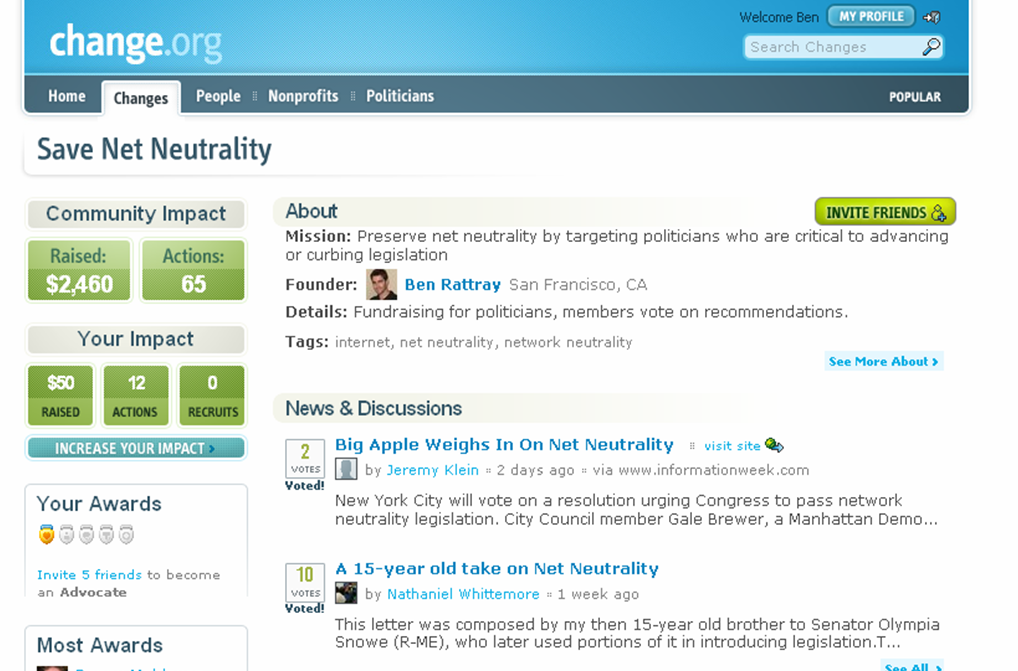
Instead of only nominating one charity per group, members can now vote on who which charities or politicians can best enact the change they want. Any member of the group will be able to submit a candidate for the donation, but only people who donate to the group’s “piggy bank” ($10 min by credit) will be able to vote the candidates up or down the list. Donations can be raised through the main site or an embeddable widget.
At the end of the month, all the money in the piggy bank will be divided between the top “n” donation candidate(s) (3 by default), minus a 1% management fee to sustain Change.org. If the money is raised for a political candidate, that candidate will get a check for the amount and their opponent will get slapped with a novelty check for the negative amount, just to let the competition know you mean business. Donations can also be conditional, such as donations to whoever wins the Democratic or Republican primary. Change.org will distribute the money when a winner is determined.
If putting your money where you mouth is isn’t your deal, you can also try lobbying on behalf of the group. Lobbying campaigns are dead simple. It just requires you to check off which representatives you want to lobby (state/federal, house/senate, governor/president), enter your address, and then type out a short message about your cause. The system automatically sends the message off to the appropriate representatives based on your address. The announcement of the campaign is then posted to the group and the politicians profile along with a copy of you message. If the representative responds, members can post the response to the campaign page.
In exchange for your good will, Change.org will dish back some warm fuzzies in the form of a scoreboard listing the total money you raised for change and virtual award medals of your contributions. Awards and posting a scoreboard will help generate some social pressure for friends to take action. We have yet to see how it will stack up against Sean Parker’s viral monster for good will, Project Agape, however.
In a time where nearly every presidential candidate has a MySpace page, it’s evident that the web is has developed some formidable political muscle. Today’s activists are co-opting new media sites like YouTube to get their messages out (see “Vote Different“). Change.org places yet another arrow in their quiver.
Activists should also check out idealist.org, dotherightthing.com, six degrees, tree nation, and essembly.com.


Finally someone has figured out how to use Web 2.0 to democratize the political process. Very cool. Also cool to see TechCrunch covering Web 2.0 companies that may have some real impact outside Silicon Valley.
This business model only works effectively if there is only ONE organization doing this.
If others create a similar model, then the overall effect gets somewhat diluted because the amount of money donated would be spread out among several candidates and would have less impact.
This is really a powerful new concept. I wouldn’t have imagined that something as tried and true as PACs would have gone Web 2.0 on us.
It sounds a little too complicated. Why would I want to go through all of this when I can just donate the money to the candidate I like the most? If you really want to put your money where your mouth is, don’t place it in this “Web 2.0 political lottery.” Do your own research, decide on a candidate and donate to/volunteer with their campaign.
GJ
http://www.60in3.com
This is Ben, founder of Change.org. Many thanks for the write-up, Nick.
Gal – good question. The reason you would want to give up some amount of control over exactly where your money goes is that it gives you influence over a much larger amount of money. It also enables you to be a part of community that, when bound together, can have much more impact than the sum of its parts.
For example, 1000 people giving $25 to a candidate in an uncoordinated fashion will get each person little more than a junk mail response. But you take those same 1000 people and have them give $25 each in a bundled donation along with a letter stating why the group gave the money, and the candidate will eagerly hear what you have to say. Heck, he’ll even come to your house to hear it. (Whether you want a politician to come to your house is another question…)
The point is, in politics concentrated and organized interests always win over disperse groups of people, and our platform allows people who were previously disconnected and powerless to coordinate political action for the purpose of gaining real political power.
Change.org seems like an awesome concept. Breaking down the existing political power structure is quite a lofty goal, but I’m glad to see these handful of sites tackling it. I still don’t think they’ve totally nailed it yet, but they’re definately getting closer. Best of luck to them!
Nick - you didn’t mention Care2.com which is the biggest activist site / social network of all with over 7 million members. I don’t think it has all the lobbying options you mention, but it’s the big gorilla in this space.
I like how they went with .org -
- becuase its an orginization -
- it just makes sense; some people buying .com ‘ because .com …..
It is a pity that we have come to widely and unquestionably accept that the politicians need to be paid large amounts of money to get them to do what their job is.
The problem here is that the public officials (who, by definition, are supposed to be working in the interest of the public) are being bought out with large amounts of money to get them to work against the public interest. The solution cannot be in trying to outdo these interests by paying even bigger amounts of money! We would never be able to compete! (and dont forget, they make all their money back, and more, once the politician is elected).
The way to fight this is to campaign to weed out this travesty and restore the democratic system. We need to raise the right questions to find effective answers.
That’s it. I have said all I wanted to.
pallet, change.org is a For Profit group- they aren’t in it for the good of their hearts. and they consistently hide their for profit status.
(cue the countdown to ben rattray’s defensive response, which won’t address why they don’t say anywhere on the site, simply and clearly, that they are a for profit group. of course, being a for profit group isn’t bad if you’re just transparent about it…but transparency isn’t a web 2.0 thing, right?)
Nor what percentage of the political contribution (although Ben calls it a donation - hey, Ben, political contributions ain’t tax deductible) Change.org will take off the top for the privilege of bundling your donation. Is it now going be “a social network for over 1 million nonprofits and over 1 million political candidates”?
I always feared that people would join the NRA and then vote “no guns”, but then people are pretty disorganized- That’s why democracy works! Everyone gets ONE vote
Jason, I don’t think it’s really fair to say they aren’t in this for the right reasons or that they hide their status as a company. Judging from my interactions with these guys at a couple conferences recently, they seem to be in this for all the right reasons. I was actually struck by how passionate they are about activism, and everyone I’ve talked to about the service seems to respect their commitment to the nonprofit community. I think the nonprofit world is starting to get over its uneasiness about for-profit ventures. A lot of us are pretty excited about the project.
You are right that they don’t explicitly state their for-profit status anywhere on the front page, but their FAQ does refer to the fact that they’re incorporated. I also don’t know why you think that information needs to be broadcasted as some sort of warning? It hardly seems like they’re hiding this fact. When I heard Ben speak at a recent conference, he spoke directly about how they can’t legally process donations to politicians as a nonprofit. Makes sense to me. Maybe they could explain that better on the site. Either way, I don’t think you should be so quick to judge - the site could do a lot of good.
PS - Wilson, their FAQ is pretty explicit about tax deductions and processing fees.
I just don’t think taking money from charities should be your monetization strategy. Seems even more shortsighted than Adsense.
-the “little guy” has just as much power as the “big guy” - and it’s not about money. It’s called “voting”. less than half of registered voters vote, and if you count the non-registered voters (that seem to have big opinions), it just goes to show why the problems exist. I’m sure this site has honorable intentions, but i’d rather send a check to whom I wish, or cause I wish, directly. I don’t need a filter site.
@ Nashferatu
If only politics were that simple. The problem that we’re addressing is that regardless of who is elected, special interests are able to buy influence to stifle debate on certain issues or get preferred legislation introduced on others. This is why, for example, genuine patent reform has been so evasive, net neutrality may not persist, and gun control won’t be touched by anyone with a ten foot poll - even if a congressman lives in a district that wholeheartedly supports gun control (hint: the NRA will spend $100k in attack ads against them in the next election if they do).
So although your vote may have as much influence as any other in getting someone elected, your influence over the way that representative acts while in office is not the same as those who fund their campaign or threaten to fund the campaigns of their opponents. That’s the problem that we’re trying to overcome. And, as I mentioned above (comment #5), giving a $25 donation directly to a campaign without a “filter” is not going to solve the problem or influence anyone. On the other hand, giving $25 along with 1000 other people in a coordinated way will certainly get a politician’s attention and, if properly targeted, can directly undercut the undue influence that any special interest might wield over that representative’s actions.
- Ben (founder, Change.org)
Jason, re: “I just don’t think taking money from charities should be a monetization strategy.”
Change.org takes a 1% fee for donations, not including the transaction fees which are impossible to avoid. GlobalGiving, a site which is TOTALLY based on the premise of donations that don’t go to overhead, takes 10-14%. GlobalGiving most certainly doesn’t going around advertising this. But hey, I guess they’re nonprofit so that puts them in the clear.
The reality is that change and donation protals need sustainability that goes beyond foundation donations. Especially in an arena like Web technology when the going salaries for top developers are far beyond what nonprofits have access to. This is emblematic of a dangerous resistance on the part of ANYONE to fund infrastructure, overhead, and leadership development in nonprofits. 9% of nonprofit leaders leave the nonprofit sector each year, creating a 100% turn around in nonprofit leadership every 5 years.
THIS is what’s alarming. Until we get comfortable with the idea that earned income strategies are legitimate and in fact, used judiciously and correctly, can add scale to good ideas that would otherwise get no where, we’re going to continue to have nonprofits so obsessed with living check to check and grant to grant that they forget what they were created to do in the first place.
Nathaniel
Founder of the Northwestern University Center for Global Engagement
PS GlobalGiving is a great organization and the fee they charge is certainly worth it for what they offer, I was simply using them as a point of reference.
In my mind, if this is just another avenue for people to be attracted to giving for any effective change-go to town! I’ve never donated directly to a political campaign or charity, but a site like this is more attractive than a direct appeal from the candidates.
The perfect chicken soup recipe
Think big, crisp, and gloriously browned when you want a bird that reigns
supreme at the table Size matters. Position doesn’t. That’s what a palate-weary …
Hello! Good Site! Thanks you! rnprdyeqlhugkv