
Do not panic. We accept late submissions for TechCrunch50, but please submit soon. »
Web 2.0 in Germany: Copy/Paste Innovation or more?
by Gregor Hochmuth on May 14, 2007

germanweb2logo.pngLast week we reported on Frazr, one of Germany’s many Twitter clones (if you’re eager for more side-by-side comparisons, see Sloggen, Wamadu, Faybl or 1you, which all launched in March or April). Frazr is symptomatic for the state of Web 2.0 in Germany and to get a better understanding for the many international developments, this post starts a series of regional profiles on Web 2.0 around the world. I’ll start the tour with a closer look at Germany, home to Europe’s largest population of internet broadband users.

Hype vs. Hesitate
Just as this week’s Pew Internet Study stirred a debate on the view of Web 2.0 in the US, Germany has seen similar arguments on the size of the phenomenon locally. For a long time, several indicators had hinted that Germany was falling behind in broadband penetration compared to other European countries like Sweden or Norway. But a recent OECD study painted a very different picture: looking at the total number of households (as opposed to per-capita penetration), Germany comes out on top in Europe with 14.1 million subscribers in December 2006 (followed by the UK at 12.9 and France at 12.7 million). So the crowds are here, but where can they go?

“Web 2.0” is a term that brilliantly translates around the world, but many of the sites that are commonly associated with it have a language barrier for international audiences (take MySpace for example: it officially launched its German version only in March of this year).

While English certainly isn’t foreign to Germans, it has still slowed their adoption – and network effects, which have been a driving force, are often tied to language and reach as well. What’s been the consequence in Deutschland? A mushrooming of German copycats that have localized and copied their US role models, sometimes down to the last pixel.

Copy/Paste Innovation
Whether you’re looking for social bookmarking, photo sharing, video posting or a college social network, Germany’s clever entrepreneurs have done the translation for you and some even fared quite well.

The best example by far is StudiVZ, whose name stands for “student directory.” Launched in October 2005, it now claims to house 2.1 million users. Despite a myriad of security problems and controversies, new users kept coming in, which only speaks to the universally strong demand for such networks among students. In January of this year, Germany had its mini-YouTube moment when StudiVZ sold for €85M ($100M) to the German media conglomerate Holtzbrinck Group.
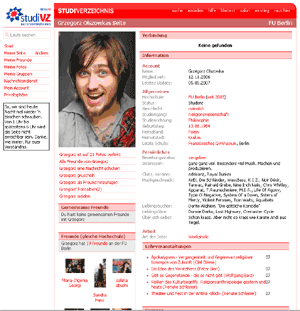
studivzprofile.pngIf the screenshots look familiar, you won’t be surprised to hear that StudiVZ’s early versions of the site were using filenames like fbook.css or poke.php. (Facebook was in talks with StudiVZ but it walked away because of scalability and security concerns about the platform. Instead, Facebook is now working on its own strategy – let the battle begin).

Another success story is Xing (formerly OpenBC), a professional network like LinkedIn. In December 2006, it became the first Web 2.0 company to go public and is now traded at the Frankfurt stock exchange. Xing’s rapid growth among the German business community came rather unexpected after it launched in November 2003, especially in a country that isn’t typically known for its culture of business networking. The site now boasts 2 million members and about 13% of its users pay for a monthly premium subscription of €5.95. With revenues of €10 million in 2006, Xing’s performance at the stock market has been somewhat lackluster and the real test for the company will come as both Xing and LinkedIn expand beyond their original markets (LinkedIn now has 9 million registered users and $10 million in 2006 revenues; it recently raised $13 million more).

Your German Web 2.0 Dictionary 
In the U.S. In Germany
Web 2.0 Web Zwei Null
YouTube Sevenload, MyVideo
MySpace  UndDu
Flickr  Sevenload, Photocase
del.icio.us Mister Wong
Yelp  Qype
Facebook  StudiVZ
Digg  WebNews, Yigg
Blogger, LiveJournal  blog.de, twoday.net
Meebo  Mabber
Etsy  Dawanda
Cafepress  Spreadshirt
Slide  imageloop
Flixster  MoviePilot
Twitter  Frazr, Wamadu, Sloggen, …

The Brighter Side: What’s next
Of course there are creative and innovative startups to be found (and growing any multi-million user base is a feat in itself regardless). For some inspiration, take a look at our previous coverage of Plazes (currently a sponsor) and SellABand; last week also saw the launch of MindMeister, a promising online mind mapping collaboration tool. Other notable services include blauarbeit.de, a growing reverse-auction site for jobs and services, and we have yet to wait for a successful US counterpart.

In short: Germany is buzzed right now and the biggest question for the startup scene is how the many look-alikes will develop over the next year. You’ll often hear that investors are hesitant to invest in ideas that “haven’t been proven in the US yet” but there are several other factors at work here: Germany is generally more risk-averse, the bureaucracy is more cumbersome, and entrepreneurial networks like Silicon Valley aren’t as strongly developed.

Nonetheless, the country’s business angels and media conglomerates (Holtzbrinck Group, Burda, Axel Springer) are eager to invest with rapid-fire pace at the moment but the majority of German internet users have yet to be convinced that there is a land beyond eBay, Google, Wikipedia and some online news sites.

Meanwhile, German and other European startups are in a prime position to tinker with mobile applications and I wouldn’t be surprised to see more innovation in this space soon. The continent is covered with advanced data networks and the UK has already seen the introduction of flat-rate data plans at reasonable prices. Germany’s market is sure to follow and the boon of the mobile web will start in Asia and Europe sooner than in the US. You also want to watch out for innovations around IPTV as subscriptions are expected to reach 2.6 million in Germany alone by 2010.

Until then, let’s see how Facebook and StudiVZ duke it out ;)

Curious fact: Google’s market share for search is near 92% in Germany. And yes, it’s a verb here, too.

Gregor Hochmuth is an analyst and entrepreneur in residence at Hasso Plattner Ventures. He runs zoo-m.com and his own homepage at dotgrex.com.

Responses

Comments rss icon

  • Actually one of the first ‘clones’ that I can think of was alando.de which was more or less an exact copy of eBay. It was bought by eBay in 1999, back then probably the most spectacular deal in the new media space. The problem is that for a long time the German market has been considered too small (which I never really understood since it’s already Europe’s single biggest market… and if you want to you can even add Austria and Switzerland, though small, to the potential target group since they speak the same language).

    German’s not know for their culture of business networking? Hm, not sure if I agree with that. What makes you think that? Or let me ask it this way: How does the German business network culture differ from other European countries’ business cultures? are we really that far behind?

    Cheers
    Ole

  • Correction: Should have been ‘Germans not known…’

  • @Ole: When talking about business networking, I was indirectly comparing Germany to the US, not to other European countries. While people certainly network in Germany and elsewhere, no question, I find that it’s “more” in the US - it’s a sport.

    -Gregor

  • What country have most WEB 2.0 super power?

  • President Geroge W. Bush should tell the America to build web 2.0 super power.

    There’s spies running around the U.S and looking web 2.0 source code. Where do you think Email SPAM comes from?

    The world.

  • Yes, there are clones, but most of these clones tailor to their local… a great way to get acquired, like alando did.

    But there is also innovation. Xing is a great example… I’m a paying member of Xing, but not LinkedIn. Maybe this has to do with the “seriousness” vs sport that you refer to above in networking, but I find the functionality much better, and worth the payment.

    Thanks for the article… good read.

  • Good article. One note is that Spreadshirt is not a Cafepress rip off. I was ceo of SS in the usa for the first 15 months here and the site was not copied from Cafepress. In fact, their (SS) innovative flash design tool was just recently copied by CP. Agreed the model is similar but Lukasz (spreadshirt founder) did not rip it off piece by piece…

  • Nice overview Gregor! Glad to see Techcrunch covering the German startup scene.

  • The lesson to be learned?

    Make your site multi-lang early on.

  • If it makes dollars, it makes sense. I don’t think any negative overtones when discussing foreign “copycats” of services that launch in the United States are deserved. We live in a global economy and 95% of the world’s consumers, or future consumers, are located outside of the United States. Mikey is absolutely correct. Startups that fail to at least consider early expansion into foreign markets are most likely forfeiting those markets. Of course, expanding into foreign markets isn’t typically as simple as translating a website, but there are lots of ways United States startups can expand internationally without having huge financial resources.

  • It is interesting that copycat behavior is usually referred to non-US companies copying from US companies in this context. What is widely unknown in the US is that Yahoo Answers is a copycat of what Naver did earlier in Korea, or Social Networking in general was already established in Korea through Cyworld pre Myspace (granted, the functionality is different, but the idea is the same). Since the author mentions Xing and Linked-in, here is another example: Linked-in recently launched the function to see who has viewed one’s profile. This has been part of Xing at least for the past two years, and is in my mind one of the biggest drivers for members coming back to the site on a regular basis.

    Based on these examples, I think that copycat behavior, BOTH ways, is more prevalent than one might think, and that probably many “innovative” companies in the US are also looking to Europe and Asia for new ideas, especially in areas such as mobile solutions (Japan) and social networking (Korea, Europe).

  • actually, the only thing mabber and meebo have in common is the web-based IM. Other than that, mabber offers a totally different set of features. Mabber is based on the popular Jabber/XMPP protocol and has a mobile client, a web-based client and will release a desktop client soon. We do offer Gateways to other networks.

    Disclaimer: I am the CEO of mabber.com.

  • Great article! Don’t forget that the most successful copycat in the world is called Microsoft (but not in the Web 2.0 space).

  • I have talked to rather many German ’startuppers’. some of them have talked to US projects and offered them to localize their servoce for them. Sometimes they were turned down, sometimes they were totally ignored.

    So what they do is, what works: Copy and get bought either by the US company (Alando) or by european Investors.

    And: If thy cook up sth. totally new European VCs often ask: Has this worked in the US, and if they say: The US does not have this service, then the VCs walk away.

    The “real” problem I see is this:

    German copies are done by two (or three) types of people
    a) developers who are no entrepreneurs
    b) wannabe entrepreneurs who have no idea about how the net and the web really work
    c) people who know what they do

    The third groups seems to be very small, sadly.

    BTW: Sevenload is not a ‘copy’. It integrated images and videos from the beginning and techs say that it is technically far more advanced than YouTube. They also help content providers modentize their content and actively scout talents. So: They care about their community and not just ‘put them to work’. (They do more but let’s leave it at that.)

    Disclosure: I am currently talking to 7load about a project ;)

    But then again I agree: I am always happy if US-projects start internationalized. This happens far too rarely and actually provokes copie(r)s, add I detailed above.

    And: Internationalization is more than translations and some translations (as in the case of Second Life and (former) Blogger.com) are really amateurish… don’t use Babelfish and German majors; use German natives who know about language & tech. That is how it is done.

  • We just started an innovative health network: http://www.imedo.de - no copy-cat or anything.

    “Germany is generally more risk-averse, the bureaucracy is more cumbersome, and entrepreneurial networks like Silicon Valley aren’t as strongly developed.”

    True - but Germany is getting closer!

  • Great article. Just to correct things.

    Photocase Start: 2001
    Flickr Start: 2003

    Besides. Photocase is a quite different story. Its not a storage plattform.

  • While I totally agree on a lot of points Gregor made, I wonder about one strange situation in germany: The awareness for copied innovations is way bigger then for new/orignal ideas.

    Over the laste weeks there was a lot of rumor about all the german Twitter copycats - not only in germany, also on some international blogs. Part of most of this discussion was one of my new upcoming projects called http://www.partnr.de/ - which is by far no Twitter clone at all, but has been considered as on. First information of this new communication tool was online weeks before that kind of hype started - but it gained most publictity during that phase.

    So my overall feeling is, german CopyCats gain a lot of attention these days, original ideas on the other site are way less interesting for german press and blogs…

    Hopefully these will change in the near future.

  • If anyone wants to digg a little deeper: I’ve recently compiled a list of the 100 most popular Web 2.0-ish sites from Germany: http://momb.socio-kybernetics.net/labs/germany-100

  • sevenload is not a copy of Flickr or YouTube, it’s exactly the opposite. sevenload creates unique value to users by empowering them to create not only their own video and photo content, but also their own formats and social networks.

    The sevenload user account is a much deeper relationship.

    sevenload also creates tremendous value to advertisers by offering not only exponentially better targeting, but also differentiated environments that brands can feel comfortable with.

    Axel Schmiegelow, CEO sevenload

  • The article says that European Markets are in a prime position for mobile applications, and states that only the UK got a flat-rate data plan and Germany is likely to soon follow the trend.

    That isn’t quite correct because German network Operator “E-Plus” started in late 2005 with a flat-rate plan for 50 Euro, and current unlimited data plans in Germany start at 25 Euro (on the MVNO BASE which uses the E-Plus Network).

    And WAP access flat-rates have started in late 2003 on o2 Germany for 5 Euro (which sadly hasn’t changed since then), with modern mobile phones (e.g. Nokia S60 3rd Devices) with this 5 euro plan, access to all normal web pages is possible ;)

    So the Germans are far more mobile in their internet usage as most people think.

    From a user who got the 5 Euro WAP flat-rate and the 25 Euro Internet flat-rate.

  • and what about german sites / ideas that are copy-pasted in the USA? and I don`t just think about blauarbeit or plazes (no US clones jet, or did I miss something?), I mean german ideas that are cloned in the USA because US guys got aware of an idea outside the US - i.g. http://www.wazap.com (german) and http://gazerk.com (usa) - I`m not sure if many examples can be found where it works the other way around…?

  • for more than 10 years now the german startup scene was dominated by followers. Unfortunately this seems still to be the fastest and easiest way to be successful.

  • twoday.net…in Germany???

    nicht ganz richtig…

    davon abgesehen passts nicht so ganz in den kontext des artikels, oder?

  • Very good article, thank you for the interesting overview. - Even though I don’t consider photocase to be an opposite hand of flickr. photocase ist a database for royalty free (but professional) photographs used in web and printing. flickr is a picture community for mostly private stuff.

  • The article is OK, but it does not address the reason behind. According to our opinion it is always much more easier and cheaper(!) to do a copycat – and this means it does not depend where it happens. Last week we launched http://www.myTV.de which is a true innovation (an interactive guide for ALL moving pictures) and covering all different existing distribution platforms. But it is much more difficult to establish such a site. First of all the founders and investors need to be prepared for a longer take off (oooh, new – why this? etc.), secondly some resistance in the market (as said before in other comments: where is the proven, working model) and third the missing buzz in the market as there is no comparison to benchmark (because of the absence of the (US-)”original”. That fits very well the german sceptics and negative “Neid” attitude. So, yes it is easier to launch a copycat but true value is only based on true innovative solutions.

    Disclaimer: I’m one of the 3 founders of http://www.myTV.de

  • Just like Germany, I’m sure other countries are mimicking US web startups. People are finding opportunities everywhere and if they can be executed well, then great for them. Let’s just hope that more competition breeds innovation. Perhaps we’ll start collaborating more on a global scale to bring new products to market.

  • Thanks for the article. Although the conclusion of being seen as copy-cats instead of innovators is nothing we should be proud of and apart from this is new to the German entrepreneur culture, I appreciate that you start your regional Web-2.0-tour in Germany. As you wrote, the market right now is definitely buzzing and I am really curious to see how all the existing projects and many more upcoming ones will have developed in let’s say one year.

  • The unique social shopping network http://www.dealjaeger.de has to be add to the list of innovations that has been developed in Germany without any us-example or vc so far.

  • perhaps some of us here in the US are overly obsessed with originality, at the expense of hard, bottom-line revenue-model-based tactics.

  • To german VCs:

    No risk no fun.

  • Not quite right,

    jogmap.de is a website for runners from Germany, it started in Aug 06 and thus preceded even the nike plus website. It is unique in the way it handles Germany’s biggest running community and makes masterful use of all web 2.0 features.

    Maybe the hesitance, using flashy words like Beta, and the typical web 2.0 aesthetics keeps it below the web 2.0 radar.

    Eric

  • arguably the most successful german startup with a unique business plan is the “Bundesnetzagentur”. it is run by the state and enables other companies to succeed. the agency acts in the interests of the german citizens and their markets and regulates between both. it sets up the constraints for the physical layer of water, gas, electricity, telephony, internet and transport networks. adam smith and harold innis would have loved it. why don´t we have something like that for the application layer, and application layer 2 (called web2.0) talking about innovation in the perspective of the upcoming 50 years, this is an antidote to headless market fundamentalism. it is about understanding web2.0 from the button up as a matter of infrastructure (as o`reilly did before someone else coined the term)

    the whole ruby-on-rails craze is just about to kickstart over here, with some delay of healthy scepticism. the german open source guys, move from their beloved linux boxes to the net as an operating system. you will soon find a bunch of companies popping up, one of them is yumondo.com, which will realize a “semantic web for the rest of us” including blogging for objects and a user experience which is not only appealing to the incrowd of sexed up bubble-loving-drop-shadow button pushers.

    if you look under the hood of wikipedia, you find the wikimedia engine. you´ll also find yacy, a decentralized search grid, and lots of semweb research which will make wikipedia the european counterpart to google, based on the 18 century concepts of diderot and d´alembert. it´s intelligent algorithms and raw computing power vs. the intelligence of people and their cultural diversity.

    at the core of many german startups sits the german language. with switzerland and austria you have enough potential users to localize english language platforms. (60,2 Millions) what some might call a “metoo” is a missed opportunity of localisation of the according “original”. so who`s to be blamed?

  • Woah. ;-) Pretty many people getting defensive here.

    To get some facts straight, yes of course there is a market for localized plattforms, and no, if you just take an idea and copy it (even though you might change design and language) that’s still not called innovation.
    Well, maybe innovation is a marginal term, because Flickr didn’t innovate strightly speaking - there was photoblogs and hosting before. But did they still put another perspective into the game? Sure!

    Or go, Google vs. Yahoo! vs. others. I remember there were search engines before everyone started using Google.

    I think there’s plenty of space on the Internet to re-invent the wheel, and to make it rounder. So if you do this, fine! There is nothing to get defensive about. :-)

    Though to be noted - look at the people from Plazes (for example) who are innovating in a space where there is no one else. And alas there are rather one of a few here in Germany. Most startups just seem to borrow ideas from the U.S..

  • so here is the german scene defending itself. from a more or less observer position i agree that we are in an infancy state still. but let’s just take barcamps as reference. they are getting packed. more and more start ups, soon to be seen here greg.

    germans learn and learn and then apply. studivz is just horrible, but were the first in the german market. would facebook have entered the market, they would have blown it off. i feel the german scene is about to hit it, but does not dare to yet.

  • You have to be provocative to stir a good discussion- and it looks like my intention succeeded in this case ;) In the end, it’s a challenge wanting to be disproven!
    -Gregor

    And btw, Photocase was included because of its strong community-centric view of photo sharing; sure, it’s a download platform a la iStockPhoto –founded accidently before Photocase in May 2000– but the casual use of the site is still very similar.

  • Ohh, Gregor?

    Where ist Michael Arrington?

  • Dear Gregor,

    no need for defense, you already mentioned, where the future innovation comes from:

    “Meanwhile, German and other European startups are in a prime position to tinker with mobile applications and I wouldn’t be surprised to see more innovation in this space soon.”

    After helping to build XING to become “the first Web 2.0 company to go public and is now traded at the Frankfurt stock exchange”, as you put it, I switched to the mobile space. Watch out for Mobile 2.0 now (and of course watch out for http://www.cellity.com)

    What do you think about covering a list of European Mobile 2.0 companies (hardly any copy-cats can be found here) in another good article?

    Disclaimer: I am one of the founders of cellity.

  • The article sucks…

    German MySpace is UndDu??? LOL never heard such a bullshit, im sorry. Did you saw YouMix? Did you saw JoinR? i dont think so…

    Sevenload is a copycat of youtube??? omg, gregor, you are a lam0r, im sorry.

    researching is everything…

  • Everyone has their favorites, Chris. UndDu is just one example- there are probably three others in most of the categories that I didn’t mention.

  • It is obvious that these are just examples, and to stay with these: There is a difference if a company like Web.de is pushing unddu to their existing userbase probably in the millions using their free mail service or of some new startup tries to get into the game.

    Especially when one compares this to Myspace in Germany. Web.de’s unddu has a chance - joinr does not.

    But that aside - it is a nice reminder for me to finally post my slides from the web2open which covers a lot of the things mentioned here in the comments - it is not just about translation, and copycats are not just copycats because they do something similar to a company in the states.

    In many cases these are much more advanced than others due to the local adaption - not of functionality or design.

    manual trackback to the post with slides and additional thoughts:
    http://crueltobekind.org/archi.....ew_on_web_

  • let´s not to forget to consider:
    a) germans are almost as overweight as americans
    b) there are more germans on second life than from any other country.
    c) one of the most popular current web projects in germany is called mymuesli.com

    ugh. i forgot to disclose the disclaimer: i work for yumondo.

  • That happens if twitter doesn´t expand fast enough to other languages.

  • I just made myself such a nice web2.0 image like on the top of this page on my page. Like them. They are realy nice!

  • You forgot the sports social network clone. In the US the main sites are Takkle and Fan Nation while Germany has Sportme.de

  • Absolutely other countries are mimicking US start ups.

  • Nives Mestrovic - June 8th, 2007 at 3:19 am PDT

    Germans entrepreneurs surely are not far behind US entrepreneurs.
    BUT a very important thing is, that German Venture Capitalists are not so far as to recognize the impact of a web 2.0 model.
    The best idea is nothing worth without money. An old slogan, but without significant capital in your pocket, the best german networking web 2.0 idea will never be rolled out!!!

    This is THE important thing to talk about and not about who copied what!!
    The US Venture Capitalists invest more hundreds of millions of US Dollars in one day than German Venture Capitalists will invest in two years!
    There I see a big issue.

    German entrepreneurs have to fight for money out of their own private placements activities. And we all know! In web 2.0 only the idea can win which is backed with a lot of money!

  • Thank God, there is nothing comparable with Linkarena (German). It combines handy features in one service: home page, social bookmark service (with tags AND FOLDERS), file manager and a blog-tool. Is there any service which can keep up with Linkarena??

  • Can we say “Germany and USA are good places to act for internet-startups”? I can :-). And I do.

    Why ideas are coming from America to be simply copied in Germany… Well… think it’s not actually true. More correctly: “Ideas are coming TO America and TO Germany” and for web-startups particularly. Reason: both countries have well-developed infrastructure and not only for internet-access but other essential for e-commerce services too. For example: parcel delivery services, credit systems, payment systems, customer rights protection laws and agencies and other [oh believe me it’s hard to get well without these little helpers of e-commerce]. And main – German and USA residents are loyal to “do things online”. By the way which are more loyal on average ;-)?

    So, what is the US/DE difference in our case? Let me make little suggestion: it is mentality - German investors are more circumspect in common while their American friends are more aggressive. No? Do you remember “dot com boom”? USA sometimes works like “early-testing-cycle” of ideas for electronic businesses. Since investors OK about risks.

    And by the way is LinkedIn “autochthon American” ?

    Well… think globally, act locally. I mean take working ideas and go get German investors ))).

  • I think that spreadshirt is way better than cafepress…

Leave Comment

Commenting Options

Enter your personal information to the left, or sign in with your Facebook account by clicking the button below.

Alternatively, you can create an avatar that will appear whenever you leave a comment on a Gravatar-enabled blog.

Trackback URL
bugbugbug
The CrunchBoard
  • MediaTemple Logo
  • QuickSprout Logo
  • OpenX Logo
  • Cotendo Logo