There was a lot of controversy recently when Wikipedia announced that all outbound links from the online encyclopedia would include the nofollow tag. The nofollow tag on a link is said to prevent link spamming since some search engines (Google among them) do not count links containing the tag towards any weighing of the destination page. What this means is that a link from Wikipedia will no longer boost the position of a page in search results, the intention being that this will deter spammers from sneaking links onto Wikipedia.
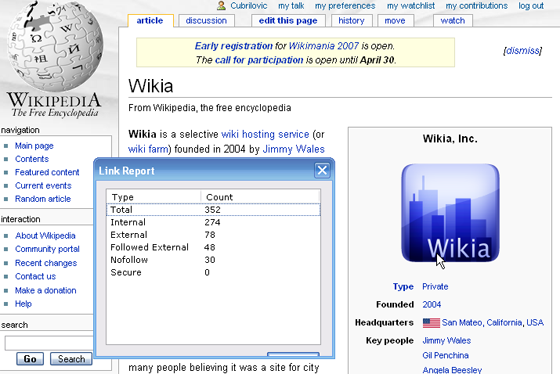
In Febuary of 2005 the Wikipedia community voted in favor (by a vote of 61% to 39%) of removing the nofollow tags, but this outcome was overruled by Jimbo Wales, the founder of Wikipedia, earlier this year. It seems that while the nofollow tag is added to the standard outbound links, it isn’t applied to inter-wiki links, including links to Wikia, Wikipedia’s for-profit spin off. For example, on the Wikipedia page for Wikia there are a number of links to Wikia pages which do not contain the nofollow tag:
<a href="/wiki/Wookieepedia" title="Wookieepedia">Wookieepedia</a> <small>(<a href="http://www.wikia.com/wiki/c:Starwars:Main_Page" class="extiw" title="wikiasite:Starwars:Main_Page">home</a>)</small>
The result: wikis included on the white list are granted outbound links that do not contain the “nofollow” tag. These sites benefit directly by receiving higher search engine placements, which is equivalent to additional traffic and authority. Many direct competitors to Wikia, such as Wetpaint, are not included in the white list as of today.
The links to Wikia that don’t have the nofollow tag are created using a special Wikipedia tag wikiasite:. The tag for linking to Wikia pages isn’t mentioned in the help pages for Wikipedia, but there are many references to it throughout Wikipedia and the talk pages on various topics. It is a special type of link known as an Interwiki link, which means that you can use special shortcut tags when linking to other Wiki’s (such as Wikia). The question is, why wouldn’t the nofollow policy apply to inter-wiki links? Specifically since there is an apparent conflict of interest with Wikia, something that you would think that the Wikia team would want to avoid.
The Wikipedia decision to include nofollow tags was not popular and many have pointed out that nofollow is not as effective in preventing link spam as was expected. Wikipedia now has very few outbound links that are honored by search engines, and all of these links are either to other Wikipedia properties, or other wikis via the inter-wiki special links. Why the nofollow policy isn’t applied to links to external wikis we don’t know yet.
To provide an even playing field, Wikipedia should include the nofollow tag for links to all other wikis using the Wikimedia platform.
We’ve emailed Wikipedia founder Jimmy Wales and Wikia CEO Gil Penchina for comment but have not heard back yet.
Update: We have heard back from Jimmy Wales and he has stated that he was opposed to the nofollow policy and had only dropped his opposition to nofollow on advice from Google and others. We stated that Jimmy over-ruled earlier decisions based on the discussion that took place in this thread – in response, Jimmy Wales claims that he did not over-rule the previous decision. The nofollow tag is an important part of the anti-spam strategy at Wikipedia.


good digging. It’s time that someone points out the huge conflict of interest between wikia and wikipedia. It goes much deeper than this.
I’m not a fan of Jimmy Wales, but if he believes Wikia is a worthwhile site to promote I just don’t see what the big deal is. ‘Conflict of interest’ implies he is making some kind of extra-legal moves or something.
He co-founded them both, I guess he can do what he wants, if that loses credibility with users then those users can look elsewhere for information.
Nice text.
You got to be kidding, it is obvious why the nofollow policy is not enforced in this case. Wikipedia is more valuable without advertising, but donations are not that lucrative. If they can generate revenue elsewhere, as a result of the “strength” of one of their assets, I think it is a shrewd move. Sure, the folks that understand what is going on here look down on it and speak poorly of wp, but they have a user base that is quite large and growing. As a pure user of wp, I just want it to get better and don’t care one way the other, nofollow or not, as long as it’’s better. If there is a link that seems relevant, I will probably check to see if there’s more info there. It sounds like people would like to use wp as an seo tool.
What amazes me is that Wales actually thinks his community search engine is going to work. He has enough problems with spam in Wikipedia and he thinks people are going to be honest and up front with the search engine? What will be interesting is how many Wikipedia listings are at the top of his SERPs.
The nofollow policy makes complete sense to me, considering it’s a PR8 site and is editable by anyone. Implementing nofollow won’t necessarily stop spammers but it makes it a lot less enticing to put links to your site all over the place. I see no problem with him giving PR love to his own sites either. It’s his site, he can do what he wants with it. You don’t like it? Stop bitching and go start your own wikipedia
The no-follow does work, Wikipedia knows this: it’s the exact reason that links to Wikia have no-follow removed.
Business as usual
nofollow is good.
Kelli:
Wikia Search is not happening IMO, at least not any time soon. Why? See this:
http://blog.sim...-Happening.html
Kewtr:
true, both Wikipedia and Wikia are Jimmy Wales’ babies, but Wikipedia is designed as a baby to be raised and given away to the community for sharing, so to speak, so it does feel a little “strange” that nofollow is not used for Wikia. But you are right, the organization behind Wikipedia can do whatever they choose.
I love democracy in action – especially when it suits people to circumvent the process.
A 69% to 31% decision to abolish the no follow tag is quite decisive.
Those in power (Wales) does appear to financially benefit from this decision.
If Wales has made it a policy to have nofollow tags to all outgoing links on Wikipedia, he should also have nofollow tags on links to Wikia as well. He would be hipocritical if he didn’t. Also, what Wikipedia really needs is a community where people can share and discuss interesting Wikipedia articles with others and use a voting method similar to that of Digg to rank articles by popularity. The main page on Wikipedia is not a very good way to find good articles. That’s why WikiVotr.com is so cool because it addresses these issues and provides a community for Wikipedia users and has some great articles to read and discuss.
Grant
http://www.wikivotr.com
Don’t you think it’s slightly hypocritical of Techcrunch to cite this controversy but still sell regular text links to your sponsors?
I’ve pointed out numerous times that selling links raw links (without nofollow) is slightly unethical. This after Techcrunch has criticized Text Link Ads, and Pay Per Post for doing something similar.
You can’t have it both ways.
WikiVotr… You need to write privacy policy guideline. Otherwise you lose people’s right and they will stop going your websites.
Digg, myspace, and other elite social website got privacy policy.
You need one to make your company grow bigger and bigger…
They don’t include the nofollow tag to their other sites because the other sites are so small that they have to use the leverage from Wikipedia in order to keep them active on the SEO banks. Nothing surprising there, outside of the unfairness of it all.
Kevin – you need to look up the definition of hypocrisy. The issue here is a Wikipedia policy that is not being uniformly applied, an the primary beneficiary is a company partially owned by Wales.
The fact that we sell advertising on our site has absolutely nothing to do with this.
But to address your question – the ads that we sell directly are nofollow links. I actually just checked them and two don’t have the nofollow tag which will be fixed (thank God edgeio wasn’t one of them or we’d be slammed with conspiracy theories). So, to sum up, I’m not a hypocrite, you don’t understand the word, and you’re wrong anyway.
I don’t like the talk about ‘well it’s his site and he can do what he wants’.
That’s crap.
Yes he may have created it, blah, blah, blah. But the community made it what it is. Now if Wales wrote all the articles himself then fine, he absolutely could do what he wants.
I’m sorry but favourtism on a community site the size of Wikipedia is unacceptable.
This is a great example of why everyone should nofollow ALL LINKS TO WIKIPEDIA. I have done this already for all links I have from my sites to theirs. A nofollow link indicates that you do not trust who you are linking to. Do you trust Wikipedia?
Also what is great about this article is that it also indirectly points something out. We are non directly funneling links to his for profit company everytime we link to Wikipedia (if you dont know I mean go and read the paper on how pagerank works). Also, by no following links he is increasing the weight of the links to his non profit site. He is also causing less link weight to escape from his sites and thus increasing the weight of internal pages in wikipedia.
Kevin is indicated in a prior comment how much he is against selling text links. That is a different subject altogether, but let’s put this in perspective – what wikipedia is doing is much worse. For a start because it is disguised to appear so wonderfully ethical and secondly because Techcrunch is sacrificing link equity for its advertisers when it does not have to.
I say this with no qualification – if you are a wiki editor then you are literally a moron. If you would not work for rupert murdoch for free why do it for Jimmy Wales?
Nice piece of reporting guys. This is a great find. What an incredible source of organic inbound links for Wikia that is not available to anybody else.
Jimmy Wales must wake up every morning and regret Wikipedia’s non-profit. Cut him some slack.
I want to throw something up here – if the search engines aren’t seeing outbound links from Wikipedia, won’t this affect their search engine rankings since having quality outbound links is as important (with some sites) as having quality inbound links?
Does anybody have an idea of how much weighing Google gives to outbound links, and if the links are nofollow does that mean the search engines don’t honor them as inbound as well as outbound links?
With some 50% of traffic going to Wikipedia coming in from search engines (I think it is higher – Hitwise quoted ~60% IIRC) the lack of outbound links could have a big effect.
If that is true, then it would be a good argument for switching nofollow back off, which is where I believe it should be.
I will go one stronger. I dont trust Wikipedia and will not link to them, nofollow or not — just won’t link, thats all. Its run by morons and wikinazis and Craig pointed out (@16).
This Wikipedia site needs to disappear quietly into the annals of the Internet as one of the darkest episodes in its short existence.
Dang Jacob. I am not sure I could personally survive without Wikipedia. I for one don’t have earth shattering research work for which I need Wikipedia. I *do* run into odd people in the news or recent phenomenons and love how I can get up to date on it via Wikipedia.
You can rant as much as you want about how easy it is to screw up articles on Wikipedia but at the end of the day, in current state, Wikipedia is damn useful and damn accurate.
Yes, Zaid, I think Wikipedia is quite useful as it is today and most people will still use it unless there is an equally good alternative.
> So, to sum up, I’m not a hypocrite, you don’t understand the word, and you’re wrong anyway.
And evidently, Michael, you’re kind of a jerk to people in your comments.
Oh boy, I can’t wait for Nick Carr to get all over this. Wikipedia disappoints as Google once did, and just like Google, somehow still manages to be useful and relevant. Forget the vast majority of the world, which hasn’t even heard of the Wikipedia yet, even to most of us geeks, [[the Wiki]] still holds more promise than peril.
Even I have a problem with so many ads on your blog? Can you remove them?
C’mon, at the end of the day, Wikipedia is HIS website..He can do what he pleases…Do not contribute to editing text, if you so wish..
No-follow tag does not necessarily mean that search engines follow “no-follow” rule. I discovered a lot of links to my site indexed by Yahoo search engine from Yahoo Answers. Yahoo Answers do have “no-follow” tags. Regarding the issue of Wikipedia, I absolutely agree with Michael Arrington – Wikipedia has non-profit status and certain public standing that do oblige uniform link policy.
As for “no-follow” tags on Techcrunch ads, Michael is overly harsh on himself, it’s your business Michael – give to advertisers what they want – you don’t have to appease the crowd.
I agree with Kelli. Wales should not be able to overrule community decisions. I don’t care if Wikia is Steve Jobs’ website or Wales’, it needs to adhere to the same rules forced upon every other website. This is just a big no-no.
Someone has submitted this story to Digg. Show your support.
More tears from those who want to use the hard work of the Wikipedia volunteers as a staging ground for their spam. Maybe they should try getting their own websites to be amongst the most popular on the net, instead of crying hot tears that they can’t spam their crap on Wikipedia to boost their search rankings.
Finally other people are catching on.
Most of the spam in Wikipedia is articles promoting wanna-be companies. I’ve volunteered as an editor there; people fight the delete process tooth and nail to keep articles about their company, product, service, or whatever. I don’t mean Photoshop, I mean articles about Joe’s Web Dezine. There are 1.5 million English language articles on WP, and 1/3 of them are cr@p.
Further, Wiki editors take “ownership” of pages, act in cliques, and discourage intelligent people from contributing to the project. If the anyone-can-edit model and self-healing promise have some merit, Wikipedia is sadly failing to make the concept a (positive) reality.
Finally, it’s the volunteer writers and editors, not the Wiki management or other Wikia site owners, that made Wikipedia popular.
nik,
very insightful report. in spite of the seeming indifference displayed in this comment stream, the implications of your claim are clearly important. this is not about the merit of no-follow tags, this is about transparency and credibility. and those who think Wikipedia can do whatever the heck it wants without suffering question are never allowed to judge major media companies again.
NoFollow is not that bad after all…
http://www.sear...attribute/4801/
So what? They have founded wikipedia so they can do anything they want. Including adding ads to the wikipedia.
Dear conspiracy theorists,
Wikia links are nofollowed if they’re an http:// link, but not if they’re in the interwiki map: http://meta.wik...i/Interwiki_map
LOOK at all those sites that don’t get a nofollow! Gosh!
That is: Wikia sites are not treated any differently from other sites known not to be spammer sites.
Just because wikipedia has the nofollow tags does not mean that the search engines will use it.
Wikipedia is a useful resource that is continually monitored for spam. Spam links don’t last for long and therefore all the long-term links are a relevant and useful resource.
Search engines will use this fact to their advantage and give extra weight to links within wikipedia regardless of nofollow tags.
I don’t understand one thing. First of all, to get things straight, I’m a Wikia employee, and a long time Wikipedian (so that people won’t point it out later on).
Now, as Nik himself pointed out, there’s an Interwiki map on Meta, which lists all the interwiki links. I tried it with some random interwiki link from there, BenefitsWiki:. It doesn’t result in a no-follow link. Nor any other link on the interwiki map does.
http://en.wikip...oldid=126840650
The interwikis on Wikipedia have one thing in common – they shouldn’t be spam. These sites are trusted by the community to not be spam. If the community, or the Wikimedia Foundation will think differently, they’ll have no-follow added to them.
But this isn’t a special treatment for “Wikia and some other Wikis”. The interwiki map lists 355 websites, suchs as EditThis, Technorati, Slashdot, MozillaWiki and many other projects. What would happen if, for example, WetPaint would be on the list? Would the headline of this post state: “Wikipedia: Special Treatment for Wikia, WetPaint and several other websites”?
I’m not too sure about that.
If you think that this situation is wrong, please raise this issue in the http://en.wikip...ia:Village_pump – I’m sure you’ll get to a consensus with the community.
Sure, Jimbo Wales is free do whatever the Hell he wants with his wikis. We users are free to not like it and set up our own wikis. That’s the beauty of open source: the kids have the keys to the factory, too. Jimbo runs Wikipedia on a just million bucks a year; building and maintaining a wiki is not that expensive a proposition, especially if you put a big brand behind it (Hey, Britannica, now’s your chance to come back from the dead!). He shouldn’t rest on the current monopoly created by his first-mover advantage, especially with something so easily replicable as a wiki.
Whats Jimbo is trying to accomplish with wikia is largely already done with http://www.aftervote.com anyways. Its no surprise hes using wikipedia for unfair gains, but what ya gonna do.
Dear Jim, Wikia is lame. Preferential link treatment on Wikipedia won’t save it.
Jim Wales is not the altrusitic guy everyone makes him out to be… read about him pre-wikipedia and you’ll know what I mean.
The only great thing about wikipedia is that it doesnt rely on anyone person. If Jim starts acting like a dictator buffoon, we can just splinter all of wikipedia’s content and start without him.
@ Nik nice reporting!
Nik Cubrilovic / #19 – While outbound links are one factor, they are just one factor, and Wikipedia may more than make up for that specific factor by hoarding PageRank. That is, they may lose on the outbound links aspect, but have so much more PageRank redirected to their own pages that it’s a wash, or even a net gain.
Empirically, Wikipedia doesn’t seem to have suffered a drop in its Google positions, so whatever the weighting of the outbound-links factor, it doesn’t seem to be signficant for Wikipedia.
So many users know about Wikipedia that Wikipedia would not care about its rating (as I think). It’s all about the content
Some of you do not understand what “nofollow” means. It does NOT mean that the search engine won’t follow the link and index the linked-to page. It just means that the site the link is on (in this case, wikipedia) is saying to the search engine that while they are linking to this external site, not to place any importance on the link. PageRank spreads from one site to another via links. With nofollow, PageRank won’t spread. And while search engines are certainly free to ignore this tag, they’d be absolutely stupid not to. Furthermore, it was INVENTED BY GOOGLE, ya know, the only search engine that most people care about, particularly spammers? Yeah, Google invented nofollow. So you can be sure that they follow it, and that matters.
I also have no problem with Wales overrulling community decisions. Wiki editors are insanely anal people, I’ve given up trying to help make the site better. Anything that chaps their ass makes me smile.
I can’t say I’m surprised a company would try to help themselves as much as possible. This seems a non-story to me, but I realize there is a public thirst for all things ‘wiki’. I would be much more surprised if my boss George wasn’t such a control-freak maniac for five seconds out of the day.
The nofollow tag is a half-baked idea. Sure, the search engines will still index linked sites but they won’t give the link any value in their ranking calculation. This has already decreased the quality of Google results in the 18 months or so since its inception, as it greatly favors big-money pages and relegates the community writers to very low ranking pages.
They tried to devaluate link spam, but instead they devaluated everyone’s links, good and bad. The only links that aren’t negatively affected are the corporately funded circle jerks like IGN and CNet. The nofollow is essentially a hit against online democracy.
Wow, what a pile-on.
The nofollow exemption applies to all interwiki links, not just Wikia links. Nik linked to a pretty long list of sites that can be linked with the interwiki syntax (http://meta.wik...i/Interwiki_map). The list can only be edited by administrators, so it’s not subject to linkspam. Thus it makes perfect sense to omit nofollow on these links, unlike other external links, which can be spammed by any anon user.
Also, you’re very quick to conclude that omitting nofollow on these links was a deliberate decision. Interwiki links use a different syntax and presumably follow a different code path than external links, and maybe the developers just didn’t think to change them at the time.
I did some brief testing, and don’t believe that this is done intentionally, but rather it comes from how the software detects the properties of a link.
I created two links to the Main Page of Wikipedia, one as a normal, internal link and the other as if it was an external link. The link created as an internal link did not have the “nofollow” attribute, as expected, while the external link to the Main Page did have it, despite the link going to a Wikipedia page.
The nofollow policy should be all or none, in my opinion. Hair-splitting only raises accusations of interest conflicts, so why open the can of worms at all?
Go or no go.
Fundamental misunderstanding here: “Sure, Jimbo Wales is free do whatever the Hell he wants with his wikis. We users are free to not like it and set up our own wikis. That’s the beauty of open source: the kids have the keys to the factory, too”
The factory ( software wiki engine ) and the product ( content – what users have created ) are completely different thing. Jimbo Jones at WP doesn’t own the content that wiki users have created. And his making money on the backs of volunteers is simply in bad taste.
This was like this as soon as they turned nofollow on. It’s probably honestly more of an issue with them not having a quick way to turn it off for interwiki links. But I still feel he is hypocritical and would give Wikia special treatment. I personally wouldn’t trust him. I noticed this a long time ago, but figured it wasn’t worth mentioning as it would encourage more people to try to get interwiki links setup (anyone can get them if they are friends with a wikipedia admin). I have no problem with Jimbo making money, but after reading how he doesn’t want Larry Sanger getting credit for helping him start wikipedia ( I mean really you fired the guy because the budget wouldn’t support him, but do you have to go on editing him out of wikipedia history too? ). Now if you had proof that once nofollow was turned on someone systematically converted all regular links to wikia to interwiki links then you might be on to something. Also I think google takes nofollow on wikipedia with a grain of salt (hence why it had no affect on rankings).
Mike,
This might be the test case that helps you see the value that the Semantic Web offers.
If you look at http://dbpedia.org you will see why “no-follow” is dead and irrelevant in the Semantic Web realm.
You really need to revisit comprehension of the value proposition of the Semantic Data Web.
“no-follow” + the various legal assaults on Web 2.0 (ala Alexaholics, skype-gadgets!watch.com and more to come) continue to show that Open Data Access is an issue that is trigging the version bump-up from 2.0 to 3.0.
Keywords as the sole basis of relevance on the Web is DEAD! Imaging a world in which we made decisions soley based on “keywords”
We are talking pre-geiko-caveman-ad territory here.
Popular Knowledge (Facts) is the fundamental issue that the Web 2.0 community is loathe to address.
does wikimedia foundation own equity in Wikia? It does not and this is clearly stated on Wikia’s website, so the whole argument about wikimedia foundation’s rules not being applied is mute.