
VisiblePath Is A Lot Like LinkedIn, Except It’s Useful
Nick Gonzalez
82 comments »
One of the better features of LinkedIn is the relationship map that shows your friends, and their friends, and their friends, and so on. It is a useful tool when you need to talk to someone you don’t know directly, or get information about them - just find a path through mutual friends.
But we all know what sucks about LinkedIn. Contacts are sorted in only a single list, and there is no way to signal that one person is a closer contact than another person. Also, there is significant social pressure to simply accept anyone that asks into your network. My LinkedIn contact list is littered with people that I don’t know and that I accepted as contacts simply to avoid turning them, whoever they are, into enemies.
Silicon Valley-based VisiblePath is a lot like LinkedIn, but it automatically determines who your real network is, and how strong each individual relationship is, based on your emails and calendar items that involve them. VisiblePath will officially launch next week at the Web 2.0 Expo.
VisiblePath obtains the information on who you interact with via a 6 MB Outlook plugin. Each connection is graded on a percentage scale that strengthens from frequent communication and atrophies over time unless you are emailing or meeting with the person regularly. The company is also creating ways to track interactions beyond Outlook, through phone calls and instant messages.
VisiblePath is engaging and insanely useful. It’s far superior to LinkedIn in measuring personal relationships, and it’s actually quite interesting to see just how close some of the people in your life actually are to you.
Here’s a look at how it works.
Setting Up Your Network

By default, your network is seeded with low strength links to all the other users from that email domain, similar to how Facebook establishes networks. From there you can manage and interact with your network through the website, but the real utility comes from installing their Outlook plugin. Without it, VisiblePath can’t do as good a job establishing and gauging the strength of the relationships in your network. The Outlook plugin figures out your current network and tracks its changes by analyzing what contacts you made, who you emailed, and the meetings you scheduled. The plugin can run this scan daily, weekly, or monthly at any time of day.
To “separate the wheat from the chaff” as CEO Antony Brydon stresses, Visible Path requires a certain level of interaction to establish a link in your network. People can’t establish connections to you in their network by simply emailing you or adding your email to their address book. You have to exchange emails, carry out meetings, or provide a deep level of contact information on their vCard to show a real relationship. Relationships wax and wane over time based on the length your relationship with a contact as well as the volume and momentum of emails exchanged and meetings organized.
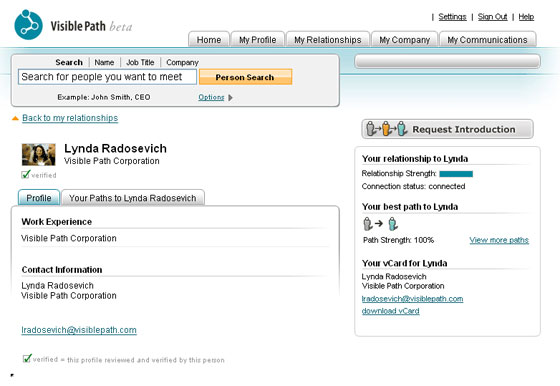
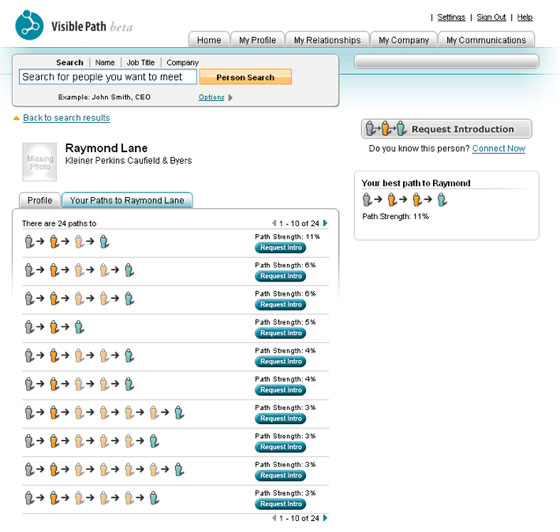
The people you interact with on a regular basis are your first degree contacts. Their contacts are also added to your network, linked by the chain of other contacts that connect you together. The strength of your connection to these people varies by the number of people along the chain and the strength of each chain. Your connection strength with contacts varies based on interaction, but can be bumped up to 100% by formally connecting to them. Taking the strength of your connections into account makes it possible to have a stronger connection with someone 4 people removed than 2 people removed from you if the connections between those 4 people are strong enough. That’s something LinkedIn doesn’t do.
Pinging Your Network
For the sake of maintaining privacy, VisiblePath never exposes your extended network to other users. Instead, to find contacts beyond your direct network, you have to search for them by name, job, or company. The results page gives you the most likely result based on that criteria and displays the shortest chain connecting you to the contact. You can also get a list of alternate connection paths as well. By default you only know the identity of the first link in the network chain, but people can choose to expose this information. Each result also has a profile page for that person, similar to LinkedIn, that contains their work experience, education, contact information, and bio. All of this profile information is hidden from distant connections and made visible to closer ones.
If you find an interesting contact, you can request an introduction, or more information on that person from the people along the chain. Information requests must be approved as they are passed down the chain. Each member of the chain can add their own input about the contact, but the last person has the final say on sending the information back to you or not. Introductions are handled in a similar way, requiring each person in the chain to approve the request before your message reaches the final connection.
The company is backed by a total of $22.7 million in series A and B financing from Kleiner Perkins, Menlo Ventures, and Integral Capital. Esther Dyson is also an investor.


Good idea, but tough to pull off. In these kind of deals its always features vs community. Keep the features simple and you have a large community…do vice versa and get the opposite results.
typo: the title of this post says “VISUALPath”, whereas the rest of the article talks of VISIBLEPath.
does it? i don’t see that.
thanks for pointing it out.
Thanks for this post. Even domain name is very intutive.
Regards,
RaJ
http://www.suggestusability.com
typo in RSS feed also : the title of this post says “VISUALPath”, whereas the rest of the article talks of VISIBLEPath
Any word on a Mac version of the software?
I haven’t touched Outlook in 2 years, having switched over completely to Gmail & Gcal, as have several colleagues. Others prefer Firebird and such. I don’t see Outlook continuing to dominate the business world forever; hopefully VisiblePath with integrate other services and applications.
ohh…go ahead, give him a kiss mike
These guys have been around for a few years now, steadily building their business up. Its not just another web 2.0 jokefest. Its a great product.
So it only works properly if you use Microsoft Outlook?
Personally, I think the whole idea of basing a networking tool on frequency of emails is complete crap. Most of my email traffic is with people in the same office (I work at a big bank and exchange a few emails every day with some people). Most of my useful contacts are from places I worked at previously. I don’t use my work email to keep in touch with these people, I use my private email address (which doesn’t change when I change jobs).
The reviewer says he’s polluted his LinkedIn account by including a lot of useless non-contacts. He concludes that LinkedIn is useless. The correct conclusion is that he’s made his LinkedIn account useless by his own actions. Tip to LinkedIn users: never add anyone to your LinkedIn contacts, if that person already has 100 or more contacts. You’ll just be adding a contact-collector like Mr Gonzalez. By leaving such people out, your network will grow much more slowly, but it will be useful.
The real killer, though, is that dependency on Microsoft Outlook. Not everyone wants to live their lives in the shadow of the Microsoft monopoly.
Looks like the site is down (atleast it’s not loading up for me)! TechCrunch overload?
In addition to all the issues mentioned here is that there is an issue with many corporate policies on installing and using such toolbars. This is why I don’t use the LinkedIn Outlook toolbar even though I think its quite nifty.
In the end it is interesting the conclusion was drawn that VisiblePath is useful, and LinkedIn is not. I ask, how useful is a network without critical mass? No offense but I think the business social network space will find itself in the Facebook scenario. You may unleash all the nice features you want but the king of Business Professional Social Networking has been crowned and its LinkedIn.
To unseat them it will take more than nice features, LinkedIn will have to do something very wrong. I suspect professionals are less inclined to switch to the new network du jour than most demographics.
thank you veryy veryy nıce very nice….
Some interesting points there, particularly about the origin of your email account (i.e. if you email people from your gmail, or worse
if you send them web clips etc.) then those interactions aren’t captured. Something that might be easy to underestimate is “the power of serendipity”. On linked-in i sometimes see contacts of contacts and go, “Hey, maybe we should talk to those guys”. I think the guys in http://www.teqlo.com are working on a feature that allows you to mash your Linked-in contacts with other applications, so maybe the proper domain for all this will be a “zillow for contacts” etc.
Though the implementation is interesting it also makes me wonder whether email conversations is the best measure.
For me I use mail only when necessary, I prefer to call people as the interaction is more direct and personal. To be even more precise, with the people I’ve got the best connection I hardly email, but call them frequently.
I agree with the comments stating email measurements can’t solve this problem. I particularly dislike the “atrophy” idea. Some of my strongest contacts exist in the “real world”, where our families get together and play at barbecues. And yet, we might only pass three or four emails a year back and forth.
Or what if I work with someone one year on a team, we forge a strong relationship, but stop communicating regularly because we move off to different projects. I would imagine our relationship is still rather strong.
Mike,
I am a satisfied LinkedIn user; and don’t think your arguments against it hold much water. What was that about ’social pressure’ and having to accept invitations? How do you avoid it in Visiblepath?
And the dependence on Outlook to determine who my first degree contacts are! What is the big value here? I can look at my 200 odd contacts and easily tell which are my “core” ones.
Giri
Most of these comments are spot on — the M$ problem, etc. Let me add one other thing: The idea of having a company scan through my e-mails to determine connections is just creepy.
Using Seth Godin’s rule, this seems to be solving a problem that I don’t really know I have. I mean, LinkedIn could do a better job of presenting some of the connections, but I don’t feel like I have a problem of not being able to use the tool because LinkedIn doesn’t know which of my connections are “courtesy” links.
i like linkedin, lets see this new one works out. I am going to signup for this.
How can I access LinkedIn’s “relationship map”?
yeah - guess This company will give no credit to Linked in? - hmm :/
I am looking forward to this opening up. I do not like the fact that some of these services require a “corporate” address vs. a personal one. As more and more services crop up it makes it harder to “take” your identities with you if you move or change jobs. In your case @techcrunch.com is your own, vs @startup is not. I believe that using a personal email or gmail account would lower chances of entry into the service…until they open it up.
I think visiblePath has an uphill battle to gain a foothold within the professional contact market. I think it will take a bit more than cool sorting features to make folks who have invested time to acquire 100+ contacts in linked in to move.
I certainly don’t want to bother my professional contacts every time a new professional network comes out.
Something interesting and uable for me would be for visiblePath to be a mashup that takes in linkedin contacts. That would make me want to join.
Build something customers want.
Someone tell me the last Webbish fad that featured a proprietary component that went anywhere because as far as I remember there isn’t one.
My sources which have extremely credible inside knowledge of this company tell me both that:
1. Management is solid at raising capital and weak at almost everything else. Apparently they have a history of vastly over-promising and under-delivering to clients, investors, employees and the like; and that
2. Their platform simply does not deliver on what they claim it does. This is for a few reasons surrounding their core (and arguably flawed) underlying thesis that email relationships and email volume = real world relationships and accurate levels of strength thereof. Some results of this misguided postulation, for example, being:
a. Massively overstated relationship strength with people who share your work email domain;
b. Mailing Lists which you may be a party to can show up as people entities; and
c. If you are regularly copied on community-wide mailing lists, the platform can interpret this to mean that you are close friends with everyone else on community list, even despite that this may not be the case at all.
My knowledge of this company runs pretty deep and leads me to believe it has some deep-rooted issues, both in man and machine. One might question, for example, why so much capital had to be raised just to get to launch. Such a question might provide some initial understanding about the disparity between management claims versus execution.
I never wish bad things on any startup and it is possible I do not have the full picture here. But red flags run a plenty.
A final comment to Mike Arrington: Mike, you are publishing what is arguably the most important blog of this industry. You are providing an invaluable service to any self-respecting entrepreneur, a task which carries great influence and responsibility (something you clearly understand) and you are to be complimented for your efforts.
This being said, sometimes I find myself wishing you would take more time to test third-party opinions before making assertions about the superiority or inferiority of a product or predicting its inevitable demise or success. I may be way off the mark here, but I sense that your research/writing process looks something like this:
-Give management great freedom to persuade you about their products. -Gain incredible (very impressive) knowledge of such products.
-Incorporate this knowledge into your existing understanding of the world and/or research competitive and/or relevant products/trends to supplant any knowledge gaps.
-Write
(I’m sure I’ve glossed over the tireless levels of research that get sprinkled overtop and between these steps ad nauseum).
Anyway, what I often find is missing and what I would like to see more often in your posts, is a move one step closer toward traditional standards of journalistic excellence, in which someone with a counter point - or simply with real, third-party credibility - is called on to express a view — a view that is then incorporated into your posts. I think the accuracy and/or credibility of your opinion will increase dramatically if you broaden your due diligence to include discussion with nay-sayers or other arms length people in advance of your posts.
I know you don’t shy away from public debate (simply look at your recent “trash-TC” contest), but it would be nice to see some of this debate happening before you post an article, rather than simply leaving it to retrospective, post-publishing comments and blog-dialogue, trackbacks etc to debate your point of view after the fact. I think this becomes increasingly important as your readership grows and with it, I am assuming here, the potentially enormous disparity between people who read your initial post and form an opinion, versus the potentially much smaller subset of people who take the time to follow up on such posts, read the comments, read the counterpoints on other blogs etc.
I’m a bit confused as to what will be “launched” at Web 2.0.
Visible Path is a 5-year old company, they started around the same time as:
- Spoke Software (they were the first)
- Leverage Software
- there was a 4th, sold early, can’t remember the name.
Last year when they picked up their series-B, all of a sudden it’being featured as the Next Big Thing left and right. Sometimes they are labeled “market leader” - but then again, what is it they are to launch next week?
Am I the only one that thinks you should accept everyone on LinkedIn, if you know them to any extent?
Then should a referral take place, you can then verbally verify the relationship with whoever.
Or have I misunderstood how it is supposed to work?
I understand the concept of social pressure. I was on the sending side on LinkedIn.
I didn’t mean to put on the pressure, but now that I see this article I realize that is what I did. I put pressure on a old acquaintence to add me as a contact. I felt a bit ackward about it and almost wanted to undo what I did, but it was too late.
I know I’m not the only one who has felt the sting of rejection. Have you ever gone up to someone at a conference and been snubbed? Maybe they were trying to schmooze some industry experts and they just don’t have time for you.
Either that, or they just don’t want to corrupt their LinkedIn pool. They might need you someday and as Nick mentioned, they might have just made an enemy. Well, maybe not an enemy, but it may have prevented a useful relationship or just “took it down a notch” if you know what I mean.
Indeed, these guys are old. Maybe what’s new is the B2C angle.
Last I heard of them they were operating solely in the corporate space; selling to VP of sales with large direct sales forces. There promise was to help sales people open leads quicker and close sales by leveraging relationship capital.
I think this is an interesting feature not a business.
The functionality is trivial. The trick is owning the content.
The content is already owned by salesforce.com, Plaxo, LinkedIn and others in this space.
From one day to the other, Salesforce.com can own this market if they add some “find me the link” functionality to their CRM products. Siebel and others could do this too.
For the B2C space I agree with comments above that it’s pointless. I can just look at my Address Book and see who I’m connected with. And, I definitely don’t want to share my Address Book connections with anybody.
I’m surprised VisiblePath hasn’t landed a trade sale in all their years of operation. There must be some issues with their platform. They must have to deal with nightmare integration problems with different contact databases (Lotus, Outlook, Salesforce, proprietary), with names spelled differently (J Smith, John Smith, Johnny Smith) with titles out of date (chap is promoted in June, some records show old title)
PS: What if Microsoft sucked in all the world’s Outlook info into a mega-peta-duper-sized database? With 95% penetration they’d be able to determine the world’s connectivity. Eerie.
I agree that using email frequency and meetings as a proxy for importance/rating is misleading, doubly so for Outlook which is exclusively used for my current work environment. The people I value most in my business or social network is pretty much an independent variable. It’s funny that a simple rating graphic isn’t incorporated to any of these services, although LinkedIn’s recommendation feature is probably close qualitatively.
The site looks great — but is the service actually helping people develop better relationships with their co-workers? Is it possible to develop and algorithm that can “with a high level of confidence” suggest a correct decision? There are many “qualitative” factors that comprise relationships whereas visiblepath hopes to select a few variables that will be the justification of your decision? Can’t we just be candid about where we want to go with all people?
So basically this just tells you who you communicate with most at work?
What if there’s someone you HATE but HAVE to communicate with a work? Would this app call them a valuable contact?
Without taking into account phone calls and physical interaction (which is close to impossible), this is just an Outlook email traffic analyzer.
If you could combine this functionality with LinkedIn, that might be neat. Basically, if LinkedIn offered this app as a download that you could use to add an “email activity” scale to each LinkedIn contact that could be cool.
You have to exchange emails, carry out meetings, or provide a deep level of contact information on their vCard to show a real relationship.
So the computer can understand my relationship with people by getting the context out of email? I’ll believe it when I see it. Maybe it can do simple filtering based on if a company / person was sending me a PR release or I was on a mailing list of their but I can’t see it doing much more than that.
Plus does this mean that VisiblePath is getting a copy of all my incoming and outgoing email? Doesn’t that present some legal problems?
LinkedIn is one of the most useful business services developed in the past few years, and as already mentioned in a few comments, the size and comprehensiveness of its network is where a lot of its value is. So claiming that VisiblePath can be more useful than LinkedIn with no users in its network is a tad ridiculous.
Disclosure: I have no interest in LinkedIn, though Reid Hoffman is a dear friend. I passed on the investment opportunity way back when because I was not convinced of the monetization potential, and have been kicking myself for it ever since.
Jeff - Reid is also a friend, but I have never gotten a single valuable moment out of LinkedIn. I believe people who say it’s great for sales purposes, or doing background checks on potential hires, but from my perspective all it is is a way to spam bloggers.
Just because Reid’s a great guy and a friend doesn’t mean I’m not going to say what I think about it.
i think the link to VisiblePath near the top of this article needs a “www.” before the url?
Zoli it’s how the Web 2.0 world works:
“Last year when they picked up their series-B, all of a sudden it’being featured as the Next Big Thing left and right. Sometimes they are labeled “market leader” - but then again, what is it they are to launch next week?”
Companies in the Web industry just aren’t written about or fawned over unless they raise capital, regardless of how compelling or interesting their offering is. My company has turned down investments because money in the bank is better than debt any day of the week, but maybe we should have taken them so people would ooh and ahh. VisiblePath’s user interface design looks like 10 steps backwards from LinkedIn, I don’t care what extra feature they drop in there, it just looks terrible.
Deleting comments, eh Mike? I must be right.
I’ll say it again…. [deleted]
VC funding is not debt financing.
He who trolls shouldn’t expect his comments to be worth much. I didn’t mind the fact that it was deleted.
jawdawg - sorry dude. you’re going to have to get your own blog if you want to accuse me of unethical behavior.
Thanks for the advice Mike!!!
http://techcrunchwatch.wordpress.com/
Zoli - VisiblePath was primarily focused on the Enterprise market for its product and seems like its following the consumer hype and trying to launch the same product for the masses!! After raising $22.7 MM it might not have found a large enough market in the enterprise world. Also, LinkedIn’s success might have forced them to change their strategy a bit.
Its an interesting idea which works in a limited manner as noted by many commentators that just mining email is not enough to understand your relationships. Also, I might work most closely with my manager and team at a company but might not send them too many emails as they are “right around the corner” to have a direct conversation with. Instead, VisiblePath will tell me that I have a “weak” relationship with them while a high one with a Sales professional in my company who I dont see too often and hence communitcate via email.
From Michael’s comparison of VisiblePath to LinkedIn, it seems that the company is going after the professional market with a consumer angle. Again, its hard to fathom a successful product if it only works with Outlook. One will need integration with Gmail, Yahoo, IM to make it work effectively. Then again the system will need to differentiate “friends” from “professional friends”?
Mike, I will always respect you for not letting your personal relationships get in the way of your writing - you have shredded enough of my own startups for me to appreciate that :-).
I did not write my comment in support of Reid, he is a big boy who can defend himself, I just voiced my support of LinkedIn the service which I have found tremendously helpful in my day to day work.
Mike,
It seems wierd to evaluate the usefulness of a service (linked-in) from a perspective of whether you or Nick, in this case, find it useful. In this case, Nick had a way of dealing with invitations that prevented him from getting good benefits out of it, and presumably Visible Path can solve that specific issue.
So the title of the blog post should probably be
“VisiblePath Is A Lot Like LinkedIn, Except It’s Useful, To Me”
As said many times, LinkedIn works great if you are selective of who you “let in” and respectful of other people. I use it for recruiting (it has been very helpful) and networking (helpful there are well). I share a lot of the concerns cited by others (difficulty in removing contacts, canceling, etc), but those things are cosmetic and fixable.
Wow, I’m late to the comment party.
Vijay,
We couldn’t fit that title all into one line
I think a lot of other people find their linked in contacts meaningless. Being connected to someone doesn’t tell me how strong a relationship is. I’m certain that Tom doesn’t go out for a beer with all his 100+ million friends.
And as to Jeff’s point. The Outlook plugin will cause the network to grow. Email is highly viral and would provide a great way to spread it.
Hi Nick,
You’re suggesting that the real value is in the Outlook plug-in. Our experience shows that 95% users will not install a plug-in and for the other 5%, we have an Outlook plug-in that provides a lot of the convenience and automation features that enhances your LinkedIn experience.
Also, a major factor in a social network’s usefulness is when it reaches a critical mass. LinkedIn currently has around 10 million members and we’re adding about 130,000 users a week.
(Disclosure: I work at LinkedIn)
Free Rapidshare.com Premium account for 6 months
Sign up here-http://www.traffic9.com/?ref=13178
Oh, great. It’s Outlook dependent. Just what the world doesn’t need. No thank you.
Ok, this is interesting. I’ve been emailing with Kay Luo at LinkedIn today about this article. Kay says “BTW, do you know that other than Reid, you’re the most “InMailed” person on LinkedIn?”
That might explain why I have a much different opinion of it than others.
Its hard for this service to make any inroads because of one simple reason - Most people feel awkward bothering their professional contacts with an invitation every time a new professional networking site comes along.
Ok…
This kind of thing demos beautifuuly. I know. I demoed the orginal.
At the risk of going down a path that dredges up all sorts of unwanted baggage….
I was a Spoke co-founder, and drove the integration of an email plug-in to help seed the social network there (in 2002). If email is working for you, you can build other plugions, so any whining about outlook is just silly (Fred). I”m sure VP could copy Spoke there and do Lotus, IMAP, POP, etc.
We also went after the enterprise market, and there were a host of competitors that came out after we got funded in July of 2002, including LinkedIn, Visible Path and Zerodegrees (acquired by IAC). LinkedIn was a pureplay personal network, and they, frankly, kicked everyone else’s ass with regard to creating a social network of stuture, as well as making money (seems to be doing well).
We pitched Esther Dyson (and got written up in Release 1.0). She subsequently became one of the first investors in VP after talking to all of us, judging an industry event where VP, LinkedIn and Spoke all went head to head (LinkedIn won judges panel and Spoke won audience votes) and getting the inside scoop on all this stuff from the folks she talked to. Nothing illegal, but a little annoying.
VisiblePath eventuially got funding from Kleiner, after we decided that Doll would be a better partner for growth (and that’s a decision that seems to have been for the best, given how much they’ve stood by Spoke). Ray Lane, the Kleiner partner seemed to draw from many of the analogies we gave him when pitching Spoke, in talking about VP after they came out with the news interestingly enough.
I love the idea behind all of this (and Plaxo, Ryze, SixDegrees and others have all played a part of this)…But what *we* found was that all the features and relationship strength information didn’t really draw as much interest as the large network that LinkedIn was growing. It demos great (hey check out Social Networking as idea of the year in Business 2.0 for 2003 with LinkedIn, ZeroDegrees and Spoke as the representatives), but the “less features, bigger network” does seem to be the way to go here.
Perhaps Visible Path should copy Spoke’s decision to try and sell information to sales teams, since Spoke has begun to actually make money this way.
They’ve copied everything else.
(Oh yeah, and any startup from New York that subsequently claims to be “Silicon Valey based” can kiss my native Palo Alto ass.)
Just sayin’….
If you want a corporate tool that can visualize and share your network based on communication within Outlook. Microsoft has there own tooling!
Microsoft Knowledge Network: http://blogs.msdn.com/kn/
I think it wil be released witin a couple of months.
My guess is that the guys at Redmond can profide better integration and had a bigger budget (the software was developed as MS Reseach).
This is a really interesting thread. I have to agree wholeheartedly with Mario. Relying on a download/plug-in for an online application is troublesome and is going to have a low hit-rate. It’s fine for a tool or maybe an ancillary widget, but if the primary differentiator of VP relies on this downloaded plug-in, then it is in for trouble. I agree that it’s totally feasible to create more plug-ins for yahoo mail, gmail, hotmail, etc, but then it becomes an even bigger pain for the user (you start involving various usernames and passwords, etc). Not counting the nerds, including me, reading this blog, most consumers hate downloading and installing things related to a consumer site, and they associate downloads with spyware and other unpleasant stuff.
I love Linked In and find a ton of value in it. They are 10 steps ahead, have probably already tried things that VP hasn’t even thought of, and could replicate new features on an installed base of 10 million+.
THANKS FOR THE LINKEDIN ADD, MICHAEL!!!! WE’LL COME SEE UR BAND NEXT TIME THEY COME THRU, LOL!!1
Sounds like zero degrees to me. Really liked that service. Wish IAC didn’t kill it.
Disclosure: I worked for Visible Path (in Engineering) for a year in NYC. I thought I’d clarify some things and give my 0.02c following a lot of negative comments.
I think Visible Path is an awesome idea. Take LinkedIn and add some science to create automatic weight in relationships. Use that weight to detremine which introductions might succeed or fail. The theory is real. It translates into $. You can argue that the system can be abused - take Google - we still use the search engine and the world is trying to abuse it with polluting keywords.
At my time at Visible Path we could scan Lotus Notes and Outlook and had early prototypes for web mail and such. So it’s a matter of time till these get developed. These are just collectors of statistical data, nobody is reading your e-mail. SFDC integration could be awesome too. PBX?
Bottom line, don’t dismiss the idea that quickly. Social Networking is in the stages of word processing ten years ago. We’re just scratching the surface.
LinkedIn has the classic inverse selection problem where folks like Mike C. are going to get pinged hundreds of times a month (that is annoying and filters need to be in place toa ddress), however for the rest of us LinkedIn is actually a useful tool today. There is simply no other place where you can go to reliably basic background info. on people so easily and at no cost. To me this is game over; Spoke, VisiblePath, etc. are not community networks they are overfunded product features.
LinkedIn needs to push beyond Recruiting/Careers:
*Silo’d: it remains a silo, needs to be interegrated with other web-apps e.g. Intuit communities.
*Answers: good quality, but very limited depth in key categories. start engaging users in the services by syndicating this to relevant web apps e.g. Intuit, work.com, etc.
*Services: poor product execution of what can be the eBay or Alibaba of business services. nobody has tapped this market and they are best positioned to do so given they have built in reputation system.
*Business publishing platform: slightly out there but the idea is to integrate with feed readers, social bookmarking, etc. so you could see what people in your network are reading/saying. There are very few people who can provide this level of personalization and LinkedIn should cease this oppty.
A few complaints for the folks at LinkedIn:
*I get the fact that you need to generate some revenues and I am fine with that, but please don’t show me a big display ad for some random movie trailer. With all the info. you have on me (where I live, what I do, where I went to school) you can and need to do far better then that.
*Feature bloat: the homepage is becoming a mess (very yahoo.com’ish). no human can process this much information. There are some tough decisions to make on that page, but it needs to be radically re-designed.
Hope somebody over at LinkedIn is listening before I need to retract my previous statement that this is game over.
Mike, that would explain why you never actually check your “InMail”
Visible Path looks like a very interesting idea. There are way too many companies, where you can’t “escape” without Outlook, so providing a plugin for it will surely help and motivate some people.
Lets see how they will do in the next couple of years, LinkedIn may be big and slow but not that dumb to let anybody to take away their business so easily … =O)
Although I agree with most posters that the Outlook aspect doesn’t seem to add much value (or none, in my case since I don’t use it), I do think that LinkedIn has some serious deficiencies that need to be addressed before it’s even close to being an indespensible resource. These would include better tools for categorizing or tagging one’s links and making it easier to request a link to someone without having to dig up an email address for them. (When I come across a friend-of-friend that I know, I want to just be able to add them directly via a single click. It’s fine if that person has chosen to filter their requests if they’re a high-traffic person but for most of us I’d be fine sorting through an 2nd-tier request folder).
So, although I’ll probably continue to maintain an account w/ Linkedin, I applaud any and all competitive pressure brought to bear on them in the hopes that either something better will come along or Linkedin will be forced to evolve.
Ahhhh… they have major coveragenow but they are down!
too bad!
————–
Maintenance Update in Progress
* http://www.visiblepath.com is temporarily unavailable due to a scheduled maintenance outage.
We are sorry for this inconvenience.
If you would like to contact technical support, please e-mail support@visiblepath.com
————
This is great!
-Steven Burda
Do we really need an application to tell us the strength of our relationships? :>)
I’ve used Linked in for years (from finding a photographer, hiring UI developers, to specialized angel investors and many things in between). These were hard people to find, and all wanted to be found. Many times, the fact that I had a solid network at my fingertips was not just an advantage, it was a lifesaver. Its also been an invaluable tool knowing the relationships between people and companies (previously I had no indepth sense of connection between people and various companies they’d worked over the years).
I find it interesting that people (smart/ communicators/ good friends) still don’t get it. Most of the friends I know who don’t get it are the ones who are more afraid of spam (vc/bloggers); that’s a shame because they are essentially missing out on something very valuable and under-utilized. This is about an entirely different approach towards networking — it is about having valuable information when you need it. Here’s another catch: You don’t always know where that essential piece of information will find its way into your network. Sooner or later you will need it, and if you don’t have a network, it will take you a while to build one.
As I write this, I realize, there’s more: LinkedIn has unveiled a deeper reality and sense of connection with the entire industry - because at the end of the day, its all people and relationships. I’m pretty darn grateful.
dude, visible path is nothing like linked in at all…the main difference: linkedin is linear, while vp is rooted in sna, and vp has stan wasserman involved, and stan is the leading mind (academic) in sna methodologies….i was fortunate enough to interview stan a couple of years ago to talk abotu sna, visible path and other things. will put the link to the interview up shortly if it’s of interest (ran in competitive intelligence magazine for my column)
oh, and to tolles up above: “they copied everything else” - are you shitting me? you folks didn’t have a single original idea - and please do remember, you were simply creative, and being creative is just about knowing how to hide your sources…so before you crap on visible path and suggest that they were copying you, or offer horrible advice like, “hey, copy these other guys” why don’t you simply relax and move on to the next poor execution? approaching enterprises was an interesting idea, but you were so busy chasing every opportunity that you blew it and never realized that corporations needed way more hand holding and way more education - the opportunities were for sales and hr and so on, not corporate wide planning and all of that, that was years away and only after these audiences understood what the hell the network dynamics actually meant…
instead of sounding like you’re on the brink of throwing knives, why not do it right? why not find an underserved niche and pull your “i’m gonna linkedin this market myself” - here are a few for you:
religious leaders/house of worship: over 435 thousand churches, synagogues and mosques in the usa, all with 2-10+ leadership figures and millions of volunteers in managerial type roles (camps, events, etc) - and on, beliefnet is not effectively serving this need, they are spread quite thin trying to cater to all communicants, which is wrong because it’s so constrained…
hs.college transition: guidance counselors, college placement personnel, etc…
The issue is we should neve lose focus on the true objective behind a proffessional (vs. just social) networking site like LinkedIn. I’m sure that you have invited people to join your LinkedIn network because you deemed them USEFUL professionally for your interests, know them personally or not. Frequency of contact does not guarantee this. I could e-mail furiously with my mom all week long, but that doesn’t mean that because of that she is a “valuable business connection”. I think VisiblePath is applying the logic behind teen social sites: the person with whom I communicate the most is my real buddy and, therefore, the most useful proffessional contact. It’s absurd! Real proffessional life doesn’t work that way!
I wish that TechCrunch would actually try products before writing a “review”.
I’d rather the blog post was written 30 days after a product was released, with a real review, than 30 days before with un-filtered PR hype. There already is a site for this content, it is PRNewswire!
Speaking of launch: Visible Path has launched in 2004, and 2006, and now again in 2007? The releases are on their own site. Doesn’t California have a 3 strikes rule?
The Outlook thing was a showstopper for me. Also, I agree with those who say that for someone like Mike, LinkedIn may not be useful, but for us lesser mortals, it’s pretty darn useful. One has to be a little disciplined about it, but it’s been quite useful for me and others I know, and not just for sales.