
Compete Knows How Much Time You Waste on YouTube
by Nick Gonzalez on April 2, 2007

competelogo.pngAll web analytics track your activity somewhere along pipeline connecting your computer to a website’s server. Comscore tracks traffic trends on computers of 2 million users. Hitwise catches traffic at the ISP level and matches it up with demographic data they collected. Compete, Quantcast, and Alexa differ from these other web metrics companies by tracking traffic on the computers of users who installed their tool bars. Each of these services gauge critical marketing metrics such as unique visitors and page views.

However, some people argue that the page view is no longer a proper measure of a website’s heft. New web page design principles such as Flash and AJAX are making constant page requests obsolete. One of the most extreme examples of this phenomenon is Justin.TV where you can log on and never refresh the page. This is great news for web users, but it’s sowing confusion among advertisers over how to peg a site’s true advertising appeal.
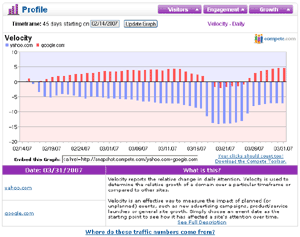
competevelocity.pngComscore, who’s currently looking to go public, has been evolving their metrics to keep up with the changes. They recently announced their “visit” metric after facing some heat by BusinessWeek over ranking MySpace above Yahoo’s in monthly page views last November. The visit metric was meant to gauge user engagement by counting the number of unique requests for a site at least a half hour from the last request. All those pesky MySpace page requests would be lumped into one visit, giving a fairer idea of how often each unique user was engaging with a website each month. It had the result they wanted, bumping Yahoo back on top.

Compete also has a visit metric. But today they also launched a new metric called “attention,” which argue see as a better measure of user engagement. Attention is the total amount of time U.S. users spend on a website as a percentage of total time spent on the Internet by all U.S. users. It’s analogous to Alexa’s reach metric, which tracks the number of visitors to a site as a percentage of total internet users. Compete’s attention metric is like airtime, whereas Alexa’s reach is more like audience size.

According to Compete, we spend about 1% of our internet time on YouTube. Compete also tracks the change in attention over time, called velocity, unique visitors per month, site visits, page views per visit, and average stay.

Advertisement

Comments rss icon

  • Compete metrics are based on the behavior of 2M internet users. Compete’s panel is based on a diverse data set including, ISPs, opt-in panels and the Compete Toolbar. Unlike other panels, the Compete panel is able to compare and contrast its various data sources to indentify and de-bias site inflation/deflation. In many ways, Compete blends the approach of comparative market offerings to offer the largest and most diverse domestic data source available.

    For a comparative matrix across existing metrics providers see: http://www.comp...e.com/help#snp2

  • I guess I am not a typical YouTube user.

    1% makes sense in early days of YouTube days. But in last few week, I only recall couple of YouTube clips that I’ve hit play on.

    -Zaid

  • I spend about 10-20 a week on youtube, 1-2 hours daily on wsj.com and bounce in and out of yahoo finance throughout the day. The rest of my browsing time is spent speed reading for whatever I’m researching at the time.

    I wish I could look at the stats of large advertisers and see what results they get from various site. Sure people may spend more time on certain sites, but shorter visits on niche sites may bring a greater return on investment.

  • I watch interesting videos people post on forums or blogs.
    I don’t activel browse Youtube… I’d rather read than watch the *CRAP* thats mostly there.

  • The new web metric that is gaining currency is Server Calls, instead of page views, for tracking the stuff people look at. People are still visitors, but the old phrase “page views” is essentially meaningless in the age of AJAX and Flash media.

  • At the end of the day… Site owners just need to know what service offers the best, most accurate depiction of our real user base. What numbers can be pushed to advertisers to show true marketing potential. They want to know where to put their dollars… and we want to know how to influence them to put them into our sites.

    I’ve never really trusted statistics from “toolbar” based rankings. Are Comscore and Hitwise still the only real figures we can somewhat trust?

  • @CJAM: “Service Calls” sounds like a metric for how many times a tech had to come out and fix your servers due to overwhelming traffic from sites like Digg. … Then again… that might actually be a viable metric nowadays. :)

  • @ Christopher Sisk

    See TJ’s post above (#1).

    Compete’s panel is based on a diverse data set including, ISPs, opt-in panels and the Compete Toolbar (small %).

    For a comparative matrix across metrics providers see: http://www.comp...e.com/help#snp2

  • good data – is only as good as how we use it ..

    – obviously; YT was a good investment for Goog

  • Thanks for the information. Statistics is very important for a new website like ours. We spent a lot of time analyzing how many hits we have or how long our visitors stay in marksmotos.com

    Analyzing these data really help us gauge what ads work for us.

    kyla
    marksmotos.com

  • Statistics is very important for a new website like ours. We spent a lot of time analyzing how many hits we have or how long our visitors stay in marksmotos.com

    Analyzing these data really help us gauge what ads work for us.

    kyla
    marksmotos.com

  • @ Sisk,

    “service calls” – that’s amusing. To clarify, however… the metric is Server Calls, or files that are called from a Server. A Server Call can be a page or a file hit (with AJAX usually an XML file hit)… the newer web metrics methods let you tag an XML or HTML wrapper with a piece of Javascript, and give the file an identifiable descriptive name so you can easily read your web reports and see what people are using (or “calling from the server” into their browsers or IP connected widgets \ desktop interfaces).

    Omniture, WebSideStory are exemplars of the new wave of web metrics tools to run on your own site, they have some fairly ornate Javascript you can add to pages to track all sorts of events.

    A basic, easy Javascriptie freebie you can try is Google Analytics; at the far end of the spectrum is something like TeaLeaf that lets you actually record what people are doing on a website.

    Things like Compete, Alexa, HitWise, Nielsen are basically web market research tools, not real web metrics tools for individual site owners to use. I imagine the vast majority of web site owners keep their real web metrics very close to their vests, so if you want to do some sort of cross site comparison (competitive intelligence), you’re stuck with toolbar or panel group services like Compete or Nielsen.

    Log file tools don’t cut it anymore for a variety of reasons, including the fact that when a web server gets overloaded, the 1st thing a web server usually does to improve its performance is to turn off the log files.

  • Complete Firefox Toolbar also does a nice job of disabling Google Reader. Sorry Compete, I had to ditch the toolbar. I have to have my Google Reader.

  • Isn’t Compete limited to US users?

Leave Comment

Commenting Options

Enter your personal information to the left, or sign in with your Facebook account by clicking the button below.

Alternatively, you can create an avatar that will appear whenever you leave a comment on a Gravatar-enabled blog.

Trackback URL
bugbugbug