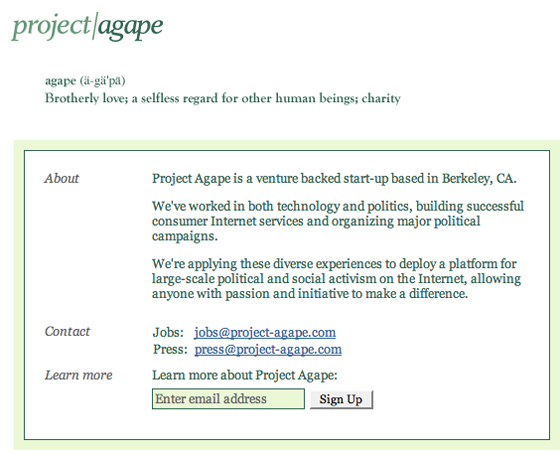
Yesterday I sat down with Sean Parker at his offices at the Founders Fund in San Francisco to see a demo of his new and yet-to-be-named startup (the working name for the project is Project Agape).
Parker is a larger-than-life twenty seven year old who co-founded Napster and Plaxo and was the founding president of Facebook. He’s been working full time on Project Agape for the last eight months, while still putting in the hours at Founders Fund as a Managing Partner.
Parker knows about how to apply viral principles to ideas. Half of our 1.5 hour meeting was spent discussing these principles and how to fine tune ideas to the point where they can grow exponentially. The only thing that can stop a good viral idea is when it runs out of population, he says. If Napster, Plaxo and Facebook are any example, he just might be right.
Project Agape is still under a heavy cloak of secrecy (Om Malik first got wind of the new venture a week and a half ago), although I was able to see a demo and some additional conceptual work. Parker’s goal, he says, is to apply the same ideas around virality that worked so well on his previous projects to the idea of altruism and activism.
Charities, political parties and affinity groups all rely on participation from people who share the same beliefs and ideals. But recruiting and fundraising are largely stuck in the pre-Internet era: social pressure and guilt are applied to get others to donate to that marathon for the Leukemia society, or donate time working with the homeless. Parker wants to harness those proven incentive structures use his new startup to increase their effectiveness.
New sites like Change.org and dotherightthing and Six Degrees help people talk about issues online, but they don’t go far enough in using virality to get new users and get them actually doing things. Parker wants the kind of activity around these organizations that Facebook sees – tens of thousands of new daily users and hours and hours of social interactions. The result, he says, will be a much more efficient engine for organizations to get volunteers and raise money.
The company is based in Berkeley and will make some announcements in the coming weeks, and a beta product will be available in a couple of months. Stay tuned for more.


Whoa. Sounds like another stealthy 3.0 startup in hiding. Hopefully will go beta just in time for the ‘08 campaign. Off topic q – Hey Mike – did you catch the latest South Park? Laden with web2.0 gems. Hilarious.
This is Ben Rattray, founder of Change.org. I think Sean’s criticism of how our platform allows people to discuss but not take real action on issues is, frankly, right on. We’ll be releasing “Change.org 2.0″ soon to address this very issue, which I think may raise some eyebrows.
I also look forward to seeing Project Agape’s approach in the future. I think that social software holds tremendous potential in advancing social good, and am happy to see accomplished entrepreneurs like Sean out there who feel the same.
Ben,
I look forward to the new stuff. Please ping us when you’re ready to launch it.
so is this basically facebook, but it is centered on charities instead of colleges?
Don’t really see what charity has to do with politics, unless it’s to get government out of the giving business altogether. Politically, you can’t be ‘charitable’ except by extracting money from someone else.
If, however, it is a selfless charity I’d expect it to keep users anonymous, but that does very little to help users trumpet how altruistic they are.
It’s not the idea I have a problem with, it’s that the name doesn’t seem to have anything to do with it. Give it a few months and look at the definition of agape again, if it bears even a remote resemblance, I’ll eat my hat. Or a corn dog.
Is this Philotic?
http://www.vent...ises-about-12m/
This is very exciting. Organizations like Kiva.org are doing this implicitly because it is passion driven and so many peope believe in the project. To have a platform that effectively leverage’s people’s altruistic nature and channels that to real action really is the seceret sauce to create lasting change for so many of these socially conscious companies!! Kudos
seems like this super successful person – is ….
capitlizing the act of being ”good” … by make a ”compassion” ”good” company….. backed by money – simply means …
– its another company; just another company –
– but this one is portraying itself as ”good” ……
If this rich guy really cared; would he not, do it with his own money – ?
Will be interesting to see what he comes up with given his track record. I’ve heard some rumors about this startup over the past few months, and most of the skepticism that I have is due to the fact that it sounds like one of the major goals of this venture is to significantly increase the amount of charitable giving in the United States. Creating or significantly expanding markets is difficult to do. The concept of applying viral principles to charitable giving has some very interesting possibilities, but at the end of the day the average American only has so much disposable income that is available to donate to charity. Many (if not most) Americans live paycheck-to-paycheck so I question just how much can be squeezed in this area to make a significant difference.
If run out of population add new products and upsell or cross sell.
http://www.tekn...ld.blogspot.com
“Many (if not most) Americans live paycheck-to-paycheck so I question just how much can be squeezed in this area to make a significant difference.”
Americans are some of the most generous people with their own money (and I”m not talking taxes here, I’m talking voluntary giving).
I would imagine more people would give (or those that give might give more) if they could get a little help sorting out some of the charities that are out there.
However, I question the association of activism with charities. Activism is just another word for lobbyist…
rack pallet:
If one increases the amount that charities receive, even without giving one’s own money, one has done good. Anti-capitalism is quite in vogue. Congratulations for being fashionable.
Drama, there is a lot of room for much more giving. Many people don’t give at all, and when you are paying $4 for a coffee drink you could also be giving to charity. I look forward to seeing what they come up with, but don’t really expect anything radically new.
There is a lot of innovation in this space already, with Kiva.org, Changingthepresent.org and *many* others working to bring people closer to the change they are seeking to make and to create community around it. If you want to see community plus action, go to Care2 (www.care2.com) where they already have 7 million people doing both.
Brotherly love? Maybe he meant philia.
I’m a big fan of http://www.givemeaning.org, which seems to be in the same vein.
Drama, people actually give quite a lot and would like to give more but sometimes don’t know how/where, in light of non-profits plagued by scandal and so on (goodwill, united way). In 2005 the charitable donations in the US alone reached a record high of over $250B. Much of that was due to an outpouring for Katrina (with some of disaster relief fund crowding out other non-profits), but it hasn’t droped much in 2006. It’s growing on average 5% per year.
Interestingly, bequests are down, b/c fewer % are dying (many contributing factors there). I read the annual report published by the Center on Philanthropy at Indiana University which has been tracking this.
Still have to say it again: plaxo (and accucard etc) is evil.
I am not saying that people in the United States are not generous, I just question whether an online platform can successfully increase charitable donations significantly, which I’ve heard is the goal of Project Agape. Of course, this may not be the goal, in which case the argument is moot. I agree there is a lot of room for Americans to give more, but I’m also pragmatic and don’t expect everybody in the country to divert the money they spend on a few cups of coffee at Starbucks to a charity instead. It’s unfortunate, but reality often is.
I agree with Amy that one of the problems in this space is that most people just don’t know where to donate money. There’s a great book called “The Paradox of Choice” by Barry Schwartz and the argument is made that sometimes when we have too many options, we end up choosing none. There are so many charities and causes that deciding which ones most deserve our money can be difficult. Throw in the existence of charity scandals and the fact that it’s not always clear how much of each donation is really going to the cause, and I think it’s easy for a lot of generous people to donate a lot less than they normally would. I’m intrigued by the possibility of applying viral marketing and social networking to charitable giving (i.e. see where people in your network are donating their money, encourage them to donate by agreeing to match their donation, etc.) but what type of impact it will really have remains to be seen.
This reminds me of an ethical consumerism social network called FiveLimes (http://www.fivelimes.com) that has a social network as well as creates clusters based on geolocation as well.
Really excited to see where agape and fivelimes goes as they build critical mass.
Sounds like Sean could be on to a good niche for his new idea. The thing that I think could make this (as well as any other web app) idea powerful is that it’s going to be built around more of a need than a hobby or leisure service.
Micah
http://foodfore...t.wordpress.com
@Drama
I totally understand your misgivings, but its lass a matter of willingness, or null choice than old fashioned branding and new tech.
Example:
Part of the issue involves standard “branding” and how the donation is framed, many small drops lead to a torrent, I’m not talking 3-4$ at a time I’m talking .10-.20c (or less) that would not be missed and can be piggybacked onto a purchase thats already going to be made anyway. Add to this the current available technology and you get an actionable result, localized to your community.
The implications for charaties and activists that understand dynamic social network analysis are huge. Best of luck to Parker and the FF.
“Surging waters flow together” even on the net….
I’m very interested to see what Sean’s putting together. At the same time I’m putting together a site which I hope will end if not minimalize joblessness in our country. Sean, let’s see whatcha got!!!
So my colleague and I were just talking about this article and thought… donations = tax write offs. Is there an biz or industry helping people write off taxes? Could this be it?
Netmuse: “Is there an biz or industry helping people write off taxes?”
Google “donate car” and look for the most common phrase in each result’s description…;)
>
>
Rack Pallet: “If this rich guy really cared; would he not, do it with his own money – ?”
Not sure where you read that he “cared”? If charity and activist groups benefit, what difference does it make who’s money it is and if he derives revenue from it or not?
i think he’s stoned….
What a delightful discussion. It is terrific to see the passion and intrigue (in Mr. Parkers new site) surrounding this topic and the “buzz” that is being created—what great marketing for Mr. Parker. One of the great challenges of the “social-cause” space is that when you look at of these sites and I happen to be a member on many of them, is they tend to look and feel the same. Here’s what I mean:
Many of these cause-focused sites tend to be started by young (under 30), attractive men for the most part, living in the San Francisco Bay area and venture-funded. The ones that are not tend to be in Canada. Now, nothing wrong with being good-looking and living in the Bay area, I used to live there. However, the comments tend to be very myopic in perspective and not very engaging at most of these sites. To be sure, Ben Rattray is probably one of the few gentlemen that seem secure and clearly shows a level of humility about the direction of his firm—warts and all. Big ups to Ben!
But in general, when you look at these social-cause site’s they look and feel—well, the same. The audience tends to be highly educated, fairly young men and women who can “afford” to pursue their interest or passion. When you look at the various communities, the comments tend to be esoteric rants and not very deep in terms of the discussion—even the site with a reported 7 million members.
The other thing is that the elitism with this stuff oozes from many of the comments. It’s as if, your ideas have to be “perfectly coifed” rather than being refined along the way for the Web 2.0 intelligentsia to accept.
Strategically, another site asking for money (donations) is strategically flawed. Too much competition and the need being filled is not compelling—donations and activism. What is missing is the critical thinking and culture around these communities. Take for example, PlumpyNut (solution to malnutrition and famine) and OneAcreFund.org (problem of the hunger season in Africa).
At our site, http://www.spangy.com we are working with OneAcreFund by promoting their site because they have a compelling story to tell—and our community accelerates the discussion. OneArceFund gets the donation should people go there, but they get traffic from us because of the compelling story to tell. Our value proposition is the discussion and engagement about these challenges in a cross-generational context.
To be sure, our site is not as elegant as the others—because it is self-funded by me, and I am not the recipient of previous big payday. I have regular job, but believe in this, which is why I am putting my money and energy where my mouth is. However, I recognized that an international focus of our energy from the start was key, rather than trying to build an audience in the US first with the same small group of people that everyone else is trying to pursue.
Our business model is quite different. While the standard advertising is somewhat important for us, the real opportunity happens when our “solution company” relationships take off and grow, we stand to do well; there are a lot of companies that have great solutions with extraordinary global application, but don’t have advertising budgets. So, not having a lot of money forces ingenuity, which we hope will pay off for us and the solution company. For now, we are working hard to build a truly global community of people from all corners of the globe. For more, check out our video vision at http://spangy.com/about.html.
re: Dan- Yeah, isn’t agape God’s love?
I’ve fallen in love with Robin Hood Fund http://www.robinhoodfund.com It’s got a pretty cool community with wishes granted weekly. Plus, it accepts direct donations to anybody’s wish. A number of users have raised over $1000 from the site. It’s definitely not pure charity, but there are a lot of charitable components.
One of the most interesting things is the number of comments people make on other people wishes. Sometimes the nice comments are more valuable to the person than the money.
For those of you who want to support an initiative which will help charities raise money over the web visit http://ideawarz...brianhouse.com/ and vote for my
onate your change” idea in the ideawarz competition at Cambrian House.
This idea will allow anyone buying something online to donate their change automatically.
cheers
Fazza
Are you kidding me? Look around the web. Just do a google for pete’s sake. Websites like these abound. Another idiotic “social” idea.