
It’s Still Very Early, But Scribd Looks Like A Winner
by Nick Gonzalez on March 25, 2007

scribdlogo.pngWe reported on the launch of Scribd, the “YouTube For Documents” a little over two weeks ago. The site drew a significant amount of traffic at launch. Unlike most startups, though, that traffic didn’t just vaporize after a day or two.

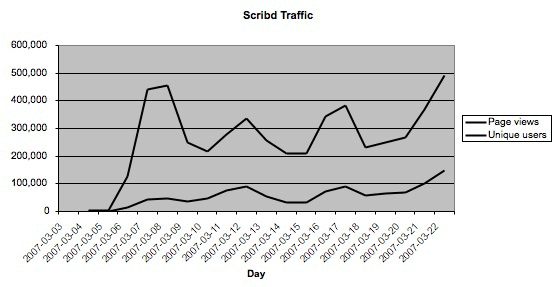
100,000 or so unique visitors come the site daily. 12,000 documents have been uploaded to 8,600 unique accounts (35% anonymous). The team says the site’s traffic has been about an even split between U.S. and non-U.S. visitors (and about half of the documents are non-English). One prolific member, Builder (Bill Allin), has 113 documents to his account. One of these, “Why Intelligent People Tend To Be Unhappy”, was so popular that it got on Digg and was mentioned on Adam Corolla’s morning show.

Scribd is an example of a small startup doing many things right. They created a naturally viral product and made it ridiculously easy to use. Posting and viewing can be done anonymously. More interesting documents get voted to the top for discovery by more users. It also seems to be very Google-friendly – many documents are working their way up in search results.

Copyright holders have been complaining, though. Twenty five DMCA take-down notices have been made against the site to date. In each case the documents were promptly taken down and things ended amicably. However, a noticeable amount of copyrighted material remains on the site, and Scribd has hired Wilson Sonsini Goodrich & Rosati (the same firm retained by YouTube) to defend them on copyright matters. Compared with YouTube, Scribd is better suited to deal with any ensuing complaints. The sheer volume of personally written works on people’s computers will make it easier to not depend on illegally copied works. Copyright violating text-based documents are also easier to detect than rich content.

Scribd will be releasing some new features to improve the user experience, including adjustable embed sizing, groups, and private documents.

Below is a graph showing Scribd’s internal traffic numbers since launch. These internal Scribd stats track Alexa data fairly closely.
scribdtraffic.png

The company a Y Combinator company founded by Trip Adler, Jared Friedman, and Tikhon Bernstam.

Advertisement

Comments rss icon

  • This is definitely the hottest startup in Silicon Valley right now.

  • Oh wait, just kidding, not at all.

  • So where’s your apology? I hope it’s still coming. Those guys from Justin TV are trying to make a decent startup (even if it sounds ridiculous to you), and you just laugh at them.

  • I’m with both of you.

  • It would be great research to see if a few submissions actually aced all or most of the following:

    Digg, Reddit, Netscape, CoRank, NowPublic, Scribd, Flick, YouTube, Delicious
    and any others not mentioned :-o

  • Their marketing guy is doing a great job. There is one user on Digg, I think with the name Michelson (See? I even remember the name), who has had at least 5 or 6 submissions to Digg from Scribd that have hit the front page. I think it’s a great startup. The thing that would make it a really killer app would be to do away with the flash paper, and have it translate everything into normal text and images in a nice, presentable format.

  • This certainly is not a new idea says this blog – check this link
    http://www.irin...hive.php?id=853

  • A “Document Youtube” is much cheaper to run than a video site.

    I wonder if they have competitors…

  • You can check out some comments here (http://www.tech...-300k/#comments), but the closest I’ve seen to the concept are: http://www.youscript.com/, and http://eioba.com/. Scribd by far has the better user experience compared to them.

    Izimi and UGresearch are also other ways of document sharing. UG is aimed at academic papers, and izimi uploads documents through a downloaded app.

  • How about shorttext.com? They have been around for a while, pretty similar, just short on features.

  • I see repository of mostly useless information that would take way too much time to find perhaps a few good nuggets.

  • Youtube doesn’t waste time, they really rely on those users who still can not only watch videos but read or at least make out the letters :)

  • Mike, hope you have also used http://slideshare.net

    It is yet another YouTube, but for Powerpoint presentations and PDFs..

  • 100,000 users come the site daily? What the hell does that mean?

  • Hi, Nick Gonzalez mentioned izimi:
    “Izimi and UGresearch are also other ways of document sharing. UG is aimed at academic papers, and izimi uploads documents through a downloaded app.” but i need to make a small correction Nick.
    izimi doesn’t need you to upload your stuff to anyone, its power is that it lets you instantly make your stuff (and that’s ANY file type) available to anyone and all they need is a web browser to see it. So, its instant sharing without waiting for the upload, and its any file type, any file size, no restrictions on quantity. izimi gives you a simple URL for anythiong you share, then you can use that in any way you like, eg email it, IM it, link in any website, embed in websites.
    Then, izimi also indexes all the stuff that izimi users share in this way in the website izimi.com (www.izimi.com) which effectively becomes a user generated social network, BUT based around all this varied content that people aer sharing (not just video, not just docs, not just photos, etc).
    (I should just declare my allegiance to izimi, since I am the VP Product at the company, but this info is no less valid for that).
    Please feel free to see (or ignore) my blog at http://www.dpingram.com if you like to read news on this sort of stuff.

  • What’s the business model? Saying that a new service “looks like a winner” because it is getting eyeballs is yet another indication that we’re in another eyeball economy. A discussion of how those eyeballs will be effectively monetized to generate sizable revenues and profitability doesn’t seem important. In fact, the Scribd FAQ says the company makes money by “Trip [playing] sax on street corners sometimes.”

    Additionally, the fact that a new startup with “only” $300,000 in new funding has retained a law firm like Wilson Sonsini Goodrich & Rosati is probably not what I’d like to hear if I had invested in the service. While there are numerous non-infringing uses for a service like this and I don’t think a lawsuit against Scribd, at this point, would be as solid as Viacom’s case against YouTube is, the fact that 25 DMCA takedown notices have already been received and I can find, for instance, just by looking at the Scribd homepage, a full copy of Thomas Friedman’s The World is Flat should not be music to investors’ ears. From an investor’s standpoint, when you start having to deal with DMCA issues and the retaining of a prominent law firm just weeks after launch, it should be concerning. Having to divert some of the money you’ve invested to attorneys instead of the building of a viable business is a waste. But what do I know? I usually like to invest in things that make me money – not things that make lawyers money.

    Given Wilson Sonsini Goodrich & Rosati’s ties to the venture capital community, perhaps the investors in Scribd have previously dealt with the law firm and are throwing some business their way? It should be noted that Sequoia, which backed YouTube (and Google), has extensive connections to Wilson Sonsini Goodrich & Rosati. A favor for a favor, anyone? While there can be no doubt that this is a top law firm, founders should recognize that when their investors start hooking them up with law firms, accountants, advisors, etc., they are often helping out long-standing associates. While this isn’t necessarily underhanded or wrong, it may not always be in the best interests of the company in my opinion, and founders should be aware that it happens.

  • “Posting … can be done anonymously.”

    Sounds like spam heaven to me.

  • Drama, some of the time a law firm such as Wilson Sonsini Goodrich & Rosati will work for a small amount of equity and defer their fees until the first venture round. If this was a normal startup, I would advise against the move, but in Scribd’s case, it’s a smart move. Considering their y combinator connections, i’m sure this isn’t hurting them a bit.

    -JLB

  • Nice site. I have numerous uses for this site. Thanks for the tip.

  • Drama – I think the business model concern is very valid. If they can keep costs low and create a real network, they can be acquired without one of course. But it’s always nice to have a plan to someday generate revenue.

  • Hey, let’s hire lawyers to defend us against accusations of infringing on people’s copyrights instead of, oh, NOT INFRINGING.

    Sheesh. I’m getting a bit tired of all of the hype over businesses that enable people to stolen content, then try to paint the people who did the work to create that content as evil. Sorry, but there’s no business model here. I’m happy that the valley is all atwitter… er… psyched about this, but Drama’s point is a good one – how are they going to make money? Youtube clips, original or stol.. ah, ‘fairused’ are short and usually fun. Will the documentd on Scribd have the same appeal? We’ll see, but I can’t see these being embedded on Myspace pages and sent around in emails.

  • Jason: giving up equity to a law firm is one of the poorest decisions a startup can make in my opinion. Don’t mistake this for greed but equity financing is the most expensive form of financing out there and going the equity financing route is something that should not be done without serious consideration. If giving up equity for services, use that equity for services that will build the business and create value. Using it for services that are simply designed to defend you against legal problems doesn’t create any value and is just plain dumb. We don’t know whether Scribd has done this, but the fact that legal issues are already arising hints that the business has some real potential problems.

    I’d also note that given what YCombinator took for the initial $12,000, and now the recent $300,000 round, a decent chunk of equity has probably already been sold unless they got a crazy valuation that would be unjustified at this point. The dilution train is probably picking up steam, especially if they gave up some equity for legal services.

    Note to any startups: if you are looking for janitorial services, Drama-Free Janitorial is willing to provide its services in exchange for equity. Many of our janitors were executives from Internet companies during Bubble 1.0 so you’re getting personal service from individuals who can also provide suggestions and advice on your startup!

    “If they can keep costs low and create a real network, they can be acquired without one of course.”

    Unfortunately that’s the problem we’re facing: far too many startups apparently banking on an acquisition without having a viable business model. In this case, even if they build a real network, the fact that legal issues are already coming into play might serve as a real barrier to acquisition. While it seems obvious that any business with potential legal liabilities would drive away many potential acquirers, this is probably even more true now that companies have seen the outcome of Google’s YouTube acquisition. Google thought it was acquiring an asset and it really ended up with a massive potential liability.

  • This site sounds interesting. I can really see potential for the sharing of documents this way. The number of cool sites that keep getting developed it is great. Finding new sites such this one is one of the things I love about the Internet.

  • I just found another site that allow people to create their own PDF file from over 300,000 pages and titles. Pick up to 10 titles and a one of a kind PDF is created for the member. This is includes the creator personal name on the front cover of each report.

    This is a free service that also includes weekly and monthly undates based on subscribing to the surfer chosen KeyWord.

    http://findallabout.com

  • another good web application to hit the web with success i think..,,

    regards,
    jean

  • Drama, I agree with you that maybe there should be a more apparent business model. In their case though, trading equity (usually a small percentage of it) is a very smart move. They’re a company that is going to have copyright issues. Entrepreneurs can’t be penny wise and pound foolish.

    -JLB

  • I’m with Drama on this one. For the life of me, I can’t figure out how ANY startup can raise a penny without revenue projections. In my opinion, “Get bought by Google for X dollars” is not a revenue projection.

    Perhaps they have intentions on letting people upload their docs and then sell the downloads of them…? I suppose that would work, but then you run in to the problem of the author having to market their document to generate any sales. And if Scribd is only getting a fraction of those sales, they’ll need a ton of docs being paid for to ever sniff the black.

    Interesting product, and that in itself could be a winner. But the financial viability of a site that has no where for me to enter my credit card doesn’t inspire much confidence.

  • # dave

    March 25th, 2007 at 2:32 am

    This certainly is not a new idea says this blog – check this link
    http://www.irin...hive.php?id=853

    dave,

    Here’s the difference:

    TechRepublic is a **waaaayy** vertical market (i.e. “Tech”?). Plus, their site requires registration, givin’ up of your email address, and (I believe) is only available as PDFs.

    The difference *appears* to be that you can take what you’d like…and leave the rest.

    I see this as a “read-only” Writely…I smell an acquisition…

    Just my $0.02.

  • While the market for sharing documents is quite large, the paying portion of the market typically revolves around people who dont want to have the documents visible to everyone, who would rather have an easy way of sharing information with selective individuals.

    The other scenario is that of sharing documents with yourself, i.e. decoupling your critical documents from your laptop or desktop computer, so that they are available to you anywhere. Here again, specific requirements would be the notion of privacy, and search within your documents. We have something that does this and more (but for presentations only). It would be interesting for scribd to morph into a document repository in the ether (for small and medium businesses).

    I’m not so sure the Youtube model is successful if applied to other contexts. Well, I’m not so sure the youtube model is successful even in its own context :) , google acquisitions notwithstanding.

  • This site isn’t going to stand a chance of fending off copyright complaints.

    They don’t get the benefit of the DCMA. While YouTube can at least argue the difficulty of scanning/filtering video, text is *easy* and *trivial* to scan. All a company has to do is tell them, don’t put up any “Simpsons” documents unless you make sure they qualify under fair use, and *that’s enough* to make them liable for any infringing document.

    Hiring the same team defending YouTube was just a stupid decision. These are the same bozos that convinced YouTube that they’d be off the hook. And the way things are going, YT is going to payout several hundred million…if they’re lucky.

  • I don’t understand what problem Scribd is trying to solve.

    If there’s anything Web 1.0 was good at it was putting “documents” online for the whole world to find. Documents = web pages. There are already a ton of services that do a decent job of finding interesting web pages — Digg, Stumbleupon, etc.

    I looked at 5 of the most popular Scribd documents and the content was all available elsewhere as a web page. The only “exclusive to Scribd” content I found looked like it belonged as a blog post (where it would be better served). If someone has good content to share with the world why choose to publish it in an offline format and then upload that document to a website?

    Specialized content aggregation sites make sense for video (YouTube) and presentations (Slideshare) precisely because those types of content are different enough from the page-based model upon which the web is based. But a website specializing in “documents” is like a fish specializing in water.

  • This is really quite a pointless service. The only people who this is legally useful to are content producers who want to put things online but we’re not in 1999 anymore. You can create web sites cheaply and use blogs and vlogs to quickly and easily update information.

    Drama 2.0 – are you the smartest poster on TechCrunch or what? Wow do I agree with you.

    Giving up equity to a law firm is a dumb idea. The only person who should get equity, if at all, is the partner working for you. The firm as an entity has no incentive – free rider problem.

    A revenue model idea for someone:
    - a site where you can BUY (yes BUY) notes from conference speeches

    This would be quite valuable. There are a lot of conferences I don’t have the time or money to attend. If someone just uploaded their notes from these presentations, I wouldn’t mind paying a $1 or $2 per session. For one conference, that’s probably $30-$40 worth of notes. 10 conferences a year that I care about – okay I’ll pay $299 for a year’s subscription to all conferences in my vertical. Oh wait! That’s not a Y-Combinator model! Who would ever acquire a site that actually has paying users (GASP!)

  • “Youtube for documents”?
    Kind of sounds like… the Internet.. and a search-engine..

    People have already been publishing their documents and texts (blogs anyone) forever. How is the utility of Scribd any different (or better) to that of Google?

  • Great idea! Probably wont become as popular as YouTube though.

  • I just went to scribd and checked it out and I really liked it. It sounded familiar and I realized I know some guys in Los Angeles that are getting ready to launch a similar site with some additional features. Check out docstoc.com and blog.docstoc.com

  • There are a lot of folks experimenting in this space. Another brand new entry is OpenFloodgate. This site is designed for authors, poets, illustrators, etc with polished work that they want to share with the world. Right now it accepts .doc and .pdf files. It is more like a magazine than a blog. One cool thing about OpenFloodgate is that you can set up a group/club on the site so that folks in writers groups or classes have a place to share their work and decide if it is public or private. Check it out: http://www.openfloodgate.com

  • Matt: I like docstoc’s idea of leveraging ThinkFree’s viewer for viewing the documents right in my browser, without having to download the actual document and having to open it with the corresponding application (Acrobat or Office). I can’t wait to play with it.

  • I appreciate and applaud the Scrybe site design – especially for its many accessibility features, but it’s become like the Wild West over there.

    A casual glance just now shows at least two documents about explosives – like we all need more of those – in the first three browse pages. While I actually can see that there are genuine bomb/explosive historians and lovers who would be thrilled with that information, I find it much easier to see how this site could be used to do a *lot* of harm.

    I can see the usual cop-out clause “Scribd does not endorse any User Content or any opinion, recommendation or advice expressed therein,” but I’d much rather see a huge “Is this content objectionable ? Press this to let us now ASAP” button.

    Scrybe’s developers are interested in protecting the privacy of under 13 year olds, but are happy to print recipes that show lunatics how to blown those kids and their parents to pieces. Why?

    The internet is superb and is, I believe, a factor that will continue to change things for the good, but we do also have to make sure that the knowledge of how to do harm isn’t freely given to those who would harm us.

  • Scribd is a great idea that has been well-executed. I’m glad to see that they are attracting a lot of attention.

  • Definitely check out http://www.openfloodgate.com — free community site and central posting place for writers. Yes, Jay, websites are an easy alternative for many people, but there is a huge population out there that doesn’t want to or can’t put up a whole website — they just want to share miscellaneous stuff they’ve written with friends, family, the world.

  • Check out http://www.wattpad.com as well. It is similar and works on both PCs and mobile phones/PDAs.

  • Almost two year later and scribd seems to be the winner of online documentsharing, it is often called the Youtube for documents. What a job the guys did.

    Obama used Scribd to publish his documents to get elected in his crossmedia campaign. See the article at http://www.docufacts.nl (dutch language)

Leave Comment

Commenting Options

Enter your personal information to the left, or sign in with your Facebook account by clicking the button below.

Alternatively, you can create an avatar that will appear whenever you leave a comment on a Gravatar-enabled blog.

Trackback URL
bugbugbug