Seriosity To Fix Email Overload (or not)
by Michael Arrington on February 28, 2007

Seriosity has a solution for over-crowded email inboxes. If you want someone’s attention, you’ll be paying for it.

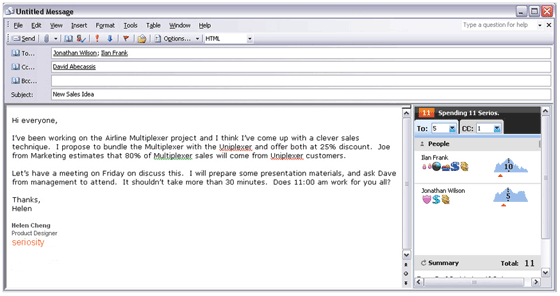
The company’s hook is that they’ve studied World of Warcraft and other multi-player games and believe they’ve found the right way to get people’s attention – virtual currency. You attach a payment to an email, called a Serio, which is transferred to the recipient. The recipient is able to determine how important an email is based on the size of the payment. When an inbox is overcrowded, presumably the reader will sort through to the higher paying emails.

This strongly reminds me of beenz, a Web 1.0 currency that would be handed out for doing various things, like visiting web sites, that users otherwise wouldn’t be bothered to do. The company fell apart just after the Nasdaq tanked earlier this millennium.

What isn’t clear is what people can do with the currency other than send emails. Let me convert this into cash or frequent flyer miles or something else, and I’m in (beenz did this). Otherwise, what’s the point, other than to amass a stunningly large number of Serio and then spend it on…sending emails.

The company, founded in 2004, is based in Palo Alto and is using $6 million in venture capital to feed 27 hungry employees. See CNET for more.
Advertisement

Comments rss icon

  • A concept like this has an incredibly high critical mass they would need to reach. For example, what is the point of me sending an email w/ Serio attached if the recipient doesn’t use Serio? In addition, I can only sort through my email and determine which ones are most important if the majority of them have Serio attached to them.

  • Solving email overload by creating yet another thing I have to remember now. Lovely. The solution to email overload is the same as the solution to the blog overload: UNSUBSCRIBE!

  • They should dole out cash and call this MoneyForMail

  • Don’t forget flooz.

  • How is this different from sending a mail with a “priority”?
    Instead of high/medium/low… you probably have more levels to it…. unless you can redeem the virtual currency for something tangible (and not something virtual like second life).

  • Argggghhhh. What element of consumer demand is really driving this service? As a consumer, do I feel the need to prioritize adverts that I get in my inbox? Nope – they’re all the same to me – spam.

  • This can only work in sales leads generation and should be done as a website not as email. For email, GMail should add a button to sort by time spent and by amount of clicks. that would get 90% of the problem solved.

    Alex

  • Wait… how did they get venture capital? $6 million at that? This is insane. Besides, Gmail and Yahoo do a bang up job of filtering out email as it is and I’d rather not have to remember to send .. uhh… “Serios” along with my emails. This’ll flame out in a year or two. I’m guessing they can last that long on $6 million.

  • #7 dreadsword

    Umm.. people don’t click to see the actual site now these days to they? Its “Enterprise” not “consumer”…. so basically telling which internal corp email is more valuable or not.

    So technically it DOESN’T require mass adoption… just adoption by an enterprise.

    Frankly, having worked in big, med, and small companies (admittedly as a peon developer), I haven’t had these “internal memo overload” issues, but I’m sure the CXO’s, marketing and HR might.

  • Was the funding in Serios? “Serios A round”? Liquidity preferences allow you to send more emails?

  • At least it is semi-original.

    I agree with the poster above who mentioned this is why we have messages marked as priority or important.

    I am guessing they have something else up their sleeves because this idea alone isn’t going to take them where they want to go.

  • geez, what a bunch of haters you guys are……

  • Interesting, because I found http://www.paidmails.com yesterday.

  • This is an interesting concept that could work in an enterprise setting as mass adoption would be necessary, but I’d be curious how the system works. Does the CEO get more points than a mid-level manager?

    I’m not really sure this is the solution for overload in the office, but giving someone a finite amount of cred to spread around certainly would make me think twice about cc’ing the whole office.

    Also, be advised, #14 Andy’s link will spam you with a popup video.

    Cheers,
    Randy Stewart
    randy@boxbe.com

  • didn’t bill gates publicly abandon the idea of email stamps a few years ago?

  • This might be the stupidest idea I’ve ever heard of.

  • What sucks is that the more important the email is for me to read, the less I should have to be paid to read it. The extreme case is when I need to read an email so much, I’ll pay to read it.

    What this does is allows spammers to go to the top of my mailbox. Wonderful.

  • We are looking for bloggers to write for our website. We allow authors to earn 100% of revenues from ads in their posts. FInd out more: http://www.busi...money-blogging/

  • I can’t believe VC’s funded this……. it’s called a priority button people.

  • When I am President of Earth, the people who gave this money will be strapped to wooden poles on live television, and an endless stream of willing passers-by will get to slam frying pans into their faces.

  • I wish we could prioritize comments on TechCrunch, don’t you agree #19?

  • This is another stupid idea. How do ideas like this ever get funded?

    Does anyone prioritise opening their regular mail by looking at how many stamps are on the envelope? No, they do so by looking at who sent it.

    Does anyone prioritise the movies they watch based on how much money was spent to make it? No, they do so based on how interesting the movie is.

  • I’m with you Anthony #22. Ugh.

    Randy Stewart

  • This is a terrible idea. 1. Does anyone get THAT much email? 2. I would never use software that allowed someone else to determine the priority of my email coming in. 3. Both senders have to use it, so assomeone mentioned, the critical mass is huge.

    Anyway, I am hoping that there is something more going on here b/c as described so far, I don’t see this idea as being interesting or useful.

  • 1. Does anyone get THAT much email? 2. I would never use software that allowed someone else to determine the priority of my email coming in. 3. Both senders have to use it, so assomeone mentioned, the critical mass is huge.

    Anyway, I am hoping that there is something more going on here b/c as described so far, I don’t see this idea as being interesting or useful.

  • Some of these comments “get it” and some don’t. Right now, Attent is focused on solving the information overload problem in corporate email. It’s not for consumers and isn’t for Yahoo, Gmail, etc (at this point in time). In big corporations, information overload is a massive problem that consumes hours of people’s time every day. By utilizing a synthetic economy – and a SCARCE currency, people will need to think about what’s important and what’s not rather than just hitting the “reply to all” button.

    Our system, which is an Outlook plug-in, makes it very easy to attach Serios to an email while being able to see important information about people to whom you’re sending emails (i.e. what is the average number of Serios they’ve received)

    We expect that Serios may be used in other areas after they gain acceptance in the corporation. Additionally, there are some interesting social networking aspects to our technology as we are able to map communication patterns within the corporation.

    This is a new and different software application but the level of interest from corporations is astounding!!

    Ken Ross – CEO

  • Someone who can really fix the spam in email problem gets my vote.

  • What if something like this was done where you give an email an actually value (credits can be converted to cash) and the recipient would choose to accept the payment or deny it after viewing the email- this is assuming the recipient is trusted and would deny it if the email was legitimate. Obviously there would be issues of abuse by recipients… but maybe a ratio of accept/deny could be viewed by senders.

  • I don’t think this scheme would not work. For one, anyone using it would devalue it so much that it wouldn’t be worth using simply because the most important emails are the ones from your boss, your clients and your family.

    If those are not your priority and they need to send you Serio dollars to get your attention then something is wrong in your life. So who’s left, reputable companies and spammers. And if reputable companies use Serio dollars they’ll use respect really fast. And spammers would just devalue it.

    So what’s the point?

  • i don’t think the problem is that the emails aren’t prioritized – pretty much everything sent from people you work with is bound to be at least somewhat important and probably needs to be read at some point, so who cares if it’s at the wrong time, the time still gets spent.

    the problem isn’t the quantity of emails received, either. the real problem with email (excluding spam) is how compulsive people get about it, constantly checking it, dropping whatever they’re doing to check it or read the latest email, etc. i think a study just came out about how big a timesink this is, it’s like pulling the fire alarm 20 times a day in the office. i have no sources.

    also, what does installed software like an outlook plugin have to do with web 2.0?

  • I am part of a Fortune 500 company. I have a smartphone to check my email.

    We use Windows 5.0 mobile. As of right now, I can tell the priority of the message in one of three ways.

    1) The author (If it is my boss, it is always important)

    2) The title (self-explanatory)

    3) The priority

    I can use all of this before opening up the email, thus helping me prioritize.

    Serio seems to be a nice addition but nowhere near necessary, or a “must have.”

    To the guys wonder how this company got 6 mil in funding…take a look at the backgrounds of the people involved.

  • re#29: Rajiv.

    The closest to your scheme would be a company called Vanquish based in MA.

  • super serial

  • This is obviously for internal email within a large corporation and I totally see the value in it. It sounds like a lot of the people writing the previous comments have never worked for a large corporation. If you receive 300 emails per day from within your company then it can take hours per day just to go through it all. This would help productivity immensely by making it possible to concentrate on the really important emails.

    And as for the “use the priority button” comments, if everything is marked “high priority” then that obviously doesn’t help anyone prioritize.

  • Re: #35 Catherine

    I’ve worked for a large company… one of the largest..as a developer and never saw the need for it. I had to read almost all my emails from colleages and bosses, so I never felt the need to “concentrate” on anything one of them.

    What role did/do you play in the org that you find the need for it?

  • I think Seriosity is on the right track with their model of trying to change the sender’s behavior. And Ken Ross is right that this type of solution is only appropriate within organizations. It is impractical for the consumer world for all the reasons that that the other readers have listed above.

    The challenge with information overload is that the sender pays little or no cost for sending the message. The burden is placed on the recipient. New communication media arrive and exacerbate the problem for the recipient.

    At our humble little company (funded well south of $6M), we took a postage approach and applied cost to internal email. Like all things, when something is free, we waste it. When something costs, we conserve it.

    There is definitely resistance among employees. But the email overload occurs due to the network effect of employee groups. And I believe that the entire network of users within an organization will need to reduce what goes through their email outbox in order for recipients to achieve a reduction in their email inbox.

    Bob Hiss
    http://www.getbacksoft.com

  • Money will never be the solution to managing “e-mail overload”. I think it’s a silly idea to “bait” people with money to read their e-mails. This is a major detour from the original spirit and concept of e-mail and we shouldn’t be trying to bring any concepts of snail-mail to the online world.

    The only solution to e-mail overload is smarter software and we can accomplish this without user intervention. The same is also true for spam. We can surely develop a more innovative solution than this.

    Finally, if these guys can land $6 Million in financing for something like this, then we all need to start lining up for venture and angel funding. All I want is about $50,000, which I’ll easily double or triple in under a year’s time with new deals, subscriptions, etc. Sitting on a cash cow is no good when you cannot afford to market it to a larger audience.

  • Sorry guys this is complete BS, it would have been since to see Arringtons actual comments on this company (yes I mean personal comments / thoughts rather than what they do)

    Where do people find the investors to put $6m into something like this, presumably the VCs really don’t care about throwing money away?

    TC deadpool here comes another :)

  • Sounds basically like a Google Adwords scheme, but for email.

    If you want to send an email you have to “bid” a certain amount to get to the top of that person’s email inbox. (You can also see how much it would take to do so)

    It might work very well with a bit of tweaking. I wouldn’t write it off just yet, people.

  • @Jessup

    you’re right, this is the next big thing….for me to poop on!

  • give me free stuff

  • I think it is obvious that this is geared towards corporate email problems. And yes, clogged inboxes are a problem in an company. At least for management and knowledge workers. There is no debating this point. (It seems most poster do not fall into this category if they don’t recognize this as a problem.)

    I think the objective is to change the behavior of the sender, not just the reader of the email. People always hit reply to all or send emails to show ‘how smart they are’ or that ‘they are working hard’. That is what clogs email and a lot of the important messages are lost in the clutter. If this can get people to think before they click send, I’m all for it.

  • VC’s (founder is a former VC), CEO’s and HR would probably love this, since they think their “attention” is valuable.

    Everyone else… not so sure. But since all it takes for success are VC and CEO buyins, so I’m pretty sure this company has a bright future.

  • yeah this is funny, much like MINTMAIL.com which paid you 5 cents for email you read, and also 3 cents for every email a referral read..

    – I at one point had 30 referrels and was making $17-20 a day for doing absolutley nothing. Big money for (a fifteen year old) ..

    – The point, making a currency for emails doesnt work. Unless you do it for every single email everywhere!, also – it would need to be real money.

    Go to video.google.com type in “EngEDU” then look for one about spam. And learn what you didnt know, its amazing – Rb

  • Your company advocates a:

    ( ) technical ( ) legislative (X) market-based ( ) vigilante

    approach to fighting spam. Your idea will not work. Here is why it won’t work. (One or more of the following may apply to your particular idea, and it may have other flaws which used to vary from state to state before a bad federal law was passed.)

    ( ) Spammers can easily use it to harvest email addresses
    (X) Mailing lists and other legitimate email uses would be affected
    ( ) No one will be able to find the guy or collect the money
    ( ) It is defenseless against brute force attacks
    ( ) It will stop spam for two weeks and then we’ll be stuck with it
    (X) Users of email will not put up with it
    ( ) Microsoft will not put up with it
    ( ) The police will not put up with it
    ( ) Requires too much cooperation from spammers
    ( ) Requires immediate total cooperation from everybody at once
    (X) Many email users cannot afford to lose business or alienate potential employers
    ( ) Spammers don’t care about invalid addresses in their lists
    ( ) Anyone could anonymously destroy anyone else’s career or business

    Specifically, your plan fails to account for

    ( ) Laws expressly prohibiting it
    ( ) Lack of centrally controlling authority for email
    ( ) Open relays in foreign countries
    ( ) Ease of searching tiny alphanumeric address space of all email addresses
    ( ) Asshats
    ( ) Jurisdictional problems
    ( ) Unpopularity of weird new taxes
    (X) Public reluctance to accept weird new forms of money
    ( ) Huge existing software investment in SMTP
    ( ) Susceptibility of protocols other than SMTP to attack
    ( ) Willingness of users to install OS patches received by email
    ( ) Armies of worm riddled broadband-connected Windows boxes
    ( ) Eternal arms race involved in all filtering approaches
    (X) Extreme profitability of spam
    ( ) Joe jobs and/or identity theft
    ( ) Technically illiterate politicians
    ( ) Extreme stupidity on the part of people who do business with spammers
    ( ) Dishonesty on the part of spammers themselves
    ( ) Bandwidth costs that are unaffected by client filtering
    ( ) Outlook

    and the following philosophical objections may also apply:

    (X) Ideas similar to yours are easy to come up with, yet none have ever been shown practical
    ( ) Any scheme based on opt-out is unacceptable
    ( ) SMTP headers should not be the subject of legislation
    ( ) Blacklists suck
    ( ) Whitelists suck
    ( ) We should be able to talk about Viagra without being censored
    ( ) Countermeasures should not involve wire fraud or credit card fraud
    ( ) Countermeasures should not involve sabotage of public networks
    ( ) Countermeasures must work if phased in gradually
    (X) Sending email should be free
    (X) Why should we have to trust you and your servers?
    ( ) Incompatibility with open source or open source licenses
    ( ) Feel-good measures do nothing to solve the problem
    ( ) Temporary/one-time email addresses are cumbersome
    ( ) I don’t want the government reading my email
    (X) Killing them that way is not slow and painful enough

    Furthermore, this is what I think about you:

    (X) Sorry dude, but I don’t think it would work.
    ( ) This is a stupid idea, and you’re a stupid person for suggesting it.
    ( ) Nice try, assh0le! I’m going to find out where you live and burn your house down!

  • #46 Eli

    Nice try posting the Final Ultimate Solution to the Spam Problem (FUSSP) questionaire. But this has nothing to do with Spam at all.

  • I don’t think this is a reallity.

  • A novel idea, but there is no way in hell you’ll get the drones in corporate america to change their behavior. The net impact of this system will be nil.

  • $6million and 27 employees to develop a currency-based priority flag for email? Anything beyond a 3-state priority system is overkill and Outlook already operates on a 2-state system (I don’t think I’ve ever seen an email flagged as low priority). Priorities are entirely relative to the sender not the receiver. Someone’s 8 is another person’s 6. In my opinion, artificial economic constraints are a poor substitute and inducement to good user behavior.

    I’m also wondering about this claim to have studied World of Warcraft. Warcraft has no mail prioritization system. All communications in Warcraft are handled by instant messaging with no constraints other than user blocking. The mail system in Warcraft has almost nothing to do with communications. It serves as a medium for conducting trade and moving inventory – like working with Fedex or UPS. Mail is very limited in Warcraft because it’s extremely cumbersome to use – you can only check mail in limited locations and it has delivery time constraints. There’s a small fee but it’s entirely inconsequential to the user. Blizzard never implemented the fee to promote a certain type of user behavior – it’s only there as a “sink” to help prevent in-game economic inflation.

Leave Comment

Commenting Options

Enter your personal information to the left, or sign in with your Facebook account by clicking the button below.

Alternatively, you can create an avatar that will appear whenever you leave a comment on a Gravatar-enabled blog.

Trackback URL
bugbugbugbug
Techcrunch on Facebook