
My Currency is launching another take on the wisdom of the crowds, this time aimed at the real estate market. Unlike Zillow, My Currency derives its housing valuations from the marketplace of user opinions by having them assess properties as over or undervalued along with the strength of their conviction. For instance, if I feel a house in San Francisco for 11 million dollars is overpriced, I vote for what lower price I think is right as well as how strongly I feel that on a 1-10 scale. The conviction of my choice and the accuracy of my past votes play into how much I can affect the valuation and price trend of the home. Home listings are a bit sparse at the moment, and rely on self listing.
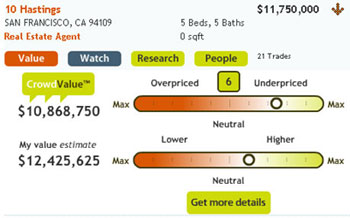
The hope is that experts and real estate agents will be drawn to the site and its users as a lead generation tool. Quality lead generation has been a problem for online realtors. Founder Karim Tahawi says that 2 out of 3 internet leads produce no sale. The site will allow realtors to make one on one contact to buyers by answering direct questions or attracting clients with their reputations. Experts will establish themselves by their voting records and distinguish themselves as the best at valuing different cities or neighborhoods.
Why be honest in your valuation? My Currency answers this through a reputation score that consists of your past performance valuing homes, contributions to the site, and popularity of your additions. These all play a part in the formula that weights your vote on a property. Contributions are measured on the volume of contributions to the supporting blog, wiki, and Q&A pages. Users that produce more frequently viewed content or selected answers, will have higher popularity scores.
My Currency is San Francisco based and currently angel financed.


There seems to be no end to the number of useless services people launch…
Somehow the original concept of peer production is lost on the web 2.0 scene. I’m sure people will flock to this site and rate unknown houses because they love to have higher popularity score or reputation or whatever the hell they want to call it
This has pontential, assuming ppl don’t pollute it with bad data. Zillow right now tends to over estimate the value of houses in my area by 15%. I pulled this number by looking at homes for sale in my area, their current sale price and what zillow zestimates.
“The hope is that experts and real estate agents will be drawn to the site and its users as a lead generation tool. Quality lead generation has been a problem for online realtors. Founder Karim Tahawi says that 2 out of 3 internet leads produce no sale.”
If that is true – 2 out of 3 don’t produce a sale, does that mean that 1 out of 3 does produce a sale? Not a bad closing ratio for a business that pays 6% (or whatever % of) on the sale.
This could work provided people dont end up spamming it or misusing it.
Just wondering is there any added security built in the site, like remembering the IP address or spam filters?
I’m not sure that expecting people to enter in housing data and expecting others to find and value that property is going to work and grow quickly. That’s too much work for the user – let’s admit it, we’re pretty lazy when it comes to our web app interaction.
We’ll see though, it could really take off and prove us all wrong.
This is an excellent way to share wisdom of the crowd.
Decision based on polling is a great idea.
I think the bigger issue to deal with here is user royalty.
Say Mr. A is looking for a house then this site could be absolutely vital – once Mr A. has purchased his house you think he would be still blogging/contributing to it.
To me it seems its a Space for Estate agents which obviously is a smaller niche
“If that is true – 2 out of 3 don’t produce a sale, does that mean that 1 out of 3 does produce a sale? Not a bad closing ratio for a business that pays 6% (or whatever % of) on the sale.”
That was exactly what I was thinking- even 1 out of 20 isn’t bad for such a large commission.
Whats up with the pooh themed color? Man.
@ 9 Matthew: was thinking the same thing as i read it. 1 of 3 leads from little work on the internet seems excellent to me.
also, how do they rank people on accuracy? doesnt this assume the house is either sold or appraised for real, and that the site learns the true figures?
Here is another interesting way to look at this space from a realtor’s point of view.
http://www.rain...tate-20-company
The thing is, groups (investors, agents, etc) could band together to push up or down the price of a neighborhood. Competition between neighborhoods could get out of hand and ultimately, the information becomes useless (if it’s not already). Even worse would be those groups that are strongly for eminent domain, they could push the value of house/neighborhood to new lows in the quest for government granted land. Of course, this is one area I’m a conspiracy theorist.
Seriously, I just see a bunch of fighting and trying to game the system… not really any value for buyers or sellers. I mean seriously, who’s going to push down the value of their neighborhood? And who isn’t going to push up the value of their own house?
It doesn’t matter what the crowd thinks. If one person thinks a house is worth more than than the crowd, he will buy it regardless of what everyone else thinks. Then the comparables for that area are now skewed. Point being, it only takes on person to skew values, regardless if everyone else thinks that guys an idiot.
Nobody really cares or should care what the crowd says about a property. The comps? Sure. The AVM? Okay. The bank’s appraiser? Yes! The crowd… well, maybe not. I either want it or I don’t. Sorry, but this one’s DOA IMHO…
i was wanting to get into real estate!!..check out techcrunch on http://www.rankmyblog.net it has 4 votes but my blog has 6!!:)
the site looks like it was put up in a weekend. TRES MERDE
Kinda agree with CrunchBack and a few others on this one. Need some way to make it less prone to gaming by neighborhood. More fundamentally, though, the biasing the votes by reputation — especially based on site contributions and popularity — pretty much eliminates the wisdom of crowds effect. It’s a system for manufacturing “experts” that can then sway the crowd – but the crowd effect only works when people’s votes are independent and there is little communication between voters.
I’m surprised this website got covered. It is too early for a launch. I actually think the idea is clever if they can get traction, but they should have seeded their database with basic pricing data before launching. For example, I typed in my area code, 94306, and don’t get a single match. What is interesting is that I live in Palo Alto so that tells me that they have NO traction AT ALL and it is of zero use to me. By launching on TechCrunch people like me came but it will be hard to get me back there. If they had populated with basic data first or contacted TechCrunch after having a moderate usage base they would have gotten more bang for the buck. But … I do wish them well. I’m a big fan of James Suroweicki’s work (http://en.wikip...isdom_of_Crowds) and a big believe in crowd ability to predict.
In other news, Best Buy announced it is only selling products to 2 out of 3 of visitors to its stores.
Best Buy II, the newly launched chain will “make up” for this anomaly and guarantee to sell something to every store visitor.
This SOOOO badly calls for gaming
Can someone please explain to me how a brand new site launches with hundreds and sometimes thousands of registered users. Am I crazy or does that seem odd to anyone else.
Karim here, Founder of My-Currency. Apologies for the belated response to this thoughtful discussion. I very much appreciate the feedback and consideration!
There seems to be concern that we haven’t thought through the gaming aspect of using markets. Let me just say, I have been a derivatives trader for 15 years and Vice Chairman of the Pacific Exchange (now part of the NYSE) and so gaming is front and center for anyone in the financial markets – its called, among other things, ‘painting the tape’, ‘cornering the market’ and ‘insider trading’. History is filled with these stories so this is nothing new and I have experienced all of these first hand. This is largely why there are regulations in the financial markets via the SEC, CFTC and others.
My-Currency does have anti-gaming algorithms in place but they are turned OFF because we want to observe behavior during our Alpha period. Long-term, we believe that if My-Currency can grow a large and diverse enough community, we won’t need anti-gaming algorithms because price inefficiencies (prices manipulated to achieve some real world outcome) will be exploited by people who have opposing incentives or those who are motivated by or aspire to achieve reputation. The best thing that can happen, if you are trying to make your mark within the community, is to hunt down prices that are misaligned with reality and bring them back into line – and therefore earn community status (reputation currency).
Bottom line: Will there be gaming? Yes – even the financial markets observe this. Can gaming be managed? Yes – explicitly through our algorithms and organically through community. Can markets get it wrong? Yes but the question is whether markets will outperform individuals over time (the answer is yes).
For a fuller post of my thoughts, please go to http://www.my-c...om/blogs/karim/
Having said all this, we have a lot of work to do get the model right which is why we have limited our launch to San Francisco during this public alpha. Thanks and I look forward to hearing from you.
Hello everyone,
I think at the least it is a good experiment. Although it does rely on input from the general public on pricing, it is not the general public that has the ultimate say in what a home is valued at. It is the buyer of that particular property that ultimately sets the value of what the property is worth at that particular time in the market.
There in lies the beauty of the lazi-fare free market with no regulation on pricing, prices go up in high-demand areas, and remain low in lower demand areas. While a home in San Francisco may be valued at $11 million the same home sitting on a chunk of land near Des Moines, Iowa would sell for far less. The Value… ultimately is in the land, not the structure, and I’m sure anyone living in such a rural state would think homes in San Francisco are exorbitantly priced. So, depending on input and where their bias lies, this site will only reflect the input of people interested in it.