AOL Founder’s Next Startup: Revolution Health
Michael Arrington
54 comments »
AOL Co-founder Steve Case, who left Time Warner (AOL’s parent company) in 2005, has effectively launched his next startup - Revolution Health. The domain name still shows a landing page, but the preview site is wide open to all comers.
Revolution Health is not a health search engine, and is clearly different than Healthline, the vertical health-related search engine that launched in late 2005, or recent health search startup Medstory.
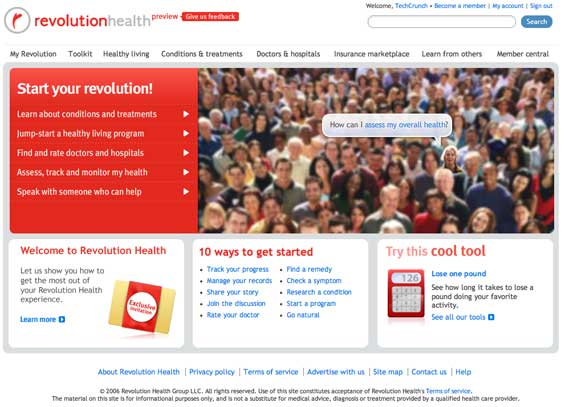
Revolution Health is a health-related portal site and social network. Users are urged to ask questions and answer other users’ questions, rate their doctors, participate in online discussions and otherwise contribute content. The site also has a number of tools to help people become more healthy, such as a calculatSor that shows how long you need to do a given activity to lose a pound of weight, and a tool for showing you how much money you’ll save if you quit smoking.
Every user has a profile page where they can link up to other users, set personal goals and aggregate content they’ve contributed to the site.


If you care about this sort of thing…its built with Ruby on Rails.
I am not sure asking who knows who health questions is really a good idea. But will see…
Sounds like WebMD.
What’s new about this? The fact they finally got this site up after about 2 years?
Stephen - that was my first reaction as well… but can you imagine asking every joe about your big mole on the side of your foot? Hmm…
Sounds like the same thing as DailyStrength
I *REALLY* care about what Steve Case is doing. Please, tell me more! Maybe I can ask some random dude on ReVoLuTioN Health why my head hurts so much after reading these piss poor posts.
How about you stop posting lame news and start talking about Web 2.0 startups? I can’t even remember the last time you mentioned a true, sweat and blood startup. All you post about now are bloated losers.
Don’t know about this stuff, but the MedStory site mentioned is killer. I’m sure these guys will be bought by Google for their health initiatives. Way ahead.
This isn’t all that exciting. Big field maybe but if their killer feature is a longevity calculator then wow… WebMD + google probably have this field covered. If I want to ask *shudder* random people for diagnoses I would trust Google more so than this.
I’m just curious why you would post the link to the preview site, knowing it was intended to be private?
It doesn’t seem like TC can be trusted with “hush” information, lately.
The company asked me to link to it.
I’ve never really cared for “health” sites… they tend to create a lot of paranoia among users. The idea of users diagnosing users ( i know that’s not specifically stated, but that’s what will happen ) is disconcerting, to say the least. I have an aunt who uses WebMD religiously and can tell you, in a heartbeat, what crazy disease you don’t have.
Who knows though … it might create more revenue for real doctors… though I’m not sure they need the revenue right now.
Med sites, pharmacy sites, anything medical will always make a dollar or three. Even sites with doctor information is big biz these days. If you can do something medical or pharm related, you will sell.
Will it be interesting. Probably not (at least not for me). Will it make you a boatload of money, maybe.
Rex
I agree, I always like reading the profiles of the smaller startups that are struggling to make it, versus Steve Case’s new pet project. Although I guess whatever he does is news.
case did an interesting keynote at LOHAS (lifestyles of health and sustainability) that i liveblogged earlier this year.
http://www.socialcustomer.com/....._keyn.html
bonus link: steve case attacked by giant rosebush
http://www.flickr.com/photos/5.....otostream/
Also, the “private” site has been linked to from the Ruby on Rails google group for some time now. Doctor Rating sites are really coming out of the woodwork.
it’s funny I was just talking to someone about a health site idea…great idea.
Users are urged to ask questions and answer other users’ questions, rate their doctors, participate in online discussions and otherwise contribute content.
- Not all users are from the medical field. There are patients going into this sites. To answer another patient’s question? Even if they have similar symptoms doesn’t mean they have the same illness. I think that’s DANGEROUS. I read medical blogs regularly. Doctors always advise patients to seek further medical advice from their own doctors.
- Rating doctors. There’s one on the pipeline [not sure if it's online already] but then it’s not welcome by most physicians.
- I doubt if there are physicians with all the time in the world to log-in to participate in an online discussion. There are medical blogs around. Some don’t even have enough time to update everyday. I think most of the time, there will be more patients on the site than medical practitioners. Unless they’ll hire someone.
- Add to content. There are several health networks around doing this.
Anyway, let’s see.
I think this is a great idea but i think it lacks the luster for people with real issues to necessarily be motivated to signup and BUILD a profile. Most people just want answers. You might as well just create a myspace account instead the way I see it. http://www.targetwatcher.com
Overall, I found the site to be well-designed but too broad in scope…asking too much of it’s users, and trying to be everything from medical records keeper to social network. I think there’s some interesting ideas in there (especially their tools and some of the co’s they acquired to build it), but perhaps the idea that sounded so great in the PPT needs to be dumbed-down a bit for the web.
(Disclaimer: I’m the CEO of DailyStrength, a product in the same space, which TechCrunch reviewed in November. I won’t accuse Revolution of stealing our ideas, but there are a number of similarities.)
Preview is wide open, huh? A producer contacted us for coverage, implying that we were being given a special sneak preview.
So what exactly is this? I agree with Doug. There’s no focus here, although I will make a comment that any hint that Revolution Health stole anything from DailyStrength is a bit absurd. There are social networks for just about everything now, and they all feed from the old school technologies of message board and chatroom communities, which have also been built around every topic imaginable, health included. In many cases I question whether some of the sites like Revolution Health are solutions looking for problems, as the components they contain are well-served elsewhere and in many cases have been for quite some time. In Revolution Health’s case, it looks like they tried to pull together every component possible, creating an incoherent product that tries to be all things to all people.
p..p…patients ranking d..d..doctors!?!? should like robbers scolding cops!
The idea of a health community is interesting, but my own feeling is that such a community would be a transient one, unless you have a long term illness or condition.
I wonder if they will sell belly fat pills.
Niche search engines and community sites. Netizen’s life is rollicking.
http://www.tekno-world.blogspot.com
I do not really know if the decision / choice of for that matter of fact anything that comes out of this ‘niche community’ would be something which I will apply on myself.
I might do it for say the email tool i use or the calendar function i use but for a situation of this importance I would really like someone more qualified than a general ‘web user/reader’ - of course I agree that there would be a percentage (albeit small) of doctors (relevant ones) who might be contributors too.
Let’s see…place is staffed by a ton of people who have become available the past couple of years via the annual layoffs at AOL.
Most of the tech and product team are old AOLers which explains why the product is 4 months behind (and counting since it is only a preview site) as they still have not figured out what HTML is much less Ajax or Ruby
The head of marketing is a guy who likes to scratch himself and fart during meetings…also ex AOL.
All the senior execs are located in very plush offices across the street from the grunts who work above a very stinky California Pizza Kitchen.
The board is made up of a number of disgraced former CEOs (Case, Fiorina and Franklin Raines)
A Revolution indeed…
What’s being built is MySpace for hypochondriacs.
The services are very primitive; for example, blogs don’t support trackbacks, and there’s no tagging, just hierarchies of categories. It looks like everything is being built from scratch, rather than relying on existing tools and ideas.
How doctor ratings is going to work is beyond me. Who is going to write them besides the severely disgruntled and doctors doing astroturfing? Look at Amazon and product ratings; even products that sell in the millions on a site visited by tens of millions gather a couple of hundred reviews/ratings, tops.
I think there’s some opportunity in the social health space, and I certainly would like a place to get opinions on doctors. Can’t say I care much about the social networking aspect, but the collective/community wisdom could be interesting.
OrganizedWisdom is another site working in this area that’s been up for few months.
Revolution is a mish-mash of me-too’s that are built much poorly than the sites that they are trying to copy. I have been using their beta for a while and I am very confused about who/what they are trying to be.
if they actually come up with a god idea, we’ll see Google Health the week after..
i think that is an issue - yahoo, google, even microsoft buy things piecemeal. Revolution acquired a ton of health care apps with niche focusess, and proably killed all their userbases in the process of this extended downtime / limbo period.. the JotSpot scenario..
I tend to agree with most of the posts here. This thing seems way too unfocused for it to work. It is an interesting idea, but I don’t think you can get honest feedback from the doctors online because of liability issues, which kind of ruins the whole idea of a feedback system — the doctors can’t defend themselves.
Health calculators and trackers are cool, but people don’t realize you can’t just throw up a couple tools and be done with it. We have built a whole business around it at The Daily Plate and we have a long way to go to complete the vision. It takes more than just a few simple calcs to service people well in this vertical.
Jeremy (Evil guy disclaimer: Co-founder of http://www.TheDailyPlate.com)
I agree with @ 31 David. A couple of sites that first come to mind are Judy’s Book and Maya’s Mom.
Agree with Tanjeel @28.
Castoffs from AOL creating a mish-mash site that doesn’t seem focused enough to be interesting. Glad Case has a lot of money to waste. He should focus on that vacation business instead, cause this one looks DOA–oh wait, after 2 years it hasn’t even arrived yet!
RH merits watching, if only because of the volume of cash behind it. But what really sets a 2.0 health site apart is **whether or not it provides actionable information** to the consumer IMHO. That means prices. That means feature comparisons. That means shopping decision tools. Not just pretty calculators and advice from the mob.
I’ll bet sites like http://www.vimo.com that let you actually price procedures and shop health insurance plans against each other, apples-to-apples, will be much more disruptive and influential in the long run, precisely because Vimo is following the Web 2.0 ethos, and tranferring power from the traditional holders (providers, carriers) and placing it in the hands of consumers.
Disclaimer: I’m the co-founder of http://www.OrganizedWisdom.com, a health focused social network that combines expert content with user content…we launched last October just before DailyStrength (although TC hasn’t covered us yet…nudge nudge:-).
Congrats to the revolution team on finally going live and opening up the curtain. As most of the people on this thread know, no matter how many resources one has, it’s an important milestone (at least to the team involved). Obviously, it looks like they have a lot of work to do, but who hasn’t launched an alpha/beta/preview and not had that problem…good luck and we look forward to watching your progress.
Some questions/thoughts…
*Curious if perhaps Revolution has too many resources? Too many big wigs…Too big of a team…Too many options/opportunities for their own good? Wonder what the 37Signals folks would have to say…even though it’s built with Ruby on Rails.
*It’s nice to see coverage starting to take place about sectors/companies that affect the lives of so many of us in profound ways (i.e. this isn’t the gazillionth video or IM site). There are finally a bunch of companies/entrepreneurs working hard to help change a broken (health) system. Not that Revolution is the best example of this, but there finally seems to be a wave of innovation taking shape — many companies/entrepreneurs are borrowing and leveraging many of the best ideas and tech solutions figured out already in other sectors. Hopefully, the end result will be better health solutions for all of us…
*Shameless plug: We’re a start-up looking for critical feedback about OrganizedWisdom.com so we can keep improving. Tell us what’s wrong…or even what you like. We’re rolling out new features every couple of weeks…
Re: Why No One (Including Revolution) Has Impressive Health Tools
Hey, Kurt@37. Thanks for pointing out vimo.com. Hadn’t heard of them. I get the potential value of price comparison for standard procedures (dental cleanings, physical, hearing, vision exams — all that preventative stuff that’s easy to pass up) and possibly diagnostic imaging, but once you hit the big ticket medical and surgical interventions it’s the same argument that Ipanema@18 made…
The diversity of related procedures, procedure complexity, and patient history would pretty much overwhelm your attempt to validate any “average” or “median” price that vimo.com might spit out. You would ruin UX if you tried to make a visitor input all the data needed to start making responsible assessments of pricing. (Imagine a 45-question poll for which many of the words have four or more syllables and sound Latin — or remind you of pus or puberty).
Also, once you add on (1) how private insurers negotiate with individual hospitals on procedure reimbursement, and (2) the nonsensical way hospitals approach their chargemasters, which list the prices they charge, you get a sense of why a HEALTH PROCEDURE PRICE COMPARISON tool is not an easy muffin to make.
QUALITY? Have you read the latest JAMA article talking about how “tried-and-true” quality measures for hospital performance in caring for heart failure patients (some of the most expensive) actually did a crappy job at predicting patient mortality. Read: hospitals and the medical profession are still trying to figure out what quality means.
Also, flip it to the patient perspective. I know patients who get pissed when their doctors’ hands are cold. At the same time, another study (I’m going to be irresponsible and not cite it) about litigious patients found that a surprising proportion of families of patients wronged medically speaking (i.e. their family member was probably killed, maimed, or disabled in a hospital) will pass on a lawsuit a decent amount of the time if the doctor says he or she is sorry.
Someone please tell me if they have a great solution for health procedure pricing and quality measures. I would love to here about it.
DISCLAIMER: I am not a CEO or SEO expert like some of you snarky folk. I’m just a content producer for the HEALTHCENTRAL NETWORK. I like my job enough to reply to this forum at 2:30 in the morning (Hi, Chris Schroeder). I focus on Cancer and Aging and have an excellent sense of why we have to develop community tools for people with health concerns. I hang out (online, of course) with the people you are calling hypochondriac MySpaceCadets (thank you, twr@29, that was quite funny). Why doesn’t Tech Crunch write about me and my sites? Seems like enough important people would be interested in my experience.
If it’s doctor ratings you’re looking for, check out RateMDs.com (http://ratemds.com). I think we’ve got the most ratings, with about 68,000 ratings so far. I’m the co-founder and I also founded RateMyProfessors.com.
Will this have categories, I like to talk only about my pains.
From what I’ve heard, Revolution Health is more than just a social networking site. The spin is that you can provide an employee a health savings account, revolution health membership, and no longer need to provide health insurance. Manage your information, find a plan, find a doctor. Check out the hospital performance comparison’s you can do on the site. HSAs are ‘defined contribution’ to the extreme, and that’s apparently where the country is going. The current situation is unsustainable. I think it’s a pretty cool idea.
I got an invite to the site…I’m a health care professional…not a dyed in the wool techie. The nuts and bolts of the site are far less important to me.
Why isn’t if Revolution serves to aggregate data sources it’s a bad thing, but when other sites do it, it’s cool? Because it’s Steve Case doing it? From a health care insider’s opinion, I don’t think the site makes Revolution Health revolutionary. What DOES is the entire offering…the web site, the insurance and putting “doc in the boxes” in Wal-Mart’s and Target’s.
Some of you who play in this space and who posted your lamentations here are about to get your doors blown off by the size and scope of this. To you, I say this…it takes BIG money to play in the healthcare space…if you aint’ got it…you ain’t playing. Remember, healthcare is a 1.7 TRILLION dollar industry. The rest is just more suck and blow. (as in breathing..suck air in, blow it out.)
Pardon my candor: I’m surpirzed that none of you “insiders” have pointed this out…there’s been plenty of companies that have tried what Case is doing and most of them crashed and burned. I suspect some of you who posted here on behalf of your companies are some of the “walking dead”- companies margially funded in hopes of a merger or outright purchase by a company like Revolution. Time will tell if he can pull it off.
In contrast, Case has deep pockets and this is a LONG term play. He’s his OWN VC. How many of you in this space can say that? Not any of you who posted here, that’s for sure. If you can’t see that he’s going to take this company public and make it huge, you’re blind. Remember you read it here first…when you’re buying Revolution brand vitamins some day or taking your kid to the Revolution-affliated pediatricians office. You don’t think so…watch. This is SO not about a web site in infancy.
I remember reading about this in the Wall Street Journal about 2 years ago. Thought it was cool then, think it’s cool now. I better sell my WebMD stock before this really hits. I’m more interested than ever to see what Google has up its sleeve. This space is going to get very hot…wait and see.
Full disclosure, I’m Chief Medical Officer at Revolution Health Group and passionate about what we’re up to. That said, we are just in the early going, got a lot of work ahead and really appreciate all the comments (good and bad) - we’ll need everyone’s help to build a great site so please keep the ideas coming.
Regarding the comment that it’s not good to allow users to interact with each other in the healthcare space — I guess we see it quite differently. We’ve gone out and licensed extraordinary clinical content (Mayo Clinic, Cleveland Clinic) that people trust and rely on. But I can tell you as a physician that consumers will also benefit from hearing the stories and experiences of other consumers like themselves, and from getting support and encouragement from others.
Our goal is to provide community interactions in a responsible way. This means helping consumers understand the clear limits of the information they glean from others, which we do. We always encourage consumers to put what they learn in the context of evidence-based data and give them lots of opportunities to do so, and of course to consult their physician first before taking any action. Our ultimate goal is to help consumers get as healthy as possible, to get as much value as possible from the healthcare system and to move toward making choices that are well informed and best suited for them.
Jeff@44: “Our goal is to provide community interactions in a responsible way.”
That goal must explain this:
https://www.revolutionhealth.com/forums/conditions-treatments/asthma-allergies/asthma/childhood-asthma/2290
“I have heard from two reliable sources in Latin America that using shark oil - not pills, but the actual oil from the fish - cures asthma in children. They say one teaspoon a day for 15 to 30 days does the trick. Has anyone heard this or had any experience with it?”
That doozy took me no time at all to track down. I’m sure a few more minutes would produce gallons more quackery, and your site is still in “preview”. With those kinds of stellar medical questions, no wonder you are proud to be an MD associated with Revolution Health.
A web site that promotes medical advice from anonymous idiots on-line is a lawsuit waiting to happen.
This site may sell…
Maybe it can hook up with companies offering HSA’s and CDHP’s and it will be a big hit conceptually with those companies. However; anonymous users offering advice… um yeah…. Not everyone uses the internet to figure out if they are having a stroke or Bell’s Palsy, a headache or an intracranial bleed, a hemorrhoid or colon cancer.
Theoretically, this site sounds great - there’s only a few minor problems. People are more interested in the superbowl than in what statistics a hospital has, they are more willing to pay $1500.00 on muffler bearings for their Chevy or Harley than spend 20 minutes online looking at reasons to quit smoking let alone $20.00 for a copay. They are more likely to relate to advice from Dr Phil as opposed to an MD - in an office let alone someone who can easily say that they are an MD online.
It’s a great idea - the question is what is it’s value to the end user vs. the people peddling it?
For one example of a successful, long running, patient self help community, see the Yahoo group surfacehippy. It has a very specific focus , on a ‘new to the US’ surgical technique for hip joint replacement, called hip resurfacing. It combines discussion on how to find surgeons (including advice on the criteria for a good surgeon for this technique), and typical charges for each surgeon, with extensive discussion on how to get US medical insurance approval . Some users make a few postings, read a lot, then go quiet. Some users stay around, and share the benefit of their own experience with newcomers. There are about 5000 members. People frequently post about how they have derived confidence in making the decision to have surgery, and how much improved their lives are as a consequence. MDs and surgeons do post occasionally, but the primary input comes from patients who have made themselves experts over time.
There should be other health conditions for which a similar community could be built, and Revolution could be a good place to do that.
It’s both fun and fascinating to see so much interest in people-centered communities and websites in the health, wellness and mental health spaces! It reinforces the idea that perhaps person-centered care — an ideology that proponents like the late Dr. Tom Ferguson have been advocating and writing about for decades — are finally getting some traction and focus by others.
But I would also caution that there’s a balancing act to be done here, especially wrt information that, if enacted, could actually cause more harm than good. Health websites and healthcare isn’t just people randomly talking to one another, but a two-way conversation that has to be had. Not just amongst community members, but ultimately between a person and their doctor.
And I think you’ll see a lot of these websites that suddenly have an interest in helping people with their daily well-being or health also don’t always have the rich, experienced health background that differentiates a company that truly understands the complexities of health and individuals’ needs, versus those who just throw up anything and everything and hope it all works out in the end.
So, yes, welcome to the world of online self-help, of online health, and of support communities online! It’s good to see people and professionals having this conversation (even if many of them are doing so for their own vested interests more than anything).
I’m a congenital heart surgeon in Miami, and I grew up in Cupertino, a few blocks from the garage where Wozniak put that first Apple together.
The smarter members of my family are in IT.
I have to apologize for my profession, we have been pathetically slow to adopt IT into our medical practices, to our and your detriment.
The discussion above shows that this is changing, rapidly, and will be driven by tech geniuses like you, by frustrated patients, by opportunistic politicians, and fortunately by market forces.
A few thoughts on Revolution:
I agree with Case that American Health care is facing a crisis, that the crisis exists because market forces are not allowed to operate when consumers purchase health care. I also appreciate his personal commitment to this challenge.
There is infinitely more to the doctor patient relationship than can be conveyed online. Listening to a patient, examining them, gaining their trust, reviewing their test data, consulting the medical literature, understanding their deepest fears, providing comfort… not even EA could pull this off in a virtual environment.
You might not get the highest quality docs to work in those “Starbucks” clinics at Walmart, and I would lose the Starbucks analogy if I were Case.
You will still have to pay them substantially more than the guys making double Lattes.
Don’t give up on medical performance measurement, instead, please demand it. I was ashamed to make up answers to simple patient questions like “how many of these have you done” and “what’s your mortality rate for this operation”. And all of my colleagues do this every day. We now measure and report out outcomes in real time on our website, so that patients and referring physicians can make informed decisions. I hope all physicians adopt this practice in the near future. I am also working on putting our cost information online in the same manner. Several of you have shown how difficult this will be given the complexity of each individual health care event, but if you can price out a trip to Disney, you can price out an appendectomy.
The quote “myspace for hypocondriacs” is compelling. My wife, a nurse, gains reassurance from seeing that other people share her pain and frustration about a chronic problem, and there is value in that.
A final note, I think the real future opportunity for tech in medicine will not be a service oriented website, but a truly searchable EMR, the pagerank of medical records (which will not look anything like a pagerank because you won’t be looking for websites, but you get the idea), which will enable nationwide and ultimately worldwide datamining, and dramatically accelerate the development of medical knowledge.
Keep crunching, your freinds in healthcare need you.
Redmond