
David Friedberg, a former Googler, is set to launch an ambitious new site called WeatherBill, headquartered in San Francisco, in the next few weeks. WeatherBill won’t be a consumer site; rather, they are combining an ecommerce site with a complicated weather forecasting algorithm to sell weather insurance policies to individuals and businesses. And having a business isn’t a requirement to purchase a contract on WeatherBill - users can also use it to simply make a cash bet on the weather swings in a given geographic area.
Weather insurance is difficult to get and even harder to customize. Enron began to dabble in weather-related securities, who’s value would fluctuate based on actual weather down the road, but that all ended in 2001 when the company went bankrupt. Today, large energy companies trade weather policies back and forth to hedge against high or low temperatures, but everyone else is left out.
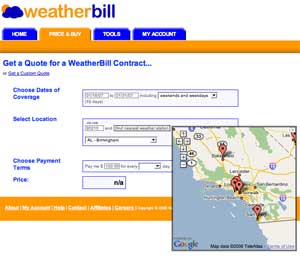
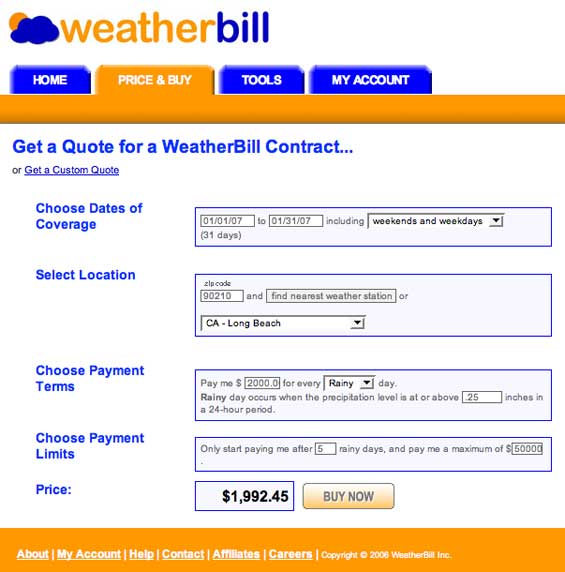
That’s where WeatherBill will come in. Anyone can buy an insurance policy for weather in a given area. Choose a weather station via a Google Maps mashup (see screenshot to right) and choose whether you want it to pay out for each hot, cold, rainy or dry day. Temperatures are set by the user by degrees, precipitation by inches. As an example, if I want to be paid $100 for every very rainy day (1/4 of an inch or more) in San Diego in March 2007, that policy will cost $370.64 and will pay up to a maximum of $3,000. Every option is variable, and so the user can decrease the amount of rain required, increase the maximum payout, etc., via an Ajax interface. A contract for a payout of as little as $1 can be created.
WeatherBill hedges their own risk via their weather algorithm, which Friedberg tells me they use to simulate 20,000 years of weather daily for each weather station. They also sell their risk on the back end to a number of hedge funds. The result is guaranteed profit for them, regardless of the weathler. All they have to do is sell policies.
WeatherBill may be useful for golf course owners, movie theaters, amusement parks and other businesses whose business varies significantly based on that day’s weather. I would imagine that having this built into things like Quickbooks and other online accounting software would be a great feature for many small businesses. The only requirement to purchase a policy is that the individual or business is an “accredited investor,” meaning they have a net worth of at least $1 million. The user has to certify this when creating an account, but no follow up is done.
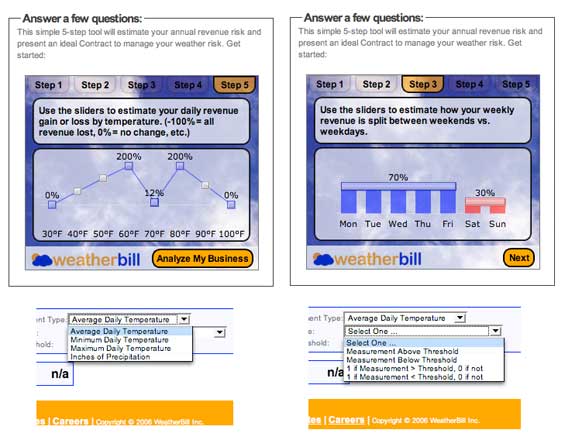
WeatherBill is has raised a Series A round of financing from NEA, Index Ventures and a number of angel investors. Look for a launch in the near future. Additional screenshots below (note: these are from an early demo, and will probably change somewhat by launch).


See all


I really like the idea of this site. I wonder who is going to measure the rainfall: The company itself, a third party with no interests, a weather service. Seems like it could cause some probles. I am sure they will figure it out. Really interesting idea for a website though. Proability is a wonderful thing.
I agree with Soso, very cool !! I love it !!!
Oh, one more question….
How is this different from the gaming sites (i.e. sportsbooks) the US gov’t has railed against so harshly?
this doesn’t sound like gambling. sounds like a business risk management tool.
Michael -
Love the site.
The possessive of “who” is “whose”.
“who’s” is a contraction meaning “who is”.
This is really going to take a lot to convince small businesses. They’re busy running their companies, not gambling. Freelance devs, domainers, or day traders seem to be a better fit.
If anyone is in the USA, one can not help but wonder what would have happened if this service had been around one year ago and had been used by any of those companies savaged during Hurricane Katrina.
Very cool. I agree with JR that it would be tough to sell small businesses on this, however it appears that they’re targeting accredited investors. If you buy into the predictions that global warming is going to cause major climate change (namely instability), markets like this may become increasingly important and a great way to make or lose large sums of money very quickly. Of course, you don’t need to be a large hedge fund or energy company to make indirect bets on the weather (a lot of commodities track nicely with specific weather forecasts) but having a way to do it directly could potentially create some interesting opportunities.
Ricl—Glad I’m not the only one who cares!
I think I will stick to the dice. (Never pick up a 9 when the stick man puts them in front of you - look him in the eyes and roll’em over)
The premise seemed silly at first, but the more I read the more I was converted to the “this is cool!” camp. Posts like these are the reason I come to TC: not only for news on web startups, but for the opportunity to learn about things (in this case, weather insurance) that I never knew existed.
I think it’s nigh time to insure my Vegas timeshare for whiteout days.
Man, that is just bizarre. File it under the “who wuddathunk?” category. The design is kind of jarring too. Clearly I don’t own a golf course though…
This is an awesome idea. I don’t see it as much of a service for small businesses as a new place for people to bet on things. Like some of the other commenters I’m wondering about the legal challenges this company will face, especially if it allows a lot of small, unqualified investors to trade these policies.
But I think it would be kinda fun to mess around with. In Denver we just got pummeled with that huge snow storm, and I’m sure this would have been a valuable service for many businesses and homeowners if it had been available a few weeks ago.
I just thought it would be an awesome idea if they were able to somehow put emissions trading on this site. Carbon trading markets are getting really big between large businesses and organizations, but I wonder if there would be a way for small, more environmentally-friendly businesses to sell emissions permits to larger business that pollute more. This site could capitalize on the whole thing about global warming and its effects on weather.
Let me get this straight… legal betting sold as insurance? What’ can’t you sell insurance for because I just had one HUGE market idea …. google …. ahh …
Never mind, already being done and worse … I’m a year late.
This is gambling and nothing more. Call it what you want but at the end of the day it is still just gambling. Now I have nothing against a little gambling, Just want to set the record straight on what it is.
“The result is guaranteed profit for them, regardless of the weather. All they have to do is sell policies.”
This part I find interesting. They have a guaranteed profit no matter what the weather. I assume their partners (backend hedge funds) also have it worked out to make a guaranteed profit. So my question is which person involved in these transactions doesn’t have a guaranteed profit. That’s right, the customer. Sure you may get a few people who hit the jackpot but just remember the house always wins in the long run.
Seems like more than just a web 2.0 startup…it’s kind of a business hedging product with a slick website front end. They probably have to have some kind of insurance or even SEC licensing to do this, plus all kinds of financial backing.
Weather derivatives and options have been viable ways of hedging against adverse weather for many years. If you’re interested in this kind of thing try ‘catastrophe bonds’ in Google for another niche risk transfer market.
I worked in this arena for many years and actually helped launch an online weather derivatives trading platform many years ago (sadly too early for the market to adopt at the time). This is more traditional weather cover, but it’s nice to see the interest is still there for electronic platforms to serve these markets. See the CME (Chicago Mercantile Exchange) for someone who is active as an exchange for these products.
In answer to Soso; the weather data comes from the main meteorological organizations, so is trusted and available easily (sometimes freely). You can hedge rainfall, temperature (degree days), snow fall etc etc. The catastrophe bonds I mention above hedge against earthquake, windstorm in a similar manner. In the past there have been deals struck over hail, tornado and more exotic weather occurences as well.
Interesting field, lots to read about it here : http://www.artemis.bm
Oh, and it’s not a gamble really. It pays out when you get hit by adverse conditions and doesn’t pay out if you don’t. It’s straight hedging/insurance…
I love the idea, and it’s no wonder that hedge funds are acting like the re-insurers here. The concept is similar to a simple CDS (credit default swap), which is a basic derivative. With CDS, a party doesn’t want to have the risk of bankruptcy when they buy a bond; so, they essentially buy something like this policy to get limit risk just like a small business owner buys a policy here.
If I were a small business owner that does have a business affected by the weather, I would buy in a heartbeat. My only question would be that who holds the risk the the process because someone will. I’m sure the hedge funds will be aggregating the policies “bought” from the site and then offering them out to the greater derivatives market. Maybe even the CME as Steve E. says above in the catastrophe bond market.
Excellent idea, and probably just one of the many opportunities to simplify derivative-like products to sell to for small business owners….
This site will be a success. I’m sure of it. I can smell a successful site when I see one.
“How is this different from the gaming sites (i.e. sportsbooks) the US gov’t has railed against so harshly? ” - Wade
My ques exactly. Unless we are missing something I would say this is a very risky venture………..
Helluva idea ! TC Rocks in bringing new info to ppl
Quick q’s -
Is this even legal ? (Similar to Gaming sites argument above)
Who / What defines rainfall / temperature / other conditions? Different sites have different numbers.?
More info on who actually looses the money?
Can we come up with a guranteed way of making money? (Put in $300 for rainfall above 1/4inch and put in equal for each day it doesnt rain? )
What a great idea for a business. I like it!
Find it hard to believe that they will be able to perfectly hedge their exposure (even through reselling risk to hedgies). Like all good models, they are using the past to predict the future, and one big event outside their model will blow them up. The first hedge fund (Long Term Capital Management) used a similar concept in buying and selling risk, was founded by nobel prize winners who won for developing options theory. They needed the government to bail them out so that the US economy did not collapse. Apparently they misjudged correlation and an ‘impossible event’ threw them into a tailspin. Great book on LTCM’s blowup: “When Genius Failed”. A guy from Google may be good at making an AJAX interface and GMap mashup, but insurance and risk modeling is serious business. Hope they have the right experts. Even so, I still bet they blow up at some point.
“Everyone complains about the weather, but nobody ever does anything about it.”
This is a prediction market like HSX, tradesports and hedgestreet. The idea is that by leveraging the wisdom of crowds you might get to fairly accurate weather predictions. It’d be neat to see if the predictions in the market did a better job than the weather reporters.
I am glad to see more companies getting into weather risk services.
Tijan - I don’t think this is much of a prediction market for the public’s eyes. For example, I don’t think that WeatherBill’s customers can see the “bids” and “offers” for a particular event the way you can as a customer of HedgeStreet.
But I’m sure WeatherBill is tracking the public’s interest in particular weather events and will tweak the algo accordingly.
Unlike just about every other type of gambling, at least there will never be any “insiders” involved and making tonnes of money due to their foreknowledge of things to come.
Jon
As an individual I could see using this when on vacation - eg if it rains or temperature is below a certain level at least you get a few dollars back to compensate you for not having the best weather.
Good odds… fun meteorology fact: if you predict the weather tomorrow will be the same as today, you will be right 66% of the time.
Yes this is cool, combine it with Trendio.com and some other prediction markets and you will soon be able to bet and take insurances on whatever you want
It’s tough to do a pay to play weather game without creating a security and thereby impinging on SEC’s domain, creating a proposition bet which makes it difficult to shield officers in the US from criminal action, or creating insurance which brings a company to the attention of insurance regulators. I built one at http://www.space-shot.com if you want to play one. It’s a skill tournament.
another business that I imagine would be very interested in this service: ski resorts
Definitely GH. Imagine owning a ski resort, you buy a derivative that will pay you a set amount for every inch of snow that you don’t get (up to the amount you defined as needed in order to have a good season). So that covers you for the winter season. Then in the summer you have a golf course and extreme sports centre, so you buy a rainfall derivative that pays you if you receive over a certain amount of rain, and a temperature derivative etc etc…
The market started with heating/cooling degree days, as a way for power companies to hedge against demand according to the weather (eg. when it’s really hot everyone uses aircon and power demand goes up etc etc).
Fascinating stuff the risk markets, and just perfect to be positioned on the web…
I used to own 30 golf course and clubs. This would have been highly attractive, as weather was a principal driver of our economics. We bought catastrophe insurance back then, and collected once during a hurricane, but this would allow me to smooth out my ordinary weather fluctuations - and eliminate all those “bad years due to poor weather.”
Since lots of other businesses are subject to weather impacts, this makes a lot of sense - if the company has devised an effective distribution method. Small business owners are hard to get to, and many of them are tech or change averse.
“I really don’t see that many accredited investors having so much exposure to daily weather risk that they’ll feel the need to hedge at prices they’ll assume imply negative expected value (given that both Weather Bill and the hedgies they offload risk on need their pounds of flesh).”
Stanford professor Eric Zitzewitz
I love the concept and I suspect they’ll figure out how to make it a success.
but…
1. the contracts are too expensive. every scenario I tried seemed like the policy was priced above what any sane person would pay for insurance (e.g., the cheapest policy was something like 15% of the payout and most had prices much closer to 100% of the payout). with pricing like this, i’m guessing it will be hard to sell policies to business owners and gamblers alike.
2. and if it works, it’s going to invite a lot of competition
With its specialty NDDS in the form of sublingual melt tabs ProVIGRAX gives you a power punch in 30minutes flat & lasts for 4 hrs. psychological erectile dysfunction