Malmö, Sweden based Polar Rose is having its coming out party today and pre-announcing a product release slated for early next year. CEO Nikolaj Nyholm gave me demo of what’s coming last weekend.
Polar Rose is trying to solve the increasingly important problem of making sense out of photos. Without semantic data, a photo isn’t much use to a computer trying to convert a keyword query into image results. Google created a game to get users to tag photos for them. Flickr and some of its competitors are doing a pretty good job at getting users to tag photos. And of course newcomer Ookles will soon release their own product. But the vast majority of images on the net have little or no semantic data associated with them, and for all practical purposes they are therefore invisible.
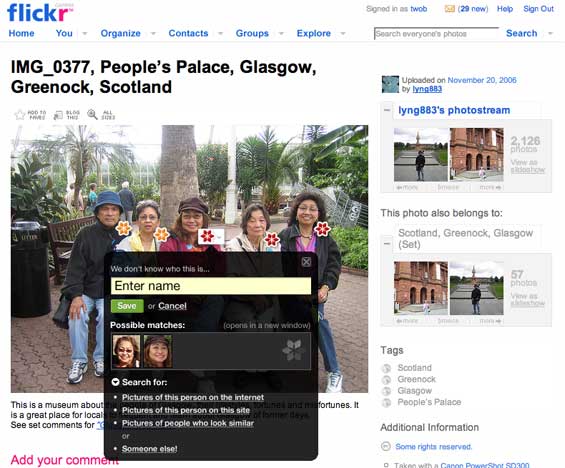
Polar Rose wants to change that. They won’t be a destination site for photos. Instead, they’ve planned a two pronged approach to winning market share – distribution of a browser plugin for users and freely available APIs for photo sites. Users of the plugin will be able to add data about any photo on the internet, and search those photos later. Companies integrating the API will get a copy of the data created by users for free.
The technology behind Polar Rose creates a virtual 3D image of a person, factoring out lighting and other conditions that can affect recognition. That 3D image is then used to try to guess when a person appears in a photo. The plugin, for example, will provide a link to try to find other images on the Internet of the person being tagged. At first, this data will be very thin. But if and when users adopt the Polar Rose plugin, the search feature could become a useful tool for finding additional pictures of people.
Polar Rose announced $5.1 million in Series A funding from Nordic Venture Partners last month.


Finally! The Europeans arrive to fix the Riya mess.
What’s the use for this? All the pics of “relevant” people are already tagged in one way or another.
Maybe they’ll use this to track neonazis & terrorists when they post their faces on Flickr next time
Finally, some face recognition software that we can use with Flickr. I hope the official Flickrites at Yahoo adopt the API from the get-go, cause automation is definitely the next step for tags.
@ U.S. Sucks: I wouldn’t be so harsh against Riya. While we obviously believe more in the decentralized model, please do give Riya credit for showing the way in a democratization of face recognition.
@ TheKid: That certainly depends on how you define “relevant”!! Also, while sites like Flickr are a model for how to add semantics to photos, that certainly doesn’t apply to the millions of other photos out there — often just thrown into buckets with no description, no comments, and no tags. It’s these photos that want to help people share, in part through automation (face recognition) and in part through user tagging.
The real advantage here seems to be that this isn’t tied to one database like Flickr. We need something like this if we’re ever going to have successful image searches. The question now is can they get users to do enough to make it viable?
The plugin is a major good thing. Browser plugins make thing convenient for users. Now we just need browsers to search through installed plugins, located ones that require database connections, and auto login to all of them on start up. This would dramatically increase the use of 2.0esque services.
I’ve seen the founder’s recent Ph.D. thesis. Same old – conversion of 2D to 3D. Unlikely to work. Just like Riya.
Huh!…maybe I should read the piece again.
TheKid is asking the ques I really should be asking…
“What’s the use for this? All the pics of “relevant” people are already tagged in one way or another.
Maybe they’ll use this to track neonazis & terrorists when they post their faces on Flickr next time
” – TheKid
The feature is cool. But as a matter of fact, I really can’t figure out what the user experiences would be for face recognition service. Image search of couse, but how? And do we really need a image search this way?
-Mike
Tech Tutorials: http://www.hotcoding.com
Pixcavator: One of the key points of Polar Rose is the interaction with the users and the tapping of their “collective intelligence” so that the recognition becomes a tool to help find relevant photos and give suggestions (for tags, names etc) not the “search engine” in itself. The search engine instead builds on both the machine generated data and the user contributions to find connections between photos.
Thanks for looking at my thesis. Sure, 2D to 3D has been around in different scenarios as long as there has been computer vision but that does not mean that all solutions are the same. “Unlikely to work. Just like Riya.” – fair enough, computer vision will never give 100% recognition for anything but if you doubt that this will help people find photos, you are wrong.
Mike: Look at how visual the web is becoming. Try doing an image search for a person on your preferred search site. What you’ll most likely get is some photos of the person you were looking for and some not even close. Most likely there are even more and better photos out there without labels/text/metatags which you’ll never see. Look at the long tail of web photos (yours and mine) and you’ll see lots of photos that are unsearchable.
As for user experiences, try
-sort, search and manage online albums (yup, I stole that one from Riya and Ookles)
-get feeds from photo sites with pictures of people you like
-find out who a person is on a picture you come across while browsing
-click on a face on a news site to find information, links or other sites with this person
Thanks for your comments guys! -Jan Erik
Jan Erik: Maybe I am too much of a skeptic, but you see so many image search/recognition/match etc programs that don’t work. And you ask yourself why? The answer is: because you loose information as you convert from 3D to 2D. It is an “incorrect problem”: one question has two different answers (or more). The same 2D image can come from two different 3D objects. This is what so many optical illusions are based on. Is it a ball or is it a concavity? If the light is from the right it is convex, if from the left concave. Even interaction with users does not seem to help with the problem, so I have doubts… By the way, I have no doubts about the need for this stuff.
First of all this news is too old and second don’t copy press releases.
For the most part, techcrunch has turned into a circus attractor peddling cotton candy. It’s extremely pretty and sweet but no benefits. It’s back to the same ole media games, selectively generating buzz for a few (those who have money) and butchering the average joe in the process.
@Jan Erik
No offense, but if you got funded on those 4 revenue generating ideas alone, than I wish you & your VCs good luck
I wouldn’t be surprised if some aggregator porn sites were interested in this, so their users could quickly find all related paid content for the selected actors
Isn’t Europe’s real entrant into face recognition Cognitec?
Is Polar Rose even entered in FRVT (Face Recognition Vendor
Test)? Or for that matter Techcrunch fav Riya?
How does Polar Rose’s stuff differ from Cyberextruder?
People who actually know something about face recognition want
to know.
Remember that Google (who owns Picasa and has a “little” search engine thingy) bought a company called Neven Vision last year…
Does the name Polar Rose sounds funny to anyone?
Once this technology starts to snowball, at least there won’t be as much identity theft. Facial finger print. Heh.
I honestly don’t understand why anyone cares about facial recognition for anything other than security purposes. Anyone care to enlighten me?
Yet another startup building their business on Amazon’s EC2…. Do I see a trend forming here?
Actually Amazon just did two talks on their web services APIs at EBIG.org last month (one for java and one for .NET). It’s VERY cool. We may even use it to ride on. I’m very impressed by what they’ve done.
Text search engines show that results don’t have to be perfect to be useful.
Take a google search. If I find a useful result in the first 10-20 results, I’m usually pretty happy. That’s only a 5-10% success rate, and yet it’s good enough, because I can easily eyball 10-20 results.
Image recognition needs to be applied in such a way that relatively low accuracy rates can still provide a useful result to the user.
I’ll have to spend some time with Polar Rose to see if they’ve managed to hit a sweet spot.
Similar technology is available to run as a backend to image-related websites at http://server.imgseek.net/
Very cool. This could really take off. I like it.