December 16, 2006

Preparing For Apollo

Michael Arrington

76 comments »

2007 will bring the launch of the much anticipated Adobe Apollo platform, a cross platform run time that will allow developers to take rich internet applications, whether they be built on Flash, HTML, JavaScript and/or Ajax, and turn them into desktop applications.

Apollo will be useful for running desktop versions of critical web applications like email and calendaring, where offline access and application speed is sometimes important. Potential developers are already taking notice: eBay is working on a project called “San Dimas” to run on Apollo, although there are no announced plans to release it yet.

We’re excited about Apollo because it has the potential to be the launchpad for entirely new classes of startups. It could be the technology to watch for 2007. And Adobe is certainly counting on it to drive future revenue.

I had the opportunity to interview Kevin Lynch, Adobe’s senior vice president and chief software architect, about the upcoming launch of Apollo. Steve Gillmor joined me as well. Listen to the 37 minute podcast over on TalkCrunch, and let us know what you think Apollo’s “killer app” might be.

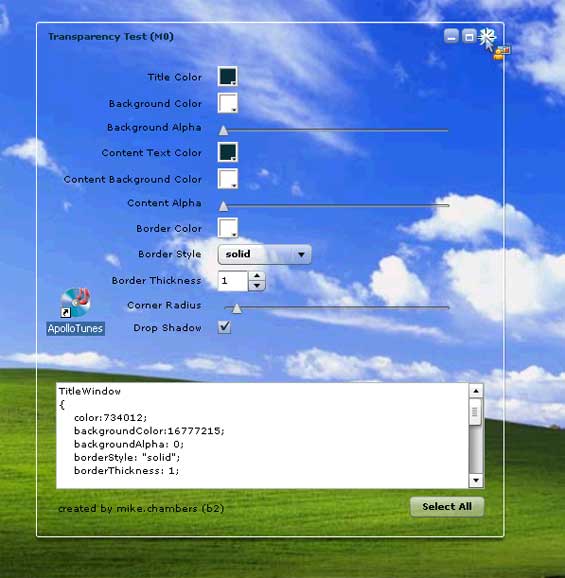
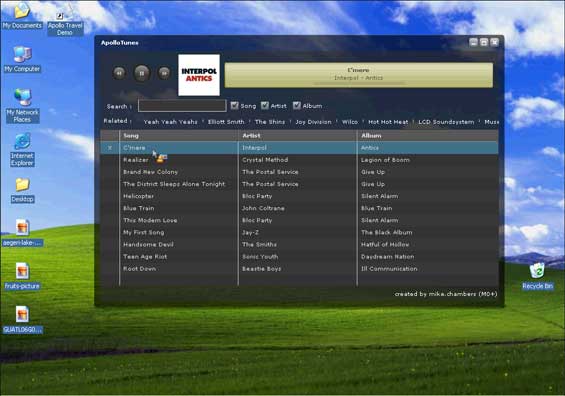
Screenshots below.
  • Sphere It

Trackbacks/Pings (Trackback URL)

  1. Adobe Apollo at All Things Dork
  2. meneame.net
  3. Alan Lewis
  4. Endocitosis de red, el blog de Albert Armengol
  5. Matthias Zeller Memento · In Search for the Adobe Apollo “Killer App”
  6. Howard Lindzon » You say Apollo, I say Adobe
  7. You say Apollo, I say Adobe | The Wallstrip Blog
  8. Apollo - a web revolution?
  9. TechCrunch Japanese アーカイブ » Apollo、準備中
  10. From my Experience » Blog Archive » Apollo - Now with Browser Begone!
  11. TechCrunch en français
  12. Apollo y Google
  13. Kevin Lynch Interviewed About Adobe’s Apollo Project - Starry Hope Productions
  14. eBay Developers Program
  15. Interaction Design Blog » Blog Archive » Adobe announces the Apollo Framework Beta
  16. Applications are Returning Back to Desktop - RotorBlog.com
  17. Preparing For Apollo (New Adobe Platform) (TechCrunch) « Iain’s Chips & Tech
  18. links for 2006-12-21 | Mike Stopforth
  19. Howard Lindzon » Wallstrip revisits Adobe and Mr. “Flash”
  20. Adobe’s Apollo Provides New Ground For Entrepreneurs
  21. eBay San Dimas and Adobe Apollo at Rob Abbott
  22. èãðû áàñïëàòíî ñêà÷àòü
  23. Adobe’s Apollo Provides New Ground For Entrepreneurs
  24. ñåãìåíòàöèÿ ðûíêà êóðñîâàÿ
  25. ìåäèàïëàíèðîâàíèå êóðñîâàÿ
  26. ðèñê ìåíåäæìåíò ññï
  27. âàêàíñèÿ áóõãàëòåðà ñîâìåñòèòåëüñòâî
  28. âàêàíñèÿ ñóïåðâàéçåð êðàñíîäàð
  29. âàêàíñèè äèàìàíò
  30. ñêà÷àòü áåñïëàòíî èãðó òåòðèñ
  31. ïðîõîæäåíèå èãðû êíÿçü 2
  32. ïðîõîæäåíèå èãðû äðóãèå ìèðû
  33. ôëýø èãðà ñïàñåíèå
  34. OS GOS » Blog Archive » Preparing For Apollo - Adobe New Platform
  35. Bishop Alexander » Blog Archive » San Dimas Gets Techcrunched

Comments

RSS feed for comments on this post.

  1. SearcH EngineS WeB

    The TalkCrunch interview was helpful :-) - but is this in theory, the web 2.0 version of the classic Java Applet??

    hmmmm….

  2. Tim

    I see lots of potential for anything that requires a decent uploading tool. It’s the one major thing web browsers really suck at. There is no progress meter (built in), you can’t upload more than one file at once, and you have to select each file individually (instead of an entire folder). To top it off there’s no resuming if you get interrupted. Uploading in a browser couldn’t be worse if it tried. (Side note, wouldn’t it be so easy for browsers to implement a progress meter?!)

    Flash8 allows selecting multiple files and a progress meter which is a promising start.

    Really the key benefit is it’s going to make multi platform, desktop like applications so much quicker and easier to build. At the moment, the same stuff is possible, but just so much more work developing for 3 different platforms.

    Could this succeed where Java failed?

    Tim
    http://advertise.free.on.bla.st/

  3. Rajeev Vashisht

    In India we wait for the Bugs to be discovered by enterpreneurs and then adopt only the improved version.

  4. Sudarshan

    Hi Rajeev,

    “In India”?? How do I parse your sentence? Are there no entrepreneurs in India? Or do you mean to say “Waiting for a technology to mature by initial usage by early adopters happens only in India”??

    Adobe got Applets right through Flash. What we were missing was decent HTML integration. The Apollo HTML integration into the rendering pipeline leaves Java in the Dust. Hats off to these guys. Eagerly waiting for the public release. Hope it turns out to be as ubiquitous as Flash!!!

  5. Rob

    It’s good to know that I really am not going crazy.

    The access log of my site ( http://www.gameboar.com ) was showing inbound traffic coming from http://adobe.com/apollo but I couldn’t find any mention of apollo when I searched the Adobe site.

    So I pretty much forgot about it until I saw this Techcrunch article because I hadn’t heard of the project before.

    I’ve no idea why they’re trying to access my site but there you go…

  6. Josh

    For some the whole concept reminds me of Macromedia Director.

  7. MrSteel

    Apollo is dream come true.
    No more 3rd party swf projector creators, now just one product to rule them all :D

  8. Steve Borsch

    Nice to see this big heads-up to the tech community on RIA’s (rich internet applications). There’s a lot going on this space with Microsoft Expression, Laszlo Systems (and the OpenLaszlo they tossed into open source), some stuff IBM is working on and, of course, this good stuff from Adobe.

    Couple of relevant posts if you’re interested in knowing more about this since, as Mike says above, “It could be the technology to watch for 2007″ and I sure think so:

    1) http://www.iconnectdots.com/ct.....oming.html
    2) http://www.iconnectdots.com/ct.....net_a.html

  9. Fashion Industry Ceo

    I think this can be really helpful…i look forward to this product to make a big impact on how we use desktop apps

  10. Robert

    I feel Apollo will be a key technology in bringing RIAs to enterprises.

  11. Clayton

    Webapps on the desktop?
    This really kind of reminds me of Macromedia Central
    http://www.adobe.com/products/central/

    /Clayton

  12. neotechie

    I can’t wait. This will change the way we develop and deploy software projects.

  13. lemon obrien

    adobe bought macromedia…i’m sure they are putting it to use.

    the only problem i have, is no engine with no real language like php or something; and no real networking like UDP. its just like a web-browser reading a file on your hard drive.

    i’d love to be able to port my real desktop apps to something like this, but….

  14. Andy

    What does “cross-operating-system” when it comes to Adobe? Will I still be seeing, as a Linux user, “please upgrade the latest version of whatever by clicking here”, then I click and am taken to the Adobe site which says the latest version is the version I freakin’ have?

    I guess “rich internet application” means flashy web2.0-esque stuff, like rounded corners, pastel colors and apparently “transparent windows” (?!).

    How is this all different than just a new implementation of a web browser with all these extra features/extensions built in? Or start up a web server on localhost and you’ve got “off-line” capability for any “web based” app. The server app, running on localhost, can do the syncing up with the server when you’re back on-line.

  15. Andy

    neotechie: “This will change the way we develop and deploy software projects”

    FAQ: “Apollo applications are installed like any other application on a user’s computer.”

    Change it back to how it was before there were web-based apps.

  16. Ramana Kovi

    Apollo is not only player in the market. Microsoft WPF/e is a cross platform mini-me version of XAML/WPF engine. Comes up with full integration with Visual Studio, Javascript and HTML.

  17. Arjun

    Ramana - good point. Apollo sounds like they’ll be competing head to head w/WPF. My bets are on MS here.

  18. David Mackey

    Ramana - You answered my question before I could ask it. I was going to ask if Microsoft had made any response to the Adobe Apollo platform, but it sounds like they already have it live with WPF. I am just starting to explore .NET 3.0, but I am hedging on WPF taking the market share rather than Apollo. .NET is a nice development platform and I plan to stick with it, its always good to have competition as it keeps Microsoft on its toes, but at this point unless Adobe is able to offer something extremely innovative I don’t have any intention of dropping .NET.

  19. Chris

    Haha @1… I thought the same thing, Apollo is basically Java for web 2.0!

  20. Jason

    The one major advantage I see here is being able to perform tasks offline then have them sync up with the website when they have an internet connection. Imagine you are going on a plane trip and you want to work on some stuff for your project, but it a web app only. What if you had an Apollo version where you take all information to your computer, go on the plane, do your work, get to an internet connection and you can sync everything up.

  21. Jerry

    Windows-only, but Zeepe is hugely more mature than this stuff as a host & delivery/security mechansim for RIAs. Check the samples, docs and the freebies here:

    http://www.zeepe.com/

  22. SchizoDuckie

    @ Jerry
    “April 21 ‘06:
    * Zeepe 7.2.4 is on release *

    This release also fixes problems using the zeepe:browser element after Microsoft Update KB912812 has been installed.”
    Thanks, but no thanks… I’m not gonna upgrade that stuff everytime microsoft releases another band-aid for some bug. I have more confidence in Adobe releasing something than in MS releasing something IE-based…

  23. Vasu Durgavarjhula

    One thing that i don’t see getting discussed in the RIA area is visualization of networks and diagrams using interactive 2D/3D graphics. Are there rich APIs for performing graph analysis, layouts and interactive visualization using scripting languages ? I know there are several APIs built on top of Swing and Java2D like yFiles, TomSawyer etc which allow us to build rich graph visualization applications. Most of the time the topics of discussion in the context of RIAs is flashy images, rich DHTML and AJAX.

  24. Abdul Qabiz

    What is the criteria, as a developer or company, you choose the target platform/runtime for your applications ?

    1) Ease in development
    2) Portability (cross-os, browser)
    3) Ubiquityof runtime/platform
    4) Commitment of the company/community behind that platform
    5) other factors?

    I have not looked at MS WPF/E, I am curious to know how can I run my existing web-applications in that platform without much effort?

    I know about Apollo so I can say that you can run any existing web-app (HTML/CSS/JS/AJAX/Flash/Flex/OpenLaszlo based) in Apollo without any effort, if you want to take advantage of Apollo’s APIs you might need to modify or write a light-weight wrapper, but not neccessary…

    I would rather watch these technologies and choose the one which solves the problem-in-hand and provides a better and smoother experience to users.

    -abdul

  25. DannyT

    The key advantage Apollo has over WPF is that it will be cross platform (Windows, Linux and Mac). Design for one platform deploy to all. And the difference between Apollo and Java is that Apollo apps can be built using Flash, HTML, Javascript, XML (”AJAX”) and any combination therein, this allows the already massive web app development community to be able to jump straight in. As you can probably tell, I think this approach is going to work well for Adobe and for us as developers.

  26. James

    Microsoft has a ways to go to prove they can do something cross platform.

    Flash on the other hand has worked on Linux/Mac for quite some time and still gets updates when the version is bumped.

    One could hope Apollo follows suit, given Adobe/Macromedia’s track record in this area.

    Adobe also has a mechanism for getting this onto people’s machines via their Flash distribution channel too, that channel is pretty damn efficient at getting people onto the latest version, if my Google Analytics stats are to be believed.

  27. dave

    i’m preparing for a disappointment. Flash isn’t available on my platform, power pc linux, and Adobe are not interested in supporting it. Since Apollo requires Flash, guess who’s not going to be able to run Apollo either?

  28. joe

    re: dave

    “Flash isn’t available on my platform, power pc linux”

    Dude, that’s what you get when you pick a funky platform. Linux has

  29. guya

    Apollo isn’t similar to: Director, Central, Java, WPF/E. The only technology it should be compared to, still with lots of exceptions, is WPF that is not cross-platform among others.

    We’ll have to wait and see if adobe can deliver all that it promises about Apollo.

  30. Derek

    I’ve written several books about Flash for Macromedia/Adobe Press in the past (haven’t for a couple years now), and I use Flash practically everyday.

    However, I personally see a shift leaning toward Web apps, and less interest in downloadable apps, as Apollo seems to push (this assumption is based on a brief review).

    I’ve ventured into both territories (Web-based, and downloadable apps), and people are becoming more and more interested in accessing applications via a simple bookmark than they are having to download and install, download and install.

    I mean, the apps that are demonstrated above do nothing that couldn’t easily be done using a Flash-based Web app. Why would I want to download and install anything?

    My money, in most cases, is on Web-based applications. Of course, there will be a need to download and install apps like Photoshop for the forseeable future.

    Those are my thoughts, unless I’m completely missing something.

    Derek

  31. Ramana Kovi

    WPF/E is cross platform, it runs in both PC and Mac. It interopates with Javascript and HTML. You can use any HTML editor as the development platform. You dont need visusal studio.

  32. Judah

    So it begins…

    (i’ve been waiting for someone to say that)

    @Derek - I see a lot of apps moving online but at the same time there are advantages to a desktop app. For example, files system access. There are certain apps, for example, image manipulation apps, where there is a disadvantage to having it online, as you mentioned. You would have to upload the image, use bandwidth while making changes, share the cpu of the server with other users, etc.

    The reason I originally, as developer, chose to work with Flex is that whatever application I wrote, would look the same and run the same across platform (including linux), cross browser. Now with Apollo my apps can be cross-connected ™ all rights reserved blah blah blah jk. Your app works online or offline.

    And so far since I’ve been working with it, its fast to develop and it makes sense (html is a hack remember) and I don’t have to worry about anything but the app.

    “Apollo - now with browser begone!”

    #13 Lemon - There is a real language in it and a new engine. I don’t know the intricate details of the engine but it is 20 times faster than Flash 8. The same test in Flash 8 that takes 20 seconds before now takes 250ms. Apollo will be at least this fast. But regardless of what I say, I’d like to see the same app created in WPF/e (windows page fault / error) next to the same app in Flex / Apollo. (Man this is like the console wars all over again).

    But what do I know. It will be interesting to see how it goes.

  33. macewan

    Will this talk of cross platform carry over to the use of Apollo on a Linux desktop to create content or will it be limited to Mac or Windows?

    Sure, we will be able to use the end product, but we’re a fairly creative bunch that could really use a port of this product.

  34. John Farrar

    What a hoot. Flex is here, AJAX is here. WPF isn’t anything but a beta/alpha rather product. It may be cross platform one day. Browsers are here today… but Apollo is the runtime that will enable AIR (Apollo apps) to run on your platform. Features will drive the market. You WPF guys are SSSOOOOO missing the point. Apollo runs on a desktop in connected and disconnected modes. But the strength of Apollo is that it is capturing all of the presentation layer and putting it on the desktop. Then the desktop app stores some things local, but only uses the internet for transfering data, pictures and other true content. (Forms and web pages are filled with HTML… and this does the same thing for the web that CSS did for reducing bandwidth.)

    This type of app isn’t about building better desktop apps (not yet at least). This is about building specialized apps where someone who interacts (networks) with a given sight/community on a regular basis will have a “BETTER EXPERIENCE”. His pages will load faster and if fortunate he will be able to use the AMF technology unique to Flash right now to make the data even smaller. So not only will he not waste bandwidth, slow his user experience and bog down the server with a presentation layer… but the data packets are typically 1/6 the size! (What size are the data packets with WPF, I haven’t heard so maybe that will be added also… it’s possible, but that is a clear advantage right now.)

    In Conclusion… There will still be the web side of business, HTML/AJAX and Flex apps… but for special tasks there will be those who package up better experiences into Apollo apps. And all us web developers know we tone down the experience now to save bandwidth. With Apollo apps we can build top of the line experiences for our key user base!

  35. JulesLt

    Like a lot of people I like the look of Apollo and what it will allow (re-use of components and, perhaps more importantly, development and design skills between web and desktop app development).

    Where I am less sure is on the statements people make when they say something like ‘Design for one platform, run on all of them’. The question you need to stand back and ask yourself is which platform are you going to design for, and whether those design decisions may cost you audience against apps with adhere to platform native behaviour.

  36. John Farrar

    JulesLt, you are thinking of design in MS/Dos terms. You don’t put the close app or the close key into an Apollo app. Those are part of the runtime and (according to my understanding) will not be part of your design. Other than that your design will be like designing a web site. It’s platform agnostic. Now with that some will like it and others may not, and that is always a point. Yet, most people who build and use Apollo apps, IMO again, will be initially connected with specific web sites or networking groups. In that case it is going to be more an issue of the personal of the site/group than the persona of Windows/Mac/Linux. So, it’s not about designing for a platform… Apollo should help us grow up in that regard. It should be about designing for the network association for a change. And having OS specific standard features included dynamically from the runtime. (Wait and see… I am expecting to be impressed rather than stifled.)

    Then again… I am more a developer/project manager than full time designer. Take it as you will with that in mind.

    http://wireless-watch.com/2006.....a-meeting/

  37. Jorge

    I think Apollo is a good idea but the way it works (as a separate exec) is not.

    In my opinion the browser is the only application a user needs to start when using web apps.

    You can not tell the users to open a browser and if no connection is available to open the program via Apollo. Apollo and it’s functionality needs to be integrated in the browser.

    In my opinion browsers are still very simple and can do little things, there is a lot of room for improvements.

  38. Vijay

    Apollo is a good concept to mix Flash and HTML together well. I see the biggest drawback is not running inside the browser. Using 2 seperate clients to access Web applications and Desktop RIA does not sound right.

    I beleive Desktop RIA applications is the way to go. More on my blog http://pullur.wordpress.com/.

    Soon we are launching a Desktop platform that will enable J2EE/AJAX/Flash developers write Desktop-Web integrated apps.

    Vijay

  39. slab

    Apollo is definitely NOT Applets and can run in or out of the browser. Weighty Applets run only in the browser and need the JRE. The JRE is only around 80% (Flash Player is near 100%) and will probably slip from here since they are perpetually changing it, and you have to download the latest to get some to run. The biggest problem is that you have no access to resources outside the broswer. Java Web Start and Microsoft Smart Clients are the only things available now that are even from the same planet as Apollo and believe me, Web Start has problems. You need the latest JRE or else, and while it is supposed to automatically go and get the latest if it needs it, this all becomes very quickly a versioning mess that Apollo will not subject the visitor to.
    Smart Clients? Well…anything other than the proper IE and IIS will cause SOMETHING to go wrong. Java really had the right idea with Web Start, but if you ask me, they’re blowing it right now. Even their Notepad demo is an embarrasment - just installed the very latest JRE and it STILL complained the JRE was wrong and couldn’t run - was supposed to be some beta JRE just to see the demo. Ugh.
    How in the World are you going to handle I/O from an Applet? Apollo is much more than that, so don’t look at it as some more presentation stuff or HTTP go between.

  40. Dave

    A major photo sharing site is retooling to use Apollo for special-purpose apps like building photobooks, collages and the like. The reason: increased control, fast access to local files, differentiability in the app and reduced storage costs for photos that aren’t used to make stuff. Replaces Flex in some cases.

  41. Nathan

    If anyone wants to build an Apollo webmail/mail app/client with me, give me a call. I’m already almost finished our revolutionary Litepost webmail basic prototype (alpha) client, getting ready to roll out desktop versions too. I am interested in ‘inspired entrepeneurs,’ investors, even philanthropists–not just developers. The only trouble with building good programs is good programmers are, inevitably, expensive. Inexpensive programmers: just plain lousy.