AboutUs: A Wiki About Every Website
by Marshall Kirkpatrick on November 14, 2006

Portland, Oregon based AboutUs announced this week that it has closed a Series A round of funding and raised $1 million. The site is a wiki directory of web sites, mostly populated automatically but with a healthy amount of traffic and a growing number of edits being made daily. If you look up your website on AboutUs, you’ll probably find an entry there. I expect most people who aren’t wiki lovers to think this is a strange business and to some degree I think it is too. It’s also very interesting and has some good people behind it.

Sixteen investors total participated in the round, with Capybara Ventures and Northwest Technology Venture providing institutional backing. AboutUs founder Ray King was co-founder and CEO of SnapNames. The Board of Advisors for AboutUs includes wiki forefather Ward Cunningham, Stephen Babson of Endeavour Capital and Keith Teare of Edgeio. The AboutUs site went live in August and has seen healthy traffic growth. The site’s traffic after only a few months is one of its primary selling points.

AboutUs is built on MediaWiki, the same platform that Wikipedia runs on. It’s not the prettiest thing in the world to look at, but it’s functional. There are entries for about 3 million websites in the wiki. The vast majority are populated from Whois records, with related links and a Google Map added for each page. The 5 person company personally checks all edits each night, now between one and two thousand on average. (Founder Ray King says that adding the words “can I really change this?” is the most common edit people make to the site.) There isn’t a neutral point of view requirement, but review type text is encouraged to be placed in a special section for reviews.

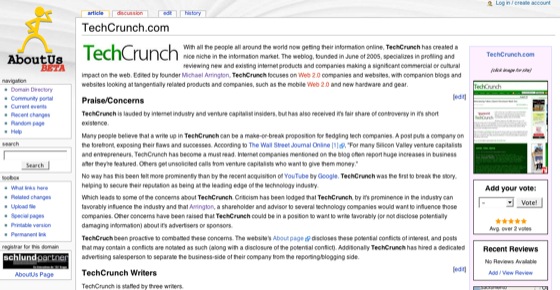
There is something that bothers me about having 3 million pages about websites, populated automatically and by any random editor who stops by, titled “AboutUs.” The phrase implies an autobiographical text. (It’s also probably very good for SEO.) The AboutUs page on TechCrunch wasn’t written by anyone associated with TechCrunch and there’s something about the name AboutUs that makes me uncomfortable about that. I could certainly go in and change the entry, but it feels more like something I’m obligated to do unless I ignore it.

The company has partnerships with a number of domain registrars in the works to put links to each site’s AboutUs page at the top of WhoIs info, in exchange for a badge linked back to that registrar. King hopes that a growing number of websites will put links to their AboutUs.org pages on their sites, as he intends to add wiki functionality and a community edited About page to every site on the web that he can.

The site hasn’t been monetized yet; Ray King says they will explore premium features like paid job listings on company pages. I probed ruthlessly for some indication of an antisocial profit drive in King, as it took me a while to believe that a business based on content scraped from the WhoIs records of other sites could be legitimate. In the end, though, I was convinced that King really is a true believer in “the wiki way,” as he calls it, a collaborative culture based on presumptions of good faith.

Presumptions of good faith aside, I’d like at the very least an RSS feed to subscribe to changes being made to sites I’m connected to. King says that’s a high priority and will soon be one of a number of extensions he’s made to his MediaWiki implementation.

Can AboutUs succeed? If it does, it will be part of a general transition of the culture of the web. I like the idea of having wiki guides to websites, though calling it AboutUs makes me uncomfortable and I hope a wave of nasty edits doesn’t make me regret pointing to it. If a happy medium of wiki purity and some control over edits can be maintained, AboutUs could be well positioned in a world still deciding how it feels about “the wiki way.”
Advertisement

Comments rss icon

  • Laurent Van Winckel - November 14th, 2006 at 4:58 pm PST

    It kind of pisses me off to see new sites come up with the same original idea I had written up on paper in detail a couple of months ago, but not created yet. Not like it’s the first time, it already happened before. Anyway, really nice site. Their index of websites seems really big already. It sure is a nice concept and could become big if expanded a bit more. Kudos to the team.

  • It is so funny that you profiled this site today. Earlier today I was going through Google pages that included our URL and sure enough…aboutus.org/LakePlace.com showed up. They are using copyrighted text…without permission – and they did not even have the decency to link to us. Thumbs down.

  • $1 million from 16 investors for a site built on a free application and that is apparently populated primarily through an automated process that gathers publicly available information of little value? Without mentioning any bubble, I guess it’s safe to say there’s a lot of money floating around out there and many investors don’t think they have a lot of good places to put it.

    It’s also amusing that they have no business model. The idea that companies will seriously consider premium features like paid job listings is laughable. It’s not like this is going to be the go-to online destination for efficient job-seeking.

    Best of luck. I think we’re going to have 16 disappointed investors.

  • To Dave:

    Wow. Copyrighted information such as company history, contact information and who owns the domain.

    Wow. Truly a horrendous horrendous practice for people to see information such as that.

    Give me a break.

  • All I have to say is: $1 million for this — WTF !!!!!!!

  • Dave,

    There are actually 3 links to your page, the “read more”, as well as the text link and thumbnail that appear on the right hand side of the page. On the use of text from your page the new bot takes a max of one paragraph of text and does a clearer attribution. Also, we have a background process that is adjusting previously created pages such as yours. So in short, point well taken.

    - Ray.

  • Oh great! Yet another site to have to track for trolls, vandals and anyone else who wants to badmouth you. I wonder if they have a policy that lets you remove your site from the index.

  • To Drama 2.0:
    Wikipedia is based on the same model applied to information. I hardly believe that the content on that site is useless! It demonstrates that value can be created by providing a platform for collaborative and communal knowledge. To what degree this model can be applied to a domain directory AND then monetized profitably is yet to be seen, but I think the content model still applies. There is value in collecting and organizing information from everybody.

    In response to the rest of you naysayers (and in agreement with Alaska), I can’t see why you’d resent some free advertising.

  • Just checked one of my high traffic sites in About Us. The text they picked up is one of the paragraphs on my site’s about us page, a very threatening sounding warning about copyright infringement and defamation that I added after I took down some troublemakers a couple of years ago. Pretty funny they picked up that paragraph. Maybe that will discourage vandals and trolls from making mailicious entries about my site.

  • Alaska: Normally I would agree with you, but this is interesting. Check out Dave’s site and listing:

    http://www.lake...m/about/company
    http://www.abou...g/LakePlace.com

    They’ve simply copied the text, obviously through an automated process. It’d be impossible to argue that this text has significant commercial value, but it’s copyrighted nonetheless. I am not an expert on fair use, and I think there’s a valid argument that AboutUs might qualify under the Copyright Act of 1976, but at the very least it’s going to be seen as highly questionable by many webmasters, and if they try to monetize these pages I would not be surprised if somebody decided to sue them, especially since many sites have terms of service which prohibit such automated spidering of content for this type of purpose. Again, I don’t know that there’s an enforceable violation of law here but since AboutUs has $1 million in the bank, somebody might take a punt in court.

    The bigger point is that this is such a ridiculous website for an outside investor to put any money into, let alone a sum of $1 million. Where’s the money going? Why are 5 people needed? Why are they only checking entries at night (keeping their day jobs)? There is nothing stopping anybody from very easily duplicating this within a week using MediaWiki and even spidering all the content from AboutUs. In fact, it probably won’t take very long for that to happen, even if it’s only to snap back at AboutUs for conduct that many people will see as unethical.

    demimooore: the value and usefulness of Wikipedia and its model is often debated, but let’s make no mistake about it: Wikipedia is an encyclopedia with a vast amount of content on real subjects of value contributed by real people. AboutUs is nothing more than a bunch of publicly-available information aggregated into a free piece of software in what many would call a questionable manner.

    Personally, I believe that in many cases there is little value in collecting and organizing information from *everybody* because the desired information is more efficiently collected and organized from a limited number of sources. At the end of the day, I care about finding the information I need in an accurate and efficient manner (without having to sort through useless clutter), regardless of where it came from. But that’s just my personal belief and it does not apply to every field. If we agree that the Wikipedia model is useful, it does not logically follow that the same model has to be, or will be, useful for everything. In the case of AboutUs, I think there’s almost no value and this does not really represent free advertising of any worth since it’s highly unlikely that people will use this substantially as a discovery tool for new websites.

    Your comment “to what degree this model can be applied to a domain directory AND then monetized profitably is yet to be seen” is precisely the point. Investors have put $1 million into this so it’s obstensibly an attempt at building a real business and should be evaluated as one. The value of the service remains to be seen, there is no real viable business model that could justify such an investment and because this is built on a piece of free software and contains data that anybody can aggregate, there is no defensibility here. Even if investors now own 100% of the company (which is certainly not the case), somebody would have to pay $3 – $5 million for them to get the return most investors seek. Think that’s going to happen given these facts? Bottom line: as a business, I’m calling DOA. If you love it, feel free to open up your checkbook and invest. I’m sure you can get in on the second round. Better yet, download MediaWiki (it’s free), set up 10 wikis around 10 different subjects and go out and raise $10 million. Then leave the country. At least there’s a viable business model there.

  • Alaska: Normally I would agree with you, but this is interesting. Check out Dave’s site and listing. They’ve simply copied the text, obviously through an automated process. It’d be impossible to argue that this text has significant commercial value, but it’s copyrighted nonetheless. I am not an expert on fair use, and I think there’s a valid argument that AboutUs might qualify under the Copyright Act of 1976, but at the very least it’s going to be seen as highly questionable by many webmasters, and if they try to monetize these pages I would not be surprised if somebody decided to sue them, especially since many sites have terms of service which prohibit such automated spidering of content for this type of purpose. Again, I don’t know that there’s an enforceable violation of law here but since AboutUs has $1 million in the bank, somebody might take a punt in court.

    The bigger point is that this is such a ridiculous website for an outside investor to put any money into, let alone a sum of $1 million. Where’s the money going? Why are 5 people needed? Why are they only checking entries at night (keeping their day jobs)? There is nothing stopping anybody from very easily duplicating this within a week using MediaWiki and even spidering all the content from AboutUs. In fact, it probably won’t take very long for that to happen, even if it’s only to snap back at AboutUs for conduct that many people will see as unethical.

    demimooore: the value and usefulness of Wikipedia and its model is often debated, but let’s make no mistake about it: Wikipedia is an encyclopedia with a vast amount of content on real subjects of value contributed by real people. AboutUs is nothing more than a bunch of publicly-available information aggregated into a free piece of software in what many would call a questionable manner.

    Personally, I believe that in many cases there is little value in collecting and organizing information from *everybody* because the desired information is more efficiently collected and organized from a limited number of sources. At the end of the day, I care about finding the information I need in an accurate and efficient manner (without having to sort through useless clutter), regardless of where it came from. But that’s just my personal belief and it does not apply to every field. If we agree that the Wikipedia model is useful, it does not logically follow that the same model has to be, or will be, useful for everything. In the case of AboutUs, I think there’s almost no value and this does not really represent free advertising of any worth since it’s highly unlikely that people will use this substantially as a discovery tool for new websites.

    Your comment “to what degree this model can be applied to a domain directory AND then monetized profitably is yet to be seen” is precisely the point. Investors have put $1 million into this so it’s obstensibly an attempt at building a real business and should be evaluated as one. The value of the service remains to be seen, there is no real viable business model that could justify such an investment and because this is built on a piece of free software and contains data that anybody can aggregate, there is no defensibility here. Even if investors now own 100% of the company (which is certainly not the case), somebody would have to pay $3 – $5 million for them to get the return most investors seek. Think that’s going to happen given these facts? Bottom line: as a business, I’m calling DOA. If you love it, feel free to open up your checkbook and invest. I’m sure you can get in on the second round. Better yet, download MediaWiki (it’s free), set up 10 wikis around 10 different subjects and go out and raise $10 million. Then leave the country. At least there’s a viable business model there.

  • Marshall, in terms of this wiki having incoming links to your site, sure, it’ll help a bit for SEO, but I don’t think there’s anything *really* extraordinary about the site.

    Also, curiously enough, about us is displaying the about me page from my blog (well, an older version of it anyway). No whois info listed whatsoever.

    And the Related Domains are some of the outgoing links from my blog. I suppose those just happen to be sites that About Us found – it’s in no way a complete list. And a nitpick, I don’t know what’s up with the capitalization of the domains…it just looks weird.

  • Joy,

    I think the point is if you don’t like what you see, you can fix it yourself.

    Vandals still an issue–perhaps there could be a section editable only by the business owner?

  • In the old days we called sites like Aboutus.org or Zoominfo Spam. Today we call them wiki. Congrats to the Aboutus.ORG :-) team and shame on the search engines engineers. How can a site w. scraped content even rank in the SERPs?

    Anybody interested in investing in my Wiki organziation?

    http://www.abou...mailadress.html
    http://www.abou...6462323232.html
    http://www.abou...boulevard2.html
    http://www.abou...runch_blog.html

  • this site will help popular sites like TC more popular, but little helpful for unknown sites. information of company isn’t like knowledge. there is no much value to digg. if aboutus has functions like PR newswire and allow users to add company news or something like that, that will be more interesting and pragmatic.

  • Ok – I swore I was never going to go “off” on a startup, but I broke my rule. I have just gone off on this one.
    http://www.cent...us-gets-funding

    One thing that Marshall does not mention (besides the huge TC plug on AboutUs home page, which I am sure they didn’t pay or ask for but is still there, because god knows no one would pay or want to be involved in this crap) is that spammers will love this site.

    I am mad.

  • If you want to know about a site, why not just go to the site itself? Why would you go to this site instead?

    It just seems silly. I can’t believe they got a million dollars! Jeez.

  • I’m going to one up this website and create a wiki website about every wiki website so when people want to find a wiki website about every website they can go to my wiki website about every wiki website and look up the wiki website about every website there.

  • lol Jake – that was a good one!

  • Mad Props (as they say on the impovrished backstreets of Palo Alto) to Drama 2.0. It isn’t easy to muster the courage to face today’s teeming, self-deluded masses who believe their widget comanies are the ticket to $1.65B acquisitions and web infamy.

    Several questions about this preporsterous model come to mind. Not the least of which is: Who is going to be more knowledgable about the background of any given website, than the team of website creators itself?

    Such a question leads to the following inevitable ambiguities, which, prehaps, not even media-wiki’s disambiguation applet could untangle were it so applied:

    1. What incentive would a website development team have for providing their background / about us info on a third-party’s wiki (particularly if said third party app were commercially motivated)? (NOTE: Heightened traffic is not a sufficient answer b/c it presupposes that there is sufficient content on the wiki to garner traffic in the first place).

    2. What additional value-add info could be provided by third parties (i.e. websurfing audiences, not web development teams) other than possible review/editorial content, which is already being facilitated by such little-known web apps as blogs, forums, social bookmarking services etc.?

    3. Who is AboutUs’s target reader? I ask b/c it is unlikely that consumer web audiences care enough about web teams to research them, before, after, or rather than simply attending the target website itself, and b/c business users (i.e. folks conducting, for example, competitive research) probably know how to use such arcane tools as “whois” and www. google.com

    4. Who TF invested in this nonsense? Actually, strike that question. The fact that they only raised a buck and that it took 16 people to pool this sum tells you about the degree of sophistication of their investors.

    5. More to the point… how did this guy convince Ward Cunningham to join his board of advisors?????!!!!!!

    6. How did Drama 2.0 so blatantly miss the boat in the evolution of comment naming standards? I observe that my moniker (Drama 3.0) contains imbedded artificial intelligence (supported by S3, EC2, Blackbox Data Centers, Dynamic Tagging, and Distributed Agent-Oriented Architecture) and is substantially more advanced than drama 2.0, which is so 5 pedabytes ago.

    7. What will be the name of Michael Arrington’s 2.0 equivalent of FC (Fuckedcompany) once the implosion trend sets in? I’m suggesting the the following, but invite others to add to this list:
    -Crunch Fucked
    -FunkCrunch
    -F’crunched company
    -Tech Crunk
    -Dreck Crunch
    -Shmeck Crunch
    -Tech grunge
    -wet funk
    -net bunk
    - Bet, Sunk
    - drankthe punch
    -Becoming a monk
    -investors-punked

    :)

  • (In response to Drama 2.0):
    It’s pretty clear to me that two things are going on here:

    1) The AboutUs bot is scraping publicly available information from a wide range of sites, and when it does so it is a) not the text in full and b) correctly cited (not to mention indented and italicized to further clarify that it is copied). I don’t see how there is an intellectual property issue here, particularly when the profile page portends to create value (i.e. traffic) for the site profiled. However, I do agree with you that this scraped content alone creates no value for AboutUs.

    2) Many of the pages on the site (Google Maps for instance), are clearly not generated by scraping alone. These are instances where a ‘real’ user has added their own ‘real’ content to the page, and in most cases it is both substantial and valuable. Some of this information is publicly available (contact info, company history, etc.) and, in the case of more subjective commentary, some is not (the article and the user reviews contain information unique to AboutUs). As traffic grows, this latter form of content will inevitably aggregate into something both meaningful and useful.

    The beauty of the wiki, as opposed to a blog, is that it is a forum for collaborative (not aggregated) information. I find it much harder to parse what I need from an endless queue of blog entries (very often ‘useless clutter’) than I do from a formatted wiki. So, it seems to me that AboutUs is only helping organize information for the user. No harm done here.

    Your point about aggregating from a limited number of sources is both well taken but irrelevant, I think, in Web 2.0. Wikipedia represents the collective knowledge of all of its users, not a group of experts (your ‘limited number of sources’)—if this were their goal, they would limit registration to those they deemed ‘knowledgeable’. As far as I know, this is not their policy. Now, it may be true that a minority of the Wikipedia community contributes a majority of the content, but they surely do not create all of it. So we must say, then, that the value of that site is something created by each and every user.

    If you apply this model to AboutUs, where pertinent information is equally about objective facts (what does the company do, how do I contact them, where are they located) and user opinion (experiences with the company/site and their products), it seems to me that incorporating each user into this collaboration is even more valuable and important. We don’t care for public opinion on Wikipedia; we necessarily do on AboutUs (it may even be the determining factor in our decision to go with one company over another in purchasing a product/service). The value, then, is more analogous to that of citysearch.com and other listing sites that collect information from their users. These sites do have a demonstrable business models to monetize this value, so I’m sure it is only a matter of time until AboutUs to follows suit.

    An end note: I think the Alexa scores speak for themselves here. The traffic is continuously high and continuously increasing at a staggering rate (around 1500 now (?)). If the site is so useless, why all the page views?

    Drama 3.0:
    The high traffic represents the incentive to the web developer to post his ‘about us’ content on AboutUs. Am I wrong here?

  • Nice! I didn’t even know my new website was listed in there. http://www.abou....org/4Indian.tv

    I love them for showing us some love. But still, I’ll have to second Dr. Phil: $1.5 mil for this, WTF?????

  • Jake (#18), please see http://wikiindex.com – that’s our goal, to be an index of every public wiki on earth. Give us a hand?

  • Woops, I meant to say 1 mil and not 1.5 mil. Beat you to it, didn’t I :-)

  • I don’t see the value in a blank shell. Wikipedia started as a shell several years ago.. but today it is full of useful information about all sorts of things. So I see there may be a value in the future if the articles are more complete. It would seem this citysearch + every domain = useful (future). It will take them 5 years I would suspect but if they already have an alexa rank of 15,000 and that continues to go up. Well then I would say this is a good investment. I would invest in wikipedia five years ago!

    Perhaps they could add RSS feeds for every page so that I can monitor people commenting on my websites, I would be interested to follow customers that talk about me. I doubt I would adverise my own product on a page about my company. But perhaps Aboutus will advertise competitors on my page…. Hmmm. The jury is out. Give it 5 years.

  • “The AboutUs site went live in August and has seen healthy traffic growth. The site’s traffic after only a few months is one of its primary selling points.”

    OK, so you can make “statistics” say about anything you want them to say. I’d be curious to know if the traffic is being predominantly driven by (1) website owners who only edit / monitor info about their own websites or (2) the mass population who is “thirsty” about information about a particular website becuase it is so patently difficult to actually go directly to that said website to learn about it?

    Oh ya … and to all the “Toppers” out there … I’m perfectly fine being DavidEzra 0.7 (Truthfully, I’ve always liked reading Drama 2.0’s thoughts, as I usually find them “right on the mark.”)

  • I had written about AboutUs.org and if the concept was ethical.
    This was when they just started up.

    Ray King did a lot of work on the site and made a lot of changes, including the ability to block the bot from your websites using robots.txt

    AboutUs.org has grown really popular since then. Yes, the problem of anyone editting your data still exists :(

  • AboutUs is nothing but complete black hat spam BS with the right backing to make people believe they are legit. I could build the same database over night. Just because I have the $$$ to strike up deals to be linked to by registrars, does that make me less of a spammer? No.

  • Idea 2.0 – Start a similar automatic wiki that gathers the same from dmoz. It is pure spam allright.

  • What a great thread. Even the people that are wrong are damn funny. I’d say it’s a toss up re who gets the last laugh on this one. As a cautious voice of moderate approval (fence sitter) I’ll be the only one who’s sure not to be 100% right. Funny stuff. Totally web 2.25

    re it’s spam: it’s spam you can edit,ok? what’s more lovable than that?

  • Drama 4.0: A lot of things seem to be irrelevant in Web 2.0, namely business models, profits, sane valuations and logic itself.

    A few points:

    - If I want basic facts about a company (history, location/contact information, etc.), I go to the company’s website. It makes no sense to go elsewhere since I can feel reasonably comfortable that this type of information is going to be most accurate coming direct from the company itself. Since AboutUs is just spidering this content from the company’s website anyway in most cases, there’s no reason to go to AboutUs.

    - You mention that AboutUs could develop into a place users go to make purchasing decisions and liken it to CitySearch. First of all, I think this is an apples to oranges comparison. There is no way you can compare a custom application like CitySearch, specifically designed to provide such a service, to AboutUs, which is built on MediaWiki, a free piece of software designed completely for another purpose. Frankly, the wiki format cannot provide the same type of user experience and functionality that already exists on websites specifically designed from the ground up to serve the purpose you describe, like CitySearch. If AboutUs wants to compete in this arena, it is going to fail miserably. There are already a plethora of established commercial comparison and feedback services and communities with much better feature sets that are successfully serving this market in various verticals. It’s hard to believe that, regardless of the $1 million they’ve raised, a viable contender in this space is going to emerge using a free platform like MediaWiki. It is ill-suited for the job and anybody could easily use to set up similar services.

    - I’ve been browsing through AboutUs and I don’t see much collaboration going on. You seem to think that this a great way for people to comment on companies, etc. Go to the Microsoft.com page on AboutUs. No comments, reviews, discussions, etc. Just basic, useless information. This is a company that everybody loves to criticize so I think a fair analysis is to look at the activity levels around companies that one would reasonably expect to generate these types of contributions. You can’t say that AboutUs doesn’t have a high enough traffic level to get this type of activity going, so the logical conclusion one would come to is that the site just doesn’t appeal to the type of use you think it might. Could this change? Sure, but I wouldn’t hold my breath. I suspect that AboutUs will become more a target for spammers looking to market their sites than it will become a forum for active collaboration like Wikipedia. Why? As a “domain directory”, the only person that would, in most cases, have an interest in a specific domain is the domain owner or people that have a beef with the website. No other parties truly have an incentive to care and devote time to contributing. In essence, this is nothing more than a Web 2.0 link farm.

    - I personally don’t claim to have any solid explanations for the AboutUs traffic figures. What I can say is that according to Google, it has a PR3. Not impressive. A search for “AboutUs.org” reveals tons of blog entries, most quite negative and questioning whether this is legal. Somebody has even set up stopaboutus.org. I suspect that a considerable amount of traffic is driven by the webmasters who learn about this controversial site and go to check it out. Additionally, it appears from Google search results that a number of domain registrars or whois services include a “Visit AboutUs.org for more information about [domain]” link when you do a whois lookup, so that would drive traffic as well. Again, it does not appear that the traffic they’re receiving is driving any sort of *valuable* user activity.

    - Regardless of whether you think this type of site has merit and use, from a business perspective I think it’s very difficult to argue that this is a business that deserves or needs $1 million. In fact, I’m hesitant to even call it a business at this point for the reasons I mentioned in my previous posts.

    Drama 3.0: I promise to let you take the lead in commenting about all the Web 3.0 companies now that the term Web 3.0 is officially being thrown around semi-seriously. In the meantime I’m simply enjoying the Web 2.0 space. But lest you think that I’m ignoring the coming Web 3.0 gravy train, I’m in the process of trying to raise $5 million from 5,000 investors for my Web 3.0 stealth startup, Agent Orange. I don’t want to give too much away, but it’s quite simple. Many Web 3.0 visionaries are stating that Web 3.0 will consist of advanced AI applications that make the Internet “less of a catalog and more of a guide.” Going to Europe and need travel advice? Get an itinerary developed specifically for you based upon a detailed analysis of who you are and all the travel data that can be mined from the Internet. Don’t know whether to buy an iPod or Zune? Let a bot decide for you. Want to know what stocks to invest in? No problem. You can be given a very specific portfolio structure tailored specifically for you without the need to hire a real financial planner (this will save the YouTube guys lots of money). Sounds great, right? The problem is that inventing HAL is tricky and expensive and Jeff Bezos doesn’t want to give me a free three-year beta test of EC2, so Agent Orange has come up with a much more effective solution: tell everybody that you’ve developed an advanced AI system that can match them up with the products and services that are best suited to their needs but really push products and services that we’re paid to promote. Call it AdWords 3.0. Because people believe that they’ve been recommended a product by an AI system that is smarter than every human on the planet, psychosomatism kicks in and the customer is unbelievably satisfied with the product. Patent pending.

  • Drama 2.0,
    You lost me at the end of your rant. What does Agent Orange and your stealth Web 3.0 startup have to do with About Us?

    How can a site 2 months old be judged on not having enough traffic? Wikipedia didn’t get big for several years. I too have been browsing around AboutUs and I find that the best place to look (and the most interesting) is the recent changes page. That shows you people are making micro page edits about themselves. On the suggest a featured site page there are several articles that are rather well done.

    I still say, give the site five years. This is DMOZ on steriods + user comments + platform. Seems that with a platform like this they can add lots of features other then just wiki. It would be great if they had a toolbar. (Like I need another toolbar, :) ) But hey it would allow me to track comments dynamically.

  • David: Apparently you have no sense of humor nor ability to recognize that I was responding to another poster.

    You also didn’t read my comments very well. According to Alexa, AboutUs has plenty of traffic, but relatively little valuable activity. That’s great that a handful of people are making “micro page edits about themselves.” Not sure what that means, but I’m way behind the times and have not learned about micro pages yet. It’s also great that there are “several articles that are rather well done.” Nice to know that $1 million goes far these days. Based on the Alexa stats showing that the site gets 3-4 pageviews per user session, it’s unfortunate that others don’t recognize the incredible value of AboutUs and find joy in browsing all the recent changes. Oh well, maybe they’ll learn.

    “This is DMOZ on steriods + user comments + platform. Seems that with a platform like this they can add lots of features other then just wiki.”

    I’m going to let you in on a little secret. It may sound completely unbelievable, but you too can have this incredible platform. You can go to mediawiki.org and download the same software that AboutUs is built on absolutely free. Yes absolutely free. You can spider AboutUs, the whois database or download the entire DMOZ dataset via a RDF dump and create the very same site very quickly and at little to no cost. Not a technology person? Just go to eLance and hire a programmer. Dirt cheap and it worked for Kevin Rose. Then you can even develop a toolbar so that you can track the non-existent flood of comments. I’m sure within 5 years it’ll run widly like the Amazon.

    You clearly think AboutUs is the greatest thing since sliced bread, and so do 16 investors. Eleanor Roosevelt once said “The future belongs to those who believe in the beauty of their dreams.” You have a dream and you’re in luck. The software to achieve your dream is free so there’s nothing stopping anybody who truly believes there’s a huge opportunity here from trying to seize it. You can do that or wait around for 5 years. By then, you’ll probably be able to find me on Michael Arrington’s Web 5.0 blog to rub the AboutUs success story in my face. You won’t have the billions of dollars the AboutUs team will have when they sell out to Google, but at least you’ll have the satisfaction. I’ll even give you incredible terms on how we define success for AboutUs. The metric: once Stephen Colbert mentions AboutUs on the Colbert Report we’ll know that AboutUs has achieved wiki stardom, if not a viable business model. Looking forward to it.

    On a side note, the really cool thing about this venture is that it realistically could survive for 5 years on $1 million. $1 million divided by 5 employees divided by 5 years means that each employee could make $40,000/year. Doesn’t leave any room for schwag, booths at the major wiki conferences or Yelp-style parties, but for some reason I think there might be time to work some gigs on the side. Just a hunch.

    I’m sorry that I plugged Agent Orange and hope that you’ll consider giving us a try when we launch. Not sure if we’ll get a writeup on TechCrunch since TechCrunch is Web 2.0 and we’re Web 3.0 Alpha. I’ll make sure that we post lots of details on AboutUs though.

  • It seems a little dubious that AboutUs.org would be receiving 1/3 the number of visitors as TechCrunch (#s according to Alexa). I wonder how hard it would be for a company to fake the Alexa data … particularly given the relatively small # of users with the Alexa toolbar.

    For example, if they setup 100 old computers, each with a distinct IP, to run a script that would open up an Alexa-enabled IE session and hit AboutUs.org, that could greatly bump up their rating. Plus, they only have a Google PR of 3, which seems awful low for someone getting that many real hits (although I guess their PR will go up now that TechCrunch has linked to them here).

  • I’m surprised that you found place on Techcrunch pages for such trivial site as AboutUS. Such sites sprang as mushrooms after rain. While idea of open content web directory that anyone can edit is absolutely viable – that’s why we have del.icio.us, stumbleupon, digg – but who needs their countless clones?

  • it’s difficult to see a viable business model in this company. Sometimes I think investors are emphasizing management team way too much.

    In the investor world the line is, “your business model will always be different, so you must have a good management team that can adapt.” What about the fact that the idea just plain sucked from the beginning?

    The other line is, “talk the investor to the point where he is so sure you know what you’re talking about that he doesn’t even know what you’re talking about.”

  • So is getting 1m$ simply enough to be profiled and featured on TechCrunch? ;-)

  • Sorry about splitting my posts. Seems that it becomes clear where they are getting the traffic from:

    http://search.m...e%3Aaboutus.org

    aggresive SEO = bought (exchanged?) links + ~content (346,000 indexed by Google) ;-)

    cheers – michal frackowiak

  • Drama 2.0,
    Colbert is so 2006. Don’t you mean Comedy Central’s 2011 news show. I doubt Steven would mention any website that is not already well known. It makes the jokes funnier if people know about the subject.

  • Wow, I have to say i am surprised at all the hullaballoo here.

    Text from a website raising copyright hackles? Gimme a break. I’d say YouTube’s copyright challenges are just a wee tad bit more serious? And, for that matter, is this any different than any search engine scraping?

    As for value here, seems to me pretty obvious. The site has virtually no value today; BUT, if the traffic trends are a harbinger of these guys become the de facto wiki people go to for editing or viewing info on companies, this becomes the wiki version of Hoovers, which is something I would invest in…

  • Where is the traffic from ?

    If you believe, that the alexa.com figures are reprensentative, a 20.000/1.000.000 pi-Rank on an estimated userbase of say 200.000.000 potential users would mean 3.000.000 pi`s a day. Form one day to another, without existing user basis, not beeing verry present in google.
    I don`t know how they did it (maybee ads ?).

  • Correction: sorry, ist 4 Mio pi`s per day. I estimated on 150 mio. users first.

  • Hey Marshall – thanks for posting on my site :)

    VCMike – I honestly don’t care about the copyright issues – to me there are much bigger issues.

    And while this could become a Zagat type site, at the same time, this come become something much worse. I want to know where the traffic is coming from. I wonder how much of it is from general web users looking for an about us page being steered in the wrong direction.

    This type of site (if anything) should complement my about us page, not steal from it.

  • About a year ago I wrote an search engine that used Yahoo search results but allowed the blurb of text in those results to be edited wiki-style – to better describe that site, or, to be more exact, that page of the site. I may be baised, but I think that is a better approach because it is inserted into a process that people are already doing (searching for information), rather than making it a step out of the way.

  • I contend that people on techcrunch are haters. At this point the main reason to get profiled on techcrunch is to find out why people hate your idea. It’s not a question of if, only why. With that being said, I do think that AboutUs has serious problems.

    I agree with a lot of what Drama said. They have no IP. All you need to duplicate this is mediawiki and the ability to spider whois records. It’s a cute idea, one that I’ve toyed with in one form or another for awhile. A place to look up “meta” information and comments about websites. But maybe it’s my limited experience that let’s me see all of the pitfalls with this.

    For one, you’re going to have serious comment and moderation problems. Wikipedia already has to deal with edit wars where someone adds text then someone else removes it ad nausuem. What if I go on AboutUs right now and edit their page to say “This company uses copyrighted text, etc etc”. Then the same people they have posting on this thread will change it. Then I’ll change it back. And that’s just going to keep going until a user never knows what content he or she will see.

    Wikipedia utilizes a LOT of editors/admins who work for free because they get so much value out of wikipedia (and because of the little power trip they get from being able to zap people’s edits). I don’t think AboutUs will be able to get that many people onboard to help them deal with spam/vandalism and most importantly flame wars.

    Copyrighted text is a minor issue. Most people don’t care. What I want as a business owner is a chance to defend myself from possibly unfair criticism. What if someone misunderstands my terms of service and I have to kill their account or some such and then they go on AboutUs saying horrible things about my company? Then I have to go and explain that no, we aren’t evil but the customer just blah blah blah, or just delete the comments alltogether. It’s just going to be a pain.

    I suggest you look into a company called “ThirdVoice”. You can find them on a google search. They went out of business during the original bubble. They were a system for commenting on various websites, discussion and community etc based on a site. Problem was site owners hated them for the reasons listed above. Users weren’t that into posting. I think AboutUs will have a lot of the same problems.

  • To express my displeasure at AboutUs.org I have posted the following message on http://www.abou.../Crisscross.com

    ==You have come to the wrong place==
    Crisscross does not authorize this page. The information on it is likely to be inaccurate and is not to be trusted.

    Frankly, we have enough real work to do without correcting errors, misguided attacks, rumors, half-truths and lies, libelous statements, and the uninformed opinions (not to mention the poor grammar and spelling) of assorted trolls, loons, half-wits, cynics, psychos, nutjobs, and/or anyone who has, had, or ever will have a grudge against us, or wants to take out their bad-hair day anger on us. The small (and unproven) gain in traffic is insignificant compared to the hassle.

    In other words we will not do free corrections to enrich the investors of aboutus.org. We are happy to make corrections to our Wikipedia page because it is a non-profit organization that has some integrity.

    If you want to find more about Crisscross please go to our about us page, our blog, or our Wikipedia page.

    If you want to find out about any website, go to the site itself or go to Wikipedia. Do not come back here again.

    WEBMASTERS: Please feel free to use this text as a template to show your displeasure.

  • Business model could be quite easy here: put AdSense, sell text-link-ads, IntelliTXT or any other. If they have traffic, no matter really where from unless it is not some king of “cheap traffic”, it can work.

    If they get traffic from search engines – it’s great and this could make money.

    Anyway – this site (and the discussion above) gives me a nice idea to make some money ;-)

  • VCMike: A wiki version of Hoovers would be fairly useless in my opinion for any serious user relying on accurate information. Just because you can “Web 2.0ize” something doesn’t mean you should, and again I don’t think that the wiki model works in every field. Hoover’s provides certain data and intelligence services that its customers expect to be accurate because that data can be very useful to their business. As such, any person that is looking for data that might be important to their business would rather get data from a trusted source like Hoover’s than from some source where any idiot could provide false, inaccurate or conflicting information. When it comes to certain data, there’s no such thing as a free lunch and the “wisdom of the crowd” can easily become the “stupidity of the crowd.”

    Joel v 0.63: I don’t think everybody here is a hater. Obviously there are a lot of people who seem to have an irrational emotional attachment to certain companies, but they’re easy to spot. There’s nothing wrong with posting a critical analysis of a company. There are some truly good startups being founded but there are also a lot of obviously flawed startups too. Opinions are like a**holes – everybody has one. If you’ve raised money and launched a company you can’t and shouldn’t listen to every opinion out there, but in a case like this, there are such evident flaws being pointed out by numerous people that you’d hope the company and its investors would take note, unless of course there’s no real goal of building a viable business, which is certainly the case with a lot of startups. TechCrunch can be great for a startup because there’s often a lot of very good feedback being provided absolutely free of charge. Smart founders will consider valid criticisms whild dumb ones will ignore it.

Leave Comment

Commenting Options

Enter your personal information to the left, or sign in with your Facebook account by clicking the button below.

Alternatively, you can create an avatar that will appear whenever you leave a comment on a Gravatar-enabled blog.

Trackback URL
bugbugbugbug
Techcrunch on Facebook