November 12, 2006

Listen To Podcasts On Any Phone

Michael Arrington

74 comments »

We’ve been testing two new services, Fonpods and Podlinez, that allow users to listen to podcasts directly from any telephone. Unlike existing service VoiceIndigo, which requires users to listen to podcasts on a cell phone through downloaded software, both of these services require nothing more than the ability to call a telephone number and listen.

Podlinez

Podlinez is a dead simple service that launched a few days ago. Go to the site and search for a podcast. If it’s already there, you can look up a dedicated phone number for that podcast. If the podcast is not included, anyone can add it and a dedicated phone line is associated with the podcast. To listen to the most recent episode of TalkCrunch, for example, just dial +1 (831) 480-3920 and listen. I assume the company will add advertising to the site and to recordings at some point to generate revenue.


Fonpods

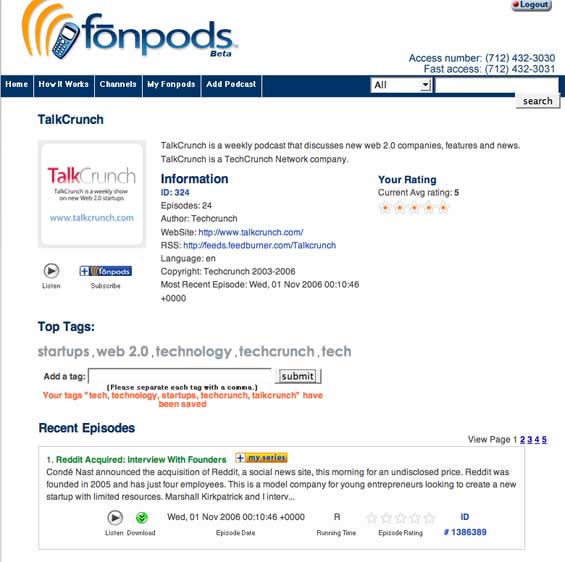
Fonpods, which is currently a TechCrunch sponsor, launched at DEMO in September 2006. It is similar to Podlinez, but has a single phone number for accessing all podcasts, +1 (712) 432-3030. Users can call that phone number (no registration required) and listen to pre-selected content in a number of categories. Registered users can also subscribe to podcasts and access that specific content if they call in from a phone that they’ve registered with the service. Fonpods also has detailed information about each podcast (TalkCrunch information page is here, for example). These podcasts can be added to a user listening list with a single click.

Even though Podlinez and Fonpods are similar services, they are both useful for different things. Podlinez, with it’s dedicated phone number for each podcast, is a good way to “subscribe” to a single podcast and listen whenever new episodes are released. It requires no registration and has zero setup time. Just call the number and listen. Fonpods requires registration and basic setup to subscribe to favorite podcasts, but is a good solution for people who listen to a wide variety of podcasts and want access from a phone.
  • Sphere It

Trackbacks/Pings (Trackback URL)

  1. » Listen to Podcasts on the Cell Phone - Blog Search Engine
  2. Podlinez « Technically Speaking
  3. Fonpads « InterMedia Blogging Network
  4. Podlines and Fonpods: Solutions Without a Problem | The Last Podcast
  5. Natuke Deformeerunud » Blog Archive » Podcastid sinu telefonis
  6. Fuller Media Blog » Podcast on your Phone
  7. TechCrunch Japanese アーカイブ » どんな電話からでもポッドキャストが聞けるサービス
  8. Recoil Communications: Effective to 300m « Zero influence
  9. Podcast Fresh - » Podcast On The Phone
  10. jkOnTheRun
  11. Listen To Podcasts On Any Phone « trent.hunger
  12. Talkingreef - problems playing podcasts
  13. Listen to Podcasts On Your Cellphone » Cool Web Tools
  14. Listen to Podcasts on your Phone at A New Wave of Thinking
  15. 14 Nov, 2006 from Download Squad « spoons for shoes
  16. Jeremy Hermanns dot org » Listen To Podcasts On Any Phone
  17. The Rotted Brain Podcast » Rotted Brain #9 11/13/06 - I’ve got your segue right here
  18. Geek Brief 11-16-06 « GGTD-Geeks Guide To Getting Things Done
  19. Verge, blogged » Blog Archive » Bei Anruf Podcast.
  20. Forgevalley Corporation
  21. Credit Debt
  22. Fonpods in DeadPool
  23. mortgage calculators
  24. SolSie.com / The Lighter Side of Mobile Technology » Blog Archive » Samsung Upstage Bundles Podcasting on Mobiles
  25. Buzzwire Gets $8 Million For Mobile Streaming
  26. Ryan Price and the Media » Listen to my BlogOrlando Podcasting Session

Comments

RSS feed for comments on this post.

  1. Daniel

    i just figure walking around the street and finding someone really engaged on his cell phone, then you ask “dude, who’re you talking to?” and the guy answers “no one, I am listening to a podcast!”

  2. Mike

    Some of these newer ideas just beg to ask the question…. why?

  3. Florian Cervenka

    I bet some people will use this service but they must be very addicted to the pod-cast.
    The sound quality of a phone-call is very bad - that makes it useless for music imho.
    If you don’t have ear-buds you get to hold the phone to your head all the time. So better don’t listen to a pod-cast while driving your car or you’ll get a ticket (at least here in Austria).
    Also its clearly not the cheapest way to listen to a pod-cast. I don’t know what the prices in the states are, but here you are charged at least a couple cents per minute.

  4. Drama 2.0

    Agree Daniel. These are solutions looking for a problem. I suppose there might be a few people that would find this useful, but I think 99% of the people that listen to podcasts have absolutely no need or desire to listen to the podcast on a phone when the PC, iPod, etc. is much more convenient. From what I can tell, these services aren’t even using toll-free numbers, meaning that they might be quite expensive if you don’t have a decent long distance plan or are using a cell phone. Given that the number of people in the mainstream that actually listen to podcasts is minimal and the number of those people that would have any interest in listening to a podcast on a phone is a much smaller subset of that, I see absolutely no mass market opportunity here.

    The information provided by Fonpods on their Partners page is almost laughable. They argue that the need to have software that can play a podcast and/or an iPod/MP3 player is “restrictive and limits market immersion” for podcasts. Perhaps they’re not aware of the mass market adoption of services like iTunes and the iPod. Fonpods goes on to enlighten us to the fact that there will be 2 billion cell phone subscribers by 2007 and that Fonpods will enable these 2 billion people to revel in the glory that is podcasting. Unfortunately, actual market research shows that Fonpods’ assumptions are completely flawed. In April, Forrester released a report showing that only 1% of online households in the US use podcasting and that it will only grow to 12.3 million households by 2010. The Forrester report indicates that MP3 adoption will be 34.5 million households by 2010. So again, podcast appeal is not limited by technology, it’s limited by consumer demand. Therefore it appears that Fonpods and other services are unaware or undeterred by the reality of the market. Forrester and all the other metrics might be wrong and podcasting could take off, but these services seem to have a very weak value proposition and are in the very best scenario extremely premature. Even if podcasting exceeds the projections, these services will not automatically reap the rewards as they need to convince people that listening to podcasts on a phone is really necessary and it just doesn’t seem that this is the case. In essence, they’re trying to create a new market within the podcasting market, which doubles their risk.

    Michael: you mention that these services are “useful for different things” but don’t really elaborate. Instead, you basically describe how they work. Fine. It’s clear that if you want to listen to a podcast on a phone they’re useful. But there’s no actual explanation of why listening to a podcast on a phone is useful (at least to a large enough number of people that would create a real business opportunity). If I’m in my office I’ll listen to podcasts on my PC. No need to pick up my phone. If I’m on the move and I’m geeky enough to want to listen to a podcast, I probably have an iPod and don’t need to hold my cell phone to my ear and hope for good reception.

  5. Michael Arrington

    hey, it turns every phone into a podcast player. Easy to listen in the car if you are on free minutes, etc. Also, many podcasts are recorded over the phone - listening over the phone doesn’t decrease quality in those cases.

  6. Florian Cervenka

    If the case is that its an interview or so and you need to get to the information asap this has a use - no question about that.
    It simply is no use for listening to music and I believe that most pod-casts are used to stream music. (I personally do not listen to pod-casts)

    There is a niche for everything. This one simply is a very small.

  7. Startups.in/India

    If I’m really that interested in a podcast, I’d rather download to my ipod or get the mp3 onto my mobile. Better yet use melodeo.

  8. Rex Dixon

    Since I have a ton of Alexa reaches (at least to the main podcast sites; can’t track my own due to my podcast sites not providing a subdomain) - I give the services a thumbs up for innovation, and a thumbs middle ways for - “Will it catch on?”. Yes, 7 Minutes with Rex Dixon and Coffee with Rex Dixon can both now be found on the services.

    I will keep an eye on it, to see if it jumps my online stats this week by having it available as a listen via your phone service. Could this be like the 1-900 craze we all saw in the late 1980’s and early 1990’s? Podcasts on the phone - is it really a good thing?

    Time will tell.

    Rex

  9. Christoph Janz

    I really like the idea. Like Mike said, it turns every phone into a podcast player and the advantage is that it doesn’t require any prior preparation (downloading podcasts to your iPod in order to listen to them later).

    A friend of mine came up with the same idea some time ago and set up a German service at http://www.phonecaster.de. If you have a flatrate for your mobile, which is getting increasingly popular in Germany, it won’t cost you a cent to listen to podcasts on the road.

  10. Richard

    The Podlinez concept is quite appealing.

    The Fonpods requirement to give out my phone number is truly off-putting. Am I now gonna be subjected to unwanted telemarketing calls? Why do they need this information? Feels like an invasion of my privacy and so I am unlikely to want to use this service.

  11. Chris

    Interesting to see the innovation taking place merging cell phones and syndication. They really could take the process a step further to simplify the process for the consumer. Dialing or remembering all those numbers is inconvenient. I propose the use of SMS technology and utilizing existing voicemail infrastructure.

    For example, if I wanted to hear the latest techcrunch podcast I would simply send the text msg “techcrunch” to a specific phone number. That podcast would be added to a pre-existing “podcast mail” account where I could dial in and listen at my leisure.

    Thoughts?

  12. Erik Schwartz

    Richard,

    They need your phone number because they ANI you so they know what podcast to play when you call. (I assume)

  13. dave

    really a small market, but honestly, i could imagine doing this for breaking and major news recaps from major media firms like cnn, that would be nice - i hear in some coffee shop that some huge thing just went down, then since i’m nowhere near a radio or tv or whatever (and since tv on the phone is slow) i just dial into cnn and get the breaking news, same for a market recap (daily) that i might put on speaker phone on a drive home versus scanning the radio and coming in partway through…but they’ll need some kind of screening and channel management…i see no value for generic podcasts, just major news…

  14. Sean

    Florian - no, most podcasts are like talk radio. There are some music ones but look at any podcast directory and find their “top 20″ or whatever list, they are all talk, not music.

  15. Say No to Crack

    I just can’t get into podcasts that much … I enjoy reading the transcripts, but listening to the whole thing is always somewhat painful (which is the same reason I don’t watch much TV news … reading it online is just so much faster).

  16. Fred

    Most of the commenters seem to have fixiated on the usefulness (or lack thereof) of the Podlinez and Fonpods technology solely for consumer podcasts. How about business podcasts? Sales training podcasts? Earning reports podcasts? Any podcast where your audience is on-the-go, are already using hands-free mobile phones, and need/want to hear content while traveling?

  17. Trott Felipe

    It’s a really cool concept. I don’t know that I would really want to listen to a podcast over my phone though, but I like what Fred points out. Definitely could be a good tool for business podcasts.

  18. anonymous

    ad advertising…

    or add ads?

  19. Evan

    HTTP://POD2MOB.COM

  20. Drew Olanoff

    I could see short form podcasts propsering from this. If there’s enough of a market for it, I could see producing a shorter rundown of the Best Damn Tech Show, Period. Bottom line is we want everyone to listen whenever they can and however they want.

  21. Jonny

    Calling a phone number for each individual podcast? This would not be fun to browse… try Mobilcast powered by Melodeo.com

  22. Patricia

    Meh, you never know what’ll happen. Five years ago, people were trying to push video conferencing via the web without much success and all my video clients at the time were barely making ends meet. Now they’re all doing incredibly good business. Nobody at the time thought about user driven content, YouTube, any of that - sometimes stuff gets developed that may not make sense now but will later. You never know.

  23. Steve Macdonald

    Worst.
    Web 2.0 idea.
    Ever.

    Seriously, this one is REALLY bad.

  24. COooko

    Is it even considered web 2.0? I mean phones are old school.

  25. Jughead

    Provided that a person has a flat rate for minutes and they can plug their phone into the car stereo, this is a great solution for a mobile sales force to listen to sales info like training, market updates, vendor/competitor analysis, etc.

    On the consumer side, don’t underestimate usage by a the younger generation of mobile phone users who always seem to want to be “connected”. Getting audio podcasts from a growing number of media channels seems very viable to me. If someone is sitting on a 40 minute commute on a bus or train to and from work, I could see them using portions of that time to listen to podcasts related to personal interets such as finance, health, entertainment, sports (like customized Fantasy Football updates), hobbies, etc, etc.

    Lastly, I don’t think these new services will be just devoted to audio podcasts. I think video is the golden goose. Then the one touch dialing to the advertiser makes a ton of sense straight from a pre-roll before a video podcast.

  26. Brent Ritterbeck

    Well, when are we going to see the satellite podcast tuner? Here’s how I imagine that concept working. You have something that connects to your computer via a USB port that allows you to program a card with what podcasts you generally listen to on a regular basis. You take that card out to your car where your satellite podcast turner is integrated into your radio system much like Sirius or XM, you insrt the card, and then you can cycle through any new podcasts that may be available that you “subscribe” to via your programmable card. This is a little outlandish, but it seems people are interesting in podcasting, so I’ll throw it out there.
    I have many ideas that are offshoots of things on this blog. The items on here seem a little out there, but that’s because these are early stage projects. All it takes is someone to solve some of the issues the commenters post to make some of the ideas actually viable.

  27. The Onion

    How will this stand up to the competition from the iPhone? I understand Apple and SoftBank will release a cell phone next year, starting in Japan.

    Drama 2.0: Whatever happened to the Dead20.com site? It’s been down for quite some time now.

  28. Todd

    @Fred

    podcast for business use makes sense. i could see listening to a podcast of product talking points while enroute to a customer site. or, catching up on the audio from a missed conference call w/ fast playback enabled…

  29. keanu zhang

    Todd, I agree your podcast idea for business, and I have such plan:)
    for these 2 sites, I have one question:
    when I am listening to a podcast, if my friend or boss call my number, will I miss many calls or podcast service providers will automaticly stop listening and connect with incoming call??

  30. Mike

    For the business cases listed above, why not use say, I dunno…an iPod?

  31. Patricia

    I agree it’d be good for business. I think more people have cell phones than iPods - it’s smart to go this route.

  32. Erik Schwartz

    29: It’s called call waiting

    30: Because an iPod isn’t a networked device. To get new content on an iPod you have to physically connect it to a computer that’s connected to the internet. Now say there’s new content 6 or 7 times a day… (news, post game shows, market reports, any kind of time sensitive information (as most valuable information is))

  33. Bryan

    This won’t fly for one reason: they gotta make money, and to make money, they’ll either be monetizing other publisher’s podcasts, or charging a fee.

    If the latter, it’s likely DOA, particularly once people figure out how easy it is to sideload.

    If it’s the former, I imagine the c&d letters are being primed. I doubt major publishers who are looking for ways to monetize their own content will let someone suck it up, add gateways and redistribute it. No publisher lets people do that with RSS feeds - why would they let people do it with podcasts? Free for non-commercial use - otherwise, call us for a licensing talk.

  34. Nemrut

    This has some interesting potential not mention further reducing the friction points to podcast consumption. A lot of people assume that podcasts are synonynous with iPod and you somehow need the latter to lsten to the former. A service like this could make it as easy as dialing for traffic/weather conditions while on the road.

    Personally i wouldnt mind listening to a podcast of Guy Kawasaki or Charlie Rose while sitting in traffic.

  35. Drama 2.0

    Jughead: You are absolutely right that if I’m sitting a 40 minute commute on a bus or train to and from work, I might want to listen to a podcast. The point you and others here seem to be missing is that in these situations, the cell phone is a much less appealing, and completely unnecessary, tool for listening to the podcast. A device like an iPod is ideally suited to this whereas a cell phone is not (it could be quite expensive depending on your mobile plan, you could face reception issues, you might miss incoming calls, etc.). So the question becomes why you would opt to use an inferior product to perform a task when a superior product is already available to you. If you are part of the 1% of American households that listen to podcasts, you almost surely already have an iPod or MP3 player and do not need to use a phone to listen. In fact, a Nielsen/NetRatings report in July indicates that most podcast listeners are Apple users (hence the “pod” in podcasting).

    Again, this doesn’t mean that there is absolutely no use for these services, but if you evaluate these services with the same criteria an investor uses, they fail miserably on the following points:

    - These services don’t address a major problem with significant pain.
    - The market opportunity looks extremely limited, both in audience and revenue potential. Some research firms project a large market for podcasting, but thus far it’s a niche and monetization on a large scale is unproven. These services are at best targeting a small subset of a podcasting market that has yet to achieve its potential and at worst are trying to create a market within it that will never develop.
    - From what I can see, there is absolutely no innovative or defensible technology. The fact that a number of services are already doing essentially the same thing and others look to be working on similar solutions does not bode well, especially when the size of the market they’re all competing for may be extremely small. These services look more like features, not viable standalone businesses.

    In terms of listening to things like earnings reports, these are already done over the phone and you can call in to listen to archived reports. As such, this market is already being served quite well. For those that have mentioned the increasing use of mobile phones for content consumption, you need to realize that these services are not really tapping into this market. Dave mentioned how it would be useful to hear recaps of breaking news, for instance. Media companies, like CNN, have already, or can be expected to, cut deals with carriers and mobile content distributors to syndicate their content to mobile subscribers. For instance, it won’t be long before I can be alerted on my mobile phone, in a push fashion, to a breaking news story that meets specific criteria I’ve set, and given the opportunity to watch the CNN broadcast about it directly on my mobile phone. While many question whether markets like mobile video will ever materialize at the level some research firms have projected, it’s clear that the scenario I just laid out is far superior to the scenario Dave presented because in Dave’s scenario, you have to hear about the breaking news via somebody in the coffee shop and then dial into a podcast number, whereas advanced mobile technology will not only provide the actual alert that something has happened, but provides delivery of richer content about it much more easily and in a friendlier fashion.

    Since some people are coming up with ideas of what potential groups might find this useful (even though they probably aren’t part of these groups), is it wrong to ask how many of the people that think this is a good idea have tried using one of these services and are seriously going to use it regularly? Next time you see somebody listening to their iPod (or another MP3 player), ask them what they’re listening to and see how many are actually listening to a podcast. Of the ones that are, ask them if they’d have any need or desire to listen to the podcast on their cell phone instead. It would also be interesting to have these services release metrics on the total number of calls they handle but somehow I suspect that this information won’t be forthcoming.

  36. Jughead

    Drama,

    You make some excellent points and I can’t argue that not a ton of people are listening to podcasts on their iPods…..yet. But i have to disagree with you on a few key points:

    The reason Apple is developing an iPhone is that it will be able to do everything that an iPod can do PLUS a helluvalot more! Their decision to move in this direction is a direct response to a very disturbing question for Apple by the mobile consumer.

    Question: Why would i want to carry two seperate devices if I can do/have all the same features and benefits on one device?

    Answer: I wouldn’t.

    The object really is not price if I’m receiving my podcasts via wireless subscription while my phone is idle. I should be able to simply grab my phone off the charger, check my voicemails via speaker while I’m dressing and slamming coffee, make my follow up calls while I’m waiting to catch my train, plane or automobile, and then scroll and select from one of my several fresh podcasts to listen to while I’m commuting. If i get a call coming in I just pause the cast and take the call. If I lose my spot in the podcast…oh well, there’s plenty more where that come from.

    Another point is that podcasting does address a market where there is pain. Mainly access to a wealth of content I can listen to or view while before I was either trying to read the newspaper or watching all the wonderful asphalt and stripmalls while I drove or rode the train or bus.

    It’s like the fax machine. Xerox didn’t think there was a real need for it. Now it’s an indispensible business tool.

    I guarantee you that once quality financial content by sources such as Barons, Business Week, Wall Street Journal, Mercury News and other podcasts begin to be routinely consumed (via cell or iPod), people will wonder how they could have wasted so much commute time listening to shitty talk radio or repetitive music.

    Don’t get me started on video. It’s an absolute frickin’ bonanza waiting to happen. That’s why all this insane web 2.0 M&A and investment money is flying around. 1.6 billion for YouTube?!!! It’s a paradigm shift of biblical portions and it’s just getting started………..via podcasting on the phone!

  37. Drama 2.0

    Jughead: Good post. As you note, the iPhone would combine the cell phone with the iPod. This is probably a smart move but let’s be clear that listening to podcasts is best done on an iPod, not on a cell phone. Fonpod’s ad here on TechCrunch says “Turn your cellphone into an iPod.” The question you have to ask is: why? You’re still left with two devices that you have to lug around. As you agree, at some point sooner than later, these devices will probably be merged into an iPhone and the only companies that can do this are those that can make the actual device (Apple, Nokia, etc.). Fonpod is a non-starter as a solution because I am unable to throw away one of the devices (all of my iTunes music is on my iPod so I still have to carry my iPod around even if I listen to my podcasts using their service).

    I think you misunderstood my comment about these services not providing a solution to a problem that causes significant pain. I was not referring to the entire podcasting market - I was referring to the podcast via phone market. There is absolutely no doubt that podcasting is extremely useful, primarily for time-shifting the quality, professional content you refer to. The ability to listen to these podcasts via phone is not extremely useful. As such, I’m calling services like Fonpods dead on arrival.

    If you want to talk about the podcasting market as a whole, I personally believe it will be used by mainstream consumers primarily for time-shifting content that is being produced for and used in other mediums. It’s extremely easy for producers of mass market content, like NPR, The Wall Street Journal, etc. to take their existing content and make it available as podcast content. Many are already doing so. There’s no reason they shouldn’t do it because the cost of doing so is almost non-existent. What I am most skeptical about is the idea that user-generated podcasts will take off in a huge way. Obviously you will have some podcasts that become very popular and might be monetizable, but those will be the exceptions, not the rule. Look at how many blogs are out there. Only a very small portion make any money of note and most go practically unread entirely. I think the idea that you’re going to have legions of people sitting in their bedrooms in pajamas starting popular podcasts that gain mass followings and make them a ton of money is crazy. From Forrester’s Charlene Li:

    “Our survey showed that only 1% of online households in North America regularly download and listen to podcasts. And when you include all of the people who are just interested or have used podcasts, they strongly favor listening to existing content like Internet radio or broadcast radio, not necessarily new content. (And for newspapers thinking about podcasting, putting print stories into audio format just ranked ahead of original content from bloggers) I think this has something to do with 1) original content just isn’t as well known; and 2) existing content benefits from users that simply want to time shift it.”

    So if and when podcasting gains mainstream adoption, the most likely outcome will be that content produced by big media is the most widely consumed. I’m sure the people in the Web 2.0 crowd who feel that big media is dying will disagree but all the surveys so far seem to indicate that the average consumer’s interest in podcasting is for the time-shifting of mainstream content, not for listening to Dick and Jane in Kalamazoo. The broader implication of this apparent fact is that a lot of the podcasting startups will likely fall by the wayside. Given how simple podcasting is (at its core it’s just a downloadable MP3) one needs to ask what value all the podcast platforms, directories, etc. offer. User-generated content probably won’t be a big moneymaker and the big media companies certainly don’t need assistance with technology and distribution from podcast startups. They already have the content and direct access to the consumers. If they do outsource podcast-related services to some of these startups, for whatever reason, the technology is so simple and commoditized that the pricing will be driven down.

    A good example some of these thoughts applied in the real world can be seen with a startup that I actually think has an interesting model: Podango. Their model is described at http://www.podango.com/learn-m.....rector.php. On the surface it seems like a decent model, but if I am capable of recruiting podcasters, building a large audience and selling ads/sponsorships, what do I need them for? Setting up a “station” without their platform is dirt easy, so the value proposition of working with some of these companies that basically want to serve as middlemen is very, very minimal.

    So while there may be a freakin’ bonaza waiting to happen with online content (audio and video), unfortunately the companies that are going to reap the rewards will primarily be media companies and those that have media connections and money. At the end of the day, this opportunity is more about the media business than it is about the technology business.

  38. Anthony

    I think a lot of people are missing the point. Last I checked, only about 10% of the population carries around an iPod, while probably 80% carries around a cell phone.

    Add to that that podcasts are now coming into the business world, this seems like a great way to get a salesforce/workforce connected to the podcasts of a company without needing to buy them all iPods.

    I wonder if the next thing they add is the ability to listen to any internet radio stations on the phone. Now that would be cool.

  39. Chris

    One thing is for sure. If any of these ideas are going work we’ll need to see a serious improvement in battery life for cell phones.

  40. Jughead

    Drama,

    All very good points. I can’t argue with people place and time shifting big media content to better accomodate their busy schedules, that is the biggest selling point to podcasting vs mobile TV and even streaming. With streaming I still have to hunt and find (even if the CNN channel is pre-loaded on to my smarphone, I still have to “discover” the streaming content and then download it) as opposed to podcasts which are delivered to me after the initial discovery and subscription process.

    The only other thing I will add is that while big media will dominate (most) of the news, entertainment and sports content categories, keep in mind there are thousands of niches out there that have been neglected due to the smaller size of the audience, meaning, in the old media model advertising to that small of an audience just didn’t scale and therefore programming was never really created for or offered to many niche audiences.

    Stuff I’m thinking about includes……

    College lectures (a massive new content category)
    Holistic Health
    Meditation
    FengShui
    Yoga
    Aerobics
    Alternative medicine
    Organic Foods
    Hybrid/alt fuel technology
    Alt energy
    Religion(s)
    Vegan lifestyle
    Crafts and hobbies (too many to mention)
    Collecting (coins, antiques, comics, sportscards, etc)
    Specialised pets, cars, clothing, homes, (you name it) categories
    etc

    There are many great niche categories for the smaller podcaster to zero in on and offer timely content that won’t butt heads with big media. These new target markets will become viable for content and highly targeted marketing because of no barriers to entry and low expenditures.

    Getting back on point about mobile phone podcasts, I just read a very interesting report entitled “This Box was made for walking” funded by Nokia regarding mobile TV. While the report focuses on TV on the cellphone, many of the same principles apply to podcasts on mobile phones.

    Google the following: Nokia, box made for walking, London School of Economics

    Cheers

  41. Drama 2.0

    Good discussions here. Last points:

    Anthony: The 10%/80% figures you give are irrelevant when you consider that only 1% of US households listen to podcasts. Clearly, the people that are “geeky” enough to listen to podcasts are probably amongst the 10% that have an iPod (or MP3 player). The Nielsen/NetRatings data seems to validate this.

    Jughead: There are certainly niches that are not going to be served by big media, but just remember that one of the main reasons they’re not served by big media is that the size of the audience is not big enough to create significant returns, as you already seem to recognize. While there may be niche advertisers that would drool over these listeners, the big advertisers that have a lot to spend are looking for big numbers, because it takes big returns from ad campaigns to impact the bottom line.

    We may very well see individuals and companies pop up to serve these niche subjects but I think you underestimate the barriers to entry. There is little barrier to entry to produce a podcast around yoga, for instance, but there are barriers to entry to produce a quality podcast around yoga. The person or company running the podcast has to find somebody that is extremely knowledgable about the subject to commit time to doing the podcast. That person has to have a good voice and personality (ever try listening to a podcast by somebody with a bad voice and dull personality?). Compelling content for the podcast has to be written/produced on a regular basis. An audience has to be acquired, which can be costly if you don’t own a website that already has an audience. And finally, somebody has to target advertisers and close ad deals. When you consider this, the opportunity is a lot less appealing. The best candidates for taking this on are existing websites built around these niches that already have an audience. This drops the cost of listener acquisition considerably and the podcast serves as a source of incremental revenue (hopefully you can sell podcast advertising as part of your existing ad sales efforts). But again, let’s remember that a lot of these very niche websites are run by people that have day jobs or that only make enough to have a decent small business. Podcasting becomes a component of their business, not a standalone venture. Podcasting isn’t very likely to make them millions of dollars, so the opportunity from the standpoint of an entrepreneur or investor is not as significant. If you want to create an online business around organic foods, for instance, it makes sense to provide a variety of content, not just podcasts.

    A company that can find a way to create some economy of scale by serving multiple niches, using a single ad sales team, etc. might be able to build a nice business but it’s not going to be easy nor cheap because while the cost of producing quality content has gotten lower, it’s still not zero and the ancillary costs of building an audience and selling advertising are typically underestimated.

  42. Erik Schwartz

    Drama wrote:

    “The 10%/80% figures you give are irrelevant when you consider that only 1% of US households listen to podcasts. Clearly, the people that are “geeky” enough to listen to podcasts are probably amongst the 10% that have an iPod (or MP3 player). The Nielsen/NetRatings data seems to validate this.”

    I think the goal here is to make “podcasts” appealing to the less geeky audience (which outside of the techcrunch community, is far larger audience)

  43. Jughead

    Drama,

    Points well taken. Time and energy from a niche podcaster are critical in the early stages to get an audience in an exponentially growing competitive environment. However, people and small businesses have to start somewhere and podcasts plug you into a global audience immediately. Getting ears and eyeballs won’t just happen as you point out because of the need to market (which isn’t cheap) but (persistant) people always seem to find a way and reaching your niche audience through targeted web communities is making it easier to gain a following.

    But I never said it would be easy.

    I guess in the future I see smaller podcast content producers perhaps banding together to form their own communities with a very targeted audience. This would provide the podcasters with the ability to offer other things like articles, blogs and more social networking features (as you mentioned) while leveraging the draw of a narrowly focused content community.

    This in turn could capture the attention of centextually related advertisers and potentially (collectively) fund the podcasters as aggregate.

    The mobile phone services offered by podlinez and Fonpods are good examples of tools becoming available for niche podcasters to both spread their content via new platforms as well as gain some monetization for their efforts and help to keep the proverbial lights on.

  44. Brian McConnell

    We looked at this space closely at the beginning of the year, and had a product that did this (hence our name). We ran the numbers and decided that this was not really a business we wanted to be in and shifted focus to building a hosted group communication platform (something organizations and businesses will pay for).

    We have not bailed on this space entirely though, and will be releasing a suite of enabling technologies that we built as part of the group platform. One of the tools we built is a universal transcoder that can take any input format (mp3, aac, windows media, real, etc) and convert it to SIP (phone) or MP3 stream (for high fidelity playback). We will probably not release a consumer facing product apart from a demo, but will be making this available to radio stations and other content providers who want to make their content available to any networked device (including legacy phones). We also have a tool that can take live audio from a phone system and rebroadcast it as a live MP3 stream.

  45. Rob Greenlee

    This is not a new concept as the Mobile Broadcasting Network has been doing this for many years now, but with the growth in interest around getting web-based audio streamed into the phone.

    While it is interesting and easy to listen to a podcast by dialing a phone number, it is not what people would think of doing on a phone. The other thing is that this process does not enable podcast search & discovery, bookmarking in the content for later continuation on the phone, being able to get a call while listening to a podcast and then resume it after the call is over. The other drawback is the potential for getting high audio quality playback on the phone.

    I can see a small segment of the market being interested in doing this process by saving podcasts phone numbers in their contact list on the phone like a person, but it is just not a long-term model for meeting the long-term listener needs in a iPod replacement device like many of the new mobile phones are becoming.

    This is good for a person who has a extra minutes to use for this or likes to listen on the weekends when minutes are unlimited, but it will not be a long-lived model that will work.

  46. Chris McConnell

    How about taking this further? To things like hearing e-mail, stock quotes, and instant traffic reports. We have done just that. Adondo Personal Audio Link (www.adondo.net) turns any cell phone into an amazingly-powerful PDA. It ties directly to Outlook for e-mail, calendar, and contact capabilities. Plus it uses Skype (or other services like Vonage). So, with one local phone call, you can be connected to anyone in your address book! PAL is fast and convenient. And it’s SAFE while driving. Best of all, for listening to most things, it’s free.

  47. Shred

    Great discussion on a post about a great idea!
    I think everyone has a valid point or suggestion about this exciting development. Having to travel extensively and be away from my desk, my PC and a internet connection, I very often pity the wasted time in the car, air ports etc. I tend to strongly forsee that this will be a big development, pushed by the business community always on the move.
    Every one in the world has (or will soon have) a mobile phone which almost makes it a body organ for consumption and any thing which can come down a mobile phone is going to be in demand.
    Unlike the guy who predicted that the world will need at best five main frame computers, I am on the side of those who think this is going to be a big trend.

  48. Leon

    A clever way to get your daily podcasts, and even better for those without an iPod.