
Live from the RealTime CrunchUp »
Riya’s Like.com Is First True Visual Image Search
by Michael Arrington on November 8, 2006

Silicon Valley startup Riya, currently a photo search company focusing on facial recognition, is making a significant strategic and product shift this morning. Riya will continue as is, but the company is leveraging the core technology to launch a new image search engine called Like.com (see our previous coverage of Riya here).

Like.com is image search. There are lots of other image search engines on the web today. But all of them only take queries as text, and compare those text queries to the meta data attached to an image file. This data is notoriously thin, and companies like Google are resorting to using human labor to attempt to add descriptive keywords to images stored on their servers. Even specialty image search engines like Pixsy have fairly thin meta data for images. And all of the existing search engines allow only text for search queries.

The Like.com engine takes both text and images as queries, something no one else does. To return results based on an image query, Like.com compares a “visual signature” for the query image to possible results. The visual signature is simply a mathematical representatioin of the image using 10,000 variables. If enough variables are identical, Like.com decides the images are similar.

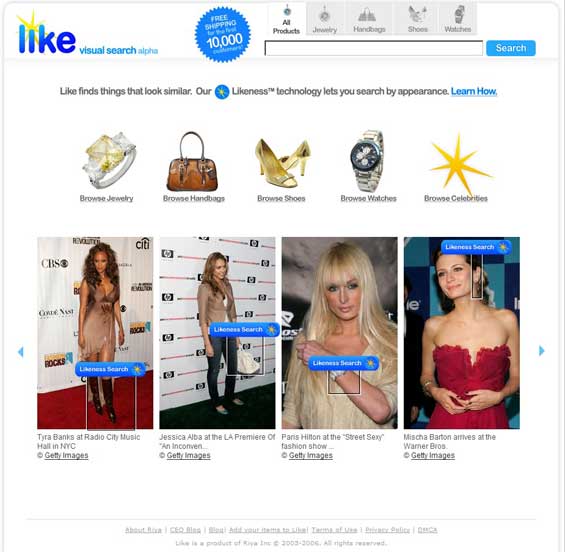
What this means – If you see an image on the web, like a watch that Paris Hilton is wearing in the picture to the left, and use it as an image query, Like.com will return results showing watches that look very similar.

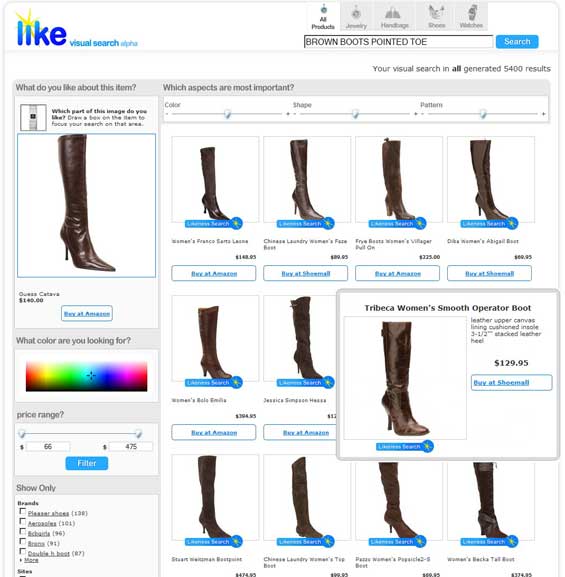
If you enter a text query, like “brown boots pointed toe,” Like.com will convert that query into variables in the visual signature and look for related image results. See screen shot below for the results from this query.

The site launching today returns results only for shoes, jewelry, hand bags and clothing. The service will expand over time to include other categories, but these initial categories represent a very large portion of consumer discretionary spending in the real world. With each result Like.com will also present a link to purchase the item, and their hope is to generate revenue from subsequent purchases.

A key feature that Like.com will be launching in the next month or so is an image uploader and a toolbar. Upload an image to Like.com to see similar results. Or, simply use the toolbar to use any image found on the web as a search query. Either way, Like.com will return results for similar items.

Robert Scoble at Podtech interviewed Riya CEO Munjal Shah on video in preparation for the launch. See the interview here, and a product demo here.

On a side note, Munjal has written a series of fifteen blog posts talking about his experience as a startup CEO. This is a very useful resource for new entrepreneurs. And given the length of this series, I wouldn’t be surprised to see Munjal publish this as a book at some point as well.
Advertisement

Responses

Comments rss icon

  • Dont know if the site is very useful, but they certainly have managed to create the world’s largest image collection of fantastically ugly watches.

  • There was a program which did this a few years ago. It’s called Miltonsoft but… it’s actually catered to searching for porn pictures from the same person… http://www.milt....com/intro.html

  • Let’s see if the business model work…

  • Mickey: it is a LOT better business model than their first iteration. I have more over here: http://scobleiz...-way-to-search/

  • hmmm….this is just a shopping portal at first glance, so whats the question about the business model?? And whats so revolutionary about it again? I honestly don’t see from first glances that this is significatnly different from ebay, ciao or any other product search engine.

  • I do not get it, do users have to only like/search what they see at like.com ? What if I see something great on some other site and want to find similar stuff ? If that can not do that, this is just a shopping portal, nothing more.

  • Neil: watch my video demo over at http://www.scobleshow.com. This is a visual search. That’s what’s revolutionary about it. No other search engine can do what this does.

    Business model? If you buy something off of this search engine Riya gets an affililate fee.

    Will this work? Would you have bet against Google eight years ago? After all, their ads only work when you click on them.

  • this does sound like a niche area…..how many of us have time to do visual search to buy something we saw some where??

    i guess this is just the start….business model might evolve over the time…like how riya got tons of buzz when they launched….but did not go anywhere….forcing company to think in different direction resulting like.com

  • “Will this work? Would you have bet against Google eight years ago?”

    It was quite reasonable to bet against Google in 1998. Back then, it was just two grad students with no business model entering a saturated market against well-funded competitors.

    Just because it worked out for the big G doesn’t mean it will for Riya.

  • Using 1000 variables defines a photo sounds like something different, I’d like to see a bit more detail on how the algorithms work.

  • Srini: true. But here we have a lot more data than we did in 1988.

    We know that if this company can get enough of an audience that they WILL use it, and click on pictures, and buy things and that there’s an affiliate model that’s well known and predictable. Wait until they turn on eBay.

    So, do you want to bet against this engine? I don’t. It’s fun to use, does what it says, and will bring in real revenues. Now, will the revenues be enough to make money? That’s the big question and is dependent on how many people they get to use this engine. That requires PR and a bunch of hard work.

    They also need more products to get a really big audience.

  • A small question:
    Why spend millions on a bunch of PhD’s developing a super sophisticated search engine and then use Microsoft Paint to make the logo? The interface makes the site look cheap and simple, even though the technology behind might be unique and beautiful.

  • This web 2.0 bubble will have very hard landing. Visual img recognition is just not there- I worked on it at Stanford, and I know the state of art. I wonder how much like.com domain costs.

  • Amazing stuff… Works like magic.. And to think it is only in alpha! Superb!

  • I think some of the business opportunity needs some explaining. Today there are about $15B worth of clothing, shoes, and jewelry sold on the web. For many of these items a text search is very hard – because how do you describe some patterns and styles (most of us just don’t have the vocabulary). So instead if you could point to a photo and say find me something that looks like this… that would be the ideal way to search for these items.

    So yes we are focusing on a niche but a $15B dollar on at that. If I include the other categories we will expand into later (home and garden for example) the number approaches $30B.

  • I wonder who has picked the blue color for the site.

  • Quite good the Like.com site, but very slow it also misses the browser aspect of shopping for products by image only;

    Pixsta a London based startup has build a great site, actually the biggest shoe visual search engine in the world, ChezImelda.com.

    I think the site is loaded with backend meta data; Knowing the academic background and state of the art this is actually not based on image recognition.

  • Is the engine actually capable of finding out which brand / model of watch Paris Hilton is actually wearing (which I fancy could translate into sales) or does it gives a similar list based on rough assumptions (watch looks grey, looks shiny so there must be diamonds etc….). Who’s gonna be interested in buying a similar watch to Paris’ ?

  • It’s absurd to suggest that Like.com is able to generate a “visual signature” for query terms outside of basic descriptions – for instance, brown. Munjal Shah effectively states this in the ScobleShow demo video.

    After experimenting with the product (in my case, shoes) I was disappointed with the “shape” matching. Color matching seems to work well. This is bad for like.com – a particular shade is not my main consideration when buying shoes.

    My take is that the image recognition technology is not effective enough to be the primary feature. Established players will continue to focus on finding the lowest price and like.com will struggle to grow.

    Hat’s off to their PR department though.

  • munjal, thanks for the market size information

    my questoin is how much of $15b is generated by people who buy look alikes? and out of total look alike buys – how many people are willing to do online visual search

    i really admire the technology behind like.com (i assume it is spiced up image processing/pattern matching technology), but i do not see big revenue opportunities through visiual search

    having said that there might be more revenue opportunities through licensing your technology to other vendors or some thing!!

  • at the first sight of this website, I had thought user can upload unknown product picture then to find out similiar products with uploaded picture. but thing doesn’t go to that. it makes me disappointed.

  • I think thats freaking amazing. Well done.

    Now you just need an ‘expensiveness’ filter as Paris Hiltons watch is probably worth a lot more than the sum of those results :)

    Seriously, I think it’s impressive.

  • my bet is that this service will fail.

  • Keanu: in the interview I did with Munjal (Riya/Like.com’s CEO) he hints pretty strongly that feature will come in the future.

  • The first true visual image search is actually Quintura.

  • I feel that Riya already come out with a killer app for visual search. I agree with Robert Scoble. It take almost more than 1 year for Google to find out the right business model until they buy Applied Semantics (context-sensitive ad technology) and Sprinks to be built into the core business. Yes, Google for sure thankful for their core search technology – Pagerank but without the aquisitions both company above, Google would not able to Giant in Internet. So, I would argue for those people that saying Riya.com would not be successful. Seriously, have you been using Riya lately? I’ve been using for quite long time. I see a lot of potential in it. How you measure a succesful internet company? Riya with it new baby – like.com obviously changing the landscape of the web. My suggestion to munjal;

    1) Approach manufacturer (electronic/ industrial design/ clothing etc.) and get the full catalog out. Because Riya – visual recognition engine which a impressive, the consumers can just compare and relevant match the right component in seconds.

    2) Built a visual search server (plug n play) and license it. The manufacturer just add the catalog (especially image) to server. Then charge them for pay per use. (just a suggestion).

    Will Riya add this features? Now Riya competing again Retrevo.com and Imaginestics.com and off course, Google, Yahoo and Microsoft.

    All the best to Riya.

    Love you product.

  • Hi Munjal,
    I have been a big of yours.I have been reading your blog for past 10 months and I have seen how you and your business idea evolved.
    Right now this is at alpha stage so I think its works pretty well BUT one thing Your UI is very poor as of Riya’s. Please redesign the UI again.I would love if you could try the ‘become.com’ site and try to understand what will the user expect to do while they are on there site and see how well they have designed, its too good,it gives every thing what you want to give to your user.
    Focusing on usability part is very important for a new user who does not know who you are and what great technology is behind it.
    Give usability and design MORE importance right now like Microsoft who wons against all competitors because no one gives so importance to usability as they.
    I am sorry if i have hurt you some where I am very young who is trying to become entrepreneur.But its my very honest feedback.I want to see you on the top because i have never seen such Honest person in my life,which seems through reading your blogs.
    USABILITY…..USABILITY….USABILITY
    Best of Luck..!!!

  • I tried isolating Tyra Banks’ cleavage as a”like” – didn’t get the results I wanted tho!
    :(

  • Nice search engine. But this will not help anybody else who has a website selling products as obviously all there images are pulled only from sites that they have an affiliate link with.

    So where does this help the regular website owner? No where.

    Maybe it will change once they get out of alpha and beta eventually.

  • Really interesting site, fun… but i don’t like it to actually shop. I prefer the approach taken by http://www.chezimelda.com – their technology is super quick and intuitive – what else do you need to shop ? Can’t wait for the handbag verision

  • The concept is really good but it would be most useful when I could see a picture on the web and instantly right click it and search in like.com. And ofcourse a faster site.

  • Steve, you can’t wait for the handbag version? You honestly have to try harder than that what your pushing your own products. Next time try saying something like “My girlfriend loves using it”.

    From a techie guy’s perspective I happen to think Like.com is pretty impressive. If they can get their name out there then this will skyrocket. The way you can browse around makes it much easier to find what you need. I’ve always hated trying to try and guess the correct keywords when looking for products.

    So, they have a business plan *and* a good technology base. I think that disqualifies them from being a real Web 2.0 company.

  • I am literally awestruck by this product. This is a simple and elegant idea, well executed that leverages great technology to meet a very real need in a very sizable market. Well done Munjal and your team. This is not a Web 2.0 company – this is a real business in the grand tradition of Yahoo, Google and Ebay.

  • I am with SutroStyle and Alexander Straub – I don’t think they have the technology. The image recognition technology simply does not exist yet, not at this level of generality. That’s why you can’t download images, that’s why you have to search within “categories”, that’s why they aren’t interested in face recognition anymore, etc. For the next year, I predict more “categories” and more promises. By the way, there have been some successes with this technology. It is missed by the public because of the different name – machine vision. The challenges are enormous, but at least there are some practical, commercial applications (quality inspection etc) right now not in the future…

  • Umm… so w/out being able to upload your own picture and try it out, how do we know there is any algorithm at all? Results for a fixed set of images is hardly amazing…

  • This is a phenominal use of this technology. The only thing missing is an API so that others could leverage this from their applicaitons. I could see how this could be utilized from other applicaitons or websites. It would work similar to adsense, where Riya would get their cut, but the site implementing the Like.com API from their site could also get a cut for pushing people through.

    It also looks that Like plans to take the approach that free411(aka Jingle) has done by offering alternatives to the original piece of merchandise, thus opening the revenue potential further, not only for Like.com, but business opps for many suppliers and merchants.

    I notice that they have a link on the bottom of like.com for getting your products into the system, but it looks like a manual process rather then a self-serve solution.

    Much success with this Munjal. This looks like a winner.

  • A brilliant application of their core technology but it’s prodominately color based, which gets in the way of finding items that are indeed similar. As for the articles title, I can find an example that proves otherwise, datawink.com — image recognition for the financial markets.

  • Michael

    I am surprised that there was no mention of how much the domain name cost Riya – any insights?

  • I, beeing a vision researcher I agree with Peter. Also, I think the quote in the blogpost above

    “If you enter a text query, like “brown boots pointed toe,” Like.com will convert that query into variables in the visual signature and look for related image results. See screen shot below for the results from this query.”

    is *probably* not true. I guess it rather looks in the meta data for the associated text (”pointed toe”) if you enter a keyword query. (look at the description of the boots). Maybe it translates the color words (brown etc.) and ranks brown stuff higher. That it would be able to classify “pointed” (and maybe even “boot”) based on visual data only is unlikely. This is a largely unsolved problem in computer vision. (But maybe I am wrong)

    It is defintely a neat product, cool page.
    But note, that they only have 4 categories, only shopping images (which are mostly on white background), and it seems only a couple of 100 000 images at the moment.

    So, to sumarize, great product. Smart use of available technology. But don’t overestimate the state of image recognition / visual search.

  • The Like.com engine takes both text and images as queries, something no one else does…..

    This is an untrue statement. If you look at the stock photography business, several web sites have been doing this for some time (I believe one uses a product called Idee).

  • does not seem that it is totally auto-indexed, i tried to give a search
    like “girl dress with blue collar” and it returned no results

  • They would have been better off turning like.com into a dating site.

  • Sounds great in theory, but the quality of their search results is below average. If you really want to find the jewelery that Jessica Simpson is wearing in a photo, you’ll laugh out loud at the results they give you – its no better than searching Google for “jewelery”.

  • You guys are missing the point…

    Munjal and Riya.com isn’t really targeting tech folks or even just the average searcher but the millions of people (mostly women) who watch E!, read US weekly and InStyle Magazine, and scour shopping/fashion blogs like my own.

    Munjal has brilliantly tapped into the aspirational feeling that is dominate in US consumer culture (ie: I want to wear what Paris Hilton wore to the Emmys, but how I find one like it in my price range). If he can effectively get the fashion/shopping bloggers as well as sites like iVillage and mags like Lucky on board, Riya could be a HUGE success with little competition. However, I do agree that Riya will need to expand their revenue model a bit- perhaps license the tech out?

    (Munjal if you’re looking for employees send a sister an email!)

  • A year ago I was skeptical of Riya based on my past experience at AltaVista.

    Now I think Riya has a much better chance of success focusing on the fashion market because “likeness” is OK, exact matches are not necessary. Secondly, the Cost Per Click (CPC) business model will be much more effective than consumer based advertising. That addresses the two concerns I had initially.

    Sometimes technology people get all wound up about the technology. It is not about the technology…it is about the problem it solves. I wrote a blog on this today. http://dondodge...tries_agai.html

  • First likeness based search? You gotta be kidding. What about http://HashThySelf.com which has been around for at least a year!

    Granted HashThySelf is focused on image search over just faces, but the idea is already there and the riya service was already suggested in the Hashthyself blogs.

    -P

  • Incidentally, the term “likeness search” was itself was suggested to the Riya founders by the HashThySelf folks in a blog entry a long time ago.

  • They should do a tie up with the popsugar guys and gals….this is good stuff so long as they can find people (should be mostly women!) who want to do the likeness search.
    And if it does take off, the business model won’t be an issue. Affiliate programs, PPC, even direct sales….there’s a lot of money to be made if people buy the concept.

  • Soon it will be time to take it to the next level. Here’s the scene. I am at a mall and I see some shoes I like but the price is too high. I pull out my camera phone and upload a picture of the shoes to like.com, along with my current GPS location or zip code. In response I get a localized list of merchants who carry similar shoes, even their current prices. Some are even at the same mall I’m at. Now I know exactly where to shop at next.

    I personally have a real need for this because this often happens to me while shopping. I hate wasting my time trying to find a similar product in another store.

  • In entrepreneurship, being too early is worse than being too late. I have seen this happen too many times. One case that I personally experienced with some good friends (Bradley Horowitz, Jeff Bach, Chiao-Fe Shu, Paul Lego, …) is the case of visual search for shopping. What Riya announced now and seems to be getting some traction was announced and championed by Virage in 1995. But that was too early and Virage became standard image blade (or cartridge) on popular databases, but could not build business so moved on to video.

    My best wishes to Munjal Shah for making this happen now.

Leave Comment

Commenting Options

Enter your personal information to the left, or sign in with your Facebook account by clicking the button below.

Alternatively, you can create an avatar that will appear whenever you leave a comment on a Gravatar-enabled blog.

Trackback URL

RealTime CrunchUp Sponsors:

bugbugbugbug
Techcrunch on Facebook