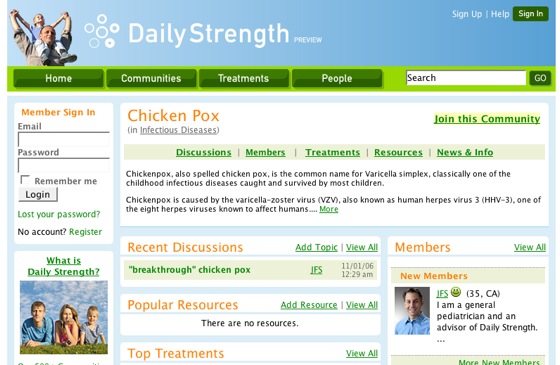
DailyStrength is a new social network that provides a space for people with a wide variety of medical, psychological and life conditions to discuss their struggles and the treatments they are undergoing. While any number of wannabe social networks are likely to spring up in coming years seeking to cash in on medical activity online, this isn’t one of those. DailyStrength has the executive team and feature set to be a real player. I think it’s a great example of a niche social network that provides topical value ads and executes the basics well too.
The site was founded by Doug Hirsch, one of the first employees at Yahoo! and most recently at Facebook. The site’s look and feel is somewhat similar to both of those companies’ products. Hirsch says that most niche social networks pick an audience, but people online are mostly concerned with sex, money and their health. He says that health networking is a vastly under served market.
DailyStrength uses the term “community” where some people might use “condition,” and that could be appreciated by people who don’t care for experiences like blindness or deafness being referred to as a disease. Note too that the site uses the word “preview” instead of Beta. I know some people will like that.
The highlight of DailyStrength is that users are asked to describe medical and psychological treatments they have undergone. They indicate what conditions those treatments were for, whether they were effective and provide a narrative about the experience. That information is then aggregated by condition and treatment - so it’s easy to see what a large number of people have done in response to a condition or what it’s really like to undergo a certain treatment. Some communities are better populated so far than others, the erectile dysfunction community for example doesn’t have anyone in it yet (in case you were wondering).
Have you been thinking about using Lexapro? Out of 58 people who have used it on DailyStrength, only 45% found it helpful. That’s interesting information, presuming the complainers aren’t employees of a competing drug company or PR firm.
The discussion and support function is likely to prove quite valuable to users as well. I know from talking to my friend Nancy White about the March of Dimes project she helped set up called Share Your Story that medical social networking and blogging can be a huge success.
There are 25,000 treatments in the database so far. Each treatment and condition has a discussion space, syndicated Yahoo! news and an excerpt from the Wikipedia entry on the subject. The company pays four medical doctors to participate on the site and DailyStrength is careful to advise against or delete medical recommendations posted by users. Hirsch told me that many doctors he’s spoken with are fully supportive of the site as it’s a way for patients to educate themselves before and after visiting a medical office. The site also has a resources section where you can find, for example, a long list of user contributed recipes for gluten free food.
There’s already a fair amount of activity on the site, lots of people offering each other support. The site is primarily targeting women, Hirsch says that seeing 75% of Facebook’s traffic come from women taught him that was the prime audience for social networks.
In the coming weeks the company will be partnering with third party services to offer chat, video and better photo sharing. Ad revenues will be split between DailyStrength and condition specific charities that will be voted on by users. Hirsch says he’s on the fence about big pharma and will likely focus on seeking ad dollars from more “wellness” oriented advertisers.
Everyone says that women, health, community and informational resources are important factors in the future of the web - of course women are more than just a consumer market, hopefully they can be equal participants in building the new web. I think that DailyStrength is a well constructed and useful site engaging with those market segments.


See all


I think a social network like this is really good because of it’s emotional impact with users. Trying to create a social network with no distinct purpose or niche would be extremely difficult, such as Huminity and Multiply. But along, the lines of following a niche, Daily Strength follows along the lines of Dogster and Catster.
Good Stuff
Anon and free is good. Clean design. What really stands out is the aggregated treatments section — what’s working and for how many people. That has good potential to get more and more interesting as the site grows.
This is one of those forhead-slapping, “why didn’t I think of that,” obviously big opportunity social networks. I love the latest activity thing on the homepage where you can see how people are supporting each other. I know a few people who could really use this site!
Bravo!
This is a good idea but I think they’ve completely missed out on the privacy implications. Take a look at http://www.dailystrength.org/treatments/Prozac/. I can view a list of users that take Prozac. Also, the Latest Activity on the homepage reminds me a lot of Facebook’s mini feeds. Will Bob like it that his joining of the “Impotence & Erectile Dysfunction” community is now publicly broadcast on the home page? Some people may not have any problem sharing this type of information, but a lot will because it can have a huge impact on somebody’s personal life or career, especially if you live in a small town.
Overall this has a nice, clean design and is well organized but seems to be built on some third-party social networking software or components if I’m not mistaken, as I see Joomla in some URLs. It’s a bit basic and there appears to be no privacy considerations given which is a huge flaw.
thanks for the feedback, datamine.
i respectfully disagree with the privacy comments. DailyStrength specifically does NOT ask for personally identifiable information - all the public knows about most users is the alias they choose to use.
We specifically do NOT ask for real names, addresses or anything else that would breach anonymity. Facebook (which is an amazing product, btw) contains cell phones, home addresses, and, perhaps most importantly, real names of the folks on their site and names of their friends. One should think much more carefully about what they post on Facebook versus DS.
I thank you for taking the time to check DS out. Let me know if you have other comments.
doug
Is there the equivilant for doctors to anonymously share information with each other regarding a medical condition?
Email address isn’t personally identifiable? It may not be displayed publicly but it does tie a person’s account to information that they might not want compromised. A lot of people use the same alias across multiple sites and use the same alias as their email address. Even the slightest data like this can be used to identify a person in many cases, and if they post a photo or a piece of information in a journal that can be tied to them, it is now possible to determine all their conditions, the drugs they’ve used, etc.
Obviously 100% privacy can’t be assured if you participate in any social network but given the information that is publicly displayed and is publicly tied to a user’s alias, a single slip or accumulation of information could easily lead to an identity. That aside, the fact that I could potentially see on the homepage that AlabamaPriest has joined the community “Sexual Abuse” just seems to be a bit creepy.
Best of luck.
i’ll take your comments into consideration, datamine, although i stand behind my belief that we are providing a very, very valuable service in a safe and caring environment.
we’ve already received 100’s of messages from folks who have been longing to share their experiences with others and compare notes on treatments and overcoming challenges. Many of our members live in rural communities or are home-bound, and it’s very difficult for them to meet other people experiencing the same challenges.
As for your comment about the priest, all websites have abuse issues they need to confront, and we will deal with it the best way we know how. I hardly find that a reason not to provide this valuable service.
oddly, your comment is somewhat hypocritical in that, on the one hand, you’re criticizing us for asking users to register, and yet you’re also concerned about the abuse potential. as you can imagine, if we were to set up a site without some form of hurdle and safeguards, abuse would be an even bigger challenge.
again, i appreciate your feedback. thanks for checking out the site.
I’m not saying you’re not providing a valuable service and there’s nothing hypocritical in my post. I’m just pointing out the tricky nature of running a service where privacy is a huge concern. My comment about the priest wasn’t made in regards to abuse just the fact that the “mini feeds” on the homepage are creepy to me and will be to a lot of people (not all). If you want to talk abuse, I signed up with a fake email address and was able to log in and post content without email validation so the idea that you have serious safeguards is clearly not the case.
FWIW as a skeptic of the social networking craze, the idea that people don’t already have websites where they can share medical experiences, compare notes and meet others is a joke. There are literally 1000s of communities out there around these subjects. They may not be Web 2.0 and started by tech execs so they don’t get reviewed on TC but that’s besides the point. When my nephew had cancer, his mom set up a page for him on http://www.carepages.com/ so that family could follow the treatments. I frequently post on http://www.healthboards.com/ which has over 250,000 members. And http://www.allnurses.com/ is the biggest nursing community with over 170,000 members. These are just the tip of the iceberg. There are plenty of open and closed communities around all medical topics imaginable. Some have a few dozen members and others have 10s of 1000s. DailyStrength is obviously the most Web 2.0 health community I’ve seen so far and probably won’t be the last. It might appeal to some people but Marshall’s claim that this is an underserved niche is wrong because I and my family have been using these types of communities for years. Not saying you won’t have success. I think you will have some but probably not on as massive a scale as somebody who doesn’t think that this market is already being served might. Just pointing out where I see something false being written and I know it’s false because I have personal experience. Web 2.0 and social networking isn’t revolutionizing online medical community which has been around and thriving for years. If anything I’m criticising Marshall’s post more than I am your service.
I’m not saying you’re not providing a valuable service and there’s nothing hypocritical in my post. I’m just pointing out the tricky nature of running a service where privacy is a huge concern. My comment about the priest wasn’t made in regards to abuse just the fact that the “mini feeds” on the homepage are creepy to me and will be to a lot of people (not all). If you want to talk abuse, I signed up with a fake email address and was able to log in and post content without email validation so the idea that you have serious safeguards is clearly not the case.
FWIW as a skeptic of the social networking craze, the idea that people don’t already have websites where they can share medical experiences, compare notes and meet others is a joke. There are literally 1000s of communities out there around these subjects. They may not be Web 2.0 and started by tech execs so they don’t get reviewed on TC but that’s besides the point. When my nephew had cancer, his mom set up a page for him on CarePages.com so that family could follow the treatments. I frequently post on HealthBoards.com which has over 250,000 members. And AllNurses.com is the biggest nursing community with over 170,000 members. These are just the tip of the iceberg. There are plenty of open and closed communities around all medical topics imaginable. Some have a few dozen members and others have 10s of 1000s. They may not have the Web 2.0 sex appeal but they work and are very popular. DailyStrength is obviously the most Web 2.0 health community I’ve seen so far and probably won’t be the last. It might appeal to some people but Marshall’s claim that this is an underserved niche is wrong because I and my family have been using these types of communities for years. Not saying you won’t have success. I think you will have some but probably not on as massive a scale as somebody who doesn’t think that this market is already being served might. Just pointing out where I see something false being written and I know it’s false because I have personal experience. Web 2.0 and social networking isn’t revolutionizing online medical community which has been around and thriving for years. If anything I’m criticising Marshall’s post more than I am your service.
Doug,
I think this could prove a very valuable service to many people (myself included). In fact, I was thinking of creating a similar site, but focused on people living with chronic pain. The support from other people in a similar situation is crucial for enduring difficult times.
Are you planning on contributing a share of the profits to medical research or similar charities? What are your thoughts on accepting sponsoring from Pharmaceuticals with regards to keeping the site “unbiased”? I.e., will you allow any sort of criticism of certain medication, including those of your sponsors?
Also, under privacy it states that “DailyStrength reserves the right to use and disclose Anonymous Information to third parties in its discretion”. Is there a way of opting out of that?
Cheers,
Fred
Does this include communities of caregivers and families of the patients as well? Especially with diseases like Alzeimers, Perkinsons, Schrizophenia, BiPolar Disorder, Down Syndrome, and other kinds of mental illnesses, the patients themselves are often in absolutely no condition to participate in online communities.
However, the families of these patients could definitely benefit from support networks and by interacting with others in their shoes. The biggest issue in this category is assisted living, residential care for patients, etc.
I suggest you look into this, Doug.
Sramana
Looks like a social network for whack-jobs.
John C,
Would you call a Cancer patient a whack-job?
This is a potentially helpful resource for millions of people.
There are many people who have illnesses - and may live in an isolated community where they have no one to talk to - or friends and family avoid them out of disdain. Perhaps they might have considered suicide out of depression
Also there are baby boomers who are almost elderly - perhaps divorced and children no longer living at home - who have no where to turn and are not very Internet Savy. So they just remain isolated and depressed.
Having on place with an easy to remember name - could be a mecca for so many around the world.
There were many occassions where - we had to teach the over 40 crowd about searching for FORUMS that would have support groups of people going through similar problems
It’s a bit scary to think of what would happen if this got into the hands of pharmaceutical companies.
Excellent niche. As a parent that had a sick child, I was always looking for others who had similar experiences to speak with. To have a place to share these experiences and provide support is critical to anyone in crises.
I’m all for DailyStrength
datamine, others are welcome to contact me through dailystrength.org to continue this conversation. i appreciate all the feedback. our site is about listening, and that’s what i’m doing here.
@John C: Your comment is harsh and immature, but there is an underlying element of truth which is that there will be people using services like these needing immediate professional psychological attention who have nobody to turn to.
I used to run a large message board support group for a specific condition. It was a valuable service, much like DailyStrength, that helped many people. It also had its share of people who joined that really needed professional help. We learned that one person who was clearly very depressed and was often ignored by other members because of their odd postings later committed suicide. The message board was not to blame but it was a sobering realization that there are people out there who are deeply isolated who will turn to the Internet looking for help that cannot be found on the Internet. Recognizing this, I wound up shutting the message board down because I felt there was an ethical dilemma I personally didn’t want to deal with. I think these types of communities are extremely invaluable but it would be unwise not to give some consideration to the fact that there are moral issues to keep in mind when operating one and I hope that DailyStrength does this. A small minority of the members of these sites will use them to cry out for help and by virtue of the numbers, some will not find a voice that responds.
DailyStrength is well put together and has the appearance of a strong offering. I have joined and there is some good community already forming. There are existing communities already covering many of these topics but I think a social network format will appeal to some people, although I have yet to see a format that appeals to baby boomers who aren’t familiar with social networks and think this may be too slick.
@DataMine: Your comments have some validity but you are not being realistic if you think that there is a perfect solution to issues of privacy and abuse. Our message board had members that posted information that could be used to identify them even though we educated them not to post this type of information. There’s only so much that can be done and we tried to manually remove outrageous violations of common sense (eg. posting of postal addresses) when this occurred. I think the bigger issue in this area is ethical. Without posting the URL or username, I came across a profile on DailyStrength where the member gave enough information to know their last name, what they look like, where they live, their family situation and a tragic event that occured when they were younger. This person has a dependent and posted about family problems and depression. Ethically, should DailyStrength do anything about this? The person posted this information willingly, but one might argue that severe depression could have an impact on a person’s judgment. This information could pose a safety problem and expose the member and their family to ridicule since they live in a small town. There is no easy answer and there are shades of gray in these areas. Any online community faces such issues but they take on new importance in a medical-oriented community given the sensitivity of the information and how it can be used. The success of other such communities means that reasonable solutions will probably be found by DailyStrength but nobody should be under the impression that running a quality community of this nature is easy. Many of the best are smaller and application-only so that spammers and abusers don’t take over. Spam is becoming a real problem on social networks and because many spams are for pharmaceutical and health-related products I would not be surprised to see these spammers attack medical-oriented social networks that become popular.
kathryn - i’d love to hear more about your experiences with health-related forums, if you’re up for sharing. my partners and i have significant experience in this space (we ran communities for Yahoo for a combined 17 years), but i thought your comments were very astute. frankly, we’re just starting to tip-toe into the issues you present above, and we’re aiming to be as open and honest with all parties involved, and to set reasonable expectations with our users.
i hope you’ll contact us.
doug
After taking a look around, I got the impression that the designers of Daily Strength were in a real hurry, or been soooo healthy all their lives, they never needed to take a medication.
It is incomprehensible to me that the site only gives users five choices when rating a treatment. from “not working” to “somewhat helpful” to “working.”
If you had any major illness, especially a psychiatric one, you know that a simple rating like this can’t convey an experience with a medication even on the most superficial level.
On top of that, 170 character cap on the “describe your experience” section doesn’t exactly encourage users to share many details on how the treatment has worked out for them.
This doesn’t put a rosy light on DailyStrength’s future when RemedyFind, a long established competitor site (sans the web 2.0/social networking hoohaas), allows users to rate a treatment on five axes and specify duration of the treatment, dosage, and formation; plus, there is no cap on number of characters in free-form review section.
This is a superb site. I have joined in. I am sure it can touch a lot of lives.
The usefulness of this site can be very high since a patient can find real solution to a certain ailment by talking to people who benefited from certain therapy. I am happy that such a site has come up.
However, there would be a swarming of quacks marketing placebos in such sites. How to stop them from causing damage?
Doug,
Congrats on the launch from another old time Yahoo. Site looks pretty good.
Erik
This is an outstanding effort at fulfilling a huge need that exists for a social networking site that can appeal to the demographic from age 40 to age 85. Although older people have been somewhat slower to adopt the web that is a dramatically changing dynamic as baby boomers retire and have more time on their hands. The potential of a site where people can share the feelings and concerns about their health and benefit from others experiences is very exciting.
I think the privacy issue is a red herring as compared to the potential to benefit from all that can be learned from this kind of a site.
Great job by the team at Daily Strength. I think you will be a huge success.
As one of the March of Dimes http://www.shareyourstory.org team I concur with Kathryn’s observations. When people’s health and safety is involved, there is an added layer of consideration both legally, but more importantly in the long run, ethically.
One of the things that came up after we added blogs to Share was that all of a sudden the blog postings were getting picked up in Google searches. So if a member searched for their child’s name on Google and if they had used it in their blog, it showed up, often quite high. This really alarmed a lot of folks who don’t live their day to day lives online and haven’t experienced this before. After that a lot of people changed their logins to pseudonyms for themselves and their children and reconsidered how much to share in their profiles. (We also have the option of members not showing their profile details.) It is an ongoing education process. We have a section called “Share with Care” that helps highlight 10 practices for safely participating in online support communities.
In addition, every post is reviewed by staff to keep alert for abuse, people who might be in some danger and for incorrect medical advice (even though there are clear guidelines for NOT giving medical advice, but we all do it, eh?) For the most part, the culture of the community - and I would definitely call this a community, not a loser social network - is self moderating. It is a beautiful thing. But the community manager has to step in - usually when we have someone who is having mental health issues and the odd person who is just in to disrupt things. Note I said reviewed: not moderated. Posts go up in real time for confirmed (email confirm) members.
What is really interesting to explore here is how this scales out to the network level. What level of dilligence is required when we move away from the community level where people participate both as individuals but with a clear association to the community, some sense of responsibility to others? In a network, we can associate through information sharing, but we may not always do that in the context of relationships with those with whom we are sharing. It is a different sort of social and interaction model.
I have found Daily Strength to be very helpful and supportive. The bereavement community gives people a place to tell their story and hear how others are going through this painful process. I am very involved iin how people are doing, and I look forward to my Daily hugs.
Thank you founders of Daily Strength for providing an avenue for sharing.
Its funny… five minutes ago I came across a healthcare community site for the first time, and now I see your post
You should take a look at http://www.mdjunction.com it doesn’t look as “polished” as this one, and the activity is much lower, but I kinda like it. Can’t really decide which I like more… (on second thougtht DailyStrength Does look more ‘ready’).
ann
We’ve been dealing with a lot of these same issues (privacy, content reviewing, role of pharma, real needs of a health community) since we launched OrganizedWisdom (http://www.organizedwisdom.com) about 6 weeks ago. We are also a health-focused social network, but so far we are focused more on collaborative wisdom/structured user generated content than serving as a bulletin board forum.
First, congratulations to Daily Strength as the site looks great and there is some nice activity already taking place. In our mind, the more great minds and entrepreneurs we all can get focused on solving real problems like health, the better. It’s really nice to see that entrepreneurs are innovating in sectors as important as health - this sector has been remarkably unchanged for years. And it seems most of the applications we read about everyday on TC, and many of the companies launching, are about whiz-bang tools or gadgets, and it’s not always clear what societal need is being resolved. But I digress…
The real magic happens when communities/new businesses. etc. start to leverage these same technologies and tools to help people solve real life challenges in new/better/more efficient ways. And that’s what the whole new crop of social networks, 2.0 sites, etc. are finally doing - but in health. It is going to be exciting to see new communities like sermo.com, daily strength, organizedwisdom.com, eons.com, and the many others that have recently launched evolve and mature. As these business keep improving, we’re all going to benefit….
Shameless plug: Here’s our launch press release and we’d love your feedback as we continue to make improvements daily: http://biz.yahoo.com/pz/061003/106107.html
I like this idea. I suffer from OCD and finding a local support group is not easy. They generally are around 30 mins. away.
Hey, I found this article when I was looking for information on a medical myspace. I also cound one of the other competitors I found related to this site was http://www.medsocial.com (http://www.medsocial.com) where they tout themselves as a ‘medical myspace’. Medsocial.com seems to be much more professional and looking to attract the older generations though. At first I thought medsocial.com was looking for doctors and professionals only, but when I when through their registration process I found I could actually get inside their site, it seem alot easier to use and more ‘clear’ though it has some neat features, the content isn’t there yet, but they seem to be working very hard on it.
Well I agree that DS is a good website, I did find another great social networking site that I actually liked more. It is called Medsocial, http://www.medsocial.com. The reason I liked it was it had the things that DS has in it, the medical discussion. But it also has health realted videos, blogs and it feels more like a social networking site. I like how it is kind of like a “Medical Myspace” by that, I mean having the unique features of a social networking site but with a professional medical discussion.
HealthChapter.com (http://healthchapter.com) is also a social network for people sharing health experiences.
Wellescent.com is a free health social networking service that allows members to share their health-related experiences and personal research with others facing similar illnesses, medical treatments, and medication side-effects. Members can read about the experiences of others in focused forums and then become online friends with these users communicating via private email and instant messaging.