How Much Money Do You Make?
by Michael Arrington on October 12, 2006

A couple of months ago I heard about a new startup that requests users to disclose detailed salary information about themselves, and in return they get information on what others are making. It seemed like a great way to get good user generated information at no cost, and there are lots of ways to make money by reselling the aggregate data to third parties. The problem was that the site, wageexchange, was a complete letdown. It is little more than a web form that spits back data at the user. There’s no analysis or ability to dig deep into trends, etc. Until it got a lot better, we passed on profiling it.

But the idea stuck in my head, and when I got a call from Seattle-based PayScale I was happy to learn that this company had been doing exactly what wageexchange promised. This isn’t a new company – John Cook at the Seattle PI has written about them, as have other local Seattle writers. But it’s very useful for people searching for a job or trying to negotiate a raise, and I’m not sure we need a new startup to improve on the service.

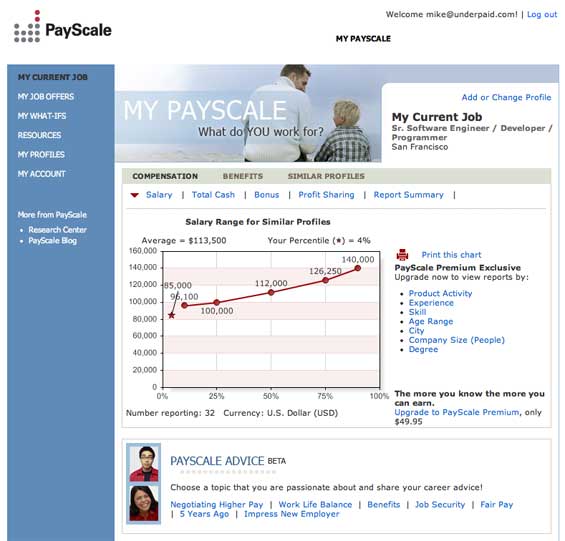
Users go through a process of disclosing detailed information about their job function and compensation, and add it to what PayScale says is the “world’s largest database of salary information” (300,000 new profiles are added each month). The user can then access detailed salary information in the database, including custom reports based on salary, bonus, commission, hourly rates, health and vacation benefits.

The basic service is free, and Payscale generates revenue by upselling users to premium accounts and selling access to aggregate data to third parties.

This is a useful service that gives significant value back to the user for spending time adding content to their database. Payscale has raised $10.6 million in venture capital over two rounds. Investors include Trinity Ventures, Madrona Venture Group, Fluke Venture Partners and Buerk Dale Victor.
Advertisement

Responses

Comments rss icon

  • Payscale.com appears to be down. It’s pretty impressive that you’re able to ‘techcrunch’ them at 1am.

  • Totally lame. There are only 9 profiles of people with the title senior programmer? Their claim of a big DB sounds like bull…

  • So I get paid $28,000 a year when I am supposed to be paid $70,000+? wth

  • Is the new way to spell “dig” “digg” now?

    “There’s no analysis or ability to digg deep into trends”

  • Not much! What is much anyways?

  • The idea is good but what about the validity of the information. How many people would be willing to share detailed information about their salary structure and most importantly, anyone could mess up the whole system by putting in wrong figures which would change the average of that particular job.

  • Is it necessarry to provide them correct information? I think it is important question, which can determine quality of they aggregated data.

  • >>

    I’d love a post or some more specifics on this. Do markets exist for this kind of data or does one really need to find their own market? A biz dev 101 if you will, would be very helpful.

  • Above comment was in reference to this statement:

    “there are lots of ways to make money by reselling the aggregate data to third parties.”

  • There appears to be a regional effect also. I changed only the city using the “What If” feature and the information appeared to be more realistic for my profession. It may take a while to collect enough data in eastern city markets.

  • Perhaps Payscale should partner with a large payroll company – like ADP, maybe – to get actual pay data of their clients’ employees. Then, Payscale could do some statistical analysis to see how honest folks are being when they enter their current compensation.

  • Here’s a tagline for them:

    “Payscale: Enabling the worst employees in your company to feel justified in asking for more!”

    Payscale has major data quality issues. For example: what constitutes a “senior widget inspector” at one company is not the same at another company. So, you end up with wild pay scales. Jason Luna’s suggestion, while good, still does not resolve that core issue of somehow normalizing the salary to the duties and reponsibilities of each inividual supplying his/her data. What Payscale may hope is that with lost of data, errors average out, but to me it would seem you just end up with meaningless, wide pay scales.

    - alphadog

  • Like that also can?where is the money coming from?Revenue generated from?????

    How they make money selling this data? Can u explain it further?

    Thanx.

  • Salary.com has been doing this for 8 years now. They have the most comphrensive data in the industry. I believe they verify their data and have proved that by being able to sell to small, medium, and large corporations.

    Do a study on them, not payscale.

  • We have long felt the deficiency that such sites like Salary.com and Payscale.com provide, and so we are in the midst of moving towards private alpha launch at Payscroll.com with a different approach on how salary researching should be. Some suggestions that Mike is pointing out are actually what we are currently doing ;)

  • Don’t like it, they ask for too much information, even if they do hide it in the search results. Why do they need all that information for, unless they want to sell it on the back end? It’s too invasive.

  • when can web companies go out there and start looking for angel funding? just curious

  • asking because i have a basic plan of what i want to do, and storyboards, but don’t have the time to do all the development; is this enough?

  • Payscale’s advantages: they’re focused and they’re targetting a large user base; however, there will be challenges. Payscale can definitely leverage their strong board members to partner with the big boys, such as payroll/HR management companies. Knowing a competitor’s salary should be appealing to HR managers. Best of luck!

  • Too many questions to answer. I was bored after the first 20.

  • Armond, that was one of the problems we identified with such sites, the user experience is poor. We think the user datamining should not be tied in to a \”free\” sample report, and in this case, it\’s not totally free afterall. ;)

  • This system has to be tested since people will not be able to share their details regarding pay. system has to be modified slightly

  • I was told, for a London programmer, that my £50k wasn’t too bad. Maybe I shouldn’t have quit! Useful service if it really works, but i don’t think they have sufficient data yet to over-analyse like they seem to.

  • I couldn’t find an option for “not enough”.

    Arrington should hire me to write jokes for him ;)

  • That was the biggest waste of 10 minutes ever! I answered all their questions, trawled through all the lists of jobs and degrees and schools and everything, and in the end, I was told that:

    “Unfortunately, your report could not be processed at this time. We have searched through our extensive database, but are unable to find enough employees who are like you to provide you with an accurate personal compensation report. Please accept our apologies for this inconvenience.”

    Not so “extensive” this database of theirs then, is it?

  • Hello everyone. Some answers to people’s questions:

    Revenue – Companies spend 40-80% of their working capital on employee compensation. Having salary information for hiring/retaining employees is key in HR and Finance. PayScale lets businesses target their search for information, and pay only for what they need. Average price of traditional (often inadequate) “salary surveys” are between $500 and $25000/year. That data is often broad, old, done manually in Excel and doesn’t fix on key attributes of the individual or the company. This can and should be better.

    Accuracy – we spend a lot of time on developing algorithms and heuristics, which remove outliers, bad entries, and get the correct match of job, skills, experience, and company information in real-time. Matching people’s salaries is no easy task – that’s the value, and we take it very seriously. If we have data problems, we work to fix them. The underlying data in the database is good – people generally tell the truth because there is no benefit to lie. Feel free to send any data issues you see to data@payscale.com.

    See more on PayScale methodology in blog entries from Al Lee, one of our PhDs on staff. We call him “Dr. Salary.” http://blogs.pa.../ask_dr_salary/

    Our database is growing and some places are deeper than others. Please contribute and sign up to be a member – it benefits all over time and changes the name of the game for employees.

    Some fun – PayScale has a public research center where you can browse the database in one dimension. See how interesting this stuff gets as the database grows:

    Programmers by years experience (national)
    http://www.pays...ears_Experience

    Programmers by what school they attended:
    http://www.pays...alary/by_School

    Programmers by Company:
    http://www.pays...ary/by_Employer

    Average Commute Time by City for Programmers:
    http://www.pays...er/Commute_Time

    Gender breakdown of Programmers:
    http://www.pays...ution_of_Gender

    Programming jobs in India
    http://www.pays..._in_All_Surveys

    Hope this helps – keep the comments coming.
    Cheers – joe,
    founder, PayScale

  • i used payscale to negotiate a 20% higher salary. taking a few minutes to provide info was well worth it!

  • I’ve checked out this site a couple times in the past, and I found it fairly easy to use and informative. I suppose there are a lot more data points for people in the SF Bay Area than other parts of the country, as I’ve found reasonable data for fairly specialized fields.

  • I am a recent architecture graduate and I recently interviewed in three major cities ( Boston, Seattle and New York City). Payscale’s service, effortlessly allowed me to cross-examine the employment market, per city as well as the salary ranges according to experience. I could get a clear idea of what I was worth at the time with the amount of experience I had. What is best is that I could also foresee what my salary increase could look like in a couple of years.

    I graduated with two years of prior professional experience and could realize how much more I could market myself for. Thanks to what I learned from Payscale, I landed a job with a salary of 10,000 above the average architecture graduate. Is’nt that something?

  • As a couple people have mentioned, salary.com / salary.monster.com is 100x better (UX, database size, accuracy, credibility with employers, etc.) than payscale. Don’t waste 10 minutes with their lengthy and rediculous process. Spend 1 minute on the aforementioned sites.

    If Payscale was any good CareerBuilder wouldn’t have dropped them recently.

    Not sure how this was TC worthy…

  • Definitely a great tool. but, lets see what else they r gonna offer

  • I like the idea, but what third parties want this data? HR teams already have access to salaries. Who else would want such data?

  • People get paid what they do in the market is because of their experience, credentials, know-how and skills. That seems to be PayScale’s strength. Typical surveys that employers participate in are little more than title matches without any of the personal data that actually makes a difference in what someone is worth. Yeah, it takes more time to fill out the questionnaire; but how many things of value take no time or effort? Some of the other blog entries talk about validity of the data, but I can’t imagine the quality of the entire database is any worse than what I’ve seen companies do when they participate in surveys. Besides, the data lines up with other sources of data I use, which makes me comfortable using it.

  • Clay, see http://www.cbsa...com…owned by CareerBuilder and powered by PayScale

  • clay may want to check his information (in an above post). it looks like this company *powers* careerbuilder’s salary information service.

  • Takes way to darn long to complete the requested information. Wonder what’s the abandonement rate is. Need to cut down this process. I didnt even complete the process and simply exited.

  • Seems like there will be serious issues in Data – Quality

  • It’s my assumption that PayScale exists primarily for “employees.” Said differently, it’s a tool that enables “employees” to “check and see” if they are being “fairly compensated” when compared to their peers.

    Although this is noble from a certain perspective, I have to express a brief “rant.”

    Its too bad that this site is not able to measure an individual’s “productivity” along with his or her job / experience / education.

    In short, when I used to work as a Pharmacist, I quickly realized that not all Pharmacy Technicians were created equal. Over the years, I’ve worked with a few Techs that could do the work of 3 Techs, the majority of Techs were about equally productive, and there were a few Techs that not only “didn’t produce,” but slowed me down as well. Ironically, they were all payed ~$10 plus or minus 2 or 3 dollars.

    In essence, what I’ve learned from my experience is that degrees, years experience, etc. doesn’t mean jack. (Especially when I reflect over the MBA program I just completed, it’s amazing that everyone in my class had the idea that they should all be compensated within a $5K window, notwithstanding the fact that there was a wide variance in each individual’s capacity to produce.)

    I suppose what I am saying is that if I were an “employer,” I won’t give a $$!@ about what an individual said they should be “entitled” to – pay wise – just becuase that “figure” was the “accepted average.” I’d want to see what the “employee” produced, and then pay accordingly. (Inevitably, some individuals would make out like a bandit.)

    I realize that such an attitude would be impossible for a large organization to addopt, but I do feel that we do more harm to society than good by trying to trick ourselves into believing that all individuals should be payed equally who have the same degrees / experience / etc. without taking the “weightier matter” of “individual PRODUCTIVITY” into account.

    Unfortunatley, PayScale falls short on this end.

    Just me two cents.

    :)

  • Michael, I agree that WageExchange.com does not have the bells and whistles that several other Web 2.0 companies have. Our goal was to make a website that was simple, like Craigslist, and give everyone the ability to see other people’s salary for free. Payscale.com is a nice site with lots of bells and whistles but you are only able to see 3 people’s profiles unless you want to pay $49.99. Our members are able to see the details of everyone’s salary information for free. We will eventually aggregate peoples data and show a nice graph but we didn’t want to copy Salary.com or Payscale.com.

    WageExchange’s goal is to have a world where everyone knows the details of everyone’s salary so our members can determine their true market value.

    Thank you for posting our site on TechCrunch.com. Even though you were not impressed with the site, I appreciate your consideration.

  • I’m amazed by the quality of the comments; I wish I got this kind of feedback on my blog. :-)

    PayScale asks a lot of questions, because, particularly for tech jobs, we need a lot of information to figure out why people are paid what they are paid. See the Dr. Salary Blog for more.

    I do agree with DavidEzra: productivity, or what I prefer to call Quality (I’m a fan of “Zen and the Art of Motorcycle Maintenance”), can be at the core of why people are paid what they are paid.

    We are always looking for questions that get at productivity and quality. For example, in sales it is easy: sales volume plus industry are great predictors of what a sales rep. is paid, because they are great measures of productivity.

    For jobs like software developer, there are no easy questions that get at productivity. Instead, we ask questions that are related (like years of experience, degrees, current employer), and use those to narrow down the pay range. If you have a question that captures productivity, let me know :-)

    I do object to the comment that PayScale falls short by not capturing productivity. I don’t know any employer that does this well for most jobs, and yet they pay people anyway. :-)

  • i did a little more poking around. HR Executive magazine rated the company in its 2006 top HR products of the year. that may shed some light on the question of how the company makes money.

  • Bureau of Labor Statistics publishes salary data that is two years old. Other salary compilers simply survey surveys. Other salary reports consist of data from companies that have no relevance. For example, a VP of Marketing at a start-up will clearly receive a different compensation package than someone at MSOFT. It’s pretty clear what PayScale is up to and the benefit: real-time salary data across a wide variety of positions and industries.

    Most folks reading TC appreciate it’s a 24X7 world we live now, because of technology. PayScale is just making a play to change how salary information is gathered and shared and push it into the new world of technology.

    Credibility issues? That is something all innovators and their inventions have to overcome. Hell, TC did wonders for the blog world’s credentials by breaking the YouTube/Google news. PayScale is onto something

  • “Is the new way to spell “dig” “digg” now?”

    Ali, I was thinking the same thing.

  • Mike, keep up the great work. I enjoy reading your posts; they help to keep me up to date on what is happening in the tech world.
    I come from a financial background, and I want to start an internet company. Many of these ideas sound interesting, and I would love to do something similar, however, I don’t see a revenue model for most of these companies, or at least a viable revenue model. It seems that many sites are springing up with one of two things in mind: (1) Gain revenue from advertising or (2) Hope to be bought be a larger company.
    Yes, Google has shown that advertising works, but what happens to all these companies when the economy turns south and advertising budgets are cut? Many of these small companies, and Google, are going to be left with heavy expenses and a much cut back top line.
    The idea of being bought by a larger company is promising, but I fear it may create another bubble, if we have not created one already. When the bubble pops, all these large companies, I fear, are going to realize that buying a company just because they have a novel idea is not exactly a good idea. A novel idea is a dead idea without a sound revenue model.
    On that note, I was wondering if you would write more about the revenue models these companies are built on. The blog is great; I am just requesting one thing that I often wonder when reading your posts.

  • I fail to see the importance or real use of this kind of site. From a plain user perspective. Employers are not going to start issuing raises just because a website shows specific statistics. An employer is not going to hire someone at a higher pay rate / salary just because the industry average on this site appears higher.

    I just don’t see what the business model is here.

  • After filling all the details, it took me to the start page :( . horrible!

  • Indeed.com has just launched a Salary Search: http://www.indeed.com/salary

    We’ve taken a different approach – instead of gathering data from users or from surveys, Indeed Salary Search culls salary information from millions of current job postings that are indexed by Indeed. So, it is objective.

    Another advantage is that you can search on any combination of skills, keywords and job titles – you’re not restricted to job titles alone as you are with many salary research tools.

    For example, you can see the market value of having Ajax if you are a web designer:
    http://www.inde...b+Designer+AJAX

    Check it out!

    Paul
    http://www.indeed.com – one search. all jobs.

  • I hate that I have to register for their free service.

  • Worst Site Evar!

Leave Comment

Commenting Options

Enter your personal information to the left, or sign in with your Facebook account by clicking the button below.

Alternatively, you can create an avatar that will appear whenever you leave a comment on a Gravatar-enabled blog.

Trackback URL
bugbugbugbug
Techcrunch on Facebook