October 5, 2006

CAPS Takes “Wisdom of the Few” To Stock Picking

Nick Gonzalez

33 comments »

We wrote about a distilled version of the Wisdom of the Crowds idea a couple of weeks ago when profiling PicksPal, a fantasy sports betting site. PicksPal’s new product takes the best fantasy sports pickers and (without them knowing) repackages their advice as a paid service to sports gamblers. It’s done remarkably well after the first couple of weeks. The idea is that if you can take the true experts from the crowd and average their opinions, you can get to really stunning results.

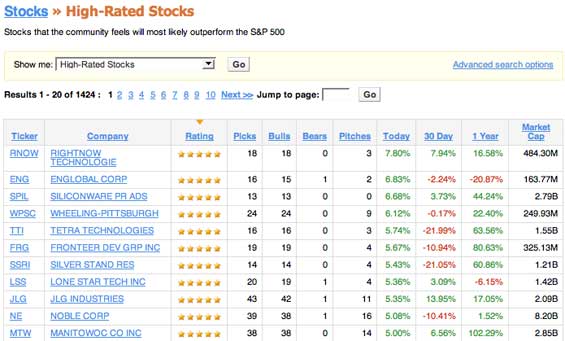
Now we have a second recent experiment in this area, the launch of Motley Fool CAPS. The service joins a host of others (such as SocialPicks) seeking to forecast markets. CAPS lets users place predictions on a publicly listed stock’s performance vs. the S&P 500 over a given time frame. After 7 such predictions a new user is given a CAPS percentile ranking that takes into account their overall return and accuracy (correct predictions / total predictions).

Users join the service for the bragging rights that come with being number one on the leader board and the various award icons adorning their profile. But CAPS is also using that data to create buy/sell recommendations on stocks. Users with a higher rating affect a stock’s recommendation far more that users with low ratings. So its like Wisdom of the Crowds, but with a weighted average towards proven winners.

Markets have traditionally been seen as the most efficient way to value information (even for the ill-fated DARPA terror futures market). But for investors looking for an edge, CAPS may give them the information they need.

A problem, though, is that unllke PicksPal, “experts” on CAPS, which are those users with very high ratings, know that they are affecting stock recommendations. The simple fact that they have this knowledge may affect how they pick stocks, and disrupt the entire system (one of the basic ideas behind the original crowds v. experts analysis in Wisdom of the Crowds). If and when that happens, CAPS may be little more than a way to push stocks that “experts” have a financial interest in, or for other non-efficient reasons.

There are rumors that the new free stock brokerage Zecco is going to offer a similar service. If Zecco customers don’t know that they are part of the user group being used to make predictions, their results may be much better over the long run.
  • Sphere It

Trackbacks/Pings (Trackback URL)

  1. Wisdom of the crowds….. « StewMcT ramblings
  2. TechCrunch Japanese アーカイブ » CAPS、「少数者の英知」を借りて株価を予想
  3. mobmash blog » Blog Archive » links for 2006-10-07
  4. XMediaLab.Pie » Blog Archive » È davvero collettiva l’intelligenza del web 2.0?
  5. Techcrunch » Blog Archive » Stockpickr in deal with The Street: More to Come?
  6. Stockpickr in deal with The Street: More to Come?
  7. Value Investing News
  8. SocialPicks Opens To Public
  9. Innovatorz.org Home (Test) » Blog Archive » SocialPicks Opens To Public
  10. Levysoft » Esiste l’intelligenza collettiva del web 2.0 o solo una intelligenza dei pochi? La regola dell’1:10:89
  11. Social Investing Site Covestor Now Collectively “Manages” $100 Million
  12. TechCrunch UK » Blog Archive » Covestor raises $6.5 m Series A, led by Union Square and Spark

Comments

RSS feed for comments on this post.

  1. Startups.in/India

    Interesting one with a huge potential. May be this will be turned into a subscription based service if there are going to be lots of active picks with positive scores.

  2. james

    This is silly really and easily abused by people who just got lucky with their earlier tips. They can potentially affect the real share price for free.
    It is not ‘wisdom of the crowds’ if any one individual can affect things. In fact, wisdom of the crowds is a fancy way of saying the market decides. The market is actually a 100% perfect predictor of the actual market. It’s funny that, and very hard to beat.

  3. Faisal

    Interesting.

    I am definitely going to port this to my country.

  4. Mike

    Stealth startup mytrade.com is creating something with a lot more potential traction. That’s all I’m really allowed to disclose right now, but keep an eye on it.

  5. Saul Weiner

    Yup, in markets that are as close to economically efficient as they get, there is no concept of wisdom of teh crowds. Once the crowd knows, it;s lickely the price of the stock has already corrected to take account of thqat knowledge. Web2.0 has a long way before it can be useful in the finanicla industry - even from a well known online vendor.

    as an fyi… this is almost an online version of those penny stock scams. One bloke says a stock is hot. He buys. Otehrs buy after him. He reaps the rewards, Others lose.

    Come on folks - statistics 101.

  6. Notsure

    How are they using Yahoo Finance Data? I don’t get it?

    Using yahoo finance quotes is clearly illegal and I can’t see this lasting long if yahoo has any concerns about its data exchanges

  7. mr. Yawn

    I always wondered if the online trading houses ever polled data like this from people that use their services. I mean if you knew what all your online traders were buying and matched a few trend patterns it would seemt that you could bank….

  8. lachlan

    Predict Wall Street is another similar idea …
    http://predictwallstreet.com/

    you plug in an instrument, make your vote, and see what the community says

  9. Ricky

    Plus Predict Wall Street actually pays money to the best pickers… good for students who know their stock picks are gold, but just don’t have the money to invest….

  10. Grace Liu

    The Market DOES reflect the wisdom of the crowds. Therefore, as an individual investor, if you want to have an edge, study the market, rather than looking toward the opinions of others, whether they be CAPS or traditional financial analysts.

    What does that mean, to “study the market”? Look at what the customer market is telling you, by looking at the fundamentals of the stock (e.g. earnings and sales growth). Look at what the stock market is telling you, by using technical analysis (e.g. price and volume action over time). Fundamental and technical analysis combined gives you the complete picture and you can’t short-cut the process by looking toward “expert” advice.

    Not to mention, it’s not just about what stock to buy, but also when to buy it and when to sell it.

  11. Drama 2.0

    This is hardly innovative and hardly worth a writeup. There are hundreds of individual “experts” and groups of “experts” selling stock picks online, and of course Marketocracy has a huge lead in the space CAPS is trying to enter, even though there may be some differences in the model.

    Saul Weiner and Grace Liu are absolutely correct: the stock market itself is already an efficient prediction market (duh) so these services are of little use. They appeal more to the average frustrated investor who dreams of being able to piggyback on somebody’s picks that will make him rich. There are people that are very successful with their investments, but for the most part the people making big money on Wall Street are not daytraders and retail investors, they’re the guys that create the markets and/or have the leverage to move/manipulate the markets, and of course those with insider information. Anybody that thinks otherwise is likely the chump having his wealth transferred out of his bank account into somebody else’s when he buys or sells a stock.

    And of course, the problem with a service like this is the small amount of data they have, which makes their statistics fairly irrelevant. Data over the long-term, including in different types of markets, is crucial to evaluating an individual trader’s abilities. Making money in trending markets, for example, is very easy if you simply bet on the trend and can recognize when the trend has been broken. Most investors, however, are horrible at trading in a sideways market. In fact, the average investor is better off taking their money out of the market when it’s sideways because 99.9% of investors are incapable of successfully timing highs and lows in choppy or range-bound markets (even “experts” are often incapable of doing this). Bottom line: anybody that would rely on this type of data in any significant way to make trading decisions is not likely to be happy with the results. Past performance is most often not indicative of future results.

  12. John Keeling

    As part of the CAPS team, I’ve read this conversation thread with great interest. I think that Nick’s original post was a good description of the CAPS service. Seems like the general criticism in this post and in the community comments boils down to 2 arguments:

    1. The financial markets themselves are the most efficient prediction market out there and therefore stock ratings are useless.

    2. Hey, CAPS doesn’t follow the pure wisdom of crowds, prediction market model and CAPS players may have undue influence that corrupts the model.

    With regard to the former, I’ll quote Warren Buffett: “I’d be a bum on the street with a tin cup if the markets were always efficient.” Without rehashing the specifics of his arguments against efficient market theory, let respond purely on mainstream consumer terms: Apple is trading at 74. Disney is trading at 31. What is the market telling you about where you should put your money? Yes, you can and should double-click behind these numbers to understand company fundamentals, technical analysis, etc., but stock rating services provide a useful basis for comparing stocks against each other. For example, on CAPS one of the two tickers above is a 3 star stock on CAPS and one is a 2 star stock. If for no other reason, stock ratings are valuable, IMO, as a second opinion to compare against your own judgments.

    Moreover, understanding consumer sentiment is an incredibly valuable form of investment research–just ask institutional investors… Beyond just the stock ratings, on CAPS can I identify stocks that have a 4-5 Star Rating, negative annual return, and a market cap between 0-500M, and then sort the results by stocks with the most bullish sentiment.

    And, as counterintuitive as it might seem, I’m not sure that financial markets are pure examples of prediction markets. Prediction markets work best, IMO, with binary contracts (e.g. who will win the next election). Is buying 50 shares of Time Warner a binary contract?

    In any case, moving on to argument #2, our objective is more to build the world’s largest stock research/ratings database and community platform than to create a prediction market. This was a deliberate choice on our part. We think that individual investors confront lots of problems that a prediction market model can’t solve. One problem is how to evaluate the variety of opinions on stocks and companies that they are exposed to on a daily basis. CAPS provides a transparent platform for comparing the performance of professionals and non-professionals alike (Wall Street and Main Street).

    I’d say that our primary objective is to create a platform where people can compare picks, performance and analysis—in this sense CAPS is an extension the Fool focus on building great communities. We think CAPS is a giant leap forward in our community efforts because we go a step beyond in terms of harnessing community intelligence via our CAPS stock ratings, tagging, collaborative filtering, recommended analysis, and much more.

    So, CAPS is not a traditional prediction market. Prediction Markets won’t identify and track the performance as a group the companies that the community thinks have “Disrupts-brick-and-mortar” business models (a tag performance group on CAPS). Prediction Markets won’t identify for you the stocks that people bullish on Apple also love. Prediction Markets won’t identify the really smart “amateur” in Topeka who seems to have insightful things to say and better performance than that professional you’ve been watching on t.v. Prediction markets won’t enable you to quickly retrieve the highest rated “bull” or “bear” argument for the stock that you are thinking of investing in…

    I sometimes call the approach we take to aggregating community intelligence a “competitive forecasting tool.” Our weighted influence model is necessary precisely because of the transparency that exists on the CAPS platform. On CAPS every vote counts, but the smartest minds are always the leading influence over the CAPS stock rating. This is a partial answer to the concerns about players influencing other players and creating an “information cascade.” It’s not a complete solution, but, of course, it’s not like real world financial markets are immune to the same level of influence (ever heard of the “Cramer effect”?).

    We’re excited to see how CAPS plays out over the long term. Whether a few years from now we’re most excited about our CAPS stock ratings or for creating a publishing platform for identifying the best performing and smartest Wall Street and Main Street investors remains to be seen.

    And if you haven’t already, please stop by http://caps.fool.com and kick the tires for yourself. You might find a new investment idea (currently there are more than 1,400 stocks with ratings) or maybe you can just get a 2nd opinion on that stock your broker recommended.

    Fool On!

    John

  13. Drama 2.0

    Thanks for the information John. The stock market is a prediction market but you are right that it is not 100% efficient. The problem is, however, that the people that are most capable of taking advantage of the inefficiencies aren’t your average investors, and they’re not going to help others, which in turn could destroy their opportunity. There is already so much information about stocks out there that the average investor suffers from information overload. Some of the features you’re building are interesting, but I don’t think they really help investors. How many different ratings systems do you need? How should I factor in the recommendation from some investor in Kalamazoo? Who cares if 100 people think a stock “disrupts brick and mortar business models”?

    Since you quote him, it would be great if you we get Warren Buffett’s opinion on these types of services. My bet is that he’d call them fairly useless. Warren’s system is so simple that it defies the logic of people that study charts, use sophisticated trading programs, etc.: find companies that are undervalued. A service like yours might help people locate new ideas, but there are 1000s of other sites doing the same thing.

    The “best performing and smartest Wall Street” investors aren’t using stock picking services or listening to Mad Money, they’re creating and manipulating the markets and trading off of information others don’t have. Don’t have your own hedge fund, but still want to make money? Here’s a good read:

    http://money.cnn.com/magazines...../index.htm

    These guys got caught because they were greedy. Anybody that doesn’t think this type of stuff is happening everyday is a fool (no pun intended). Of course, the Average Joe can still make money in the market, but just remember that when you buy a stock, somebody on the other end is eager to sell it to you, and when you sell a stock, somebody on the other end is eager to buy it from you. Many times, the person on the other end is a lot richer and knows something you don’t, so the average investor paying $99/month for some stock picking service should keep in mind that he’s at a major disadvantage and easily f*cked with. Even “good” stocks are taken down by smart money so that they can force out weaker (retail investor) hands and then ride it back to the top, only to repeat and profit each way. Anybody that has looked at charts and watched Level II quotes for any length of time will tell you that they’ve seen some “interesting” things.

  14. Notsure

    John - I still dont get how you are using Yahoo Finance Data?

  15. John Keeling

    Notsure, we currently license our exchange data from Yahoo.

    Dramo 2.0, I certainly agree with you that average investors need to be careful of those who are manipulating the market, and, as you point out in your Buffett example, exploiting short term inefficiencies isn’t the only way (nor the best way) to make money in the market. Many of us embrace the approach of identifying great companies and holding them for the long term. And CAPS is a great resource for those who take the latter approach. I know that a community of investors working together can generate market beating investment ideas. The goal of CAPS is to provide a tool for those interested in this type collaboration–a more powerful tool we think than traditional community models. Stock ratings are just one interesting feature of this tool.

    Best,

    jk

  16. mark

    This seems to go diectly against a basic tenet of the “wisdom of crowds” model. According to the author of the book by the same name, a group of experts can/is *less* likely to correctly predict than a mixed group of people because they draw on different sets of knowledge to make the decision.

    Assuming the research behind the group prediction process is correct, that means that by providing stock picks from a selection of the overall crowd who are deemed “best pickers” you will do worse than average. Is there more information or data behind why this particular model is a better selector?

  17. howard Lindzon

    Many features - no benefits - mucho confusion - thumbs way down

    Social stock picking is like nose picking. Just do it yourself.

  18. Laurie

    I run a financial forecasting system at work that takes a similar approach. We weight predictions based on a number of factors including level of confidence and past performance. There is a fair amount of research under way with this type of approach. Guess that makes me a social nose picker too. :)

    I think this web site is interesting, although I don’t invest in individual stocks. I’d like to see them do something like this for Mutual Funds!

  19. Notsure

    Ah I see, I didn’t think Yahoo was in to the business of reselling its quote information ? Well clearly they are!

    Can’t imagine that it would be cheap?

  20. filmmaking

    interesting am gonna have a look

  21. Pierre Henri Clouin

    Social investing is a valid space - as a media venture - because a fair amount of social activities revolve around investing and because ads for financial services are at a premium. In a sense, genuine individual investors’ opinions is not less valuable than those of a sell-side equity analyst.

    It only make sense for Motley Fool to go beyond user forums and newsletters to take advantage of user generated content. To John’s point, there is obvious potential in this space to improve on Yahoo! or Google Finance.

    Now, as Drama 2.0 points out, rating and ranking this type of information is a delicate balancing act to make it useful and to protect it from abuse.

    Overall, social investing websites will have to overcome three top challenges to succeed:
    - build a community while keeping spammers at bay;
    - rank and rate information in a way that makes financial sense
    - aggregate content beyond their own website.

    See a more in-depth analysis on my blog: http://phc.typepad.com/infonom.....estin.html