
Facebook Retreats in Face of Student Revolt
by Michael Arrington on September 8, 2006

If aren’t familiar with the recent controversial changes at Facebook, read our posts here and here.

Two new related products were launched, News Feed and Mini Feed, which give Facebook users a quick view of what they and their friends are up to – relationship changes, pictures and comments added, etc. Hundreds of thousands of Facebook users, unhappy with the perceived privacy issues brought up by the new products, quickly organized anti-Facebook groups to demand a roll back of the new products.

Founder and CEO Mark Zuckerberg made an initial statement immediately afterwards, saying that Facebook was listening to its users and contemplating changes. This morning, Facebook released tweaks to the products that should as assuage even the most angry Facbook users.

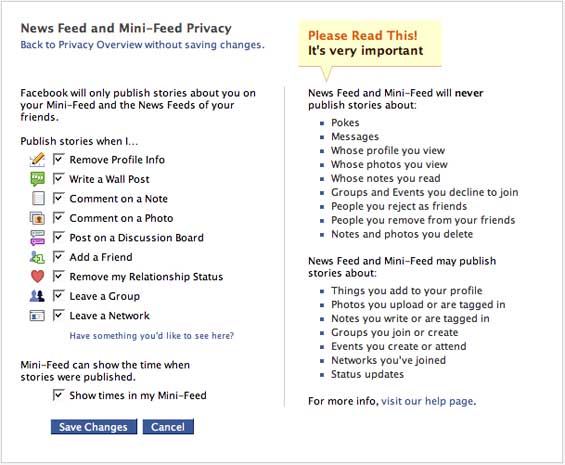
So we have been coding nonstop for two days to get you better privacy controls. This new privacy page will allow you to choose which types of stories go into your Mini-Feed and your friends’ News Feeds, and it also lists the type of actions Facebook will never let any other person know about.

Anyone who isn’t comfortable having some or any of their personal information included in the feeds can now have it removed. Facebook is also auto-removing some of the data that people complained about most – status changes, groups added, etc. (see screen shot below shows the settings).

This is an excellent example of a company listening to its users and quickly pushing intelligent changes, in a transparent manner, to deal with a problem. Facebook is growing up, in a good way.
Advertisement

Responses

Comments rss icon

  • All of this over a few lousy changes (and pretty cool changes at that). I guess it really is up to the users, but seriously – this much fuss over something so minor? I think I’m going to revolt because TechCrunch changed colors awhile back, or now has ads…

    Some users just need to take a break.

  • Hmm.. You might want to consider changing your post title “Facebook Folds in Face of Student Revolt” ..because in chinese context.. “Fold” means “closing down”.. so the title literally means “Facebook closes their business in Face of Student Revolt”

  • Hey, I liked the new changes too. But honestly, these tweaks make sense. Good stuff.

  • I apologize to my Chinese readers for any confusion. In this case, I use the word “fold” to mean “give up in the face of a challenge”.

  • And there are a lot of Chinese readers here. Me included.

  • Facebook deserves credit for acting quickly on this in light of all the complaints. Zuckerberg has plenty of VC cash so he might want to use a few of those bucks on a focus group or two the next time around.

  • I am an American and I read “fold” as meaning close too. I know what you meant, but it was a bit alarming when it rolled across my Original Signal page…

  • For those of you that think these features were good, do you actually use Facebook? I have yet to hear of one person who uses Facebook frequently think the change were anything but intrusive. The fixes Facebook pushed out should have been there from the beginning, and the features should be opt-in (they are still opt-out).

    I wouldn’t call this a good example of a company listening to it’s users. When you have a bombardment of negative comments after a feature launch, it’s hard not to.

  • I changed “Folds” to “Retreats”. I think that works better anyway.

  • Ashish, this is a pretty revolutionary product. Of course it was going to be attacked by people who were shocked by it at first.

  • Oh and Mike, maybe use “concedes” instead of “folds”. I think most entrepreurs would read that title to mean Facebook closed up shop.

  • Here is how I feel. I think these privacy changes were always coming. The past moves that they have done have been accompanied with overrides if we didn’t like the features. I don’t view what happened yesterday as folding but rather something that they probably knew was inevitable..

    I also feel that the negative comments were more viral than well thought out. But I was extremely surprised at the speed of the spread. I applaud facebook for keeping up with feedback..

  • Mike: Well, first, it’s not really revolutionary. Also, I think you’re missing the point here – it wasn’t what people wanted, at all. Nobody ever wanted their friends to know anything close to the level of data being proactively pushed in the News Feed.

    I was frankly surprised that both you and Om reported on the features as something positive. From a tech standpoint, one might consider it cool. But as an actual Facebook user, they ruined the site with the redesign, and even with the privacy controls I think the feature are negative.

    A lot of people I know deactivated their Facebook accounts, and it wasn’t because of intitial shock. Facebook has lost it’s simplicity, which is why most people like it over MySpace.

  • :-) No one deactivated their facebook account. Lots of people said they did, but they didn’t.

    The features are excellent because they remove friction on the flow of information. If you don’t get that, or appreciate it, it’s because you don’t understand why the Internet is wonderful.

  • While it is easy to criticize Facebook for their lack of planning, and for media to jump on the story overstating ‘privacy’ issues, this seems to be turning into a case study for how to deal with the unexpected missteps that inevitably happen at any company. In the end, they will probably benefit from the extreme amount of media exposure.

  • I for one access Facebook for more than 1+ hour(s) per day, and I don’t mind the features – some people just aren’t ready for these type of features.

  • @Ashish

    I actualy liked the new features on facebook.
    The so-called privacy intrusion didnt bother me at all since I am careful about what I post online. If I don’t want my friends to know it, theres not a chance in hell it’s going to end up on somebodys wall in facebook.

  • >The features are excellent because they remove friction on the flow of information. If you don’t get that, or appreciate it, it’s because you don’t understand why the Internet is wonderful.

    Wow. The arrogance.

  • “The features are excellent because they remove friction on the flow of information. If you don’t get that, or appreciate it, it’s because you don’t understand why the Internet is wonderful.”

    Honestly, Michael, while I understand why some users like them, I think it’s inappropriate to accuse those who disliked the features of “not understanding”. Though this may be difficult for some Web 2.0 advocates to realize, not everyone wants their information to flow freely, and we shouldn’t denigrate them for making such a choice.

  • Also,

    “Facebook is also auto-removing some of the data that people complained about most – status changes, groups added, etc. (see screen shot below shows the settings).”

    If you look at the screen shot, Facebook is doing no such thing. In fact, status changes and groups added are two of the items that Facebook explicitly states they’re going to share, and there’s no option to disable that.

  • I am assuming that you received my email about this. Anyway I liked the idea of the news feed that appears when you log in but I think that the fact that no one had control over any of it was why people became so angry with it not because there it was new. I think if people had gotten these controls when it came out no one would have complained. The fact that we didn’t get them right away angered people because they were used to having control of almost everything that was in their profile.

  • Yeah, ‘Concerned User’ and ‘Jay’ might have a point. Having a feed that tells me two European countries have just started warring might not be on the same level as knowing that Michelle just took a piss, Mike’s mood is *sad* and little Johnny just left the “I’m-scared-of-the-sun-so-I-sit-around-and-facebook-all-day” group. Might, but I could be wrong.

  • I’m still reeling at the banter around the recent events on facebook.com.
    Is anybody listening to the people who use their products anymore?

    This is not about if Facebook did something cool. They did.
    This is not about how wonderful the internet is. It is.
    This is not even about privacy (in the overused-industry-buzzword sense of the word).

    This is about control. Control over my life, my reputation and how I want people to percieve me. Facebook did a good job at having a fast response and being transparent, but their decisions makes me wonder if business developing social networking tools, like Facebook, really understand the sociological and psychological impact that they have on their customers.

    I don’t think so.

  • And let’s not forget that as soon as something cool happens with the Feeds, like say, oh I don’t know, some dude gets to have a threesome because you can see who has joined a group, they instantly become Awesome.

    Oh, it happened. (a guy bet his girlfriend that if he could create a group with 100k members then he’d get to have a threesome. It hit 100k this afternoon)

  • “The so-called privacy intrusion didn’t bother me at all since I am careful about what I post online. If I don’t want my friends to know it, theres not a chance in hell it’s going to end up on somebody’s wall in facebook.”

    I just want to clarify one of the points about “privacy”, as the term has been tossed around, because while this is a valid point, it misses the fact that in the case of the new Facebook features, privacy is more than an individual issue.

    The News Feed feature keeps track of, and broadcasts, not only things that *you say*, but things that are *said about you*. This is a really, really important point, and I hope we’re not overlooking this in our haste to criticize. If someone were to, for example, write something offensive on your Facebook Wall, or tag you in an inappropriate photo (and I mean inappropriate in the offensive way, not in the “I shouldn’t have been in this photo” way), there’s no way for you to stop that information from going out on the News Feed. You can edit your Wall later, or untag yourself from the photo, but the damage has been done, everyone has seen it, and you weren’t given the opportunity to stop it. This, at least in my humble opinion, is a real problem, and it’s enabled by Facebook’s new “free flow of information”.

  • While I thought Facebook’s News Feed was innovative and efficient, I see clearly why hundreds of thousands of Facebook users demanded flexibility in which information about their lives was posted at the top of all of their friends’ News Feeds (i.e. extreme numbers of wall posts, changes in relationship status, etc.).

    The “tweaks” are exactly what every angry Facebook user needed. I applaud Mark for fixing the problem quickly and transparently; his letter to the Facebook community was honest and plainly apologetic. I agree with Michael that this PR fiasco has actually highlighted the maturity that Facebook has grown into.

  • May be they should add another option to their list of privacy settings… bycotted facebook.

  • I’m also glad for Mark that he was able to implement the changes before ‘Students Against Facebook News Feed’ reached 1,000,000 members – the group lost its momentum just shy of the 750,000 mark.

  • Yup, before those tweaks, the site was definitely crossing the line.

  • There is an owner of a college/law school message board that is trying to shamelessly use the Facebook feed fiasco to get publicity for his own site. Yesterday, on his website’s home page he posted a super-size bold link to something called a Facebook Feed Killer which supposedly is some innovative hack his company developed to disable the Facebook feeds. Early indications from some of his site users was that it wasn’t working properly. Nonetheless, his site’s name & his name were published today in a USA Today article right along with Facebook. It’s amazing what people will do for free publicity. It’s one thing to plug one’s own site on a blog post but to publicly try to upstage Facebook so directly is not very cool. I won’t give the website’s name here since I don’t want to give them anymore free publicity….. as this was probably their goal in the first place.

  • “This is an excellent example of a company listening to its users”

    I would have to disagree, this is more of a classic example of a company not knowing or researching its users.

    A company which follows a user-centered design process would have learned prior to public release the problems which facebook has just seen.

    Facebook’s folly should be a wake up call to itself as well as other companies to invest in user research and usability as a core component of product design.

  • The “user research” angle is getting some play here. Dave Winer also wrote about it. Complete nonsense. If you spend your time talking to users and what they say they want, you get cornflakes. I want sugar frosted chocolate pizza instead. You don’t get that from focus groups. Build something your users didn’t know they wanted. That’s what Facebook did, and soon their users will depend on it in the same way I depend on netnewswire and tivo, which I never knew I needed until I had it.

  • I respect Zuckerberg for his open letter today. He admits they messed up – not researching users – and more importantly, how they did not follow their true “mission” when developing the news feeds. How many CEO’s do you see these days admitting mistakes so openly? This is both a lesson in researching before designing, as well as how to properly address mistakes to your customers. Zuckerberg’s letter stated his original facebook vision, which will resonate well with diehard FB fans. His acknowledgement of the anti-feed groups gave them the attention they desired.

    Everyone is happy again!

  • Michael – I disagree. Innovation and new features need to be customer centric. You do have to communicate with your customers when researching. Innovation means knowing what your customers want before they do – but this still requires research along with the abillity to see through their “cornflakes” demands to what they TRULY need.

  • Michael,

    Would you agree with me? (Not intending to spam, it’s just too long to post here, in comment form)

  • “The “user research” angle is getting some play here. Dave Winer also wrote about it. Complete nonsense. ”

    750,000 facebook users took the time to join a group that was against the newsfeed feature. Granted, quite a few of these were viral but it still doesn’t diminish the significance of the backlash because that is a lot of users who took time to join the group. While I agree open ended “what you want” focus groups are sometimes useless but a focus group to evaluate a “specific feature” such as the Facebook newsfeed would have been worthwhile as it would have highlighted the aspects the users were uncomfortable with. With this knowledge in hand, there is a good chance Mark would have introduced the opt-out features from the beginning. Regardless, Facebook acted pretty quickly which was good but I’ll have to disagree with Michael on the “user research” angle being nonsense.

  • Michael, there’s a difference between an open-ended brainstorming session (”Tell us what kind of cereal you want”), and a focus group exploring a single product or feature (”Tell us what you think of sugar-frosted chocolate pizza”). With the former, you’re right, you get cornflakes. But with the latter, it doesn’t matter if people “don’t know they want” sugar-frosted chocolate pizza, if you ask your target market if they want your product, and they all say no, they maybe you should re-evaluate your strategy. We’re not talking about coming up with an entirely new product; we’re talking about a fundamental, radical change to an existing product with a dedicated, active user-base. I hate to use this example because I think it’s cliche from a marketing perspective, but here it goes: New Coke. Creating something new (i.e., adding additional choices to the roster of Coke flavors) is a vastly different animal than changing something that’s already popular (i.e., replacing Coke Classic with new Coke).

  • I must disagree with your assertion that “[this] is an excellent example of a company listening to its users and quickly pushing intelligent changes, in a transparent manner, to deal with a problem.” To me, this is an excellent example of how NOT to proceed in developing new features and making design changes to websites or anything else. Facebook committed the classic example of rushing into functionality and ‘improvements’ without doing basic market research of its customers as if they knew better what their users want than the users themselves. Sometimes this works, but often it fails miserably resulting in lost customers, significant delays and revisions leading to huge costs, etc. Had they done some intelligent market research before coding and rolling out these features, they would have found these issues before the poop hit the fan. And if they did do the research, they should hire someone better next time.

    For goodness sake, when will these companies learn that the users (customers) are the ones making the calls. I hate to say it, but perhaps we need a little more humility and due diligence in this industry.

  • Michael,
    Your example of TiVo goes against your argument, as TiVo was heavily researched and tested with users prior to release. One of the beauties of user experience research is that its results appear transparent. The final product it exactly how you’d expect it.

    Here is a great interview with Tivo’s director of User Experience. She clearly lays out the importance of talking with users and testing early and often, prior to release.

    “TiVo has an on-site lab and a strong research team.” – Director of User Experience, Margret Schmidt

  • Yeah, well forget what I said about Tivo then. :-)

  • “How many CEO’s do you see these days admitting mistakes so openly?”

    Mark’s first response was arrogant and filled with hubris. Quite a few blogs and comments commented on how poor the response was and how this showed a real lack of management experience on the part of Facebook. I don’t think those went unread by Facebook and they decided to do the smart thing and follow the advice of people that understand effective management. I applaud them for *finally* deciding to do the right thing, but that first response is really important and wasn’t handled properly. It showed the true culture and agenda at Facebook.

    The bigger issue here, however, is whether this will impact Facebook’s acquisition goals. Web 2.0 is changing. It’s clear that the community is in control and now we have the new management at Viacom stating that they will be looking for small acquisitions, not large ones. After already being rejected by Facebook for $750 million and telling Facebook that $2 billion was unrealistic, one has to wonder if the opportunity for a huge acquisition has passed. Will this fiasco create doubt amongst potential acquirers? Will they now recognize that these sites are too risky to throw huge sums of shareholder dollars at?

  • Seriously, I am sick an tired of the same user using multiple names spam this post.

    Its OVER, they added your privacy features.

    Some ppl just can’t let things die. They just love trolling.

  • One of my many student workers, most of whom are Facebook users, noticed this morning that her news feed included an item from a close friend who, as it turned out, had no idea it was being posted to the home pages of the thousands of people she is connected to through Facebook.

    “(Name)’s relationship status has changed from Engaged to Single.”

    Reduces friction, indeed. Prior to FB’s “retreat” users had to uncheck individual checkboxes for every single item that was automatically generated every time they made a single page to their home page. Talk of “friction” and “free flow” is truly absurd… I wonder who doesn’t “get it” in this context, those who wish to have multiple levels of interaction based on demonstrated interest in the information, or those who want everything posted everywhere all the time.

    Time to eat your crow, Michael. You missed the boat on this one.

  • Maybe the default for users should be that none of a user’s updates goes to straight to the news feed and if they feel that they would like to participate in the services, they’ll check-mark this into the privacy setting themselves.

  • I’m sorry Michael, but I feel the need to call you on this comment:
    “:-) No one deactivated their facebook account. Lots of people said they did, but they didn’t.

    The features are excellent because they remove friction on the flow of information. If you don’t get that, or appreciate it, it’s because you don’t understand why the Internet is wonderful.”

    First of all, do you have any figures to back up your statement, or are you just guessing? If so, why do you assume people are lying about this?

    Second, you can’t just dismiss people who don’t agree by saying “they don’t understand why the Internet is wonderful”.

    That’s like saying you understand why the Internet is wonderful but people who don’t share your opinion just don’t get it.

    I agree that the new features have their benefits, but don’t you think the execution of this update could have been better, by polling their users and not making that update both mandatory and retroactive?

    After all, Web2.0 is supposed to be about making user-centric apps, not just dismiss people’s opinions and force updates upon them.

  • I really think you should take a step back Michael and look at who exactly is using Facebook and how they are using it. It’s not people like you, someone who is interested in technology and cool features, and happy enough to see the information you put out there aggregated wherever it is useful. You have to understand that college students are young, happy enough to get on facebook with their friends, and have no problem putting up all manner or “personal” info about their relationships etc.

    But there key thing here is that they don’t mind people seeking this information out – what they don’t want is for it to be broadcast! There’s such a big difference and I think you’re missing it. It doesn’t matter how innovative it is, or how much you think people will get used to the feature, it’s clearly not what people want. If I add some info to my profile, I might look at the change and remove it again. Then add something else. I don’t want all these changes broadcast to everyone on my “friends” list (who by the way for the vast majority are really just acquaintances).

    The new settings are good, but they don’t go far enough.

  • Steve

    By merely having a facebook profile, you are broadcasting your information. Furthermore, if you are friending people you really aren’t friends with (like the majority of people are doing) your defeating the best privacy control: yourself.

    That’s why the “stalker” argument dies.

  • Kyle,

    At least initially (the new controls fixes it), if someone friended you and you rejected them, it broadcast it.

    If you removed something BECAUSE the new features broadcast it, it not only broadcast that you removed something, *it broadcast what you removed*. Why would you possibly want something you removed to be broadcast? That defeats the entire purpose of removing it in the first place.

    If you declined an invitation, it broadcast that. It’s all well and good (to me at least) if it tells people I’m going TO a party, but I don’t want people to know I rejected the invitation. It’s all social….but rejecting an invitation looks bad.

    Likewise, as someone mentioned before, have no control over what people post *about you*, yet it all gets broadcast to all your friends and all their friends. Inappropriate pictures, stupid wall posts, everything. Unnecessary.

    This is all a moot point now, since facebook has fixed it. I seriously hope they learned a lesson though. Focus groups exist for a reason…use them!

  • “Furthermore, if you are friending people you really aren’t friends with (like the majority of people are doing) your defeating the best privacy control: yourself.”

    Ideally yes, everyone would have just their close friends on their “friends” list and wouldn’t care about what is broadcast to them. But “friends” on social networking sites have turned out to be much less specific than that. There’s the guy you met at the bar in the pub one night and chatted to for half an hour. There’s the girl on your course who you always say a few words to while waiting to go into a lecture. There’s the friends of friends you see and chat to at parties after a few drinks. For all of these people, you are more than likely to accept onto your friends list (you wouldn’t want to reject them, if only through politeness). But you don’t know these people well enough to want to broadcast your every move to them.

    The vast majority of people have friends lists that look like this, and that’s why this feature was not well thought out (and indeed remains an issue that has only been partially resolved).

  • “:-) No one deactivated their facebook account. Lots of people said they did, but they didn’t.”

    I know a handful of people, myself included that deactivated their accounts. It’s been different, a life without facebook, but I intended to join back once the newsfeed was removed or privacy options were enabled. However, in the mean time i have been researching other sites and have found some others that have interested me.

    ..Good call, Mike (rolling eyes)

Leave Comment

Commenting Options

Enter your personal information to the left, or sign in with your Facebook account by clicking the button below.

Alternatively, you can create an avatar that will appear whenever you leave a comment on a Gravatar-enabled blog.

Trackback URL
bugbugbugbug
Techcrunch on Facebook