Startup Uses Military Tech to Fix Low Res Video
by Michael Arrington on August 31, 2006

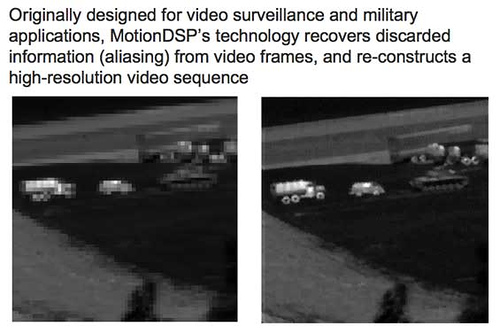
Motion DSP is creating a simple web based interface that will significantly enhance low resolution camera phone video into surprisingly high quality stuff. It started off in 1998 as a U.S. military funded project at UC Santa Cruz. In January 2005, Professor Peyman Milanfar, the primary researcher behind the technology, co-founded Motion DSP.

The company compares multiple frames in a video to find and replace lost pixels in a given frame, significantly enhancing the experience with little increase in overall file size after compression. The service works best when a video is not moving rapidly or in a jerking fashion, but tends to improve just about any low quality video. To see a demonstration, check out this page on the site that contains three different before and after video shots.

The service will go into consumer beta sometime this year, CEO and co-founder Sean Varah told us. The service will be free and will allow users to upload a video and download an enhanced version. But he also stressed that the focus will be on getting deals done with the large online video sites, such as YouTube, to enhance user-uploaded videos.

Motion DSP is headquartered in San Mateo, California and outsource large parts of software development to Serbia. They’ve raised a $500,000 angel round and are currently pitching a Series A round of financing.
Advertisement

Responses

Comments rss icon

  • Finally something worth writing about. Looks like a winner to me.

  • “…east, west, south and north somewhat.”

    funny how those satellite photos we had of Iraq’s alleged WMD facilities were so bad, no? must have been a sand storm or something on the single day of surveillance that our government possessed. yeah.

    or, maybe Google and Nasa just rapidly advanced past the Pentagon’s spying capabilities over the past 3 or so years – and delivered to the desktop, too? yep.

    there’s no other logical explanation – unless, of course, you want to say that your government is run by a bunch of lying criminals, and….errr?

  • Amazing. This stuff is just brilliant. I wonder if it can clean up a Hi Def video and make it even better…

  • The book video is impressive – You can read the titles after the reconstruction. Pretty impressive stuff.

  • This is really cool. If somehow they can allow users to upload videos and enhance on the website itself, it will really be kickass.

  • Anyone knows competing technologies to this one? How crowded this market is?

  • EP. They aren’t making anything better, they are using tricks to make us perceive better image quality. It’s just like the overuse of edge enhancement, sharpness etc in home video. You can’t magically create information from nothing. Once it’s gone, it’s gone.

    Doing this to High Definition video would just make it worse.

  • The before and after clips were very impressive. It is very cool that they will be offering this as a free service as well.

  • I can’t wait to use this thing.

  • Micheal very cool. I would love to know what framework of AJAX these companies use for their programming. I think it will also help us all distinguish which framework we should all be using for our sites.

  • Looks a fake, the “after” video is the “before” and vice-versa :-)

  • The reason why these videos are grainy in the first place is due to low resolution and compression at the source. Video phones do this on purpose to conserve space, but that will become less and less necessary as chips, bandwidth and memory become cheaper. So this technology seems like it doesn’t have much of a future for general use.

  • It’s important to clarify that the reason YouTube videos are so low in qualiy is because they are down-sampled for streaming to Flash 7 330Kbps.

    So this is not something a video host could enable and then improve their OVERALL inventory unless all their source file uploads are lower quality than their output. The easiest way to get higher quality video is to just use someone other than YouTube.

    Here is a detailed technology comparison of output video quality.
    http://www.medi...itepapertbl.asp

    Now, tht said, the MotionDSP sample is very impressive and might help if someone has a very low rez camera phone video to start off with prior to upload.

  • Bah, CSI (the TV show) has been doing this since 2001!

    Hell, they can even manipulate file folders in 3d and zoom up on a low-res video to analyze DNA!

  • 1. This is REAL technology, not a swap of before and after (to Kame)
    2. To Overcast: this IS real enhancement and is NOT like edge enhancement, which as you say does not add any information. There is a lot of lost information in that multiple frames over time are utilized rather than appearing as invisible subtle changes.

    The only downside, or trade-off, is that a lot of processing is required and the result might have lower frame rep rate. I say “might” because just like pixel averaging in the spatial directions can but doesn’t have to result in a lower res image, the same can be true in time averaging.

    I think work should be started on special proprietary high-speed low power consumption chips to do this stuff in real time. In my mind that should be the missing link to really enable video conferencing.

  • It’s the same deal with the video processors I use in my home theater. Takes a 480i video image and processes/scales/cleans up the image and outputs at 1080p. The resolution may have changed, and it looks a lot cleaner. But it’s still standard definition, and there is no more detail. I’ll agree the samples look impressive, but I just want people to be aware, that you aren’t gaining any detail out of this. You’re just getting a cleaner version of the same signal.

  • overcast EP. They aren’t making anything better, they are using tricks to make us perceive better image quality.

    Got any proof of that? What they are probably doing is taking information in surrounding frames of a slow moving object and combining them into a single one that has facets of each of those pieces, thus improving the quality of a single frame.

  • Man, the moment I read the title and saw those pictures, I thought “but ofcourse! that’s so obvious once you think of it”

  • Mmm, I guess what they do is combine the pixels of several frames into a higher detail picture, and then paste that back in the original frames.
    Some pretty impressive algorithms, but it will only help with video’s showing fairly static pictures I think, that’s why the one with the books shows so much improvement, the car ride is much less impressive, and fast moving things won’t be enhanced at all.
    That sayd, it will allow you to make a high res picture with a low res phone, just by making a movie of the (Static) thing you want to make a picture of.

  • Bear in mind that this technology is only effective on static or slow-panning videos and is a processor-intensive task (hours), unless they follow the Riya approach (client side app). Anyway I think this is going to be a great solution, in the long run, when someone use this kind of algorithms at the encoding level and not just as a post-prod tool.

  • About the comment on kick-starting videoconferencing. I gotta point out that it was actually possible to produce a decent video stream on a modem in the nineties. The problem with videoconferencing is not a technological one. The problem with video conferencing is that the general population simply does not want to appear on live motion video. Actors on TV and in the movies have makeup and costume departments that make them look good on film and video and this is what people have been conditioned to expect when they see a person on a video. When you see yourself on camera without those benefits it can be embarrassing especially for people who are image conscious like teens who are supposed to be the ones to lead the way on this kind of technology. It’s simply not going to happen. It’s a fantasy that telecoms sell to shareholders every year so the promise will never go away as there is a financial incentive to make such promises; nonethless, it never will happen.

  • Sounds like a similar process to that used by the old “Snappy” video snapshot device. It used multiple frames to gather additional information and could generate amazing resolution stills from regular video signals.

  • If you don’t believe what you see, you can submit a video to the guys over at MotionDSP with the following requirements:

    User-test requirements
    Short videos — under 1 minute in length
    Video taken outdoors, or well-lit indoors.
    Slow panoramas.
    Video of people or things taken at 10-20 feet
    Video you’re willing to release the rights for (ie: allow us to post on the web as part of the trial)
    Send them in their original format (usually 3GP or 3G2 to video@motiondsp.com

    Keep in mind the technology is under continuous development and refinement. I don’t think the YouTube videos neccessarily did the service justice, but of course I saw a demo on an HD plasma.

  • They seem to use the same technique that for example astronomers use to gain quality improvements for space imaging. I tried this myself a few years ago, directing a telescope with a webcam in its ocular at saturn and then capturing a few hundred frames. Looking at a single frame the quality is really poor. But calculating through hundreds of frames you really get pretty good images.

    I used a software called Giotto: http://www.vide....org/giotto.htm

    I never tried it outputting videos but I guess its kind of the same thing. So if you have slow moving or better almost static video, you can average out some frames and copy them above each other and thus improve video quality. The faster the movement is, the less optimized the result is.

  • Moving pictures can be greatly enhanched by using some kind of a motion compensated smoothing algorithm. Motion compensation is used in most mpeg compressions. I was also thinking of deconvolution which can enhance blurry images but takes a lot of time to finish.

  • I forgot to mention the edge directed interpolation alchorithm.

    Try to combine the above mentioned algorithms.

  • I forgot to mention the edge directed interpolation alchorithm.

    Try to combine the above mentioned algorithms.

Leave Comment

Commenting Options

Enter your personal information to the left, or sign in with your Facebook account by clicking the button below.

Alternatively, you can create an avatar that will appear whenever you leave a comment on a Gravatar-enabled blog.

Trackback URL
bugbugbug