August 29, 2006

Podango to Create Podcast Channels

Michael Arrington

41 comments »

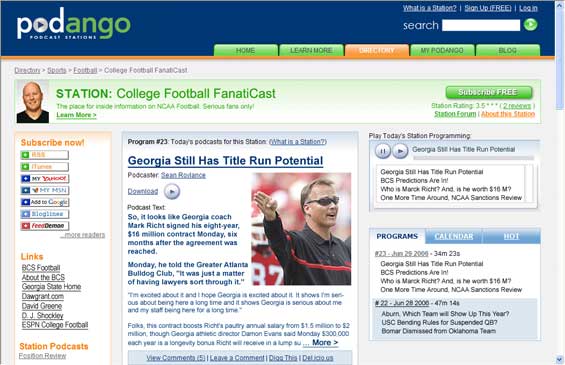
Yet-to-launch Podango, based in Salt Lake City, is trying to corner the podcast market by aggregating popular, topic-specific podcasts into expert-driven channels. The goal is to combine multiple podcasts, which may only be publishing weekly, into a 3-5 shows per day channel with a single RSS feed. Just like old-style television and radio stations.

Podcast directories, like those created by Yahoo and iTunes, are very popular ways of finding new, good podcast content. Podango wants to take this a step further and mash the talent up into topic specific channels, taking some of the work out of finding good content by listeners. If they are successful, look for the established players to quickly follow suit.

Podango will recruite station directors, who in turn will recruit podcasters for their channels, manage the channel using an Ajax drag and drop admin interface, and help recruit advertisers. The hope is that listeners will gain from having a person select the best podcasts for a given category as well as avoid dead air time since shows will be queued one-after-another. Podcasters will gain an audience. Station Directors will have a chance to make “$25K to $250K a year or more.” Of total revenue, Podango will keep 30%, leaving 70% for station directors and individual podcasters.

If this works, I’ll be signing up for sports editorial and their equivalent of Comedy Central. Hurry up and launch, Podango.

A screen shot of how a channel will look is below.
  • Sphere It

Trackbacks/Pings (Trackback URL)

Comments

Well, it does say “$25k to 250k per year or more. (Mileage varies)” but how exactly? Any details on that front?
Also, would be interesting to see how well the public would embrace the concept of being told what to hear.

Startups.in/India
(Nag .B)


My guess is that Podango will take some grief over that quote.


Would be interesting to hear from them as to how they came up with those numbers but I’d think for a lot of people even the $25k/yr is a lot.


PodCasting is the core of Web 2.0. Web 2.0 allows user to have more control over their web experience and PodCasting does exactly that. The will be a day when most everyone will have a Podcast . If you podcast regularly, then you should consider using this product. If might help you acquire a lucrative income. I love it user-centered apps.


and, as a podcaster, what will happen if I decide I don’t want these “experts” deciding if my podcasts are worthy? Will my shows “cease to exist”? This is like about.com deciding what info is worth linking to by their ‘experts’. One of my shows is directed to people in the performing arts - so, when I interview the cast of a show, and have an in-depth conversation as to why a piece was chosen, or the mehtod of preparation for a role, where will they place it? Arts & Entertainment? or the Black Hole of “Who wants to listen to this shit”?


I heard that you will be able to customize your experience quite a bit. I think the “experts” line up is just a suggested starting spot but you are able to take it from there and make what you want of it as a listener.


Web 2.0 could really use a truly great podcasting portal with lots of functionality.


This approach might work with blogging, but Steve Rubel posted some stats a few weeks ago suggesting that only 8% of internet users even know what podcasting is, compared to the 22% of users who actively read blogs.

http://www.micropersuasion.com.....s_a_r.html

I don’t see this as a viable business model. Perhaps somebody should focus on a way to bring podcasting more mainstream.


I’m please that they’ve at least implemented the station director model. The problem I’m seeing with the channel models is that they are basically “throw your stuff here” channels, and not crafted editorial-honed content. Not professional, and not to limit free speech. Instead, I’m suggesting that if someone were weeding YouTube, it’d be much more watchable. Maybe that’s the channel model there? Thanks, Paris.

But It’s great to seem them trying new models.

My model is similar but not. I’m building content around themes, and then will grow companion podcasts to augment and extend the conversation. It’s great for enterprise clients, and partially what PodTech does.

My only difference is that I’m going after non-traditional markets as I move forward.

Thanks for this post. Great pics on Business 2.0


The station director model sounds very interesting, but to get the scales of listeners for advertisers could be more challenging. Look forward to see how this goes.


One of the selling points of Podcasts is that they’re “audio-on-demand”, surely taking various podcasts and creating channels from them “like old-style television and radio stations” goes against the grain of this concept…


Podfeed.net already allows ALL its registered members to create custom myPODFEED channels, that other users can then subscribe to either via RSS or OPML. These channels can also be made private of course.


Podango is not alone in this space by a long shot. Feedburner is already aggregating feeds they select into channels and presenting them to advertisers. Podcast.com is readying similar functionality as well. And you certainly don’t need Podango’s interface to create group feeds. WordPress, for example, has an aggregator plugin that allows you to create one channel on your blog from multiple feeds of your choice.

Podango is attempting to move into the same space as Feedburner, Blubrry, PodTrac and PodShow by becoming the single point of contact for advertisers looking to get involved in podcast advertising. Their success is definitely not assured as it will rely heavily on recruiting quality podcast producers, many of whom already have a decent variety of choices for monetizing their content.


Podango is building a their own channel in niche market of web 2.0. My first impression suggest that their aiming for the right direction. But maybe the challenge is having (building) both large amount inventory of advertisement and generating really niche content. Then maybe it will be interesting. :)

ps: Any detail on ““$25K to $250K a year or more.”?


Perhaps they should include a feed mixer so I can create hip-hop style feed overlays (TalkCrunch and {name here} VC) riffing on the same me-too web 2.0 non-starter-up. If I can listen to the salient points of about 10 or so podcasts that I currently subscribe to, in the space of one, that would be cool. Many podcasts are just too full of dead air and stupid stuff (because the speaker never got trained in on-air journalism??).

The real issue here is if 2000 podcast jockeys (PJs!!) create thousands of overlapping “channels” will anybody get enough scale to make money. Will users be able to determine good channels from bad (ratings…)?


Doesn’t iTunes have podcasts sewn up?


Okay here´s my idea - a podcast just reviewing otherpodcasts.
That´s what the internet is boiling down to - summaries of summaries of summaries.


“$25K to $250K a year or more.” sounds like bubble burst rapidly approaching.
I would love to see the business plan!


Lee Gibbons, Podango CEO has info more info on the “$25k to 250k per year or more” plan at their blog. Sounds plausible.

Nag .B


Along the same lines I’ve started a site that does kinda the same thing with IPTV shows. Let me know what you think, and if you like it tell your friends. http://www.iptvboards.com


The concept is viable but all TechCrunch readers know the issue is delivering sustainable quality to daily listeners. Will the quality be there for a station? It’s difficult to herd two podcasters at a time.

To your point VentStation.com, I think iTunes simply owns a large piece of a pie that is much larger and growing.

-Brent


If the corporate entities also join the bandwagon of podcasting, more economic benifits can follow.

-Raju G Ramachandra


Expert editors and reviewers in my opinion can produce nice podcast portal. While Itunes has abundance p\of podcasts. I have difficulty in finding reliable podcasts.


I’m not sure I see much value to a 3rd-party “station director” programming a channel. I do see value to the channel concept itself — but I don’t think this is what it will ultimately look like.

I think it’s far more likely that companies and organizations will begin to program their own channels, populating them with content their important audiences find interesting. So, for example, X Community Hospital will produce content (or pay to have content produced) for an X Community Health Channel. Bob’s Sporting Goods Inc. will produce content (or pay to have content produced) for a Youth Sports Channel.

I work for what would be considered an “old media” company. We’re getting a lot of requests from clients who used to think only about advertising in 30-second chunks. Now they’re asking us to produce full-fledged programs for their most important audiences. They see the value in engaging their audience with more extensive programming than a typical commercial. We see value in producing those programs for narrow audiences, instead of producing only “lowest-common-denominator” programming with broad reach.


Sorry, the comment form is closed at this time.