
Seattle based Redfin is making two major announcements today.
First, they’ve closed an $8 million Series B round of financing, from Vulcan Capital, BEV Capital and Madrona Venture Group. This follows a (roughly) $1m Series A round in January 2006. New CEO Glenn Kelman, the founder of Plumtree, joined the company in September 2005.
Second, Redfin is expanding their service out of the Seattle area to include the bay area in California (and will be expanding to Los Angeles, San Diego and nationwide soon).
They have an intruiging and aggressive business model. Instead of providing useful real estate information to consumers and then pointing them to real estate professionals like competitors Trulia and Zillow, Redfin is doing their best to completely remove real estate agents and brokers from at least half of a home sale.
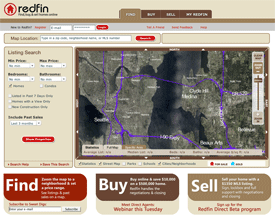
Redfin combines MLS listing information (homes for sale) with historical sales data (homes already sold) into a single map. If you find a home you like and want to place an offer, Redfin will represent you in the buying process (they have a call center with licensed real estate professioinals to guide you). Here’s the good part: They reimburse you 2/3 of the buy-side real estate fee directly on closing. The average amount reimbursed to the buyer is $11,402 (and that is based on relatively low Seattle home prices).
Redfin is also testing a seller-representation model, called “Direct for Sellers”, that will handle all aspects of a sale for a flat fee (currently $1,350). On a $500,000 home sale, this saves the seller $13,650.
Everything isn’t rosy for Redfin, though. They’ve been operating in Seattle for a number of years and have numerous war stories to tell about threats, stalkings and other disturbing behavior towards their employees and some customers from, apparently, angry real estate professionals. Hopefully things won’t get out of hand as they continue to disrupt this stubbornly inefficient market.
I haven’t met the Redfin team yet, but am looking forward to seeing them tonight at the TechCrunch Seattle party that I am co-producing with them, Farecast and Triphub.
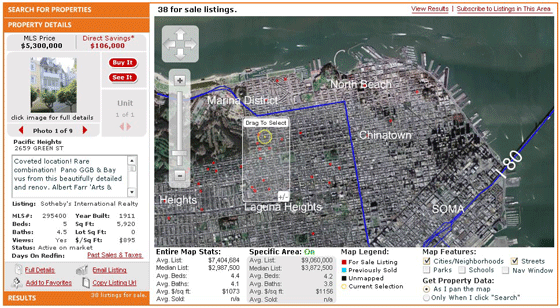
Screenshot (showing $106,000 refund on a $5.3 million San Francisco house):


There is an endless list of corpses around this business model. It’s not to say that it shouldn’t change (it will, someday) but there are nearly 1m licensed realtors in the U.S. alone.
Technology people love to conveniently overlook installed bases (I’m one of those tech people, so I’m not pointing fingers) of professionals like real estate salespeople and car salespeople.
I’ve done a real-estate Web startup and two automotive startups trying to unseat these guys and I can tell you it’s a LOT harder than you would think.
That said, I wish them the best of luck. Someone will win someday… someday…
So Redfin wants to be the real estate exchange? Thats great, but such centralized plays never work out…Whilst the role of agents may diminish to simply oversee negotiations and represent buyers/sellers sides as laywers, they will not disappear, for the same reason there are law firms. The internet is only changing the way people find information. Guys like Trulia and Extate get it. They bring customers to agents, and allow the transaction to occur offline.
Redfin is taking a very interesting approach. As a tech-savvy user I could see myself using the service rather than an agent. It may be tougher to get others to migrate to online transactions however most states tax filing, school can be done online so why not a real estate transaction? It is only a matter of time.
Redfin should be applauded for taking on this inefficient and expensive business model. I believe that their type of model will ultimately blend with a personal service professional. Where the real estate agent is a paid professional like a lawyer or accountant and they, along with their client, use Redfins’ technology to purchase or sell real estate. This would be the blending of both worlds and one that the real estate industry does not want to happen…fair exchange of money for services.
I find all the new real estate players fascinating to watch, but I believe the way Google is going about it is the most likely to stick. By simply aggregating listings on realtors’ web sites, they can bring more business to those realtors who put more of their listings on the web. Since they are not directly challenging the way houses are bought and sold, it should encourage more realtors to add more listings which in turn will make the search service more valuable. Then, when the average house buyer makes online searching a regular part of their buying process, the power will have shifted to Google and they will be able to introduce services that can disintermediate the existing players. The only way to dislodge the real estate brokers and agents is to gradually change the public’s house-buying habits and Google is probably best positioned in terms of scale, patience and financial wherewithal to just do that.
I would like to comment on the American Dream of Homeownership.
We stress Homeownership, but what about Forclosure Prevention ?
Educating the Homeowner who gets in trouble after 24 months, not knowing what options available due to circumstances beyond their control.
We spend our entire life trying to accomplish the American Dream! Show us
how to Keep it In Hard Economic Times.
“threats, stalkings and other disturbing behavior”… a sure sign of success, if not in the flesh, then at least conceptually… I love what I’ve seen of Zillow, will look into this one and Redfin… thanks for the post.
Will this be bad for realtors and companies of the like?
>and that is based on relatively low Seattle home prices
Half a million dollars as the average price of a home is relatively low? Since when?
Multiple Listing Services (MLS) seem to be flying under the radar. The real inefficiencies of the system at this point have more to do with MLSes than the Realtors themselves. MLSes don’t present data well in the first place, don’t use standardized data formats, and don’t offer meaningful ways for their data to be remixed.
Which is why I think the Trulia model has so much going for it. It reads feeds, presents data to a much larger audience, presents data meaningfully, and offers outgoing feeds. It gives the Realtor more bang for their data. It empowers rather than controls. The Trulia model will oneday (hopefully) allow Realtors to bypass their local MLS. But if we can’t take on data-centric MLSes, there’s no way we can take on people-centric real estate professionals.
Redfin on the other hand is trying to compete with the trust, relationships, local advertising, and local market knowledge that a local Realtor has spent years building. That’s pretty tough to do on a national scale. Yes, the average home buyer today is already using the Internet as a key part of the process. But consider this: most consumers struggle to spend $1,000 without some good solid human interaction; are they really going to start buying houses in significant numbers based on an Internet search and a phone call?
The bottom line for me? I’m sticking with Realtors, and the Realtor I choose will be the one who has empowered me by making the data I need available in a meaningful format before we ever meet.
I love this model but agree with comments around the challenges. The pain is clearly there – having bought and sold several homes and having studied the the market at a more general level, it’s painfully clear that there’s a huge inefficiency – and an expensive one – in the traditional broker models. Freakonomics (the book) has a great analysis of the failure of the commission model to incent performance (in the form of extracting maximum price) on the sell side. But the “purchase hesitation” – what prevents people from listing by owner, and encourages them to fall back on realtors – is fear. Fear that (in a good market) you leave money on the table because a real estate agent could get additional buyers to appear, or (in a soft market) that an agent could help you find that elusive buyer soon and steer him to your property over other competitive ones. And the “value” of that fear tends to feel like it’s worth more than cost of the delta between a traditional real estate broker fee and a discount / FSBO one. Classic chicken and egg problem – and i can’t wait for the disintermediation models to get enough critical mass to tip the scale.
At first I was disturbed to read about Redfin, as I will be getting my real estate license this fall and it is targeting the same customers I was going after: technically-savvy, well-informed buyers and sellers who come to an agent educated and prepared. But then I realized that this is exactly the kind of service a geek like me craves, and since they have not yet come to my state, well…
I applied to work with them as an agent, when they arrive in my state.
Dare – $500k is nothing compared to a decent house in the Bay Area
I wasn’t excited about Redfin until I read this entry about their business model. Finally, perhaps they can bring FSBO to the masses… Reminds me of FSBOMadison, a site that has been gathering some steam in Madison, WI. I believe they’ve gotten the same threats from real estate professionals in their area. *sigh* gestapo tactics…
It wasn’t that long ago that stocks traded in 1/8 of dollar or wider increments instead of a penny as they do now and stocks were bought, transacted and settled in a manual completely manual and expensive process. Many people said this change would never occur. They were wrong.
That said, I see the following barriers to the success of this concept:
1) User acceptance and lack of understanding of real estate transactions in general – based on data involving the mortgage market, many individuals do not understand the complex derivative nature of certain loans at the time they sign them – only later once payments rise do they understand them. To me, it signals a clear lack of complete education for many consumers to get this.
2) Size of opportunity to scale – this is a state by state endeavor as local laws must be followed. This is both complex and costly and a considerably smaller opportunity and more illiquid than a stock market. The real value of this service ultimately might not be cost savings, but rather simplification of the process. If the administrative burden could be reduced at the same time costs are lowered that could prove fruitful. It would make the sale easier for the transacting parties while removing the argument that you need an expensive “expert” who knows all of the steps of the process.
It would be foolish and premature to dismiss this idea because “others have tried it before”, often people perfect a business model based on the lessons of others who have attempted to do so previously. The threats show how big the potential disruption of income potentially is to certain individuals and signals to me that they see the threat as all too real. I look forward to meeting the Redfin folks this evening at the Techcrunch party and learning more about the direction of their venture.
Wow, death threats. You can pay for that kind of publicity. Surely a sign that there product is in fact a threat to the old business model.
Too bad the product is not immediately scaleable to a larger area. Talk about a limited market.
As a technology director at an online travel company turned realtor in Chicago. I think this kind of innovation is fantastic. I’m very excited to see Trulia pop up in the Chicago market and will definitely be feeding my own listings into it. There is no doubt that the real estate is ripe for massive change – especially in it’s mentality towards and use of technology.
One general comment on the Redfin business model is that I believe many people overlook the value that a good realtor brings to the table, especially for buyers and high end sellers. I tend to work more with buyers (often first time home buyes), and these folks really don’t have a lot of knowledge, nor have enough confidence to do to find a place and go through the home buying process on their own.
For sellers, I think FSBO combined makes a lot of sense if they have the time (and energy) to market their property on their own (they’ll save at least 2.5% here in Chicago, since often buyers working with an agent will buy the FSBO and the seller pay the one side of commission). If people don’t have the time, they’ll go with a realtor.
Redfin’s business model has about the biggest chance to succeed in the industry. If they can roll out a model that covers the US, the fact that you can get a large $10k+ refund will make a lot of people think twice about using a normal realtor.
Redfin is a true disruptor as opposed to the Zillow pseudo-disruptive model.
I like the idea, but local is as local does. In a small town like the Idaho Falls market, many home buyers want brokers to take their hand and lead them home to home. The local brokers have the wealth of local knowledge, this is a bad neighborhood, that’s a great school, your playground is around the corner, you’re close to the best little Mexican restaurant in town, etc.
http://www.idahofallz.com
To be truly great they should swap business model to align with client wishes.
They should charge 1% from seller when they represent him – encoraging higher price to get higher markup.
They should charge fixed fee from buyer – in this way they encorage lowering price in negotiation process.
Now both buy and sell agent are interested in highest price.
Redfin can change rules of the game dramatically.
They should also build and publish schema for transactions between similar sites. Yes – they should encorage and build their competion. Only if hundred of such sites will appear they will have chance to change real estate.
Redfin is just another real estate technology company that doesn’t understand the barriers to enter this market. Brick and mortar brokerage, tied to referral fees and amateur vertical search doest equate to much in my book.
Master your domain!
http://www.reyestate.com
As a Realtor and veteran IT guru, I can guarantee you that Redfin will not dominate anything in the future. Realtors have just recently been given HUGE tools for manageing escrows “Transaction Mgmt Software”. With the “Internet” marketing properties wonderfully and with transactions becoming extremely efficient for Realtors to manage, Realtors WILL be able to drop commissions significantly while still providing local and experienced help for each client’s UNIQUE needs. Commissions have already started dropping dramatically for all realtors and these tremendous savings offered by Redfin are not compared to the average commissions but the highest commisions. Redfin will also be HARD PRESSED to find qualified realtors to work for them given that 90% of new Realtors fail within the first year. Realtors will not go away, they will just evolve and commissions will drop.
Having worked with erealty and ziprealty in the last few years (buying) with a nearly identical “1% refund” model and a flat fee listing broker ($495/listing) in Boston (selling), approximately nothing in the Redfin is disruptive. Maybe even less. The web sites of the Real Estate 2.0 are undeniably cooler and more useful. But we’ve seen this before.
The buy side agents really cannot be displaced: in the end, you need someone to unlock the door for you, push the paperwork around to closing and so on. This is not the kind of thing you can outsource to a call center — the licensed real estate professionals who work there really have to get out the building, get a key and open a door for you. This happens 10-20 times for a buyer on average, dependent on market conditions.
My erealty broker gave up on his job and joined ReMax. What they paid him (after paying me the refund) wasn’t enough to make it worth his while.
While it sounds nice to NOT disintermediate and “work with the brokers” by aggregating their listings (as maybe Google, Trulia, vast might say they do), the MLS system has too much power. Really simple features, like knowing whether the listing you are looking at is now off the market, or knowing about a new listing as soon as it comes on, isn’t possible without a centralized model. While the MLS system doesn’t have a spiffy web site, these little bits of information matter. A lot.
What is needed is MLS 2.0 — how this will happen is anyones guess, but no refin or zillow on their own can push it.
I don’t understand why everyone commenting about Redfin is so bearish about their chances. I have bought and sold three houses in Atlanta, GA in the 200K to 700k rangeand never used a real estate agent. Realtors deliver no value for anyone with any sense of initiative. In fact, in my experience, they subtract value from the purchase/sale process, as most are lazy and many border on dishonest.
Most of my friends likewise avoid agents. It should be noted, however, that these friends as a group are at least moderately net-savvy and are all financially sophisticated, so perhaps that market segment is the one that will be attracted to Redfin. In the final analysis, I guess I can only speak for myself, but I would jump all over their value proposition as a buyer or a seller.
The information provided by Redfin is valuable to home buyers and sellers, but it doesn’t look like the number of people trying to go without agent representation is increasing. There have always been people who conduct real estate transactions withhout an agent. However, most people prefer to hire an experienced professional to help them successfully market a home for sale or evaluate available homes on the market. Why should people trust an anonymous source for guidance and advice on what may be the greatest transaction of their life?
I’d also like to add that sourabh in reply 22 is spot-on. S/he explained why local real estate firms in Seattle like John L. Scott have convinced the Northwest MLS to allow them to make Sold data available on their website along with everything else. Most people will soon be able to get access to all real estate market info online. Watch johnlscott.com for the new release of this information.
“jwm4″ you hit it on the head!
Real estate agents bring absolutely ZERO value to the home buying transaction and are simply a leftover from the non computer age.
Yes MLSes need a make over too, but its the agents charging $15,000.00 for three hours worth of paper work that have got to go.
Hillarious spoof of agents:
http://www.zero...ailer_1000k.wmv
Todd (#26)
I suspect alot of the naysayers on here are actually real estate agents – like newspaper publishers and wireline telephone companies, their livelihood is seriously threatened with extinction (over a 10-15 year time period) and they don’t have the slightest idea of how to compete with broadband Internet centric competitors.
I had this same argument 10 years ago regarding auto purchases and all my family members said they would NEVER buy a car using online webtools. A recent survey of them found that ALL had used web info sources to obtain negotiating leverage when purchasing an auto.
The notion that a human real estate agent can provide a seller with more exposure of his/her property than one of the major search engines is just plain absurd. If you add the targeting effects of a website that specializes in real estate transactions, the mathematics of the economics become simply overwhelming in favor of the Internet (just as Web ad economics are destroying traditional network/cable TV advertising).
As a potential buyer, I can use the Web to identify ALL properties available within a given area in 2-3 hours. If I used an agent he/she will first show me only his/her listings and then his/her company’s listings and finally other company’s listings. And I would just be looking at reprints of what I can find without him/her on the Web anyway.
In the final analysis, a home purchase is an information based transaction and the Web is the ultimate information processing/distribution system.
Nice to see all of these Realtors chiming in about how valuable their services are and why they’ll never be disintermediated.
Maybe if you all close your eyes, click your heels together, and wish the internet didn’t exist then things will work out for you; The rest of us see the writing on the wall and it says “YOUR BUSINESS IS CHANGING!”
I’ve purchased (and sold) 4 homes, one agent actually added value and two others were useless suckups … guess what? The useless agents and the good one all charged the same commissions. The fourth time I did it myself, and I’ll do it myself the next time as well.
Good agents, like any other business, deserve to be compensated for the value they create. Unfortunately most agents have no clue how to create value, yet they still believe they are ENTITLED to a commission.
What most people don’t seem to understand is that finding the house and putting it under contract (”the three hours of paperwork”) is the easy part. Getting from there to a successful closing is another story.
No doubt there are people (like this tech savvy group) who have no problems, but the average buyer does not yet know how to overcome the obstacles (inspections, repairs, surveys, well and septic reports, what to do when the loan is held up, first right contingencies, what to do when the sellers haven’t vacated the premises or have left it damaged, etc.).
I deal with buyers of country real estate for which comps are often not readily available or easy to find. I am not dishonest, and definitely not lazy!!
As a reasonably tech-savvy Realtor I will neither defend or attack either position but only say it”s all about value Those who can add proven quantifiable value and those who can’t …be they an incompetent useless agent or a slick and useful website.
Change is always scary and always profitable. FREE MARKETS rule and RULE WISELY. I say with great confidence…” let the strong survive and the weak wither and the consumer win”
Christopher Braxtan wrote: “…Why should people trust an anonymous source for guidance and advice on what may be the greatest transaction of their life?”
Sir the LOAN is the “greatest transaction”, not the house. It has been statistically proven that people move every 5 to 7 years. The 30 year mortgage is carried over and managed by a loan officer – NOT a real estate agent.
Notice the National Association of Realtors’ desperate attempt to block financial institutions from entering the real estate market:
http://www.real...RE?OpenDocument
I have no problem paying a fair price for services that I am unable or unwilling to provide for myself, but Realtors don’t want me to be able to decide for myself what those are. The proof of this is clear … NAR attempting to pass legislation in Texas mandating the services that an agent must provide in an attempt, disguised as customer advocacy, to eliminated competition from discount real estate brokers, and numerous attempts to restrict the use of MLS information. The difficulties a consumer faces in getting information from the MLS is laughable and the quality, depth, breadth (esp. in light of what COULD be done) is absurd.
If Realtors were really concerned with delivering value-added services, instead of protecting their monopoly, they would embrace changes, like Redfin, that have the potential to improve the buying/selling experience and focus instead on delivering those services that can be delivered more effectively by a person.
Saying real estate agents will disappear because of the Internet is like saying mechanics will disappear because I can find all the information I need to fix my car online. Yes I have access to the information about how to fix my car, but I still consider it a better investment to pay an expert than do it myself, for a whole range of reasons.
Also, how hard is it for an agency to take advantage of the power of the Internet? For a relatively small investment (in terms of returns) they can easily have their listings display on a range of sites like Trulia, in addition to their existing website and local MLS exposure. And the information is updated automatically! I’m setting this up for a client now. (Yes, I’m a web developer, not a real estate agent.) It just doesn’t take much to remain competitive in this area.
Redfin’s buyer’s seem to be spending an average of over $500,000 on their homes, which doesn’t exactly reflect the national average. Average savings for those buying houses closer to the national average is going to be a lot less, so Redfin’s model will be less appealing to them.
Having said that, I actually happen to like Redfin’s model. Innovation is always a good thing. I just agree with Charles (#21) that they won’t be the death of Realtors. Real estate is a big market, and there is plenty of room for niches. The only agencies who need fear the Internet are the ones who care more about an easy commission than the value they offer their clients.
HOUSES TAKE MONTHS TO SHOW OR SOLD HOUSES ARE STILL FOR SALE WTF!
i think the models offered by trulia, google, vast, and extate have a higher chance of succeeding. this is distributed search vs centralized database = a standard web 2.0 theme. If at some point a unified, national MLS 2.0 comes out, it may become the ultimate property market place (think ebay) however the distributed plays have more chance as long as agents cant find a way to cooperate.
Different business models and consumer choice is great for the realty business.
Sam wrote: “…Saying real estate agents will disappear because of the Internet is like saying mechanics will disappear because I can find all the information I need to fix my car online.”
No Sir, its not that they are going to disappear, it that the insane commissions they charge will. The average commission on a home sale is something like $10,000.00 for a few hours work. That is over – expect to see it crash to a few hundred dollars very soon.
Example: When was the last time you paid a travel agent a couple hundred dollas to book a flight for you? Or did you bypass the travel agent all together and just use Expedia?
Before the decentralization of information, travel agents had dedicated terminals hooked to the airlines computer network that you the consumer could not access. With that closed loop, travel agents charged huge commissions when you booked a flight. Sound familar?
Todd I agree 100%. Well said.
Todd and the others here, let me enlighten you. You have bought into an idea that an agent does a “few hours work.” My last sale required over 200 hours of work. Many potential sales don’t happen, do to no fault of the agent. All of those hours are completely uncompensated. Then there is the time spent on marketing, both yourself and the home. The average agent makes less than a mechanic.
I find it curiously gratifying that so many people do not understand the difference between a service and a commodity. It underscores for me the concept that the internet brings a level of unschooled arrogance to consumers based on their willingness to become economic patients in business experiments that are based on incomplete thinking, thereby guaranteeing the value of the face-to-face practitioner.
Still, many will have to suffer, just as thousands already have suffered when someone with a “new” business model promises to provide “full service” without charging a cost that is typical in a local market. People forget that value and cost are not identical variables, and they are subsequently taught by the school of hard knocks the lesson that generational wisdom holds great value, wisdom such as “you really DO get what you pay for” and “a sucker is born every minute.” The job of the professional is to prevent his client from becoming a “sucker.”
“Representation” from a call center is an idea that would be truly laughable if it did not carry the potential to damage the “clients” of the service being proposed. Anyone who has been involved in real estate for more than a few weeks has already learned that representing a buyer or a seller is often a 24-7 proposition, and many folks are already charging additional fees to clients who choose to purchase from unrepresented “FSBO” sellers due to having to perform additional work normally done by the seller representative. How would a call center notice something about a home that an insightful agent might notice and question when a potential buyer visits a property? How will the call center have an intimate knowledge of a neighborhood, knowledge beyond recent sales and U&O requirements? The answer is clear: they can’t.
The idea that Freakonomics could be considered a definitive discourse on the real estate industry could only be held by someone who knows even less about the industry and its dynamics than the authors. Entertaining reading, yes. Sound conclusions to live by, no.
Virginia, this is not Santa Clause. This is another idea that a few will love (the service owners) most will suffer by (clients, not traditional agents) and which will ultimately reveal that real estate isn’t about houses at all. It’s about people, and making them happy. And it’s the people of real estate that cannot be replaced by a call center, people who take a personal interest in the well-being of clients they want to serve for a lifetime, and whose interests they are sworn to protect.
I agree with Art #38.
I am an active, experienced Real Estate agent. I make a good living. I also spend a lot of money on marketing and education, including a business coach. I keep current on Laws, rules & regulations, community information, my market place and more. I add value to every transaction. I agree, not all agents do as much as I do…but some do even more.
There are many new agents who thought Real Estate was an easy job where you do 3 hours of paperwork and collect a big check. This always happens in a strong market. In the San Diego area, 40% of the agents have less than 3 years experience. We are going to see a large decrease in the number of agents over the next few years. That is good because the real professionals will still be here, guiding buyers & sellers into and out of the biggest investment of their lives.
I have a link at the bottom of this post to a list of 47 things that can go wrong in a transaction. It is not an all-inclusive list! It is my job to oversee the whole transaction and do my best to control and/or avoid these problems. I aslo help my clients understand the difference between minor problems and major concerns. What battles do we fight and what do we walk away from.
The average Real Estate transaction can include up to 26 different companies…title, escrow, atty, several inspectors, insurance, appraisers, repair people, movers and more. A good agent should know which of these different trades and businesses to recommend or stay away from. All part of the job.
I am expected to be available nights and weekends to show property AND be available 9 to 5 during the week to deal with the 26 different service providers. Then, if for any reason, the home does not close, I do not get paid a dime or get reimbursed for anything.
Being self employed, I get to pay both sides of the social security tax and I get no company benefits like insurance or paid vacations (I have to pay someone else to cover for me if I take more than one day off at a time).
Will these limited service, discount business models survive – yes. Will most people be happy with the limited service model – no. Will they eliminate the professional Real Estate agent – no. Most people have limited knowledge and lots of emotion.
Realtor provide a service. There will always be people ready to use a provided service. There are about 163 things a great realtor does to complete a transaction – most of it is uncompensated. Here we are with a fad that has come after great years of high prices. Homeowners have made a ton of money and now complain that the sales agents have made money as well.
Sad to say that the true reason many homes sold for top $ was because of Realtor expertise.
Three “Realtors” in a row and every single one misses the point.
No one (very few people?) has a problem paying for value added services, but the FACT is that what real estate sales people once thought of as value added, namely the MLS, is now a commodity that can be delivered much more effectively through other channels. Proof of this fact is that Realtors are fighting tooth-and-nail to make sure that MLS access remains a barrier to entry.
It’s clear that sellers (and buyers) are becoming less and less willing to pay 6% for a package of services they don’t want or need. If I find my own buyer (or seller) in Silver Springs or San Diego, Realtors still want to TAX me $45,000 on a $750,000 transaction. Let’s assume that I DO need someone to help me complete the “163 things” necessary to close the transaction; I’m certain that I can find someone to do it for less than $45K. I close incredibly complex $300 million transactions several times a year for less than $100k.
No one disputes the need for real estate sales professionals and the value they CAN add; What consumers have a problem with is the anti-competitive tactics they employ to protect their self-interests (at the expense of consumers) and stifle innovation that could significantly improve the entire buy/sell process.
This entire thread has only served to confirm my already poor opinion of the real estate industry.
How come we’ve gotten to 41 comments with not a single person mentioning that Redin uses real-live agents to help you arrange a home tour and negotiate the sale. In fact, Redfin will probably have to get into the business of showing you homes in the future, since most seller’s agents won’t show homes to just you and me. The up-shot is that once you’ve made an offer the real estate transaction is virtually identical to the existing real estate model (there’s an agent on both sides). The main difference is that Redfin charges 1% and most agents charge 3%. Really Redfin’s revolutionary in that they’re not-so-different. This makes me both more bullish and bearish on their chances of success.
In the “bullish” sense, if Redfin the company (with its agents + tech people + support staff) can find a way to make money on 1/3 the commission that normal agents make, and still offer buyers confidence that they will get the homes they want, that’s great. Why wouldn’t most moderately savvy, already-local buyers just use Redfin? If you’re sure of where you want to live and your price range, you get all the other benefits of an agent (which are most important during the negotiation, imho). There are lots of customers who don’t fit that bill, but Redfin doesn’t need everyone to use their service to be successful.
In the bearish sense, it doesn’t seem hard for established companies and other startups their model, eliminate any technological or business “differentiators” that Redfin has, and more importantly, offer less worry/concern than going with an unproven startup.
For example, if the big real estate agencies were smart, they’d beef up the technology for finding homes and communicating with agents (shared document spaces, archives of back-and-forth discussions) on their web sites and offer tiered service rates: 1% for “do-it-yourselfers” and 2% commissions for “full service customers”. If you told me there was only a 1% difference (at most – remember that’s assuming your Redfin agent is as good a negotiator as any other agent) between Redfin (who has almost no track record and requires that I do all the work myself, even calling listing agents to try and get into homes I want to see) and a full-service agent, I’d be a lot less tempted by any cost savings.
If small companies were smart, they’d say “If you’re going to do all the work, why go with Redfin for even 1%, we charge a flat-fee that’s often less than 0.5%”.
The net-net for me is that the “6% commission” adage will go by the wayside, and many (if not most) new agents will end up leaving real estate. Technology, on both the front and back-end, will reduce the amount of work
On a side note, I sometimes miss travel agents. It’s a ton of work finding a good vacation, and even with a plethora of “discount sites” I don’t always feel like I’m getting a “good deal”. I don’t mind using airline sites directly for just booking a flight, though. That seems like a good innovation.
I agree with jcricket ..Redfin is only automating the one part of the process…and still using the traditional agent model….
Redfin has found it’s Niche – by offering alternative choices to Tech Savvy buyers that know how to navigate online sites and just need a bit of assistance. More traditional full service brokers are still a very large part of the industry and will continue to be as they provide more personal service and local expertise to a more traditional clientele. Choice is good.
p.s. jcricket – re: “On a side note, I sometimes miss travel agents. It’s a ton of work finding a good vacation, and even with a plethora of “discount sites” I don’t always feel like I’m getting a “good deal”. I don’t mind using airline sites directly for just booking a flight, though. That seems like a good innovation.”
check out our post on Travel Agents which may interest you: http://blog.sel...tate.com/?p=958
American Dream Home Inspection provides professional home inspection services to all orange county cities in southern california. Certified Home Inspectors providing excellent service to all real estate clients agents, brokers, and real estate buyers and sellers. Know what you are buying, have your property inspected.
Yet another real estate company pushing their new website that will revolutionize the industry right? No more of those pesky realtors, except when the transaction doesnt close the stuff hits the fan. Great website!
Well… of course you agree with #38, you are a real estate agent and therefore threatened by this new model.
I have visited 82 apartments through agents before buying mine and in the end, I didn’t buy it through an agent. Best deal I ever got.
I keep reading: “Nothing replaces experience, human contact, etc.” and that makes me laugh ! This kind of BS is just hot air because in reality, there is little value-added provided by real estate agents. (I’m not saying there is none; there is little).
I do not consider myself being threatened by RedFin…
I do not think you worked with professinal agents…
Thanks
Troy
I already have problems with part time and rookie agents . . . now a call center. In 19 years I have never ended up in court. According to a title company spokesperson last week at a class, out of 39 real estate lawsuits on the third of May this year, 15 involved FSBO’s, 13 involved real estate agents who 2M or lower producers and the remaining involved experienced agents. Will this company recommend attorneys?
The technology is only one piece of where the industry is going. To be truly disruptive- to the point where actual change can be achieved, centralization needs to occur, through or without the MLS’s.
BlueRoof includes FSBO and MLS listings- and allows a buyer to make an offer directly to the seller- and then after acceptance, a Realtor will coordinate the entire transaction for both sides- for $1000.