Free: Pack Of MySpace Branded Playing Cards »
Microsoft Quietly Launches Froogle Competitor
by Michael Arrington on May 5, 2006

Microsoft Live Products launched today at products.live.com. They’ve included retail products from 100,000 sellers. Like Froogle, Live Products is a commerce-only search engine/shopping comparison engine that will, hopefully, give users more relevant results when looking to buy items online. Like Froogle, Live Products does not take payment from merchants for appearing within search results.

There is an important difference between Froogle and Live Products, however. Froogle takes data from merchants via a push model (merchants use a Froogle API to include information), whereas Live Products pulls the data from the main Live Search web index – so Live Producst is presenting crawled results and algorithmic ranking. Merchants will be included if they are in the index without taking any additional steps.

Live Products is not as good as Froogle yet, although a big part of this may be due to the fact that Froogle, with their push model, obtain very structured data from merchants. Live Products, in contrast, structures the data directly.

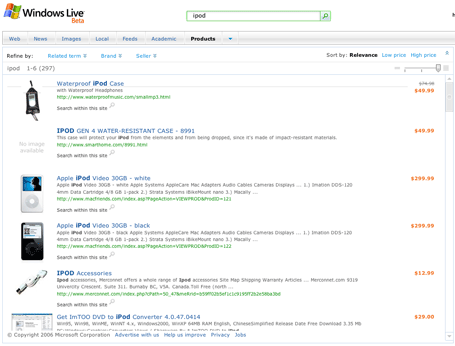
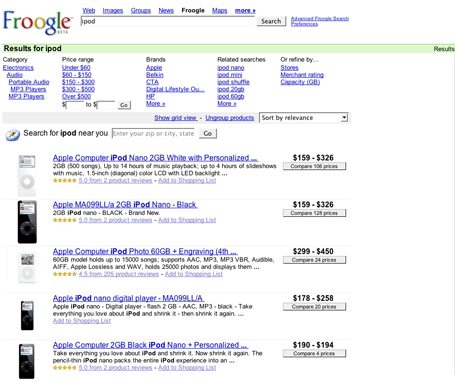
Compare a search for “iPod” on Live Products v. the same search on Froogle (screen shots of both are below). Froogle returns results near-instantly, whereas Live Products takes 2-4 seconds to return results on my computer. Froogle also returns just iPod results, whereas Live Products is including accessories, and even putting them above actual iPods in the results. Finally, while both services allow users to refine results by brand, seller or related terms, I like that Google includes this at the top of results without an additional click: its easier to notice (compared to Live Product’s very clean, but easy to miss drop down links) and it saves a click.

Froogle also includes user reviews of merchants, something that is in the planning stages at Live Product but hasn’t been released yet.

Live Products does have a couple of great features, though. The fact that they are taking information directly from the search index means they’ll have more complete data than Froogle. Also, I like the Ajax slider that controls how much information is returned for each result (including images on/off). I also like the ability to sort results by price, it’s a better way to see results v. Froogle’s refinement by price feature.

Some users will like using Live Products for ecommerce related searches. It makes sense for Microsoft to address this group – the ads that are served on Live Products are going to be significantly more targeted, and therefore more expensive, than similar ads on general search.

No word yet on how Live Products will integrate, if at all, with Live Shopping. The good news is that, unlike Live Shopping, Live Products works with Firefox.
Advertisement

Comments rss icon

  • “Live Products is not as good as Froogle yet”

    Interesting. Isn’t Froogle fairly poor anyway? How could it get worse?

    Great post, by the way. I like this screenshot trend you’ve started.

  • Michael Griffiths - May 5th, 2006 at 1:57 pm PDT

    I have to disagree as to a “Froogle Competitor.”

    I would say that Windows Live Shopping is a direct Froogle Competitor, just as Yahoo! competes with Yahoo! Shopping.

    Windows Live Shopping (from hereon out MSN Shopping) accepts “push” data (for a fee, I believe). They also have access to ebay’s database, and Shopping.com (I think).

    Yahoo! Shopping was unique in the fact that it accepted both – push data for a fee, or crawled data.

    Windows Live Products seems to be a more strategic iniative designed to pull product information from websites. It still doesn’t solve the Local Search option (e.g. ShopLocal), but it’s still a considerable improvement to searching for products online.

    I’ll be interested to see if WLP is folded into WLS… or if something else happens. They certainly seem to be occupying the same space for the customer – they simply use different ways to get tere.

  • Michael – Great comment, and I agree for the most part. I think from the merchants’ perspective you are totally correct. But from the users’ perspective, Froogle and Live Products are direct competitors. It’s interesting that Microsoft has two products in this space, while Google and Yahoo have just one each (although, as you say, they are very different). Lots of experimenting going on at MS.

  • I love it if they had a split screen interface for Shopping and Products or a tabbed interface with options of a checked box saving results for comparison later on (or more cooler dragging and dropping into a shopping cart or basket :) ).

  • I agree with Pete, here. Shopping.com is really way ahead in terms of results as well as user experience and I believe it is difficult to deliver a comparison shopping engine with a pure crawl approach. I think Froogle started with that and then moved to a merchants-push-data model. Again, I am not sure end users care of about prices at 100,000 shops that may be selling ipods. Getting price comparison amongst the better few is more critical. I have seen a lot of friends who use Shopping.com for price comparison and eventually go and buy from Amazon once they know that either Amazon is the cheapest or may be just a little expensive.

  • Well I’ve been trying out this startup companies solution for this whole product search engine. It’s at http://www.fatlens.com. I must say its much better than both of the big guys combined. Go check it out!

  • Michael Griffiths - May 5th, 2006 at 5:48 pm PDT

    Rahul, that’s a very blatent attempt at advertising. It is poor, too, because the site isn’t even about product search. It’s about searching for tickets around the web – same sort of technology, perhaps, but far more specific.

    In thinking about this more, musing over the “1.6 billion into MSN” so recently quoted, and in an effort to make this comment useful, I have to wonder at some of the reactions people (still) have about Microsoft’s Live efforts. It’s obvious that Microsoft is taking this VERY seriously; not betting the farm (as they did, arguably, with Hailstorm), but making a serious attempt to be the best.

    A large number of Live! efforts are closing the gap with competitors. There are unique elements to many of these, but it’s still primarily feature parity. It’s products like Windows Live Product Search that make me think on the strategic direction of Microsoft.

    Google’s strategic direction is fairly simple. They are an advertising company – every single service they have is advertising-focused. Google receives a large amount of praise for this )free products!), which isn’t justified in terms of revenue model. The most intruiging thing about Google is how they buy products for a strategic focus and then do absolutely nothing with them.

    Let’s take Picasa, Blogger, and Hello! as an example. Hello! is an Instant Messenger program focused around sharing images, and integrates very niely with Blogger and Picasa. However, Google goes ahead and releases a basic Jabber client that integrates with Gmail, entirely bypassing the Blogger/Picasa/Hello angle. Nonetheless, it’s obvious that Blogger will eventually integrate very closely with GMail, and Picasa+Hello will play some part in a image sharing product.

    It’s very strategic – buy companies that are still on the cheap, and then let them by and large idle until Google needs to release a product.

    I’m still not sure what to think about it. On the one hand, it could be strategic – on the other hand, it could easily be a sign of internal chaos; growing too fast, project sponsors moving in and out of new jobs this dropping their project. People get reassigned based on new iniatiaves/etc – given how fast Google is growing, I wouldn’t be surpised by some of this. They have the profit margin to afford to be inefficient in terms of using all their assets; focusing on expanding their lead in Search and Advertising MUST be the overriding goal (given Google’s success over the past year with search marketshare, this is unsuprising).

    Jumping back a bit from that side tour, I think the most interesting Google product out there now is Google Base. Google Base accumulates information, and is mutually beneficial. The listers get their product listed in Google easily, and Google can pull from a database of highly structured information – creating *instant* vertical search engines. It’s really an expansion of Froogle, and to some extent a spiritual successor to Web Directories. It gives Google a huge headstart for “search in depth” as opposed to the traditional web “search in breadth.”

    Microsoft doesn’t have a competing product there. Everything Live is a service (and with advertising, so far, poorly integrated). There is obviously a huge investment into becoming a traffic-generating giant, but I’m uncertain as to how focused Microsoft’s online strategy actually IS.

    Windows Live Products is a very interesting technological trick that emulates some tech Yahoo! has had for years, but that’s around it. Windows Live Shopping is a UI upgrade to an already excellent service in MSN Shopping. Windows Live Expo is a rather facinating experiment in social selling, yet to be proven. Windows Live QnA looks like a “me-too” response to Yahoo! Answers (an area Google has neglected). The list goes on; Microsoft is being innovative in terms of interface and AJAX (which is not necessarily a good thing), but doesn’t have a coherent strategy for making money, or killing Google.

    I do hope the above was useful. It seems, now, to be rather chaotic and unorganized. I suppose that’s an advantage of commenting – no real editorial oversight needed :-)

    - Michael

  • Great post! It is interesting to see Microsoft enter the fray. However, I am a bit surprised by the path that they took. It seems that they are starting out the way that Froogle did by getting results from a search index vs. from merchant feeds.

    However, Froogle after many years has failed to gain any meaningful traction. Shopping.com is far superior. I guess this is a category where the vertical players are still far ahead of the pack.

  • I want to take a little bit of an issue with your blog title – do you think Froogle is the service to beat in this space? I am interested to know why yahoo shopping is not the more relevant service to beat. As far as I know it is the more comprehensive solution in terms of technology.

    I dont have the numbers, but I would guess based on the number of users that both Yahoo and Google have, the competition is against Yahoo Shopping and not against Froogle. Unless of course you believe that any service Google currently provides is the real thing to beat.

    By this logic Wallop would be an Orkut competitor and not a MySpace competitor, right?

  • As far as this is concern, Microsoft has a wee bit more to catch up in terms of quality of the products available. I see it now as in the infant stage, but soon I’m sure both quantity and quality will start pouring in. At the same time, I’m not sure if one could get a good bargain at Microsoft site?

  • Ok, I just used this for a bit and I love the AJAXified search. It’s so much more appealing than Froogle’s pageload search. And also the pictures are nice and big and detailed. I think this is better than Froogle in UI for now. They’ve gotten it right. With Windows Live Mail they went overboard and messed it up. But on the other hand, Gmail is a bit to dry. And Yahoo! Mail BETA quite unappealing, though I love the integrated feed reader.

  • According to traffic numbers over the last six months, the services to beat are Shopzilla and Shopping.com, with Yahoo! in third place and steadily losing ground. Froogle is in the middle of the pack somewhere. MSN Shopping has been irrelevant. Shopzilla attracts about 19 million users/month (Amazon gets 40, eBay gets 55).

    Microsoft, I think, realizes that the only way to become an order of magnitude better than the existing players and start getting a piece of the REAL pie, the one dominated by Amazon and eBay, is to tap the long tail (obligatory nod to Chris Anderson, http://www.thelongtail.com). The competition doesn’t center around iPods, which you can get anywhere. It’s about specialty items. And the only way to reach smaller specialty stores is through a “pull” (or crawl-and-extract) model. Froogle and Yahoo don’t rely on crawling because they CAN’T – they haven’t solved the extraction problem. Microsoft seems to be closer but it doesn’t organize results very well or search by price or features.

  • Trust ms to copy google, but they are making a great job of it lol, Thank you for sharing, nice blog by the way, keep up the good work!

  • Would someone be willing to share the best place to find the traffic numbers that Carlos shared in his May 8th post? Thanks!

  • It’s very strategic – buy companies that are still on the cheap, and then let them by and large idle until Google needs to release a product.

  • Interestingly I found this old post about products.live.com, and could not find information about it anywhere else on the web.

    That was Dec 2006. Looking back today in Aug 2009, it seems that this was one more product Microsoft failed at.

    If anybody remembers using this product, it NEVER worked. I’m in this domain myself as an engineer. I’ve read the papers which the Microsoft China team published on these topics. However they were never able to do a decent-ass job on the product extraction and search. I know through friends that the 50 person China team working on this project was shut down.

    Looks like microsoft is not good at search. They’ve released bing recently which is doing an ok job, but it sucks at shopping. Well, froogle sucks too, but that’s another story.

Leave Comment

Commenting Options

Enter your personal information to the left, or sign in with your Facebook account by clicking the button below.

Alternatively, you can create an avatar that will appear whenever you leave a comment on a Gravatar-enabled blog.

Trackback URL
bugbugbug