Rapleaf to Challenge Ebay Feedback
by Michael Arrington on April 23, 2006

eBay’s feedback system is, arguably, their most valuable asset. It provides the grease necessary to make complete strangers comfortable enough to buy and sell from each other. But it’s a closed system – only eBay transactions can affect a user’s feedback score. And as much as eBay doesn’t like it, these users (and more) buy and sell stuff through services other than eBay all the time, online and offline. There is tremendous demand for third party services to incorporate eBay’s feedback system into their applications to make them more usable. But don’t expect to see eBay embrace mashups any time soon, or ever.

Last year I asked for an open version of eBay’s feedback system to be created (see no. 3 here). I also suggested that iKarma, who’s in this space, make changes to their product to address this larger market. But until now, no one came at this problem head-on.

Enter Rapleaf, a new San Francisco-based service created by Auren Hoffman and Manish Shah that is a fully open version of eBay’s feedback system. It’s in private beta, but will be launching to the public on May 7, 2006.

Rapleaf will allow anyone to leave feedback for anyone they’ve transacted with. Others can use this feedback to help them determine if they are doing business with someone who’d likely to engage in fraud. Rapleaf is eBay feedback for the rest of the web, and the offline world.

There are three important things to understand about Rapleaf – the interface and basic feature set, fraud prevention and detection, and their API set and related policies.

Interface and Features
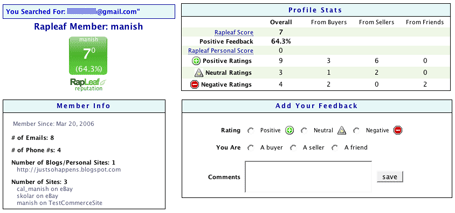
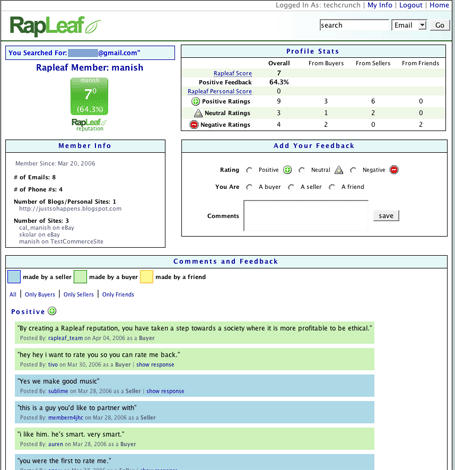
Rapleaf allows any user to leave feedback for anyone (whether they are a user or not), based on a unique email address or phone number. Type that identifier into the search bar. If no results occur, you can be the first to leave feedback for that person. This can be someone you’ve bought or sold with, or just a friend that you want to endorse. Like eBay, a free-text area is included for comments in addition to a positive/neutral/negative rating.

A person’s feedback rating is a raw score, with a point added for a positive review and a point subtracted for a negative review (just like eBay). Non-transaction endorsements are calculated and shown separately. Various stats are calculated and displayed based on feedback ratings by others (see screen shot below).

Fraud Prevention and Detection

eBay knows when two people have transacted. That removes a lot of fraud issues (although a big issues on eBay has been users selling thousands of low priced items to jack up their feedback and then engaging in fraud with high ticket items). Rapleaf won’t have this luxury, and so they are focused on preventing and detecting fraud in their system.

First, any feedback left of a user can be challenged. At first this will be handled by Rapleaf employees. Later, they will probably use a third party to handle disputes.

Rapleaf will also employ human and machine based analysis of all feedback to look for patterns that suggest fraud, particularly in boosting a feedback rating. A user can probably get a an extra point or two every few months without being detected. But co-founder Auren Hoffman tells me he’s confident that they will be able to detect any large scale fraud attempts and shut the offending account(s) down.

He won’t disclose his trade secrets, of course, and so I have no way of telling if he’s right. But if they’ve nailed this issue, the biggest one facing them, then they’ll have gone a long way to achieving success.

Open, Open, Open APIs

Rapleaf will (on launch) deploy an API to allow third parties to access the key parts of the service. Account creation, review creation and feedback scores will all be accessible, and free, to third parties who choose to integrate. For non-eBay shopping sites, Rapleaf will be a competitive leveler. And if enough sites start to integrate with Rapleaf over time, the data will become even more relevant than eBay’s.

Final Thoughts

If Rapleaf succeeds in their plans, it will make the Internet a better place to do business. And Rapleaf won’t be limited to online transactions – there is no reason that transactions occuring offline can’t be measured by Rapleaf as well. The fact that an identifier can also be a phone number tells me that Rapleaf is already thinking this way.

Business development will be an important area for Rapleaf to nail. Their APIs will spur countless mashups without a direct business deal. But I also expect to see some big retailers, classified sites and shopping engines integrate with Rapleaf over time. That will require a good business development team to search out and close those deals.


Additional Screen Shots:

Advertisement

Responses

Comments rss icon

  • wow. this is so cool. is there anything else out there like this?

  • just looking at your ikarma review. it looks like its the same thing?

  • … so how they intend to make money?

  • very cool. definitely will check it out in detail. thanks again for keeping us informed and filtering through the clutter :)

  • JP – It’s a lot different than iKarma, although I like iKarma too, for different reasons. I am preparing a comparison post with opinity, ikarma and rapleaf. all are doing good things.

  • Lo – My recommendation would be for Rapleaf to avoid trying to generate revenue for a long while. They need to establish themselves as the center of this new network. If and when a lot of people start using this, they can choose to engage in revenue generating activities, or just go down the acquisition path.

  • Yes, still wait for the inviting email for further research.

  • I have frequently blogged about the need for companies who want to behave ethically to use some sort of feedback system. If you are doing a good job tell others about it, if you are doing a GREAT job, let your customers tell other people about it.

    I get just under a third of my business from people who have checked out my eBay feedback and have then gone on to buy from me over the phone – bathroom suites at £950 a time with no hesitation in handing out credit card details to a total stranger.

    Equally, because I know bad service or problem resolution may result in negative feedback, I go FLAT OUT to try and ensure total and utter staisfaction with my customers.

    Negative feedback has far more bad consequences than positive feedback has good ones, so I strive to make sure that everyone in the business has the customer as king.

    Too many companies hide behind the excuse of a lack of measurement tools to
    provide custoemr feedback – but now there are no excuses and only those companies who have something to hide will not adopt this type of scheme soon.

  • I like the idea, but if they develop mindshare, it could lead to a funny big-brother element where they act like a reputation court. Not that this is a bad idea, just one with large implications.

  • At iKarma.com we may hate you for making us cancel our vacations after reading this great review, but we still love what you’re doing. Welcome to the Web 2.0 Reputation Management Roadrace!
    Ready. Set. Go!

  • What’s to prevent people from leaving good or bad comments for themselves or others when its not tied to an actual transaction or verification of the users’ indentity like on ebay?

    No amount of internal fuzzy logic can eliminate such activities. And without actual proof of a person’s claims, what’s to prevent people from challenging every negative review and/or threatening lawsuits when rapleaf’s score starts hurting a companies’ business?

    A great idea but its going to be a major challenge to keep it an accurate and trustworthy rating.

    Michael, do you think perhaps that this web 2.0 frenzy has clouded your judgement a bit when it comes to what really matters at the end? I can’t get over this statement of yours “My recommendation would be for Rapleaf to avoid trying to generate revenue for a long while” – are you serious?

  • *chuckle* @ Paul Williams

    It looks a lot like the rapleaf guys either read my blog or came to the exact same unorthodox conclusions that I did about trust. (I’m really assuming the latter.) Good for them. There are a lot of non-obvious and very subtle issues and they seem to have addressed some of them.

    However, I personally wouldn’t trust any kind of feedback system that can’t guarantee that a transaction has or has not occurred unless they can somehow guarantee that each account maps to one person and one person only, and that one person cannot open two accounts without the system being aware of it.

  • This looks really nice – and it would make a lot of sense if you could extend these ratings beyond transactions – but to things like blog comments and other information transactions. Very nice looking app..can’t wait to try it out.

  • This is a challenging space to be in as human nature elements will complicate things. For instance: how does one distinguish between legitimate negative feedback, and trolling by an ex or disgruntled co-worker or something? In a battle between two people on RapLeaf, how will RapLeaf determine who’s claim is valid? i.e.: if an account holder asks RapLeaf to remove negative feedback they think is spurious, how do they detemine in the “challenge” process that this is really the case? Especially with humans handling the challenge process, this seems like a model that is in danger of spinning out of control fast.

    Also, if someone’s reputation is damaged, is RapLeaf liable? i.e.: if RapLeaf fails to remove spurious feedback after a challenge process, does RapLeaf become legally complicit in slander/libel?

    Anyway, good luck! I’m looking forward to adding RapLeaf to BlockRocker.

  • Yet another site that will be either modified or obsoleted upon the completion of the inevitable user-centric datastore architecture.

    Let’s give up now on the idea that data silos, even if api-accesible, are genuinely web 2.0.

  • So Michael, you recommend they avoid taking revenue for a while. I suspect they’ll inadvertently take your advice for a long, long time.

  • Mike & Ian, On the revenue issue – the real value here is in the network. Once people rely on this there will be ways to make money.

    Also, Rapleaf is just two employees. Their burn rate is extremely low.

  • Okay, I agree the value is in the network. I’d love to learn more about their strategy to get around the cold start. How are they going to build mindshare in the market? Just building it doesn’t mean people will come. What’s the hook?

  • The only way most sites like these will make money at all is through partnerships. And long-term, I don’t think that’s really sustainable at all.

    Ads won’t generate revenue because there’s no traffic.

    People won’t pay because, uhm, who wants to pay money to be criticized?

    And if you charge for access to your API, no one will bother using your system in the first place.

    The best you’re going to get away with is having tiered access to the API where big sites pay extra for some additional functionality of some sort.

    Good luck making any real cash off from that.

    Which leaves us with reputation either being the realm of an altruistic nonprofit or reputation being a function of a larger entity. Right now, that means eBay… but perhaps someday it will be the financial institutions instead.

  • Peerrap.com is essentially the same idea but taken a bit further. Of course, they have nothing to show the public yet so who knows.

    This space may get crowded very soon.

  • Sorry about the typo in the message above, its actually http://www.PeerRep.com

  • Heh Rob — your comment “In a battle between two people on RapLeaf, how will RapLeaf determine who’s claim is valid?” is spot-on. our biggest challenge is detecting and acting upon fraud. both false-negatives (a disgruntled person) and false positives (someone trying to pump their rating). we’ve built some interesting internal systems to detect this. but we’ll need to expand out systems continually to combat committed fraudsters. i love what you did at BlockRocker and i look forward to your further feedback.

  • Re a person signing up with lots of accounts – perhaps they could make a charge to start an account on the system? I’d pay $5 or $10 for such a service, personally. I realise that may severely limit its uptake, though.

  • So this is kind of like Heatware.com except for a broader audience? (Heatware’s target audience is traders in online forums…)

    I agree with earlier comments that if it’s not tied to actual transactions, then that’s a big hole that’s easy to exploit…those familiar with Heatware will be aware of that. Human verification of problematic feedback helps, but it’s still not a solid solution.

    One other issue I have with feedback systems (eBay, Heatware, etc.) is that positive/negative/neutral are not specific enough. There have been times when I would have liked to give a rating of maybe 7 out of 10 to more accurately reflect my experience in the transaction. A 99-100% positive rating is deceptive if a significant portion of those transactions were only marginally positive.

  • This has no chance of success. Stop wasting your time and just forget about it.

    The reason why eBay’s feedback system works is because it IS tied to a real transaction where the users had to go through a verification process. For good reason, eBay doesn’t use just an email address because they are extraordinarily easy to fake. Major sites like Hotmail, GMail, Yahoo, AOL, etc. give away email addresses to anyone that asks! So, all you need to do is create 100 new accounts and pump up your ratings (maybe over time, maybe from different IPs, maybe from proxy servers, maybe by faking cookies, maybe from different email providers, …). All of a sudden, the fraudster is “trusted”. That misplaced trust can then be used to defraud. So, you are going to have a lot of fraudsters that LOVE this idea.

    Also… Please don’t try to say that code can uniquely identify a user from an email address and other data in HTTP requests (IP address, cookies, etc.). It just doesn’t work, no matter how hard you try (at least not to the extent required for “trust”).

  • This sounds like a very necessary component of many sites. Especially those that are new were an existing user reputation system is necessary to enable widespread adoption. Prosper.com is one site that comes to mind.

  • Although PayPal is owned by ebay, I think this type of system would work best with a company like them. That way you can have a greater trust that actual monetary transactions went through and even know the number and size of these transactions.

  • Rapleaf needs to create a unique ID system (or partner with someone) such that it cannot be easily generated – make it easy to create the first one but hard for another one based on the business Tax ID or person’s social security number etc. As Bret noted in a post here, everything else can be created fraudulently. This way, fraudsters cannot move around easily and still be in the Rapleaf network (similar to prosper.com network).

  • I certainly agree that the value here (and in many other places) is the network.

    So much so that I’m running a conference on Networks in a few weeks – MeshForum (http://www.meshforum.org) which will be May 7-9 in San Francisco)

    And I’m writing a book about Economics as a Network – looking at all economic activity as a network, and what that then implies.

    I think that there will always be value if you can become part of the ecosystem of commerce – i.e. if you can become part of the cost of doing business – but one whose cost is less than the value provided (showing that you are ethical and trustworthy online is massively valuable to any serious business) This value suggests that Rapleaf will have many opportunities to charge small, reasonable fees from sellers.

    And I suspect that as part of that process they may also be able to get access to data to help verify and enhance the value of the ratings – so a win-win-win (last win being for all of us if they help make it easier to find trustworthy sellers and harder for scammers/shady dealers).

    (And there is some value, though perhaps less, in showing that you are a trustworthy buyer – and online most people and businesses are both buyers and sellers)

    I suspect as well that there may be many opportunities for Rapleaf around related/enhanced offerings – for example I know that if I were a seller I would want to have (if Rapleaf offered it) a chance to present an immediate offer/link to anyone rating my business (without regard to how they rated it) Something as simple as my phone number and website and a personal note saying “Thanks for rating my business, please feel free to call us at this number” By being open and available, even if I disappointed a customer for some reason I would then have a chance to (I hope) redeem myself.

    So, is that an ad? Perhaps, but it certainly seems like an opportunity for Rapleaf.

    In any case, as a consumer – anything that helps business be more ethical – as well as more profitable is a good thing.

    Shannon

  • I am not an expert in this space, but instead of viewing eBay as a competition, why not RapLeaf floks work with eBay and use their data and help in creating a more ethical intenet for and trusted transactions.

    May be this is a naive view…

  • i like the general concept, but this seems like a risky venture. who knows, maybe they will pull it off

  • Why do you bother putting up screenshots when we can hardly make out the details? Why not make them linkable to larger versions?

  • Diego,

    I’ll start linking them to larger versions. Thanks for the suggestion.

  • Michael,

    Thanks! Look forward to it! :)

  • What about the HUGE service called BizRate that has been doing this for years?

  • As someone pointed out above, the main challenge with reputation systems is to get them started. The reputation system itself needs a reputation, otherwise I won’t trust it. That process happens organically and over a period of time. While I feel that there is value in a web-wide reputation forum, I question how they will get theirs off the ground when there is no natural community around the service.

  • Michael, wouldn’t it be appropriate to point out that you actually have a business relation with Auren Hoffman, the founder of Rapleaf? When I first read this post I had the impression of an independant review, while I only later found out that you two guys work together. More transparency!

  • Michael, I’m happy to let you know that Opinity and RapLeaf are today announcing a partnership.

    For details, see the Opinity and RapLeaf blogs:
    http://blog.opinity.com
    http://rapleaf.blogspot.com/

  • Biggest and most important challenge to any reputation system must be Trust. eBay has trust of those who use reputation since it’s a provable fact that those who leave feedback were involved in transaction in question. unless a system is developed that assures reputation ratings can not be tampered with, such system is doomed to fail. one way to go about this is require to escrow money from those who leave feedback and those who wish to challenge it. looser in the arbitration over the feedback would loose the money which will pay the arbitrating entity overhead. as for positive feedback fraud, escrow method also works there.

  • Just got some interesting iKarma-related spam. Here’s the image I got: http://img288.i.../unravel9zj.gif

  • It has come to our attention that certain individuals or entities have been distributing unsolicited spam materials regarding iKarma.com. These materials are being distributed without our support, input, control or knowledge. Moreover, the individuals distributing the spam e-mails are taking measures to mask their identity. Despite these efforts, we at iKarma, are working diligently to learn the source of unsolicited spam e-mails and intend to demand a cease and desist of all improper communications and to assist in seeking enforcement of federal and state anti-spam rules and regulations.

  • Hi,

    Have anybody been getting alot of spam from ikarma lately? my domain is getting masquedered with emails with images like these http://img122.i...1130e399144.gif .

  • As mentioned by Fortino, how come there are no references to BizRate.com
    Haven’t they been doing something similar for quite some time now?

  • I have reservations about the 3-point rating system (positive, neutral, negative), it simply doesn’t provide the depth needed to truly effective. Second to the fear of feedback retribution, I think this is the second worst thing about eBay’s feedback.

    Also, the “friends” rating, which Overstock has, runs the risk of simultaneously being completely bogus yet trusted by viewers who don’t fully understand it (I’m assuming it’s the same as Overstock’s).

    However, I think this service has huge potential, and could even make money soon out of the gate. If we compare Yahoo with eBay, eBay came out ahead even though they were charging and Yahoo was free, so execution is also a very critical factor. I would argue there are proven models that people are willing to pay for this.

    Disclaimer: The above are my personal views only. While my employer, Opinity, is entering into an agreement with Rapleaf, I have yet to participate in this and have no insider info. All of my comments are based on publicly available information (basically blogs).

  • As I commented my thoughts to “dummy@rapleaf”’s profile:

    Errr. The possibility of leaving feedback as a friend bothers me:
    1) how could a “friend” leave bad feedback
    2) there are always too many people who say positive things about people they know even though those are in fact jack-asses.

    I really like the idea that Outfoxed (getoutfoxed.com) has build: that the recommendations’ “strength” depends on the relationship *you* have to the recommender. In RapLeaf (as well as in almost all recommendation systems including eBay) all given recommendations have the same “strength” whereas in reality people rely on the opinions of very few people that they *actually* trust.

    I strongly believe that modeling the social realtionships and weighting references accordinly is both closest to how people really build trust and also (because of this) the best way to go. I really couldn’t care less what eg. George Bush says about whoever.

    I wonder why social networking services such as LinkedIn, Ryze, or whatever haven’t picked this up. Or Yahoo, Google or other big players for that matter … Maybe RapLeaf could?

    Very interesting system in ny case. I like the openness as an idea. But you need to find powerful ways of solving the problems that come with the openness. Social network approach by Outfoxed could be an excellent solution. In that it doesn’t matter that much if a transaction really happened. In that model you rely on people’s opinions that you rely on in real life, too. … For situations where you don’t have strong/large enough network there could be an option of relying on this “traditional” type of “not socially networked” recommendations?

  • Feedback is tough to obtain on Ebay. Power sellers on Ebay complain that they do not get feedback on a significant percent of their transactions. I agree that fear of being the first to leave feedback also diminishes the validity of the 3 point system.

    Rapleaf could utilize a random number generator (which changes daily) that a seller and buyer can exchange with each other. Perhaps feedback tied to random numbers could be more heavily weighted into a score which would encourage people to give out their number and also validate transactions. To address fear, submitted feedback would be hidden for 7 days after submittal and if only one person submitted feedback during that time period then that person would get extra feedback points for being the only person to submit.

  • A good service and the one that I use, is the service at http://www.auctionpixie.co.uk – it automates my feedback and is a bit of a time saver, leaving randomly selected comments, non-positive feedback notifications, selective comment leaving (for buyers and sellers), etc.

    Its basically free now too (if you use their rewards thing), worth a try if your a ‘leave em last’ kinda feedback guy and want to do it automatically.

  • Michael
    Please send me your contact info. We are building something that is more than a reputation system. I would like to know your comments.

    Thanks
    Kansen

Leave Comment

Commenting Options

Enter your personal information to the left, or sign in with your Facebook account by clicking the button below.

Alternatively, you can create an avatar that will appear whenever you leave a comment on a Gravatar-enabled blog.

Trackback URL
bugbugbugbug
Techcrunch on Facebook