April 22, 2006

A Look at Plum

Michael Arrington

29 comments »

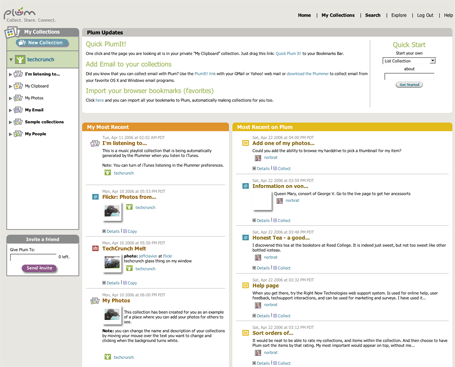
Plum, which I first saw at Demo in February, will be launching in mid to late May, co-founder and CEO Hans Peter Brondmo tells me. If you’d like to be notified the moment it launches, give Plum your email address on their home page.

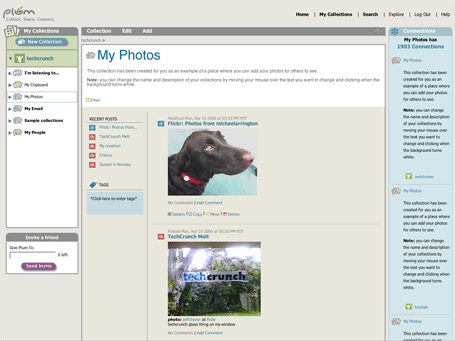
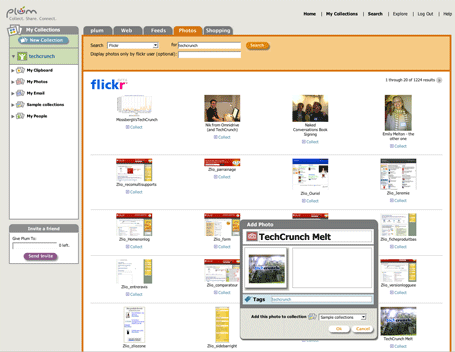
Plum is similar to Kaboodle and Stylehive in that it is a social bookmarking site that allows users to add a lot of metadata about bookmarks (including images). Bookmarked items can tagged and be added to a public, private or shared “collection” (there are a number of defaul collections and more can be added).

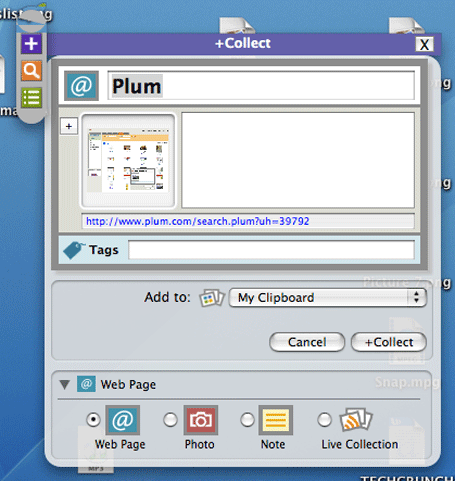
One key way that Plum is different than other bookmarking site is that it allows users to bookmark items on their computer, not just on the web. A file that is open in certain desktop applications (things like photos, power point presentations, iTunes playlists, address book entries, email, etc) can be added to Plum by clicking a button on the Plummer, a small downloadable application for Windows or Mac. See the last screen shot below for a look at the Plummer.

Plum also makes an effort to show related public bookmarked content through a feature called “connections”. These appear in the right hand column of a collection of bookmarks, and are a really interesting way to find stuff related to what you’ve already bookmarked.

If Plum suffers from anything, it’s too many features. But the design and flow is intelligent and the help section answers most questions. See here for a video of Plum’s presentation at DEMO in February.

In addtion to Hans, Plum’s founders include Margaret Olson and Julie Hanna Farris (founder of Scalix).
  • Sphere It

Trackbacks/Pings (Trackback URL)

  1. What I Learned Today… » Blog Archive » A Look at Plum
  2. vantriloquisms » Plumming
  3. Ivan Multescu » Blog Archive » Plum, a good idea?
  4. Greetings from Atlanta. » Blog Archive » links for 2006-04-24
  5. Mashable* » Plum - A Mild Case of Everythingitis
  6. Social Intelligence - Social Networking Market Research and Analysis » Blog Archive » Plum - social bookmarks (stored locally too)
  7. over 500 social networking sites that can bookmarks - vBulletin Setup

Comments

RSS feed for comments on this post.

  1. Vaibhav Domkundwar

    I does look to be extra feature rich from the screen shots. I think the reason delicious works is that its quick and simple. The more you add to that 1-click bookmarking step, the more inertia users are going to be develop, I believe. The interface looks really nice though.

    It is also difficult to envision generic social bookmarking sites without a focus on a market segment (tech, design, medical, indian, music) or a business process (shopping, news). Digg and reddit are great examples of news business process social bookmarking sites. The value really comes from a focused community bookmarking and sharing - without a focus the community of users may not exactly benefit from each others’ saved links.

  2. Saul Weiner

    One possibly silly question: With all these bookmarking sites coming out, why haven’t they broadening into search for related data? Almost like a mini recommendations engine. That would be useful. Especially with the metadata driven bookmarking sites.

  3. Hans Peter Brondmo

    Saul: “search for related data” is absolutely where this gets interesting. Mike makes mention of Plum’s “connections” in his post. Our connections look at the totality of the things you are collecting and then find the closest matches in other peoples’ (public) collections.

    Extracting meta-information from all the things you collect and using all this rich, structured information (not just a link, or just a tag) as well as the “groupings” and ordering that people make as they collect and share, turns out to be a very powerful way to discover interesting and at times surprising relationships, and hence new information, topics and knowledge.

    Oh and one last thing. The terms social search and social bookmarking are gaining some momentum. I also like the idea of social collecting. Bookmarks have a web page association, and at Plum we believe that you should be able to collect and share anything, regardless of type and location (web, email, desktop).

  4. Ted

    Honestly, I really like all these web services. But, it is getting too complicated, too many features. Is it necessary for all these fancy features? I agreed with Vaibhav about Delicio.us, in that it is simple and useful. Also, site like Digg, Reddit, and Newsvine are really focus services. I’m currently a beta tester for another great simple site, cheapr.com, they too has a focus - finding and tagging deals for products and services. A similiar Digg method. With sites like Digg, Newsvine, Cheapr, etc. - I get it!

  5. David Haddad

    It would be nice if those screen shots, especially the first few could be enlarged, as they usually can in your reviews. Thanks for the review.

  6. Mike Jones

    These companies think we must have nothing better to do than spend all day tagging our bookmarks! There is already a bookmark option in IE and Firefox which is far more than I ever need.

  7. 3spots

    Nice idea to share everything.
    Are there any way to communicate to other users?

  8. Bas

    I agree with Mike Jones, I don’t see the point in this, or del.icio.us for that matter.
    Also, Plum’s HTML is very bad (many nested tables), that’s not really ‘web 2.0′, isn’t it?

  9. Ted

    Someone has to figure out a way to make this exceptionally easy to use, so it gets mass adopted. Most likely position to make that happen is probably a huge player (Microsfot, Fox, AOL) who will buy the tech and integrate it into their existing user account system. As a standalone it will be very hard to gain critical mass, I think.

  10. Simon

    Mike, Bas - why I use del.icio.us (and will look at plum):

    1. with these services I can access my bookmarks at home, at work, in a cybercafe….

    2. I have hundreds of bookmarks. The hierarchical folder structure of IE/Firefox wasn’t really working for me - it doesn’t scale.

    3. Resource discovery: I can see what interesting sites are being tagged by other people (either the crowd, or individual users whose opinions I value).

  11. Doug Geiger

    “These companies think we must have nothing better to do than spend all day tagging our bookmarks! There is already a bookmark option in IE and Firefox which is far more than I ever need.”

    I don’t go to sporting goods stores and claim fishing poles are irrelevant because I happen to buy my fish at the local market, and have no use for catching fish myself - why would you comment on a thread about social bookmarking sites, only to say that they are useless to you?! Let’s not forget that they are FREE services, if you dont use them, that’s up to you. That said, Simon offered a great list of reasons you should be willing to be imposed upon to organize your own links.

  12. Chris Wallace

    Mike, Bas
    One more reason for social bookmarking is the ease of sharing a collection of bookmarks. For example, I use de.icio.us with my research students by tagging any relevant site I find with their name as well as subject tags, and they can then just check that tag occasionally or add the RSS feed for it. I think these services really can help with collaboration in groups both small and large.

  13. Jean-Marc

    Mike & Bas:
    I spent two years working on a bookmarking site of my own that would focus exclusively on private bookmarking. It was meant to be a piece of software that would synchronize bookmarks withought you ever having to go online to check them out - your favorites/bookmarks menu would just update ‘miraculously’. I gave up on the project when I found ma.gnolia (not a plug, but try the site out) because it did more then just save my bookmarks. Sure, the interface is terrible when it comes to looking through hundreds of bookmarks, but the way it handles groups of users has won me over. Bookmarking is interesting in that if you seem to share the same interests as a group of other people typically you’ll be interested in what they deem worth of a bookmark.
    Hope that answers your question.

  14. Otis

    Chris & Jean-Marc:
    Have you seen/tried Simpy (featured on TechCrunch twice before)? It’s simple, has private/public bookmarks, group functionality (no need to pollute your tagspace, Chris), excellent search features, etc.

  15. john

    I am eager to see if these sites really do become a platform for collaboration, or if they just stay as private-value storage tools. Here’s another one - http://www.clipclip.org - similar in that it allows ‘clipping’ of specific web content. Very light ‘bookmarklet’ approach rather than feature-rich extension-based (like kaboodle, plum, etc). Hierarchy is achieved via tags and “activities” (activities act like tags but are higher and action-based.

  16. Jean-Marc

    @Otis
    Simpy looks clean and simple, but what’s its key feature? I don’t want to knock your site, but it seems to me it’s just another take on del.icio.us but with private bookmarking thrown in.

    Sites like ma.gnolia and digg become really successful and gain a strong fan base because they offer unique features that differ them from del.icio.us, which one could consider the ‘core model’.

    I don’t find digg to be my cup of tea because it seems to be less of a private bookmarking solution and more of a news/link aggregator. I like ma.gnolia because it allows me to save my links and lets me sign up to groups that I feel I share an interest with, and whose links I can then check when I have some free time. Of course, this approach may not suit say… a lab technician so they may choose another solution tailored for them. Sticking to the basics won’t work anymore becuase the market’s over saturated, which is why I closed my doors. Luckily in my case it was just a project and not an actual business model

  17. sjk

    @Simon, Re: I have hundreds of bookmarks. The hierarchical folder structure of IE/Firefox wasn’t really working for me - it doesn’t scale.

    The lack of scalability in usability with hierarchies has become an increasingly sensitive issue for me in many interfaces over the past few years. I don’t want the burden of finding specific hierarchical locations for items I think “belong” in multiple places.

    I’m interested in interfaces that allow me to create more arbitrary “virtual” collections of items regardless of where they’re “physically” stored. Sometimes that may be a hierarchy, but that structure shouldn’t be so rigidly enforced (e.g. by the filesystem) that other arrangements aren’t equally and as easily possible. And deleting one of those virtual structures needn’t destroy the real data unless I explicitly want to.

    Ambitiously oversimplifying, a more pervasive separation of the storage layer from the presentation layer that eventually encompasses (or replaces) the hierarchical filesystem.

    Darn, I’ve digressed too deeply off topic. Higher level services like Plum seem to influencing some of the lower levels towards a kind of convergence that creates a better foundation for more generalized interface/usabiliy improvements. Contrast that with how low level stuff like the filesystem has imposed itself on traditional interfaces that some of us are outgrowing. The “file manager” interfaces are giving way to “information manager” interfaces that are more connected, flexible, usable, and scalable.

  18. Billy Warhol

    i’m interested in Plum cuz of the Photo aspect* initially i thought it might be helpful in organizing info if U were writing a book.

    i agree with some of the comments on both sides about social bookmarking. i’ve tried Diigo & Magnolia but i’ve fallen back to Delicious. U can only really use one & the point about it having to be Quick & EZ & Simple holds very true.

  19. Jean-Marc

    @sjk
    I think a solution to your problem exists - tagging :P
    I disagree with the idea of it being applied accross an entire filesystem however. The fact is, tagging each file/document takes time. Would you want to do that for *everything*?

  20. sjk

    @Jean-Marc

    Aren’t filenames sort of a massive collection of tags embedded in a hierarchical structure? :)

    Of course I don’t want to manually tag everything, nor explicitly assign names/locations for every “file” in the filesystem. In some cases metadata could be doing more of that grunt work than it currently is. And I can choose to let iPhoto/iTunes create and manage their data storage hierarchies without my explicit intervention, focusing more on handling the content at a higher level of abstraction with less concern for how and where it’s stored.

    One UI along the lines of what I’m thinking about is described in the metaFinder comments in “this posting.

    And these articles relate to Simon’s issue that I originally replied to:

    The Evolution of Bookmarking — Bookmarks, Firefox, and del.icio.us
    Advanced Tagging — Hierarchical And Ordered Tags

    [hope those links work; comment previewing would help here]

  21. sjk

    Try this link for metaFinder comment post I referred to.

  22. fvfhvsfhkrk

    pepmlkiti kmnfqfvwhc zwpwcwzgrm