 Wikio, a Switzerland based company, was released in private Beta yesterday night (in French). It is one of the most ambitious web launches born in Europe this year. Pierre Chappaz originated this idea after the successful adventure of his vertical ecommerce comparison engine Kelkoo, that was sold to Yahoo. He’s going to try to make it again but this time with an interesting news search service after he realized there was no true satisfactory solutions on the market. Wikio is a smart combination of Digg+Technorati+Google news. It should extend to other European countries and USA very soon.
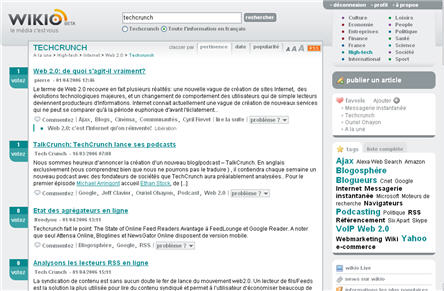
Wikio is a really ‘web2.0’ news search engine where you can find interesting features and technology and where the role played by the user is very important. Wikio runs search on a library of sources, indexed and qualified manually, that is composed of online media (newspapers, etc..) but also edge content sites (blogs). And here is the first difference with Google News. They are covering more than 10,000 reliable sources (for France but for other country quantity will be important also) when Google News is covering only 500. Each piece of information is defined with a category (economy / high-tech) and a series of tags.
Wikio is a user managed news search engine. It watches, real time, thousands of news sources, gathers hundreds of thousands of stories every day and classifies them by their topics in a multi millions documents database. information classification is based both on its relevancy and on its members popularity who vote, discuss or even write new stories
The search algorithm is a combination of ‘logical’ and semantical requests that will enable association with other relevant words. Only Accoona is able to run search like that to our knowledge. On the technological side Wikio has also developed a tool that will convert any web source in RSS format.
Indexing the sources and building the algorithm took about one year of development.
A social search engine
Here is where Wikio will outperform other players. They integrated all sorts of web2.0 features so the user will be able to improve the relevancy of the results. They integrated for each search results the already very popular rating /comment system you can find in Digg for example. But unlike Digg (which is mainly tech-oriented although you can virtually post anything) Wikio will cover all categories of information. The user will also have the possibility to edit a news in a given category/tag and each page results is equipped with a mini-wiki ready to be edited.
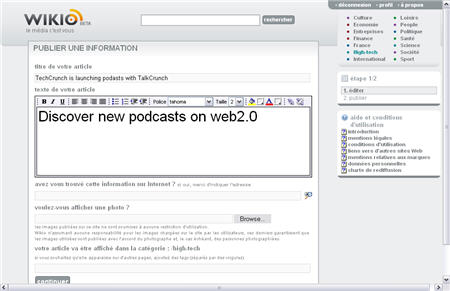
You can if you wish create your own profile and store your favorite search queries always available at hand. Pierre Chappaz mentioned they would also store your search history as well as clicked and rated news.
 The user interface is quite clear and in a way familiar (digg structure / search ). You can easily re-order results according to date/ popularity/ and relevancy and change in a click font size. Each search query is coming with an RSS feed you can subscribe. And one of the most interesting aspects is the automatically generated tag cloud for each query that will help you extend your search intuitively. So if you run a search on TechCrunch it will lead you to web2.0 or blogs or podcasts……
Wikio will soon include podcast search and I would love to see a picture and video search feature to make it complete.

It will open to the public in the next few weeks and will quickly extend to most European countries and USA.
The company is managed by Pierre Chappaz and has ten other employees. It is self financed but will consider a first round by the end of the year. Business model will be based on integration of sponsored links and Wikio bets on viral marketing and the quality of its product to reach critical size (could we suggest integration of sharing features, forward to a friend or even APIs to build mashups and widgets for Typepad/Wordpress).
Challenge and Assets
Will Wikio manage to become a reflex as Kelkoo, Google or Technorati did? That is the question. Wikio certainly has strong assets in Europe where competition and localization is close to non-existing (Google news is very limited and they never managed to impose Froogle vs Kelkoo) but they will have to face serious and well funded US players like Technorati, NewsVine and recently acquired NewRoo. Social news is a crowded space and Wikio will be a new feature to bookmark but we can trust Pierre Chappaz expertise in building successful stories to make it happen.
Wikio is a very ambitious project and has a strong technology with a skilled team in vertical search. This is certainly the most interesting European initiative since Skype. To be continued.
You can subscribe to the beta version here. Wikio and Pierre Chappaz blogs (in French only).