Well, just as soon as one company stopped being evil, another one has stepped in to take its place. Jigsaw is a marketplace for contact information, and it is very efficient. It boasts detailed personal contact information for 2.5 million people, and 7,000 new people are added every day. If you want the name, title, email address, direct phone line and/or address of any executive of any company, there is a very good chance Jigsaw will already have it in its database and will sell it to you. And if you are a sales guy and have no ethical concerns about where you get your contact information, you probably already know all about Jigsaw.
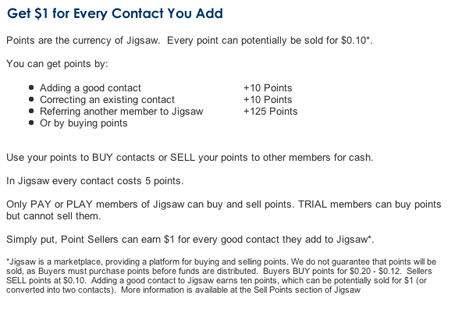
Unlike competitors like Hoovers and InfoUSA, which gather company information by semi-legitimate means such as scouring SEC filings, cold calling companies and asking for information, and reviewing other public documents, Jigsaw simply pays people to upload other people’s contact information. Users are paid $1 for every contact they upload, and some users have uploaded information on tens of thousands of people. See the demo (and note the other demos on that page as well). Jigsaw is also self correcting, and incentivizes people to also correct bad contact information.
That’s right, the next time you hand out a business card to someone or otherwise divulge your contact information, you may be handing it out to the entire world.
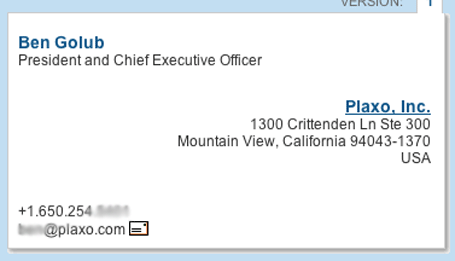
Here’s how it works: Sign up and start downloading contact information. This includes name, title, company, address, email and direct phone line. For example, a quick search brought up all of this personal contact information for Ben Golub, CEO of Plaxo (appropriately smudged):
But wait, it gets much worse.
Anyone can find out if Jigsaw has their contact information via a link on the home page, but amending or trying to delete that information simply puts a flag on the data with the changes noted – but the original information also remains.There appears to be no way to remove your own contact information from Jigsaw once someone has entered it into their database. There is no method that I was able to find on the website to do this (including in the privacy policy), and an email to the company asking about this went unanswered (its been three business days now).
Jigsaw has a carefully worded privacy policy to deal with the fact that they are the antithesis of privacy. They say “This privacy policy covers how, when and why we collect, use and share information about our users…This policy does not apply to our collection and use of data about companies and contacts contained in our database system.”
Is Jigsaw legal? Maybe in the U.S., although I’d love to see a class action case brought against them. Is it ethical? Absolutely not. Every Jigsaw employee and investor has dirty hands and they should be ashamed of themselves.
Like Plaxo, Jigsaw makes money while pushing costs to other people. In Plaxo’s case, its spam. In Jigsaw’s case, its making private contact information public. The problem here is that Jigsaw’s actions aren’t easily found out by people getting constant cold calls and emails – it’s very unlikely they’ll know that these people got this contact information at Jigsaw in the first place.
If they wanted to do this right, they’d set up a marketplace where individuals could choose to sell (or give away) their contact information. The owner of the data could set the price, and Jigsaw could take a cut. Would this model work? Perhaps not, but that just proves my point. The only reason Jigsaw does work is because they don’t have to bear the costs that they push to third parties – all of the people who are in their database.
Management team and investors are here.
UPDATE: Rafe Needleman emailed to point to an article he wrote about Jigsaw in late 2004. He calls it “clever but creepy” and says “I don’t approve of Jigsaw’s ethical position”. I agree.


Ok this is just about the worst thing I have ever seen. How do I find out if they are selling my information? How do I remove it immediagely!!!!!!!!!!
How much effort would it take to spam their database full of incorrect, irrelevant information thereby rendering it next to useless?
Marcus you can’t remove it – the original information can never be removed. I am a complete privacy advocate and I already spend enough of my day responding to unsolicited emails and phonecalls – I don’t need more of this, I don’t need or don’t want my information being sold without my knowledge. Add up all the time that has been wasted by unsolicited approaches from people who have purchased information from Jigsaw. It’s 2006, it should now all be about permission marketing and social networks ..
They’ll get what’s coming. Remember: they’re messing with C-level executives, who have the best lawyers out there.
It’ll be interesting to see how this unfolds.
Wow, paying people to give away their add book is really really evil.
This is terrible news.
Maybe I’m not corporate minded enough, but it seems that it would be fairly easy to use multiple false identities to “correct” your contact information, say – from your personal info to your business info… advertising that pays you.
The problem is, there will be a lot of people who hate this, but there will be just as many people who would LOVE access to this information.
And some people, like myself, hate AND love this idea. I wouldn’t tons of random cold callers etc, but I would definitely also like to be able to try my luck emailing some big shot whom I’d otherwise NEVER be able to get to, should the need arise.
Double edged sword.
Would I pay for the information if i really really wanted it? Yes.
Would I like it if someone put my contact up and I received tons of cold calls? Nope.
All I can say is that this is a really interesting idea that will lot of people will be pissed off people.
A slightly better version might be to form contact sharing groups with privacy/permissions levels etc.
This really, really stinks.
Mr Wave Theory thinks that Web 2.0 may be in a bubble and Most Analysts Are Overestimating the Size of Google’s Total Addressable Market for Internet Advertising
I am sick and tired of hearing analysts make wild projections about Google’s growth prospects based on wild projections about the size of Google’s total addressable market.
Continued …
This isn’t really private information, certainly according to data protection leglisation in europe.
Your work address, phone number and job and so forth are not protected in the same way as your home details, and rightly so.
If you don’t want people to know where you work, don’t hand out business cards!
Let’s just hope these guys get the attention they ‘deserve’.
But this creates the market for another startup: business cards that can be invalidated. You would print each business card with a unique email address and telefone number and would forward the emails and phone calls to the real number. In the case of emails you could append a small “invalidate the contact information used for this email” button at the end of the email, in the case of phone calls there would be a number to call to invalidate the number used for the last call. It would need a little work to ensure that the real email address stays secret even when replying to emails – but that’s doable.
You might want to do a better job “smudging” that screenshot. Unless you planted false data in there, it’s pretty easy to tell what is behind the blur.
Sorry if I missed some kind of joke. Nice article.
Seems like these guys are the anti-network antichrist.
I’m a sales person for a large IT company. Jigsaw is the smallest of the contact supply companies we use. Harte-Hanks is far larger. The are also less visible to the publis. They have been handing out IT contacts for a large fee for many years. Jigsaw is just the newest and most up front with their tactics. Yes Jigsaw pays for contacts, or you can add a bunch of contacts in exchange for acces to a bunch of contacts.
Harte-Hanks has college interns who make phone calls to companies to try to get the same information. Both are full of good and bad information. C level execs have dealt with this for years, without resorting to attorneys. They have assistants who screen calls for them.
Valentin, that would be useful: individualized cards, with an extra bonus if you track (perhaps by serial #) who you gave which to: (a) for each email/phone #, you would know who was calling/emailing, much easier spam-filtering, and (b) Each could include a warning: if you give out this contact info and I hear from anyone besides you, my system will automatically invalidate this contact info.
I already use semi-automated variants of the above for e-mail list management… every list gets its own email for me, and as soon as it gets spammed, bam, that address is toast, and I change my list address.
Techcrunch, you are using language that should be reserved for companies that hijack computers with spyware/adware that is very difficult to remove, like Claria (Gator).
Jigsaw is not much more evil than the average B2B trade show or magazine.
Ask yourself:
(1) are tradeshows really evil when they sell (restricted) lists of their attendees contact info?
(2) are B2B magazines really evil when they sell (restricted) lists of their subscribers contact info?
(3) are salespeople really evil when they sell (restricted) lists of their subscribers contact info?
As every street marketer knows, tradeshows and B2B magazines sell contact info for “middle managers”. But they sell it at such a high price that it is not something that the attendees and subscribers complain loudly about. The cost of getting pieces of the list and then using it is so high that when contact is made, its at least as targeted as the tradeshow, and usually MUCH more so. Most people are not paranoid when they register for a badge at a tradeshow. They don’t beat up the trade show operator for not displaying a Privacy Policy in large print at the bottom of the escalator either. Should tradeshow operators (and their investors and employees) be ashamed of themselves??
Just like the tradeshow operators and magazines, Jigsaw charges a buck to use the information (literally: “Pay $25/monthly and get 25 Contacts”). This is really a high price. If spammers had to pay $1 then: … um, no spam. So, the sales guy is really placed on the same level as the tradeshow.
If Jigsaw (or the tradeshow operator) lowered prices from $1.00 to $0.00, you would see untargeted cold calls, more junk mail, more spam.
Yes, this would seem bad, but the Beloved “We seek to organize the world’s information” Search Engine already go down to the $.00 level by displaying ads along side the search results for “Sourabh Niyogi Cambridge MA” (3 yrs old, save yourself a nickel, don’t call me). If they are this far, Smart Men are inevitably going to show the most relevant answers for “CEO Techcrunch” (nope, wrong answer Google) and not even bother selling it for $1!
No new privacy laws or class action suits will be required to counter this seemingly doomsday scenario. People will just age a youthful policy of “Allow All except for ____” to a middle-aged policy of “Deny All except for ___” as they find their Privacy violated more than they can bear.
Its going to take a while. Right now, far from being concerned about wasted time of middle managers, businesses are going to have to learn how to protect their internal company information as Jigsaw (and many others) enable people to sell that internal company information. When Joe Salesguy sells info about Sally Purchaselady, what will Joe’s ex-employer get in return for winning the court case against Joe? What if Joe knew Sally before working for them? When the hacker gets root access to thousands of Customers tables sitting in ISP MySQL databases, will Jigsaws actually pay the hacker a jackpot?
You suggest that Sally Purchaselady should “own” her contact information, but Joe thinks he does, Joe’s Company thinks it does, Joe’s Future Employer thinks they could when they try to hire Joe. That’s how B2B worlds think. What Sally does own is the “Deny All except for ___” policy that sits in her phone, mobile, email client and IM client. Sally’s information wants to be free, but Sally is already in control.
Yeah, I noticed Jigsaw a year or so ago, and posted about it here.
There’s a little more detail in the post, but I’ll just echo an earlier comment that they actually *are* the social networking antichrist.
The premise of most networking tools, business, social, or what-have-you, is that you’re providing information about yourself in return for access to the information that others are providing…but you retain control over your own information. Jigsaw perverts that relationship by requiring you to provide information about *other* people in return for access to the system.
I haven’t checked in on it again since late 2004, but there is hope: when I checked the Jigsaw information for my company more than 50% of the “contacts” listed were wrong in one way or another. Wrong like having not worked at the company in more than two years, for example.
So while Jigsaw is a terrible idea that encourages disrespectful treatment of your colleagues and friends, at least it doesn’t work very well…
This statement caught my attention in one of the comments:
“If you don’t want people to know where you work, don’t hand out business cards!”
The “handing out business cards” would translate to ME uploading my information to Jigsaw. I think where people are dis-liking the idea is when they’re not the one “handing out their business card” so to speak, but rather someone else has “made a copy” of thier business card and started handing it out to anyone and everyone. Whether it’s legal or not, if it sounds kind of screwy, it probably is. And it sounds kind of screwy to me.
I don’t have a problem with people knowing my contact information. You just simply have to do a Google search on me and you can find it. But then again, I’m not an exec and not highly sought after outside of my local area.
Sourabh, the people you mention are evil in those respects, if one thing holds true – that they haven’t given their express permission to have their info sold. This is just a more efficient extension of this.
This is like when the banks sell all their customers without telling you.
It wastes paper and time and money… plain evil.
To be fair, this is exactly what almost all credit card companies have been doing for years, except JigSaw has made it easy for anybody to do. I still remember back in the late 90’s when people used to sell e-mail lists for thousands of dollars.
Maybe the solution isn’t to compromise a new privacy policy, but to make provide Jigsaw a BOATLOAD of “fake names”. How many people will use their product when they get “Seymour Buttz” as the CEO of Oracle?
There’s one good way to help prevent this sort of stuff in the future. If entrepreneurs start to boycott Norwest and El Dorado, VCs will learn pretty quickly to stop doing this sort of stuff.
This company will thrive and there will be no government interference.
This isn’t a defense, but how is this much different from offline list-sellers? I don’t see how it is any *more* sinister than the rest of the list-publishing industry, it’s just more efficient.
Did you know there’s a “Who Has What” book for marketers where we’re all sorted by medical conditions?
Nothing is more amusing to me than an ex Wilson Sonsini lawyer posing as a “do gooder” guardian of the net. Give me a break.
You can Google anyone and find out just about anything about them in under 10 seconds and now you villify some jagoff company like Jigsaw for creating an address book?
Its funny that so many of the responses here are to try to figure out how to “stop” Jigsaw — kmx, etc. talks about providing fake information. Is that really the answer and where do you draw your ethical line oh high and mighty people? You are willing to do something unethical/evil to prevent something you consider unethical/evil? That seems like quite the double standard.
I frankly don’t have a problem with this at all. Jigsaw is using a very similar business model that many of the other list providers and data companies have used successfully for years but is doing it in a better way. Unfortuneately not a lot of the people here seem to realize business models outside of “web 2.0″ that have been successful. As a sales professional, if I want to contact you I will find out how – it is my full time job to do this and the desire to feed my family makes me do this every day. All Jigsaw does is make my life more efficient which is why I will be a lifetime subscriber now. Incidentally, it does appear you can put your notification preferences in the product so I think that is a big plus. Thanks for pointing this great service out to me.
Why is this such a big deal? At least these guys are paying for the data. There are companies that have more personal information about you and sell it for a fee and you dont even hear about it. Starts with your bank. And then there are the credit bureaus. They sell details such as your date of birth, SSN, different addresses you have lived at… And sometimes they lose the data or are socially hacked. And this has been happening for years!
And of course there is big brother google. If you are logged into gmail or any other google service, they know of every search you make, website you go to, contacts in your gmail a/c… And all of these are used to make money.
My point: there are bigger sharks out there messing with our data!
I am not sure I understand how this is substantly different than me being in B2B sales and telling a friend who is also in sales, “hey, you should speak with John SoAndSo at Johnson & Johnson. He’s the VP of SuchAndSuch. Here’s his info.” Is that evil?
Taken a step further, this is probably more similar to the contact beaming functionality on my Treo. It doesn’t require permission from the contact for me to beam it to someone else. Should it? I don’t think so. Is that evil? I don’t think so.
There is definitely a difference in scale — JigSaw is much more efficient and scalable than word-of-mouth. If, because of the scale, it becomes a nuisance to people, then an innovator will create a tool to enable people to avoid the nuisance (think caller-id, spam filters, etc).
At least everyone who has a problem with this should have an easy time contacting the CEO of JigSaw to tell him about it. There are 47 contacts from JigSaw in JigSaw, including 2 C-levl execs.
Michael, just wondering how you found out about the company. Did they actually submit their webiste to you and hoping for a positive review? LOL.
I think after this post from you, they will soon have a way for you to remove your info….
I agree with some of the comments that this could actually be helpful.
I wonder how many GOOD business proposals go unheard because they can’t get from the low level employees (who often deal with e-mail) to the higher level execs (i.e. the CIO).
I think it’s pretty clear that Jigsaw is doing something reprehensible. The fact that “it already happens” is a very weak counter-argument.
This sucks. Are you telling me people are now going to be able to find out my contact information and I’m going to get phone calls from people that want to do business with me? That is really really bad as that means I’m going to have to start doing work at the office instead of writing to my blog and reading blogs all day long. What am I going to do?
Mike, it’s real easy to read Ben’s phone number in the image you posted.
Does that mean we each owe you a dollar?
Hi Mike,
No need to pay a dollar to Jigsaw for my contact information
If you (or any of your readers) want to reach me, my e-mail is ben@plaxo.com. I’m more than happy to talk.
Do you realise the amount of data that D&B, Acxiom, Equifax ad Experian have on each and every one of us? Do we realise that our government sells data on all of us to these guys, like what our party affiliation and how many times we’ve voted? Only big companies can afford this data from these big guys.
It’s funny that you pick this start up to rail against. They are at least democratizing the industry for all of us.
Maybe you should mention that our president is allowing his cronies to collect data on us that is REALLY personal. The act that somebody pays to get my business card is a non-event!
Hi Mike,
Thank you very much for this article! I was intrigued from the very beginning and I have to admit that as I read on I became extremely excited. I know that you were trying to be derogative towards the company, but I only saw more and more benefits! You see, I am in sales and before I read this article, I wasted at least 1/3 of my day, every day, researching and trying to find leads. Now, I can become a part of an ever-growing community of salespeople who are willing to share the rolodexes that we have already compiled with each there. This means that we have been given the opportunity to help each other eliminate that 3 hours a day we all spent trying to find these leads. We can all make more money (which is the reason we all work isn’t it?) and have more productive work days!
Thank you Mike for opening my eyes to Jigsaw, you have made my life much easier.
I see nothing unethical or evil about this company at all. The information they have is obviously public. It comes from the public!
Amazing that people have no problem with Google collecting the world’s information and spitting it back at you in various forms, but you decry this company for doing basicly the same thing.
Maybe it’s because they aren’t on the NASDAQ.
So clearly Arrington has never had to sell anything in his life, generate a list for cold calls or find “warm” leads. Jigsaw is fantastic for this, cheaper and more effective than Hoover’s et al. All of this information is available anyways, and good sales guys have been trading prospect business cards since business cards were created, this is just a much more efficient way to do it.
So Arrington, get off your no-operating and no-sales experience ass and go out and learn someting useful.
All the naysayers should keep in mind that only *business* information is kept on Jigsaw’s database. They don’t allow any personal information of any kind.
Jigsaw’s business model is not evil. It’s a clever solution to a challenging business problem.
So Mike, which company gave you stock options to write this article, Plaxo, LinkedIn, someone else??
Wall Street Journal reporters are saying you get paid for many of your posts, so I’m just trying to figure out which company bribed you to trash Jigsaw. Or was it that Jigsaw wasn’t willing to bribe you to “keep it friendly”???
Your advertisers should seriously reconsider paying money to show up next to paid content.
Great discussion about this! I go out of town for a day and miss all the fun of bashing a new company!!
Check this out:
http://online.w...ON=wsjie/6month
The CEO Fowler kind of looks like Dr. Evil in this article.
Bob (post number 27), your idea sounds even better after reading the above article in the Journal about jigsaws vc’s – they sound like they don’t add any value at all.
Mike, interesting strategy going after an ex-Navy diver – hope he doesn’t make you sleep with the fishes.
Amid the ad hominem and anonymous innuendo/slander, there are some more thoughtful responses here, many from salespeople, it seems.
But none address the fact that Jigsaw encourages and enables the sale of info that is offered from one person to another with the expectation of privacy. Nope, it’s not really the same as one salesperson passing a tip to another. It’s one salesman selling his contact data to the world. Is that ethical? That’s a point I’d like to see debated here.
They have basically applied basic Web (or, if you must, Web 2.0) practices to what is already common place. In that sense, it’s genius.
It’s highly disruptive to existing contact-sales companies, and they may fear this.
I’m having a hard time seeing jigsaw any different that a toastmasters get together or some young professionals event where people physically get together, talk, socialize, trade contacts and work out all those lovely gestures in the friend of a friend universe…. applied in this web world way, its evil.
What’s really evil in this article is that its clearly slated to paint Jigsaw as serious problem, hence the usage of “evil” itself in the message.
Jigsaw isn’t particularly new either. Its been around for at least a year or so and just now you’ve discovered it, yee o web2.0 infused one?
I agree with BitterReader, who paid you to write this article? Either way you’ve surely given them a bit of press in doing it. I agree, people either LOVE this idea or HATE it. Still in the end people still control how it gets implemented. Just because you have a name doesnt mean you have deal. I find it more tactful to talk the lower totem pole people and weed yer way into a biz from the ground up, with always a real offer possible.
I mean if i call them, slammed dead end.
If I email them and they dont know me, i go straight to spam. So maybe jigsaw is a spam acceleration service then.
I really hate the way you say “if yer a sales guy with no ethical concerns about how you get your information…” hello, ethical??!? So if Randy at the boat show tells me about so and so who could use my services, thats unethicial? I guess its the selling part you don’t like, but seems pretty straight to me, dont be a leech, offer some to get some. Personally i wouldn’t care to be on that list really, in the end i still control it.
Its wierd to see how we can share everything regarding our stuff, pictures, boomarks, gps data, 43 things to better understand how i shop, buy, aspire, and emotionally connect to things, yet the who we are and where we reside is waaaay off the menu.
funny
***** I personally have known about Jigsaw.com from day 1 of the company. Working closely with the founders, i feel Jigsaw is a great tool for many people. Someone had a great point, You can obtain a companies contact #, you can obtain a name and their title from Linkedin.com, plus usually you can figure out their email if you do a little digging. It’s very common sense. Jigsaw is just brining it all together to one place. Yea, this will tick some hot shots off out there, yet i think it appeals to the larger market share. If C level guys & Sr. Directors do not have any screening set in place, then it that is their issue. Bottom line is, the need is there, and the service is here. Jigsaw will make people happy. Bottom line. You can’t please everyone, but my starting a post like this, that just causes non-sense.
Kick some ass Jigsaw.com!!
Is it just me, or does the jigsaw.com website look a little too familiar? (www.ibm.com)
I worked for 4 pretty big start ups (80+) people in the bay area, all of them used jigsaw.
I am with the salespeople in this thread. One could debate the merits of making data available, and paying people to do so, but jigsaw seems to do no more than put another slant on a standard industry practise. A rolodex for hire as it were.
What’s the point of “smudging” the graphic such that you can still read that it says ben@ and the phone number is 5481 or 5491?
(If you decide to smudge it more so that’s illegible, feel free to redact this post to match, with my blessings.)
Josh, #53,
Given your past, I’m not surprised that you came out on the wrong side of this issue too.
http://www.crun...notes.com/?p=92