February 13, 2006

Technorati now has Authority

Michael Arrington

26 comments »

Assigning some sort of quality to real time search is necessary. Tracking incoming links to a particular post doesn’t work because, well, since this stuff is real time there is no time to track links. Memeorandum does track blog post links in near real time, but with a very small index of blogs. Tracking this across the entire blogosphere is much more difficult.

Robert Scoble points out that Technorati has taken a shot at the problem, though. They’ve quietly released an “authority” slider to allow results to be filtered. See results anywhere from all blogs, to just blogs with hundreds of links. They assign authority to a post based on how many links a blog has. The image below shows the slider at the top and the text within the imagedescribes how it works.
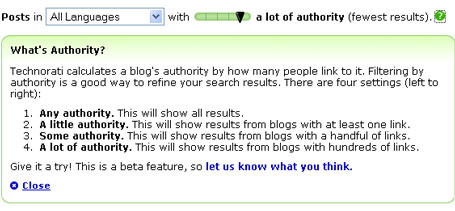
The slider is a bit buggy but works. This is another good way for people to sort results to find what they are looking for.

Steve Rubel uses this as an opportunity to talk about how everything has devolved into a big popularity contest. He’s right…but what is a better way to determine authority other than links into a blog?

  • Sphere It

Trackbacks/Pings (Trackback URL)

  1. Data Mining
  2. amos moses griffin.com »
  3. Standard Deviation » Blog Archive » Whose authority?
  4. Somewhat Frank
  5. JD’s Tech Journal :: Technorati gives more weight to authorities :: February :: 2006
  6. /Message
  7. Technorati Authority Filter at joshteeters.org
  8. Links as measure of Authority on Technorati » @ Ambot ah! [ technology news and reviews ]
  9. ad blog
  10. Irishwonder’s Black Hat SEO Blog » Gmail goes down, Yahoo displays favicons
  11. StartupFutures.com » Blog Archive » Dan Grossman: What Technorati Can Learn from Online Dating Sites (TECHNORATI)
  12. 網絡暴民 Jacky’s Blog » 20060215網摘 - 香港諧音字文化
  13. Ideum Weblog » Blog Archive » Museum Blog Survey: Follow up
  14. Ideum Weblog » Blog Archive » Museums and the Web

Comments

RSS feed for comments on this post.

  1. jamessloan

    First ‘authority’ is a subjective term, but let’s assume its tag synonyms are ‘expert’ and ‘respected’… Secondly, with all due respect, Michael, your quasi-rhetorical “what better way to determine authority other than links to a blog…” can easily be read as a sel-serving. It might be useful to offer some other alternatives/compliments as I’m sure you may have considered on or two. The ‘link’ to blog is nothing more than a re-purposing of Google’s pagerank .. so while Library Sciece begat pagerank and pagerank begat authority .. you see the dilemma .. perhaps we might explore such things as heuristic analysis of surrounding words on the ‘blog link’ .. for instance, technorati’s engine might look for proximity words such as ‘insightful’ (+ score), ‘important’ (+ score), ‘asanine’ (- socre), etc within a post that references a blog in order to calculate a reputation rank. While still not orders of magnitude better than a pure link, nor much more scientific - it at least might provide a tad bit more opportunity for less bias when determining blog ‘authority’ …

  2. Michael Arrington

    I wasn’t being “quasi-rhetorical”, I am really asking the question.

  3. jamessloan

    Ah, my mistaken then. Well, above I offered one roughly hewn example of what another methodology might be. Channeling Joyce: I suppose another might be for technorati to amass “rankings” for each blog by logged-in Techorati users — but again, like eBay’s, reputation system, this has many flaws — chief among them is the danger that the very popularity contest you’re trying to avoid is perpetuated. So, maybe Technorati can combine the contextual analysis of “meaningful” proximity words with a Web2.0-inspired grievance system, where blog owners can ‘dispute authority rank’ and have Technorati users arbiter their disputes by some binary voting mechanism (R)-TM-Copyright :)

  4. isbo

    I personally think that pure link-based analysis like Pagerank is not very useful for the Blogosphere. What we need is a topic-specific rank (Ask/Teoma does something similar).

  5. Bernhard Seefeld

    One could also look at past performance against a certain metric. For example on where in the linking cycle of popular links a blog usually is, i.e. if the blog often links to items that become very popular a short time *after* the link is posted, this blog is either an influencer or follows influencers closely (and is thus aggregating influencers..). I don’t know if there is enough signal vs noise here, but my guess is that the small number of blogs watched by memeorandum was picked (automatically or by hand) by this criteria.

    Other “past performance” criterias could be used, too.

    But the actual question would be, what the user is looking for when he searches with “authority high”: High quality posts (regardless of actual “buzz”, that is google filtered by recency) or rather getting a sense of what opinions are currently flying around for a specific subject (i.e. memeorandum for any subject) or just accuracy of information? I think there are quite a lot of different objectives when searching in technorati and it will be very hard to put all of them under the same authority umbrella.

  6. Bernhard Seefeld

    A small addition: Imagine if technorati would put their database on the Alexa Cluster and anyone could datamine historic link structures in the blogosphere.

    That would disrupt the hell out of the real time web!

  7. Paul Montgomery

    One authority measure is how often you mention people in your chosen field, which is what Tinfinger uses.

  8. Ozh

    We just need a tool that merges stats from technorati (for incoming links) and feedburner/bloglines/stufflikethis (for readership size) to really measure popularity.

  9. Jeremy Pepper

    I thought I remember seeing the Authority slide, but in the end it really means nothing if they are equating it with links.

    It looks like since I stopped tagging my posts with Technorati tags - which never seemed to work anyway - I have dropped in their blog finder rankings … which only measured … links.

    And, on that list, I am higher than Richard Edelman? Um, for worldwide authority, I’d put Edelman a little bit higher than me and others (speaking at Davos will do that for you), and on that list, I’d put myself a little higher than others that are good at being link whores, but say nothing but sometimes posit psuedo-philosophical questions while linking to others’ posts.

    But, so much for egalitarianism.

  10. Jeff Dalton

    I’m still waiting for Sphere and topic specific community based ranking.

  11. kareem

    “but what is a better way to determine authority other than links into a blog?”

    How about item-level links that rank authority based on topic?

    Instead of Scoble being an authority on everything (the way it currently is), he’d be an authority on things that he writes about that other influential people in the topic area link to.

    So if he writes about knitting, he’s not considered authoritative on the subject because no influential knitters link to his post. But if he writes about Microsoft, lots of other authoritative bloggers about MS link to him, so he is considered authoritative.

    The key is having an engine that distills a piece of content down to its essence.

    Pretty sure there are a couple of companies you’ve reviewed who are thinking about things like this…

    Kareem

  12. CetaMac

    Authority? Just like the PageRank? Ha, I’m not sure it’s meaning. Being judged by others makes me uncomfored, first, no one have the power to judge you except your self. Two, any judgement is advise in general for most people. No one knows how worth the blog is, for a specified guy who is just visiting it. Because it comes from how many useful information “this guy” could be found on the blog. Technorati is making a boreding job, except for satisfieding personal vanity.