San Francisco-based Prosper launched today (Prosper was called Circleone during its stealth stage).
Like London-based (and Benchmark funded) Zopa, Prosper is a marketplace for borrowers and lenders.
Individual borrowers say how much they need to borrow (up to $25,000) and the maximum interest rate they will pay. Interested lenders say how much they want to lend, and at what rate. Prosper takes the lowest price lenders and groups them into a loan.
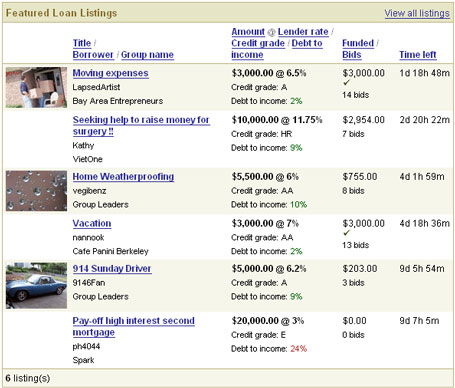
It generally takes 2-4 days to close a loan, according to Prosper. However, a borrower can request an expedited loan, which will take the first lenders who meet the minimum requirements for amount and interest rate.
Prosper charges a number of fees, including a 1% closing fee to the borrower and a 0.5% annual loan maintenance fee for lenders.
Benchmark has funded both Zopa and Prosper. Other Prosper investors include Accel, Fidelity and Omidyar.


Great, now we only need a similar service not for borrowers/lenders, but for angel investors/start-up founders… =)
I don’t know if I’d feel safe loaning my money to strangers. In fact I don’t know if I’d feel safe borrowing money from from strangers.
am I alone on this?
i second Philipp’s comment.
I don’t feel safe lending money to people I know!
Worldchanging had an interesting piece on distributed microfinance, which was the first time I heard of both Kiva and Zopa.
I personally would not be comfortable with the chance of the loan defaulting. Especially with the limited return… seems to be anywhere between 3% and 10%
Why should the loans be separated? I can see that it is nice to match up the lender with the borrower, but wouldn’t this concept be much more liquid if I could put up $500 and say I just want a specific rate- without doing the work of finding specific individuals/causes? The only way this can work one-on-one is if they have ebay’s amount of user feedback/ratings, otherwise there’s very little for the lender to go off of.
Interesting stuff nevertheless. Tough road for adoption.
sorry, what i should have summed up is that it seems they are sacrificing efficiency so they can be ’social’
After taking a peek at this one I think they’ll need to do a better job helping lenders manage and diversify their risk, like Zopa does, and, like Aaron suggests, make lending to many individuals automatic. But I assume they’ll eventually get there…
It seems to be there is a monitoring issue here, and what basis their credit scores on are misleading. I am fairly sure this would be illegal in the UK – operating a loan and repayment service requires FSA accreditation, or something.
it’s a good idea but it’s prone to huge amounts of abuse as is. social lending really only works when monitoring is available locally. there is no enforcement mechanism, yadda yadda.
so my development economics teacher tells me…
Aaron, Greg: I think what you guys are looking for is what Prosper calls a “Standing Order”. Lenders specify the amount of money they want to lend (say $5000), the maximum amount to bid on each listing (say $50), and the minimum interest rate they’re willing to receive (by credit grade). In this example, the lender would get the diversity of 100 loans, and would have had to spend maybe 2 minutes setting it up.
“Standing Order”? This sounds awefully like a bond market.
I have this thing right now called a “savings” account, with an institution called a “bank.” The way it works is, I put money in it, and the “bank” loans my money out to people to buy homes, cars, etc. The bank then gives me interest on my money. I don’t have to worry about who the borrowers are, their credit score, of if they pay on time – the bank does all of that. Plus, my bank is FDIC-insured, which means the government says my money is safe.
Although, I’m sure the “Prosper” website is much more web 2.0 than, say, INGDirect.com, I’ll stick with the bank thanks.
Before you reject the idea outright, don’t forget that the exact same (il)logic was applied to eBay and PayPal.
Tom, your bank gives you 1% interest and lends out at up to 25%. Are you suggesting that there is not an opportunity here?
How about taxes on interest income? There is no reference to this in the lender section of the web site.
From the “Become a lender” page:
Aside from any legal issues of this, I think the biggest problem is how you can manage the risk. I suppose prosper isn’t just putting up a site and let people bid on loans like ebay without any potential intervention. How would they prevent someone from just disappearing with the money?
It’s a fine idea, but I think it may be solving problems that don’t yet exist.
I like the idea of this site. I really think it could take off. Of course, what I like about it is that it puts a human touch on lending that had disapeared long ago. I am sure that it will eventually become more sterile but right now it is cool.
I think it is a good idea, but it requires an easy enforcement mechanism for collecting defaulting loans. This could be a service by a partner of Prosper (enter the mob
? ) or an online money claims website like in the UK (www.moneyclaim.gov.uk)
Arvind: Collections are handled by one of Prosper’s three collection agency partners. If funds are recovered, the lenders pay a fee to the collection agency (as any creditor would).
Dave from Zopa here – we’ve been tracking Prosper for a while – and it’s pretty interesting. We like the community aspect – although we’re worried about exposure that individual lenders are encouraged to take on (the standing order functionality is pretty buried) vs. the Zopa model.
Our belief is that some lenders will be attracted by this individual style and greater risk:return model, but that larger numbers will prefer a more hands off, safer environment for lending. We want to offer both, and we think it’s easier for Zopa to replicate Prosper than the other way around.
We’re busy planning our US launch – so we’ll get the chance to go head to head and find out. See you in SF Andrew!
Seems like this is an awfully high risk proposition where I wouldn’t get anywhere near the return for my risk. If the desire is to lend/borrow money outside the confines of a bank I’d only do that with people I know and use something like http://www.loanback.com to take care of creating some structure around it.
Ditto that, Bill. I’d rather know the person I’m lending to. I guess I don’t care who I borrow from, but I want to look someone in the eye before I cut them a check.
This is all very interesting…
In response to Phillip, there is a VC market here in the UK called Angel Bourse [http://www.angelbourse.com/], which seems to have established itself quite well.
These lending site will only start to make sense if they can allow investors to access new areas where capital is scarce, which is hard to do in the West. (I could borrow about $23k in a few days in England, which is just frightening.) Or if they can reduce the cost of financing for both parties, which seems feasible. To do that you need better information [make a single credit more predictable] or better diversification [blend credits into a single more predictable investment].
At the moment Zopa makes diversification easy (mandatory), while Prosper gives you more data to price risk. But there’s a real question of how accurate Prosper’s data is. Or how safe Zopa’s diversification of credit can be, given that it will be over a pool of potentially very similar borrowers.
On-line markets seem to start with a honeymoon period when most users are legitimate, then experience massive in-flows of fraud as the value transacted on them becomes worth stealing. (See https://www.fin...ves/000580.html .) Prosper & Zopa are likely to have to go through what Paypal/eBay did if they become successful. They’re idea of Groups offers interesting ways of trying to manage this… Even if Zopa can diversify fraud risks away, the cost of dud loans would get priced into the cost of borrowing for everyone.
I think a better benchmark for evaluating these P2P lending services isn’t their social value (come on – they use the same credit card networks and debt collectors as General Loan Shark Inc.), but in how they can bring the efficiencies of the money/stock/bond market to the little guy. Prosper’s plans to allow lenders to sell on their debt would be a huge step forward in that. (Although perhaps not without its own legal issues.)
If I were running one of these services I’d be looking very seriously at issues like letters of credit, loans sales, collateralisation and insolvency. There’s a limited amount of social capital available for stranger-to-stranger transactions. For all the rhetoric, a low-income manual worker will still have to pay a nose-bleed interest rate to start their business, unless they can mortgage something or find someone to extend a guarantee. (Besides the ability to float a callable fixed-rate bond issue against a a five year old used car would be kind’a cool !)
So my questions to both Zopa and Prosper would be:
1. How will you deal with sustained organised attempts to defraud your lenders?
2. Will you take institutional money? If not, will there be enough capital from individuals?
3. Do you intend to be more efficient than banks? If so, how? If not, then what do you offer?
I’m generally quite keen about these sorts of new lending services. But you have to make a very good case before people will start abandoning bank borrowing.
This looks really interesting, but I am wary of lending money out to people I don’t know.
My comment is directed to Dave at Zopa.
Dave why would any American want to “zopa”, when they could “Prosper”?
Instead of saying “goodbye” people are now saying “Prosper” in their farewell greetings. They sure would look silly saying Zopa!
Dave how about you surrender Zopa and merge with Prosper? Just like x.com and Paypal, That way zopa will not become irrellivant when Prosper goes worldwide!
I’m sure prosper will be more successful than any other “bank” on the internet. I don’t see much risk for lenders, just check the borrowers credit, see if he has any late payments, if he owns a house etc., spread your money over many borrowers and expect that you only get 98% of your investment back, but if the interest earned is high enough, who cares? The banks give anyone a creditcard just based on a credit score. At prosper you get a lot more info about the borrower, like what he wants the money for, and much other personal info some people leave.
A new innovative group on Prosper.com called “Two Millionaires cover High Risk Loans, Restore Credit” is helping ordinary people prosper by providing a way for them to get a series of small loans at interest rates below 30% to move their credit grades from HR high risk to B or better.
In less than a month this unique group attracted 200 members, placed 10 loans, and had 50 active listings.
Two Millionaires is helping high risk borrowers who can’t attract lenders even in the socially exciting Prosper.com people to people market. The goal of the Two Millionaires founders is to help sincere high risk members get to the point where they qualify as Prosper.com lenders and group leaders themselves.
Two Millionaires attracts lenders by offering a large selection of quality listings at high interest rates, and an opportunity to help others.
https://www.pro...rt_name=Mayans2
With the click of a mouse late Thursday night March 1, 2007, the leader of the Two Millionaires Group on Prosper.com admitted the 5,509th member and created the largest group on Prosper ever! The one remaining challenge at the time was to beat PsychDoc’s record number of loans created….
Asked about how his group succeeded in growing so large so rapidly, “TwoMillionaires1″ the group leader replied that he did a lot of internet marketing in the beginning to bring new members in, and it grew from there to the point where today word of mouth from contented borrowers brings in probably hundreds of new members each week.
“It didn’t hurt either to have a private website that has attracted more than 300,000 hits and 10,000 unique visitors,” the group leader added.
As of the date of this report, more than one and a half million dollars has been loaned to members of this popular people-to-people online borrowing and lending group, almost 400 individual loans.
Details are available at:
http://www.2mils.org