Company: Last.fm
Location: London
Launched: 2002, redesigned in 2005
With applications like Pandora (profile) getting some attention from the blogosphere, it’s time to shed some light on another music-related project that’s been around for some time now and that I’m quite fond of – Last.fm. Last FM (now merged with the Audioscrobbler project) allows you to generate a profile of your musical taste based on what you like or listen to the most. Here’s how they put it:
You get your own online music profile that you can fill up with the music you like. This information is used to create a personal radio station and to find users who are similar to you. Last.fm can even play you new artists and songs you might like. It’s addictive, it’s growing, it’s free, it’s music.
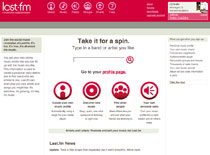
Last.fm, like Pandora, suggests bands and tracks based on your current taste, but it is Last.fm’s social network-based approach that makes it interesting. Last.fm generates recommendations from your musical tastes by compiling a list of your musical neighbours (people who listen to the same things you do) and suggests bands they also play and that you don’t. This organically built ecosystem of relationships between people and their musical tastes is what makes Last.fm stand out from the competition.
Being out there for longer also has its advantages like the huge user-base and the amazing extra capabilities of the system like the stand-alone player, that keeps playing new music for you until you grow tired of being suddenly so musically rich and go back to your own tracks.
A lot else could be said about Last.fm because I’m one of those guys who’s completely in love with the system but there’s nothing like the joy of discovery, so I’m going to leave it to you to click this link and explore it yourself. People who are curious about the architectural diferences between Last.fm and Pandora can read this post on my personal blog, that talks about just that. And if you’re really curious, you can check out my own profile up at Last.fm.


It’s good to note that some mp3 players make use of audioscrobbler, either with a plugin (for example winamp), or included, like Amarok.
Amarok send the current playing song to audioscrobbler, and can get back a list of related music to auto complete the playlist ! see http://amarok.k...tent/view/51/1/
Question: are they clustering people with same musical tastes (”people who listen to the same things you do”) or are they clustering music bought by the same people?
The first route is much more computationally complex then the second one. If they’ve gone the first one, it would interesting to understand something more abount implementation.
CapNemo: they’re clustering people by their musical tastes, not by what they buy. I don’t agree that its “much more” complex, though, but still quite impressive and more dynamic than anything non-social network based like pandora.
Implementing something like this is just like pattern recognition with folksonomies. If everybody is “tagging” something “apple” and “mac”, and loads of people using “apple” and “mac” also use “macintosh”, “machintosh” automatically becomes suggested.
It’s the same mechanism, actually. If you need any more insight on the implementation, I might be able to help you out. Take care.
Awesome, thank you Frederico
Had heard Scoble talking about Pandora but had not heard of this but I think these guys have nailed it, superb music recognition engine. And these guys are UK based superb very impressed.
Regards
Al
I love Last.fm. Have been using it for about 2-3 months now. I am very happy with it, accept sometimes the music gets a little repetitive. Otherwise, I highly recommend it. The Last.fm Player is also really neat.
My Last.fm account is “bbenzinger”. Check it out!
Frederico – thanks so much, yes more insights would be very helpful.
I’m working on a concept involving a “social approach” to semiotic analysis. Paraphrasing a famous quote “the (semantic) network is the word significate”.
Great blog – you’re permanent in my google.com/ig!
Well, for an old-timer like me (40) Last.com is simply incredible. I am glad that some kids have master maths and put it to good use.
The issue is, of course, the degree of complexity and therefore how subtle the matching program can be.
Is it be track or artist? If by artist, that is ok, but by track, now that is clever.
one of the best sites for music, all the genras and the music you can handel.if it’s out there last.fm has it give it a shot i bet you will love it
Last.FM is exciting becuase it can make medium-term revenue, because it can become a de facto platform for music discovery and finally because it is an important mechaism in “next generation search”….
http://paulfish...s_lastfm_s.html
I’ve been a member of Last.fm since April of 2004. It has been a vehicle for musical discovery, expanding my musical experience and knowledge. It is interesting to view other people’s profiles and discover what people around the world listen to. It is also somewhat disheartening to discover that people in the Netherlands and Japan often listen to purely American music. This cultural hegomony is disturbing.
While I was working on my Masters, I contacted the Last.fm staff with some technical questions. They originally used PHP, but quickly discovered some problems. PHP didn’t scale well, so some of their routines had to be rewritten in Java. Since PHP is interpreted, it is computationally intensive. They used an open source opcode cache to improve performance, but in practice it caused a number of problems. The PHP opcode cache from ZEND may have improved matters, but Last.fm is run on a shoestring budget. The Java tools were free and solved the problem. (I mention this in a paper I wrote—it’s on page 3: ). The Last.fm team appears to have made the conservative and wise choice—they didn’t let their devotion to their beloved PHP stand in the way of solving their technical issues.
LastFm has the advantage over Pandora that it addresses classical music. Unfortunately it reckons that each piece is the work of one artist. I think of classical works as having two artists, the composer and the performer, and I am equally interested in the two angles. Addressing this simplification would greatly increase LastFm’s usefulness to me.
Nice post. FYI, I’m a french newbie on last.fm and could be addicted soon. Frederico, this comment is just to let yu know I used your original writing to translate/adapt a post in french dedicated to a small french audience. Thanks for all.
jyyo98i[pouiytg
merger ?
look at this pic carefully
http://www.flic...@N00/121308854/
Along similar lines as Last.fm radio, is BeeThere.net, which delivers concert events in a similar fashion to how Last.fm delivers radio.
There are Artist Images, full tour dates, and of course, recommendations for concerts in your area, based on the artists in your iTunes collection.
does any1 no any meebo sites, school keeps blocking them. grrrrr. email me on michealamillican@hotmail.com
“good idea,good site !”said by 机票查询
Aparently the way we understand, use and consume music is suffering tremendous and interesting changes. Ever since the digital revolution, the music industry has been seriously afected, since napster and limewire facilitated mp3 files exchange, the way we listen and buy music is not the same.
Then comes personalized radio wich is very welcomed, since my music library, exceeds 5 thousand legaly purchased tracks, and creating playlists that suit my different moods becomes very important, but it can be a full time job!
Then services like Last.FM and Pandora are great when you have a party or when working on you computer, its music you like with little effort.
OK, figured I’d give both sites a test. One of my favorite artists is Otis Taylor. Pandora has him. Last.fm does not. Guess who I registered with.
Last.fm has a great system. I was very fond of it until they banned me for listening to European nationalist bands. Too bad. Rap and hip hop glorifying gang violence, drugs, pimping whores & violence against women is still a-ok of course.
Last.fm is clever radio program, it’s very good idea.